


A useful digestive record describes what happened, when, how often, what changed, and how the whole dog is functioning. Stool appearance matters, but it cannot diagnose parasites, infection, inflammation, obstruction, toxin exposure, food response, or systemic disease. Track vomiting, appetite, water, urination, weight, body and muscle condition, pain, energy, sleep, behavior, diet, treats, medication, supplements, travel, scavenging, and environmental exposure. Use consistent terms and photos when helpful, recognizing that fecal scores vary between observers. Bring packaging and a sample only when requested. A checklist never creates a universal number of days that is safe to wait. Sudden, severe, persistent, progressive, or concerning signs require professional assessment.
Short answer
Describe the pattern without turning it into a diagnosis
Digestive disorders share many signs, so accurate history and examination remain central. AAHA nutrition history and current chronic-enteropathy guidance include stool, vomiting, appetite, weight, body and muscle condition, complete diet, medications, environment, and follow-up. Fecal-score agreement varies among observers. [1] [2] [3] [4]
- Start with the individual dog, exact question, complete history, and current veterinary plan.
- Use observations and evidence to improve a veterinary discussion, not to diagnose or treat at home.
- Keep population findings, research endpoints, and product-specific conclusions within their actual limits.
- Escalate sudden, severe, persistent, progressive, or function-limiting signs promptly.
Safety first
Stop logging and seek care when the dog is unstable or rapidly worsening
Seek urgent care for collapse, severe weakness, repeated vomiting, inability to keep water down, substantial blood, severe pain, a swollen abdomen, unproductive retching, breathing difficulty, suspected toxin or foreign object, pale gums, inability to stand, or rapid decline. Do not wait to complete a full day of observations.
- Do not delay urgent care while completing a checklist, testing a diet, or seeking a cheaper option.
- Do not start, stop, combine, divide, or calculate medication or supplements from this article.
- After a possible toxin, foreign object, overdose, or hazardous ingestion, contact veterinary or poison help promptly.
Veterinary note
This article is educational and does not diagnose, treat, prescribe, or replace care from a licensed veterinarian. Your dog’s history, examination, diet, medications, and current signs determine what is appropriate.
Record time, frequency, and context
For every vomiting or stool event, note date, time, location, appearance, estimated amount, urgency, straining, blood or mucus, and what happened before and after. Distinguish vomiting from regurgitation only if the veterinarian has taught you what to observe; otherwise describe the sequence and provide safe video.
List exact food, formulation, bag or lot when available, measured amount, treats, chews, toppers, supplements, medications, preventives, scavenging, trash, plants, toys, water sources, travel, boarding, and other animals. Preserve packaging after a possible exposure.
AAHA's nutrition history explicitly includes vomiting, diarrhea, flatulence, constipation, complete intake, medications, activity, environment, and feeding practices. [2] This context often matters more than an isolated adjective such as soft.
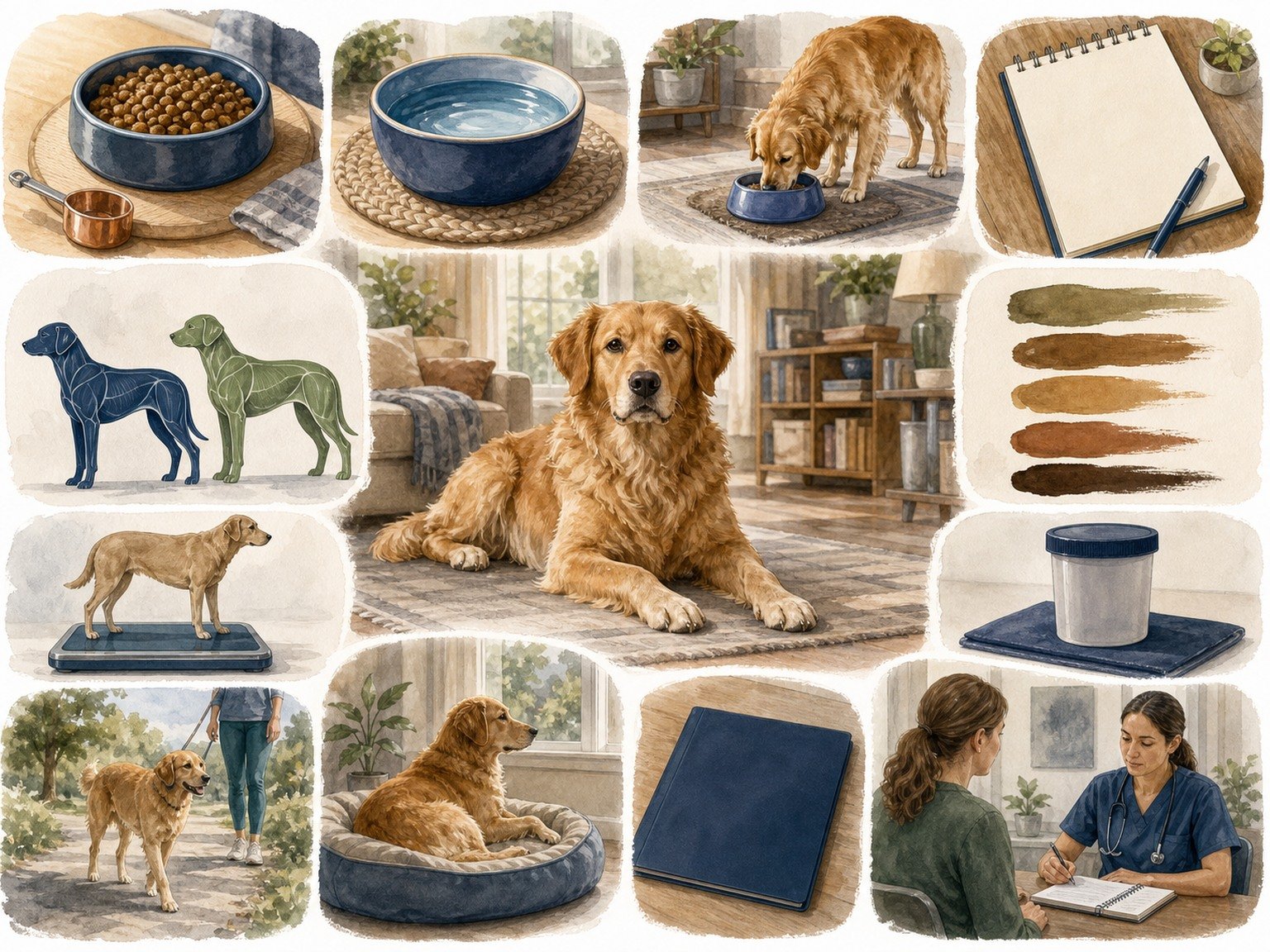
Track the whole dog's function
Record appetite, enthusiasm for food, chewing, swallowing, water, urination, energy, sleep, posture, movement, social interaction, abdominal guarding, restlessness, and recovery. A digestive sign with weakness, pain, breathing change, or neurologic change carries a different concern than stool appearance alone.
Use a consistent scale for body weight when safe and ask the veterinary team to demonstrate body and muscle condition. Weight can be masked by hydration or fluid accumulation, and stable weight can coexist with muscle loss. Trends need clinical context.
Current chronic-enteropathy guidance uses longitudinal weight, body and muscle condition, clinical signs, fecal score, medication effects, and quality of life in veterinary monitoring. [1] Do not copy a disease-specific scoring schedule to manage an undiagnosed dog at home.
Use stool descriptions and photos within their limits
A fecal chart can help describe consistency consistently, but a prospective study found variable agreement, especially between laypeople and veterinarians. [4] Color, firmness, and shape do not identify cause or dictate medication.
Photograph representative stool with consistent lighting and a neutral scale object only if useful. Avoid sharing graphic images unnecessarily. If the clinic requests a sample, follow its instructions for container, amount, contamination avoidance, timing, storage, and delivery.
Do not repeatedly collect samples or transport old material without instructions. A negative test result must be interpreted in relation to the method, sample, timing, prior treatment, and ongoing signs; it does not prove every infectious or noninfectious cause absent.
Turn the record into a veterinary conversation
Summarize the first sign, trend, worst point, current state, exact intake and exposure, weight change, whole-body signs, and what has already been given. Bring the full record but lead with the concise timeline so urgent information is not buried.
Merck notes that similar digestive signs can have many causes and that accurate history, examination, and selected testing guide diagnosis. [3] Ask which observations matter next, whether food should remain unchanged, and what sign requires immediate reevaluation.
After a plan begins, track the target outcome, adherence, adverse effects, and recovery without changing several variables. A photo or apparent improvement supports communication; it never replaces examination, requested testing, or follow-up.
Prepare for a focused veterinary conversation
Bring a concise timeline, short natural-movement or symptom videos when safe, the exact names and photographs of every food, treat, medication, and supplement label, and notes about appetite, water intake, stool, sleep, activity, comfort, and behavior. Include recent injuries, travel, boarding, diet changes, missed medication, and previous test results. A complete record helps the veterinary team separate a repeatable pattern from a single impression.
Decide in advance what you need from the visit: an urgency decision, a diagnosis plan, a nutrition review, a pain or mobility assessment, or a monitored trial. Ask what result would change the plan and what finding would rule an option out. This keeps research and product information in the right role. Evidence can shape questions and expectations, but it cannot determine what is safe for an individual dog without the history and examination.
Owner tool
Use a home digestive monitoring checklist
On a phone, swipe across the table to see every column.
| Checkpoint | What to record | Why it helps |
|---|---|---|
| Event | Time, frequency, appearance, amount | Defines pattern |
| Whole dog | Appetite, water, weight, pain, function | Shows impact |
| Exposure | Food, drugs, travel, trash, animals | Adds context |
| Handoff | Photos, package, requested sample, timeline | Supports care |
Better questions, calmer next steps
Questions to ask your veterinarian
- Which observations are most important for this dog?
- Should food or medication remain unchanged while we assess?
- Do you want photos, video, packaging, or a stool sample?
- What finding requires same-day or urgent care?
- When and how should the trend be reassessed?
FAQ
Can a stool score diagnose the cause?
No.
How many days is it safe to wait?
No universal threshold applies; call based on the dog and signs.
Can photos replace an examination?
No.
Should I bring every stool sample?
Only when the clinic requests one and provides instructions.
What if the dog seems better?
Record improvement and follow the agreed recheck plan.
Sources
- Journal of Veterinary Internal Medicine: ACVIM Guidelines for Canine Chronic Inflammatory Enteropathy. History, signs, body and muscle condition, diagnostics, and monitoring.
- American Animal Hospital Association: Gathering a Comprehensive Nutrition History. Structured diet, sign, medication, and environment history.
- Merck Veterinary Manual: Introduction to Digestive Disorders of Dogs. Diverse causes, history, examination, and testing.
- Journal of Small Animal Practice: Consistency of Canine Fecal Scoring. Observer agreement and description limits.
- World Small Animal Veterinary Association: Global Nutrition Guidelines. Body, muscle, diet history, and follow-up tools.
