

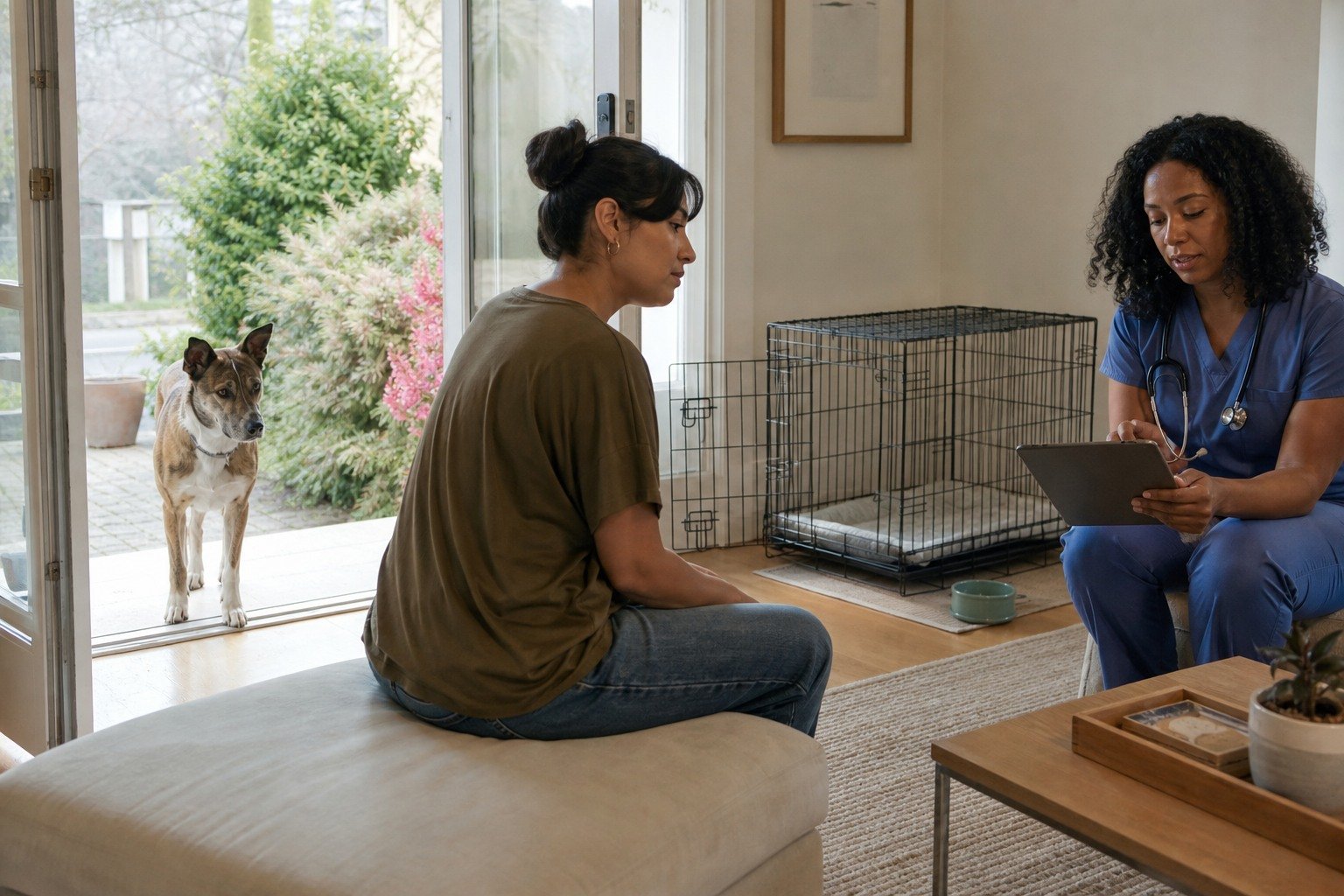
The popular 3-3-3 rule is not a diagnostic or predictive timeline. Research shows that owner-reported behavior can change after adoption, but patterns differ across dogs and behaviors. Adoption status does not prove abuse, neglect, trauma, anxiety, pain, or illness. Day one should therefore begin a record rather than a test. Gather available shelter, foster, transport, diet, medication, and veterinary information. Observe sleep, appetite, elimination, activity, social context, and the environment without forcing interaction. Medical and behavioral causes can overlap, so sudden, severe, dangerous, or persistent changes belong with the veterinary team, not an adjustment countdown.
Short answer
Treat day one as a baseline, not a deadline
Longitudinal adoption studies report that behavior can change over the first months, with different trajectories across behaviors and dogs. These group findings do not predict one dog's day or validate a fixed 3-3-3 schedule. Veterinary behavior assessment still requires medical evaluation and a detailed individual history. [1] [2] [3] [4]
- Start with the individual dog's baseline, complete history, and current veterinary plan.
- Use repeated observations to improve a veterinary discussion, not to diagnose or treat at home.
- Keep associations, population findings, and research endpoints within their actual limits.
- Escalate sudden, severe, persistent, progressive, dangerous, or function-limiting changes promptly.
Safety first
Do not label illness, pain, or danger as normal adjustment
Contact a veterinarian promptly for inability to eat or drink, repeated vomiting or diarrhea, breathing difficulty, collapse, severe pain, inability to urinate, sudden neurologic change, self-injury, serious aggression, repeated escape attempts, or rapid decline. Keep people and animals safely separated when risk is uncertain.
- Do not delay urgent care while completing a log, testing a setup, or seeking a lower-cost option.
- Do not provoke, corner, restrain, punish, flood, or force exposure to test a behavior or capture a video.
- Do not start, stop, combine, divide, or calculate medication or supplements from this article.
Veterinary note
This article is educational and does not diagnose, treat, prescribe, or replace care from a licensed veterinarian. Your dog’s history, examination, diet, medications, and current signs determine what is appropriate.
Collect the handoff that exists
Request intake findings, vaccination and preventive history, diet, medication, known injuries or illness, surgery, transport details, foster observations, identification, prior veterinary contacts, and any established behavior or safety plan. Missing information is unknown, not evidence of mistreatment. Also note who can clarify a record and which details came from direct observation rather than assumption.
Record exact product names, amounts, and last known medication times without restarting or changing anything on your own. Keep the initial diet stable when practical until the veterinary team advises otherwise, and document any unavoidable change. Photograph labels and discharge instructions so the clinic can reconcile the information accurately.
Post-adoption research follows group trends over months and shows that different behaviors can change in different directions. [1] [2] [3] It does not create a countdown by which every dog must eat, socialize, relax, or show its true personality.
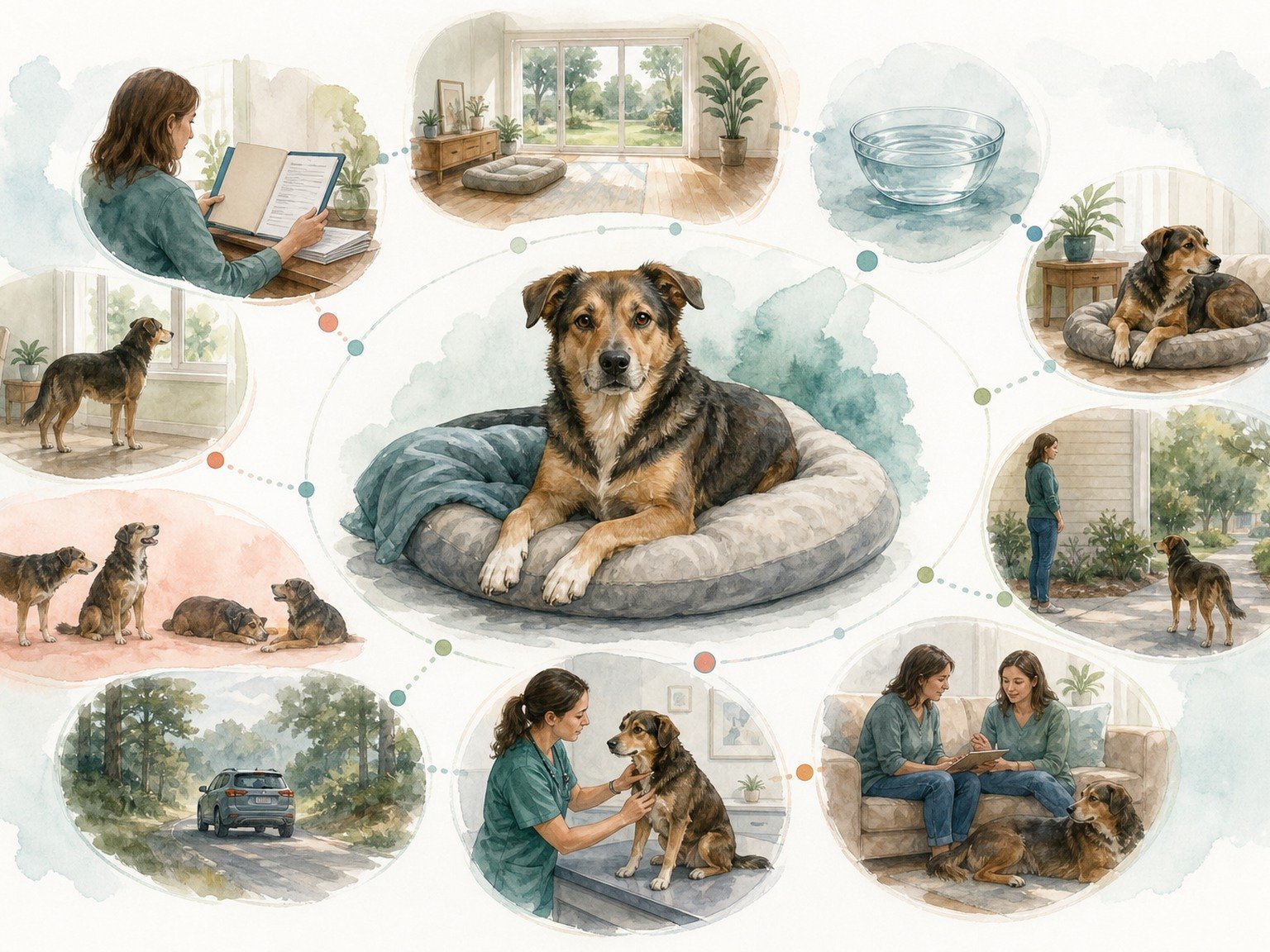
Observe without testing the dog
Note sleep, appetite, water, elimination, mobility, activity, vocalizing, retreat, orientation, response to ordinary sounds, and distance chosen from people or animals. Describe what happened rather than interpreting motive: remained behind the doorway is clearer than traumatized or stubborn.
Offer a predictable, low-pressure environment with access to essentials and a retreat where appropriate. Avoid crowding, prolonged staring, forced handling, introductions, busy outings, and staged tests. A quiet routine may help some dogs, but no single decompression schedule fits every patient or household.
Do not provoke a response to discover triggers. Keep children, visitors, and resident animals separated when safety is uncertain. Use barriers and professional guidance without trapping the dog where approach is unavoidable.
Keep medical and behavioral explanations open
AAHA behavior guidance emphasizes medical evaluation and detailed history because pain, illness, medication, environment, learning, and other factors can contribute to behavior. [4] Hiding, withdrawal, panting, appetite change, elimination change, vocalizing, or aggression is not specific to anxiety.
Schedule routine veterinary follow-up appropriate to the dog's records and condition. Bring the handoff, food and medication list, first-day observations, and safe videos if available. Do not recreate a concern for the camera.
Ask whether pain, gastrointestinal disease, urinary disease, sensory impairment, neurologic disease, sleep disruption, or another medical issue should be considered. Qualified behavior referral may be useful for persistent fear, aggression, handling difficulty, escape risk, or complex household safety.
Create a first-day-to-first-visit summary
Use a short timeline: arrival, food and water, elimination, sleep, medication, mobility, interactions, unusual events, safety concerns, and changes from the first observation. Include what the dog chose to approach or avoid without assigning cause.
Track improvement and worsening with equal care. Improvement does not prove that an earlier sign was only adjustment, and persistence does not prove prior trauma. The professional team needs observable function and context. Preserve representative dates instead of replacing the record with a general impression.
End with three questions: what needs medical assessment, what management protects safety now, and what change should trigger earlier contact. This keeps the dog's actual needs ahead of rescue narratives and social-media timelines.
Prepare for a focused veterinary conversation
Bring a concise timeline, short natural-movement or symptom videos when safe, the exact names and photographs of every food, treat, medication, and supplement label, and notes about appetite, water intake, stool, sleep, activity, comfort, and behavior. Include recent injuries, travel, boarding, diet changes, missed medication, and previous test results. A complete record helps the veterinary team separate a repeatable pattern from a single impression.
Decide in advance what you need from the visit: an urgency decision, a diagnosis plan, a nutrition review, a pain or mobility assessment, or a monitored trial. Ask what result would change the plan and what finding would rule an option out. This keeps research and product information in the right role. Evidence can shape questions and expectations, but it cannot determine what is safe for an individual dog without the history and examination.
Owner tool
Build a first-day record
On a phone, swipe across the table to see every column.
| Checkpoint | What to record | Why it helps |
|---|---|---|
| Handoff | Health, diet, medication, transport, prior notes | Supports continuity |
| Baseline | Sleep, intake, elimination, activity, mobility | Shows function |
| Context | People, animals, sounds, distance, retreat | Prevents assumptions |
| Follow-up | Change, safety, videos, questions | Guides care |
Better questions, calmer next steps
Questions to ask your veterinarian
- Which records or gaps matter medically?
- Could this sign reflect pain or illness?
- What management protects safety now?
- Is a behavior referral appropriate?
- What change requires earlier contact?
FAQ
Is the 3-3-3 rule proven?
No.
Does hiding prove trauma?
No.
Should everyone meet the dog immediately?
Avoid forced socialization.
Can appetite change be anxiety?
It can have behavioral or medical explanations.
Should I test triggers?
No.
Sources
- PLOS ONE: Shelter Dog Behavior After Adoption. Longitudinal changes and individual variation.
- Applied Animal Behaviour Science: Nocturnal Activity Before and After Adoption. Adaptation measures and research limits.
- Animals: Post-Adoption Problem Behaviours. Post-adoption group findings and variation.
- American Animal Hospital Association: Canine and Feline Behavior Management Guidelines. Medical assessment, history, management, and referral.
