

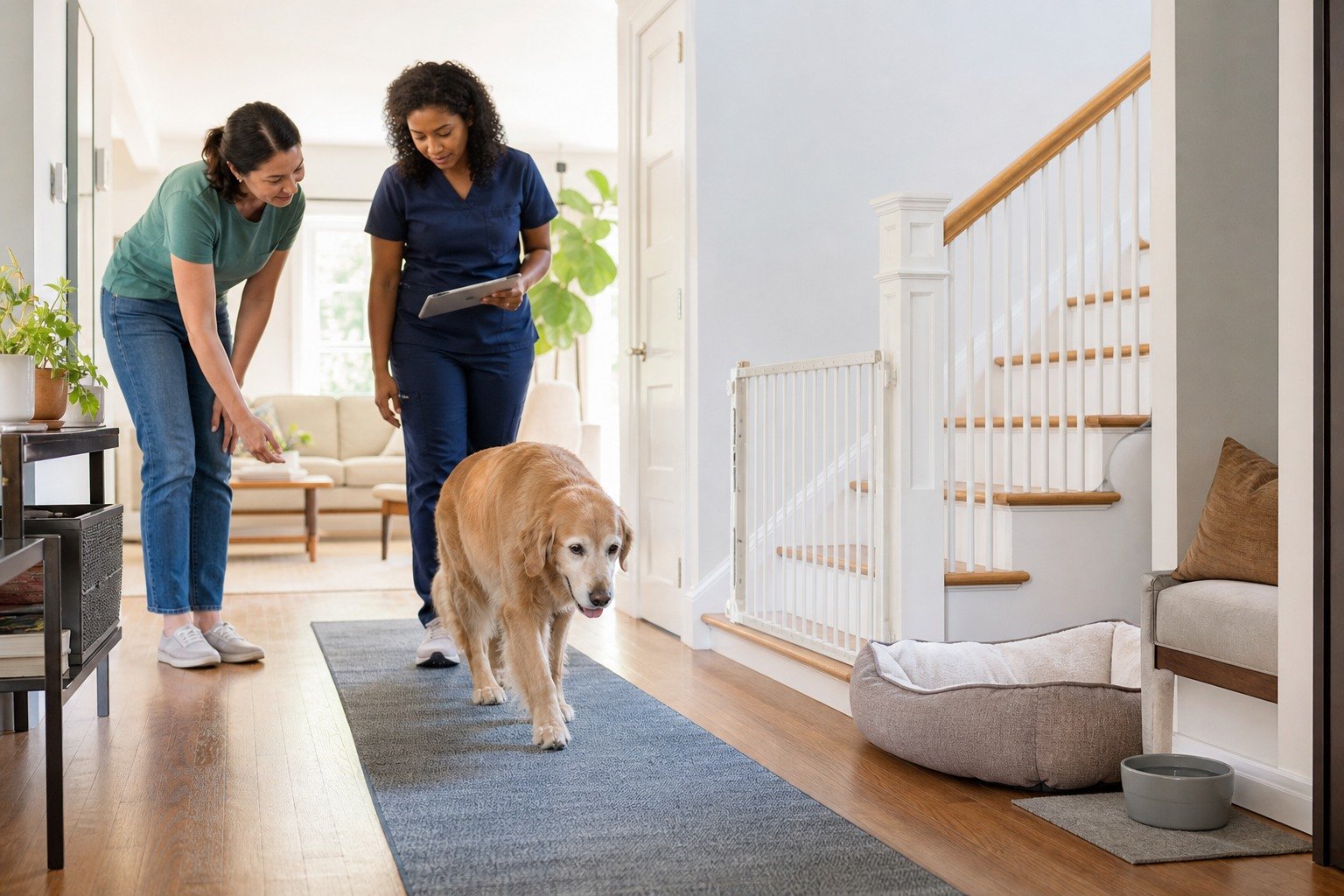
Environmental modification can reduce a specific barrier, but it is not a diagnosis or treatment by itself. A dog may slip on one surface, hesitate at a threshold, struggle to rise from a particular resting place, or lose access to food, water, toileting, family space, or transport. The appropriate response depends on the diagnosed condition, strength, balance, vision, body size, cognition, medications, daily tasks, and household. A generic shopping list can introduce new trip hazards, steep transitions, unstable equipment, or handling demands. Start with a room-by-room audit, review the findings with the veterinary or rehabilitation team, trial only patient-appropriate changes, and record function and safety after each change.
Short answer
Audit the barrier before choosing a modification
COAST and AAHA guidance include environmental modification among individualized mobility and pain-management options. Veterinary rehabilitation sources likewise emphasize patient-specific impairments, progression, and reassessment. These references support a structured home review; they do not prove that one product or layout will reduce pain, prevent falls, or fit every dog. [1] [2] [3] [4]
- Start with the individual dog's baseline, complete history, and current veterinary plan.
- Use repeated observations to improve a veterinary discussion, not to diagnose or treat at home.
- Keep associations, population findings, and research endpoints within their actual limits.
- Escalate sudden, severe, persistent, progressive, dangerous, or function-limiting changes promptly.
Safety first
A safer-looking setup can still be unsafe for the wrong dog
Seek prompt veterinary guidance for sudden inability to bear weight, severe pain, trauma, collapse, dragging or knuckling, inability to rise, new loss of bladder or bowel control, or rapid decline. Do not lift, restrain, test stairs, or improvise equipment when the dog's capacity is uncertain.
- Do not delay urgent care while completing a log, testing a setup, or seeking a lower-cost option.
- Do not provoke, corner, restrain, punish, flood, or force exposure to test a behavior or capture a video.
- Do not start, stop, combine, divide, or calculate medication or supplements from this article.
Veterinary note
This article is educational and does not diagnose, treat, prescribe, or replace care from a licensed veterinarian. Your dog’s history, examination, diet, medications, and current signs determine what is appropriate.
Walk through the home from the dog's point of view
Map the route from the usual resting area to water, food, toileting, exits, and family spaces. Note slips, pauses, failed attempts, collisions, narrow turns, thresholds, steep steps, unstable surfaces, clutter, low light, and places where assistance is already needed. Record the exact location and task rather than writing mobility problem.
Watch ordinary movement without creating a test. Compare rising, turning, stopping, stepping over transitions, and settling with the dog's baseline. Include time of day, recent activity, medication timing, fatigue, and surface condition. A barrier can be intermittent and still matter, but observation cannot identify the painful structure.
COAST places environmental modification inside patient-specific osteoarthritis staging and reassessment. [1] The same floor or stair may affect two dogs differently because strength, balance, neurologic function, vision, size, and learned movement differ.
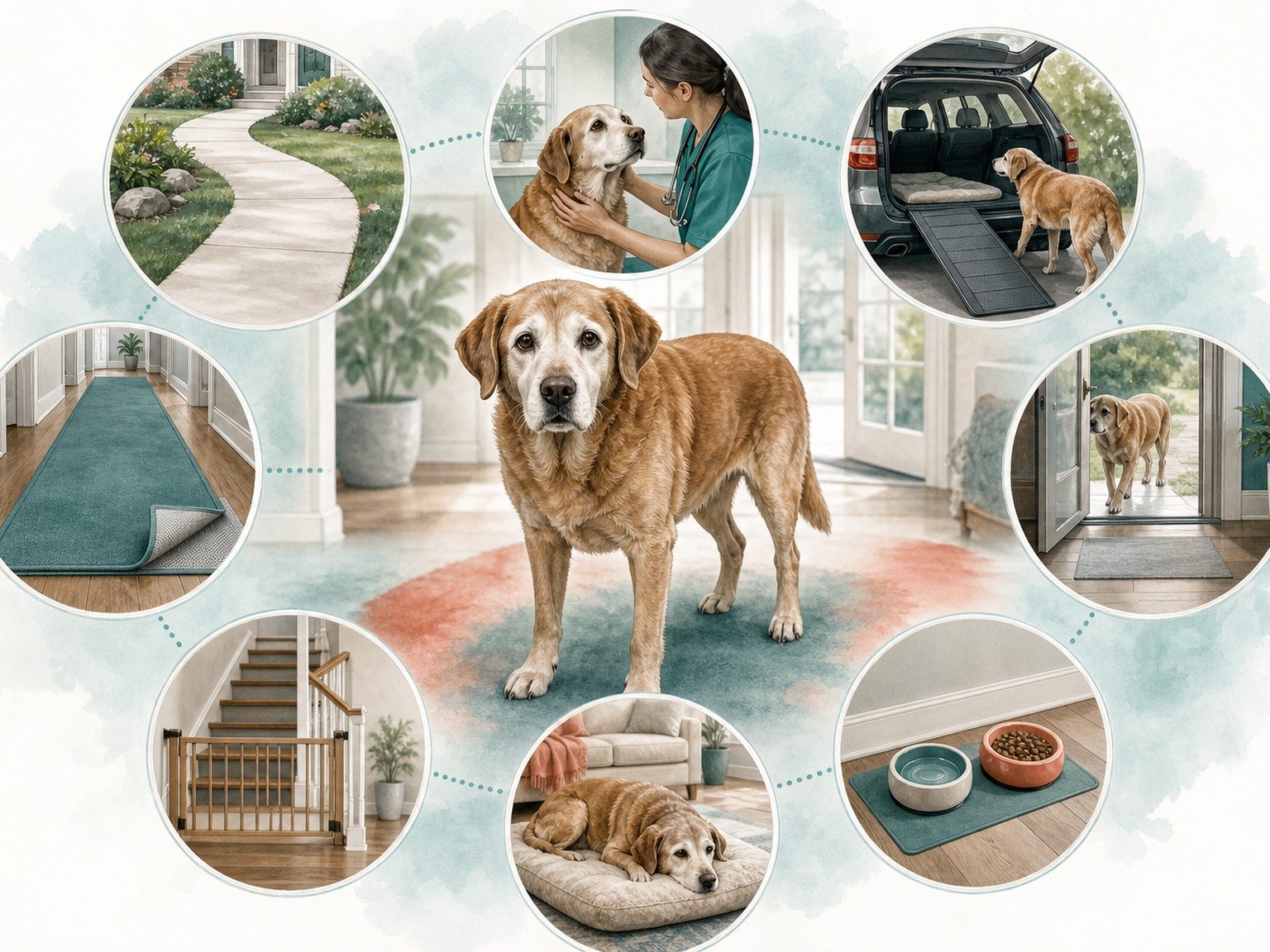
Review traction, access, rest, and essentials
Possible discussion categories include secured traction on necessary routes, removal of loose hazards, improved lighting, blocked unsafe access, stable resting areas, reachable bowls, and easier toileting access. These are categories, not product endorsements or installation instructions.
AAHA senior-care guidance discusses traction, bedding, access, assistive devices, and household hazards as possible individualized supports. [2] A soft bed can be difficult to exit, a runner can curl, a gate can block safe toileting, and a ramp can be too steep or unstable. The details matter.
Photograph the barrier and, when safe, capture a short video of the ordinary task. Add measurements only if the professional team requests them. Do not make the dog repeat a difficult movement or continue after hesitation, pain, fatigue, or distress.
Match changes to diagnosis and professional assessment
Veterinary rehabilitation guidance recommends designing home exercise and lifestyle changes around patient impairments and progressing according to response. [3] That same logic applies to the environment: the plan should fit what the dog can safely do now, not what a generic diagram assumes.
Ask whether orthopedic, neurologic, cardiopulmonary, sensory, cognitive, skin, or medication factors change the recommendation. Some dogs need rehabilitation assessment, handling instruction, or a different route rather than more equipment. Environmental changes do not replace pain management, diagnostics, surgery, or medical care when indicated.
A physiotherapy review places environment within a staged framework while noting limited direct clinical-efficacy evidence for some strategies. [4] Describe the intended functional goal and uncertainty instead of promising comfort, injury prevention, or independence.
Trial one change and monitor the whole result
When the team approves a change, define what success would look like: fewer slips on a necessary route, easier access to water, less assistance at one threshold, or safer rest. Record baseline, change date, use, avoidance, fatigue, new hazards, and any decline.
Change one major variable at a time when practical. Several simultaneous changes make it harder to know what helped and may disorient a dog. Recheck the setup after cleaning, weather changes, furniture movement, visitors, or progression of disease.
Bring response data to reassessment. A modification that once helped may stop fitting as strength, balance, pain, vision, cognition, or household routines change. The goal is an adaptable plan, not a permanent universal setup.
Prepare for a focused veterinary conversation
Bring a concise timeline, short natural-movement or symptom videos when safe, the exact names and photographs of every food, treat, medication, and supplement label, and notes about appetite, water intake, stool, sleep, activity, comfort, and behavior. Include recent injuries, travel, boarding, diet changes, missed medication, and previous test results. A complete record helps the veterinary team separate a repeatable pattern from a single impression.
Decide in advance what you need from the visit: an urgency decision, a diagnosis plan, a nutrition review, a pain or mobility assessment, or a monitored trial. Ask what result would change the plan and what finding would rule an option out. This keeps research and product information in the right role. Evidence can shape questions and expectations, but it cannot determine what is safe for an individual dog without the history and examination.
Owner tool
Build a room-by-room mobility audit
On a phone, swipe across the table to see every column.
| Checkpoint | What to record | Why it helps |
|---|---|---|
| Route | Rest to food, water, exit, toileting | Finds barriers |
| Task | Rise, turn, threshold, stairs, settle | Defines function |
| Context | Surface, light, fatigue, timing, assistance | Explains variation |
| Trial | Goal, response, new hazard, recheck | Supports reassessment |
Better questions, calmer next steps
Questions to ask your veterinarian
- Which barrier should be addressed first?
- Does diagnosis or balance change the safest option?
- What ordinary video or measurement would help?
- How should we define a useful response?
- When should the setup be reassessed?
FAQ
Does every dog need a ramp?
No.
Are rugs always safer?
No; unsecured edges can create hazards.
Can home changes replace pain care?
No.
Should I test stairs?
Do not provoke a difficult task.
How often should I recheck the home?
Whenever function, layout, or circumstances change.
Sources
- Frontiers in Veterinary Science: COAST Consensus Guidelines for Canine Osteoarthritis. Patient-specific staging, environment, and reassessment.
- American Animal Hospital Association: Pain Management: 2023 AAHA Senior Care Guidelines. Traction, access, bedding, devices, and hazard review.
- Veterinary Clinics of North America: Guidelines to Home Exercises and Lifestyle Modifications. Impairment-based planning and progression.
- Veterinary Sciences: Physiotherapeutic Strategies for Canine Osteoarthritis. Staged strategies and evidence limits.
