

A practical reporting and follow-up checklist for a dog missing after a disaster, with family safety and veterinary care first.
Short answer
Get somewhere safe, report the separation, and keep one current record
If your dog is missing after a disaster, first get your household to safety. Contact local animal control, shelters, and the animal-response organizations identified by local authorities. Share a recent photograph and a clear description. If your dog has a microchip, tell the registration company the dog is missing and confirm how it can reach you. Keep the reports and follow-up notes together. These steps support a coordinated search; they cannot promise a reunion.
Safety first
A search must not create another emergency
Do not enter restricted areas, damaged buildings, floodwater, or other places authorities have not cleared. Ask local responders how to report an animal believed to be in an unsafe location. If your dog is found injured, struggling to breathe, collapsed, or otherwise seriously unwell, contact an emergency veterinarian promptly rather than finishing the reporting checklist. Tell the clinic about any known exposure or injury. Do not improvise treatment or attempt an unsafe rescue.
Use this as a coordination tool
This educational guide does not replace local emergency directions, professional animal rescue, veterinary diagnosis, treatment, or individualized behavior advice. This guide is not a substitute for veterinary or qualified behavior care. Contact your veterinarian if distress, pain, or unsafe handling makes the plan difficult. See our medical disclaimer. A frightened or injured dog may need experienced handling. Ask the relevant responder or veterinary team for help rather than relying on familiarity alone.
Start with your household’s location and the last confirmed information
The CDC’s pet emergency guidance puts family safety before a missing-pet search. If you are staying at an evacuation center that houses animals, tell its pet caretaker about the separation. Ask local animal services which organizations are handling displaced animals for this event. Do not assume the usual building, opening hours, or reporting arrangement is unchanged.
Write down the last place and time you personally know your dog was present. Separate this from a later sighting someone else reports. A note such as “seen by household member near the east entrance before departure” is more useful than an uncertain location presented as fact. If the time is approximate, label it approximate.
Use one person as the household contact if possible and identify a backup who agrees to answer calls. This is an organization suggestion, not an official reporting requirement. If your phone is unavailable, tell each organization how it can currently reach you. Keep your own evacuation arrangements workable while the search continues.
Ask the local response system where to file and check reports
Contact local animal control, animal shelters, and the response groups identified through current local guidance. The CDC lists local humane societies, animal welfare organizations, animal-response teams, and animal control among possible reunification contacts. Their roles vary. Ask where found animals are being recorded and whether a report in one system is visible to the others.
For each contact, record the organization, date, contact route, and any report number provided. Ask what information is missing and how to follow up. A completed online form is one reporting step; do not treat it as confirmation that every nearby shelter has received or matched it.
Keep the answers in your own words, distinguishing a responder’s instruction from your next task. For example, “Shelter asked for a clearer side-view photo; Morgan will send it” is actionable. “They are looking” leaves the next person unsure what has happened. Avoid making assumptions about how quickly intake records will update.
If you cannot reach an organization, mark the attempt as unanswered. Use another current contact route that the organization itself provides, or ask local animal services where to go next. Do not turn a busy line into a claim that the organization is closed, and do not travel into an unsafe area to check in person.
Notify the microchip registration company
AAHA’s microchipping FAQ recommends telling the registration company immediately when a pet is lost. Verify the contact information on the account and explain any temporary change in how you can be reached. A microchip provides an identification number when scanned; it does not transmit a live GPS location.
If you cannot locate the number or company details, use the records you already have and ask your veterinary practice for help. Our dog identification and microchip check explains the separate verification task. Do not delay local missing-pet reports while trying to solve an account problem.
Record what the company actually confirmed: the missing status, usable contact route, and any instructions it gave. Keep login details private. A registration update and a shelter report are separate actions; completing one should not make the other disappear from the household task list.
Prepare one consistent description and photograph
Use a recent, clear photograph and a plain description of the dog’s appearance. Useful fields include the dog’s name, approximate size, coat color, distinctive markings, and the collar or harness last seen. State uncertainty honestly. A coat that looks darker in a wet photograph should not become a second, conflicting description.
Prepare a short public version and keep sensitive ownership or account information for the organization handling the report. Do not post home access instructions, account passwords, or copies of identification documents publicly. Ask the receiving shelter what it needs privately to match the report or verify a claim.
Label each version with a date so helpers know which contact number and photograph to use. If you change the callback number, update the reports you have already filed and ask helpers to use the revised notice. A tidy record cannot replace a search, but it can prevent your household from circulating incompatible instructions.
Keep sightings separate from confirmed recovery. Record who reported the sighting, when and where it occurred, and whether a photo or other detail is available. Share relevant information with the organization advising you. A similar-looking dog or an old photograph is a lead to check, not proof that your own dog is at that location.
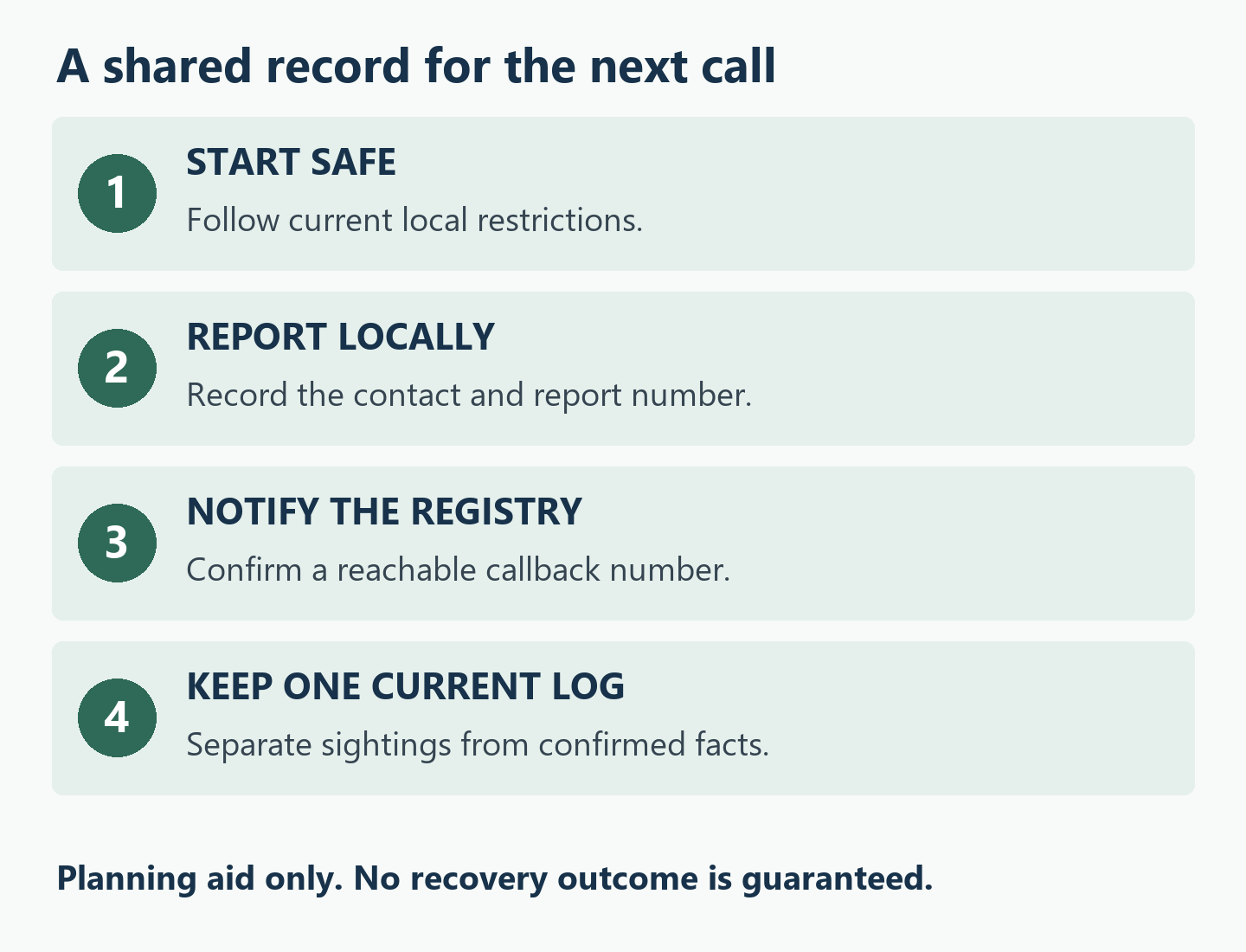
Owner tool
Keep one reporting and follow-up log
Copy these fields onto paper or into a document your trusted helper can use. This is a suggested coordination worksheet, not an official form. Do not fill in a task as completed before somebody has actually done it.
| Field | What to record | Next check |
|---|---|---|
| Last confirmed location | Place, approximate time, and who observed the dog | Separate later sightings |
| Local reports | Organization, date, report number and contact route | Follow the stated process |
| Microchip registry | Company contacted and reachable callback number | Unresolved account questions |
| Shared notice | Current photo, description and version date | Replace obsolete details |
| New information | Who reported it, when, and what remains uncertain | Person assigned to follow up |
| Recovery | Confirmed location, receiving contact and care needs | Close reports after reunion |
For example, one person might contact animal services while another gathers the photograph and chip details. They can then compare notes and assign the next call. The aim is a shared picture of what is known, not a rigid order that delays an urgent report or safe action.
When your dog is found, coordinate the handoff and care
Ask the organization caring for the dog how to verify identity and arrange collection. Follow its current requirements. Bring the records you have without assuming a photograph alone settles every ownership or identification question. Our emergency records folder guide can help organize that information.
Tell the receiving veterinary team about the known timeline, possible floodwater or other exposure, injuries observed, and any care already given. Mark unknown details as unknown. Contact a veterinarian for signs of discomfort, stress, or illness, as the CDC advises after an emergency. This checklist does not diagnose an apparently normal dog or establish that an exposure was harmless.
Once recovery is confirmed, notify the organizations and helpers who hold open reports. Update the shared notice so people do not continue responding to an obsolete search. Keep the timeline and contact record for the next care conversation, then review the household plan when everyone is safe enough to do so.
Better questions, calmer next steps
Ask about the dog who has actually returned
- Does the known separation or exposure history require an examination?
- Which signs mean we should contact an emergency clinic immediately?
- How should we handle uncertain medication or care history?
- What help is appropriate if handling or transport is unsafe?
FAQ
Can the microchip show me where my dog is?
No. A microchip is identification rather than live tracking. Contact its registry and local animal services instead of waiting for a location signal.
Should I go back into the evacuation area to search?
Follow current official restrictions. Report the location and circumstances to the relevant local responder; do not enter a hazardous area because a sighting sounds promising.
Does filing one report notify every shelter?
Do not assume it does. Ask the receiving organization what its reporting system covers and where else you should check.
Sources and limits
Direct sources checked October 28, 2026. Organizational examples and the reporting worksheet are practical synthesis, not a validated recovery protocol. Local response arrangements change, and no recovery outcome is guaranteed.
Not yet medically reviewed.
Start with safety, one current description, and the local reporting route. Keep the next action visible to the person who will take it.