

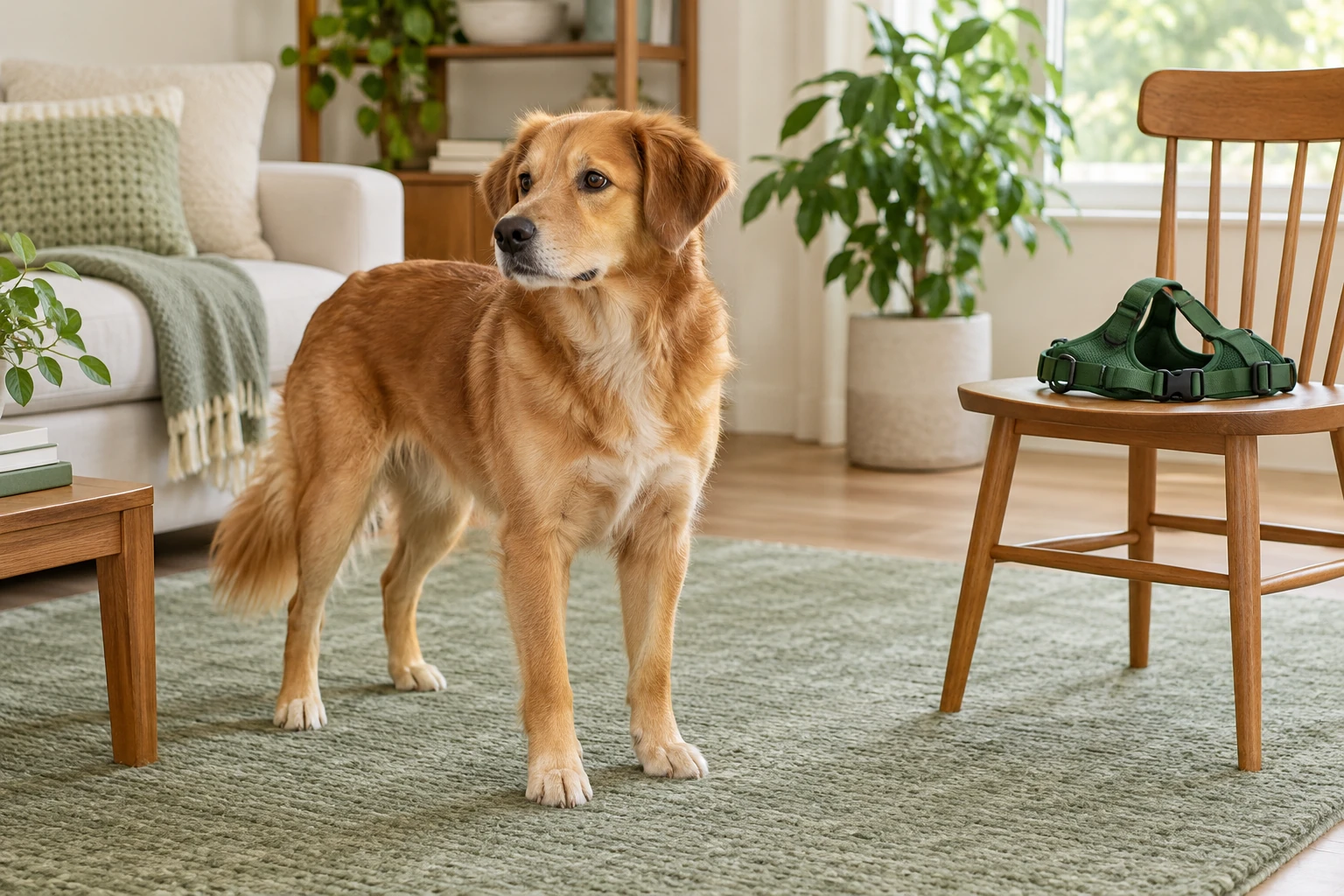
Your dog sees the harness and moves away before you have opened a buckle. You were only getting ready for a walk, but suddenly you are following them around the room with a handful of straps. The more you need to leave, the harder it becomes to separate getting dressed from getting the dog to stay nearby.
It can help to work on a smaller task at another time: the handling that happens before the equipment is worn. A hand moving toward the chest, a strap approaching the body and a clip making a sound are different experiences. They do not have to arrive together in one hurried attempt.
This guide explains how to think through those pieces without forcing your dog into the finished arrangement. It is not a harness-fitting guide, a treatment for fear or a guarantee that practice will make every piece of equipment suitable. Our cooperative care and grooming guide covers the wider approach to optional participation. Here, the focus is the moment before dressing.
Review status: Not yet medically or behavior reviewed. This is general educational information, not an individual veterinary or training plan. This information is not a substitute for individual veterinary or behavior guidance. Stop home practice and contact your veterinarian for apparent pain, a sudden change in handling tolerance, growling, snapping or concern that someone could be hurt.
Separate being near the equipment from wearing it
A dog can approach a harness and still be uncomfortable with a hand reaching around their body. They may accept an ordinary touch but move away when the same hand carries a strap. Rather than assuming the whole task has been learned, notice which part of the situation changed.
Dogs Trust’s harness-introduction guidance separates investigating the equipment, approaching the opening, hearing clips and later wearing it. Its advice also includes stopping when the dog seems worried about the harness or handling. HPE uses that gradual approach here, without adopting every fitting instruction or promising a result.
Think of the task as several questions, not a ladder you must finish in one sitting:
- Can the equipment be present without anyone trying to put it on?
- Is an ordinary hand movement near the dog already comfortable?
- Does adding a strap change the interaction?
- Does the clip sound deserve its own introduction?
- Is actually dressing the dog a suitable next step, or does that need help?
You can stop at any question. Noticing that the hand movement is the difficult part is useful information. You do not need to turn that discovery into a successful fitting before putting the harness away.

Check the human part before involving your dog
Learn how the equipment opens without using the dog as a model
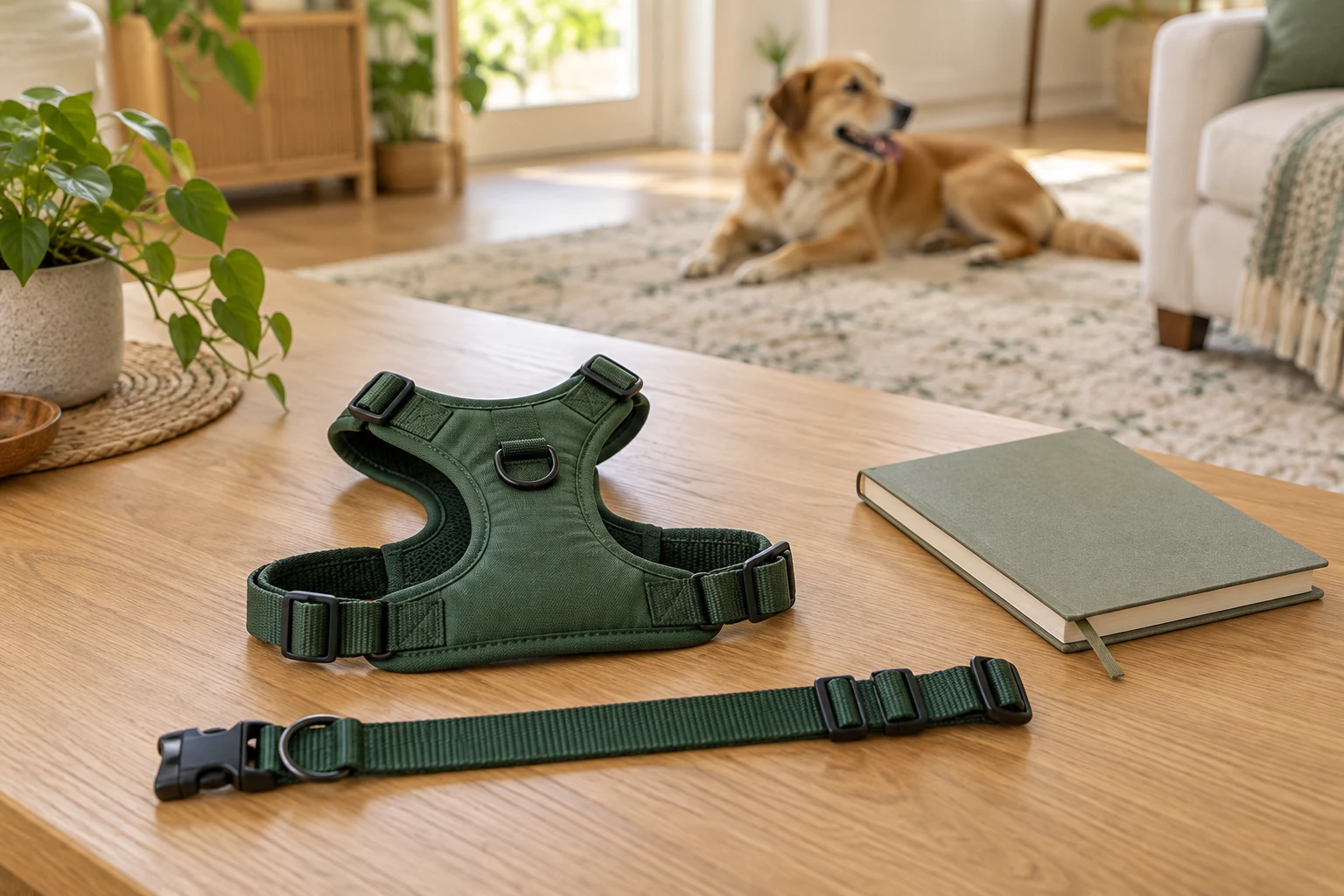
Read the instructions and handle the collar or harness yourself first. Know which buckle opens, where each strap belongs and how you would remove the item. If you are turning it around repeatedly to work out the shape, that is a preparation task you can finish away from the dog.
Do not assume that a harness called step-in, easy-on or no-pull will be easy for your dog to wear. Those labels do not describe their comfort with hands near the body. Equipment choice and fit also remain separate questions. Our collar, harness and leash safety guide puts those decisions in context; this article does not choose a fit measurement or product for you.
Choose a moment that does not require an immediate walk
Practising while someone waits at the front door gives you two competing jobs. One is learning about a small interaction. The other is getting outside now. Choose an optional moment instead, so you can stop without feeling that the household schedule depends on finishing the equipment task.
If necessary equipment cannot currently be put on safely, ask your veterinarian and a qualified reward-based professional for an interim plan. Do not solve the problem by walking an unsecured dog, substituting unsuitable equipment or postponing necessary veterinary care until practice catches up.
Keep the surroundings ordinary
Use a familiar indoor space where your dog can move away without being followed into a corner. Put away objects that do not belong to this small lesson. You are not preparing a full grooming station or setting out every collar and harness the household owns.
Decide where the unused equipment will rest and how you will put it away if the interaction ends. Keep straps and clips from becoming unattended chew items. This is preparation for your own movements, not a way to contain the dog in position.
Offer one small, familiar interaction
The American Veterinary Society of Animal Behavior recommends reward-based training and rejects aversive methods. That is the approach behind this guide. It does not mean using food to keep a dog occupied while you complete handling they would otherwise avoid.
Begin with what is already comfortable
If your dog is comfortable near you, allow that ordinary interaction without immediately bringing out the harness. Do not call them over and then surprise them with a hand around the neck. An approach should not become a trap in which the expected next event changes after they arrive.
For a comfortable dog who already accepts a light touch in the relevant area, keep that familiar touch separate from fastening equipment. You are not testing how long they will tolerate it. If touch itself is uncertain, difficult or associated with avoidance, stop there and seek individual guidance before adding straps.
Keep the reward plan within existing care needs
Use only rewards that fit your dog’s existing diet and individual care instructions. Do not introduce rich foods, withhold meals or change a prescribed diet to make equipment practice happen. If food creates tension or you cannot manage it safely, ask the care team for an appropriate plan rather than improvising.
Reward delivery and putting on gear should not become a race between your hands. You do not need to hold food in front of the dog while your other hand reaches behind them with a buckle. If your setup depends on that distraction, return to planning rather than trying to make your movements faster.
Let an ending stay an ending
If your dog moves away, stop the optional interaction. Do not follow with the collar or make another invitation immediately to try the same movement again. You can put the item away and carry on with an ordinary activity. Ending without the equipment being worn is allowed.
This does not require deciding why the dog left. You may not know. The useful response is to stop adding the thing you were introducing, then consider whether you need help choosing a different starting point.

Keep hands, straps and clip sounds as separate pieces
A hand approaching is not the same as a strap touching
Notice what you are adding. A bare hand may be familiar; the same movement with equipment can look or feel different. Do not combine reaching, moving fabric, lifting a leg and fastening a buckle because one earlier moment seemed uneventful.
If an individual trainer has given you a plan, follow that plan’s starting point and stopping rules. If not, do not invent a more difficult step to check whether the dog is ready. A professional can help you separate the components without repeatedly creating the part your dog avoids.
Introduce a sound without fastening it on the dog
You can learn what the clip does while the harness is away from the dog’s body. Keep the sound separate from a fitting attempt; do not make it right beside an ear as a test. Dogs Trust treats clip noise as its own part of the introduction, rather than assuming a dog who accepts the fabric also accepts fastening.
There is no sound distance, number of repetitions or timetable in this guide. If the noise prompts concern, end the attempt and ask for help rather than repeating it until the response stops. A quieter response after repeated exposure would not, by itself, explain how the dog feels.
Do not use the finished harness as proof of learning
A dog being dressed is a physical result. It does not show whether they understood the interaction or felt comfortable with it. Keep your attention on what you actually introduced and observed, not whether you managed to close the last clip.
Actual dressing needs suitable equipment, correct fit and a safe, individual handling approach. Do not leave an item half-fastened, dangling around the neck or caught on a leg while continuing a lesson. If you are unsure how to proceed or remove it safely, get professional help rather than improvising with a struggling dog.
Know when a pause needs professional support
Stillness is not enough information to call an interaction comfortable. AAHA’s list of nonspecific distress signs includes rigidity, freezing and avoidance. These signs need context; they are not an owner diagnostic test. If you are uncertain during optional practice, you can stop rather than continue to find out.
Battersea’s equipment-introduction guide advises pausing and seeking support for signs of pain or fear. A dog who suddenly objects to previously ordinary handling needs more than a new training cue. Tell your veterinarian what changed without forcing a demonstration for a photograph or video.
Growling, snapping, substantial distress or difficulty safely removing equipment should not become a home training challenge. Avoid putting your hands into a risky position to complete the routine. Explain the practical problem to the veterinary team and ask what help is appropriate.
When contacting a trainer, ask how the proposed lesson will remain reward-based, what you should stop doing and how necessary daily care will be managed meanwhile. You do not need another general wellness tracker. A concise description of the difficult part is enough to begin the conversation.

Troubleshoot the specific part, not your dog’s personality
The dog approaches the harness but avoids your hand
Do not use interest in the object as permission to reach farther. Put the equipment aside and describe the difference to your professional: approaching an item is comfortable, but a hand moving toward the body changes the interaction. That is more useful than calling the dog inconsistent or difficult.
The dog is comfortable with one caregiver, but not another
A familiar routine with one person does not automatically transfer to someone with different movements. Do not have the more familiar person hold the dog while the other practises. Explain the difference and ask how to arrange a suitable introduction without adding restraint.
A new harness changes an otherwise familiar routine
Different openings, materials or clips can change the dressing task. Do not insist on the old sequence when the equipment is different. Review its instructions away from the dog and check suitability with appropriate help. Buying a new item does not mean the dog must learn it immediately.
You are running out of patience or time
Put the optional practice away. There is no need to correct the interaction with one more attempt before you stop. Necessary walks, toileting and appointments still need a safe plan, but that plan should come from an appropriate professional when equipment handling is not manageable, not from escalating a hurried lesson.
Frequently asked questions
1. Does sniffing the harness mean my dog is ready to wear it?
No. Investigating an object and accepting it around the body are different parts of the task. Your dog may be comfortable with one and not another. Do not convert a sniff into an unexpected fitting attempt. You can let the object remain an object and end there. If introducing hand movements or straps is difficult, ask a qualified reward-based professional to help identify an appropriate starting point rather than assuming the dog needs more persuasion.
2. Should I practise collar touch while getting ready for every walk?
Do not make every necessary outing depend on learning a new handling step. Use optional practice time when you can stop without a deadline. If your dog already accepts the normal equipment routine, you do not need to dismantle it for the sake of this article. If that routine has become difficult, ask for an interim care and handling plan. You should not have to choose between forcing practice and taking an unsecured dog outside.
3. Can I use a treat to slip the harness on before my dog notices?
That is not the approach described here. A reward should not hide the handling you intend to add. If your plan depends on distracting your dog while another hand fastens equipment, stop and make the task smaller with appropriate guidance. Food acceptance does not establish comfort with every simultaneous movement. Keep existing dietary instructions in place and seek individual advice if food itself creates tension or cannot be used safely in that setting.
4. What if the clip noise is the only difficult part?
Keep that observation separate from the rest of the dressing task. Do not repeatedly close the buckle beside your dog’s head to test the response. The sound can be considered away from body contact, with help choosing a suitable introduction if needed. This guide does not supply a universal distance, volume or repetition count. If your dog seems worried, end the optional attempt instead of combining the sound with straps, hands and a fitting deadline.
5. Is a step-in harness automatically better for a dog who dislikes touch?
No design label establishes suitability for an individual dog. A step-in style changes which movements are involved; it does not remove the handling question. Do not lift or hold a leg to make a design work because the packaging calls it easy. Discuss the dog’s comfort, mobility, equipment fit and escape concerns with the appropriate professional. This is a preparation guide, not a product comparison or a promise that another purchase will resolve the difficulty.
6. Should I wait until my dog is calm before letting them move away?
Do not block departure during this optional practice or make remaining still the price of ending it. Stop adding the hand movement, sound or equipment when the interaction needs to end. If a dog is already wearing something that cannot be removed safely, that is a different practical problem requiring professional help, not a reason to improvise a training rule. Avoid cornering, chasing or restraining the dog to create a more convenient ending.
7. When is veterinary advice more important than another practice session?
Ask your veterinarian about apparent pain, a sudden change in handling tolerance, injury concerns or worrying behavior. Seek help when safe daily care cannot be managed, rather than extending an optional exercise indefinitely. Tell the clinic which part is difficult and ask how the immediate need should be handled. A qualified reward-based professional may help with learning, but a training article cannot assess a medical cause or replace the veterinary plan for your individual dog.
What to do next
Before bringing your dog into another equipment session, choose one preparation task for yourself. Read the harness instructions, work out how the buckle opens or identify which hand movement has been difficult. None of those tasks requires the dog to stand nearby while you practise.
Then separate the next question from the finished result. Being near a harness, accepting familiar touch, noticing a clip and wearing secured equipment are not interchangeable achievements. You can learn something useful about the first part without completing the last one.
For related care planning, the low-stress grooming overview explains how preparation fits into everyday hygiene, and the Care and Safety collection provides a route to broader household guidance. Keep the lesson specific to your dog and seek help when the practical or medical question is beyond what you can safely manage at home.
Sources and editorial boundaries
Sources were checked on October 30, 2026. AVSAB and AAHA support the training-method and distress-awareness boundaries. Dogs Trust and Battersea provide original equipment-introduction guidance. HPE has not tested a harness or obtained medical or behavior review of this article. UK legal statements, universal fitting measurements, unattended trailing-lead activities and instructions to continue through discomfort are not adopted here.
