

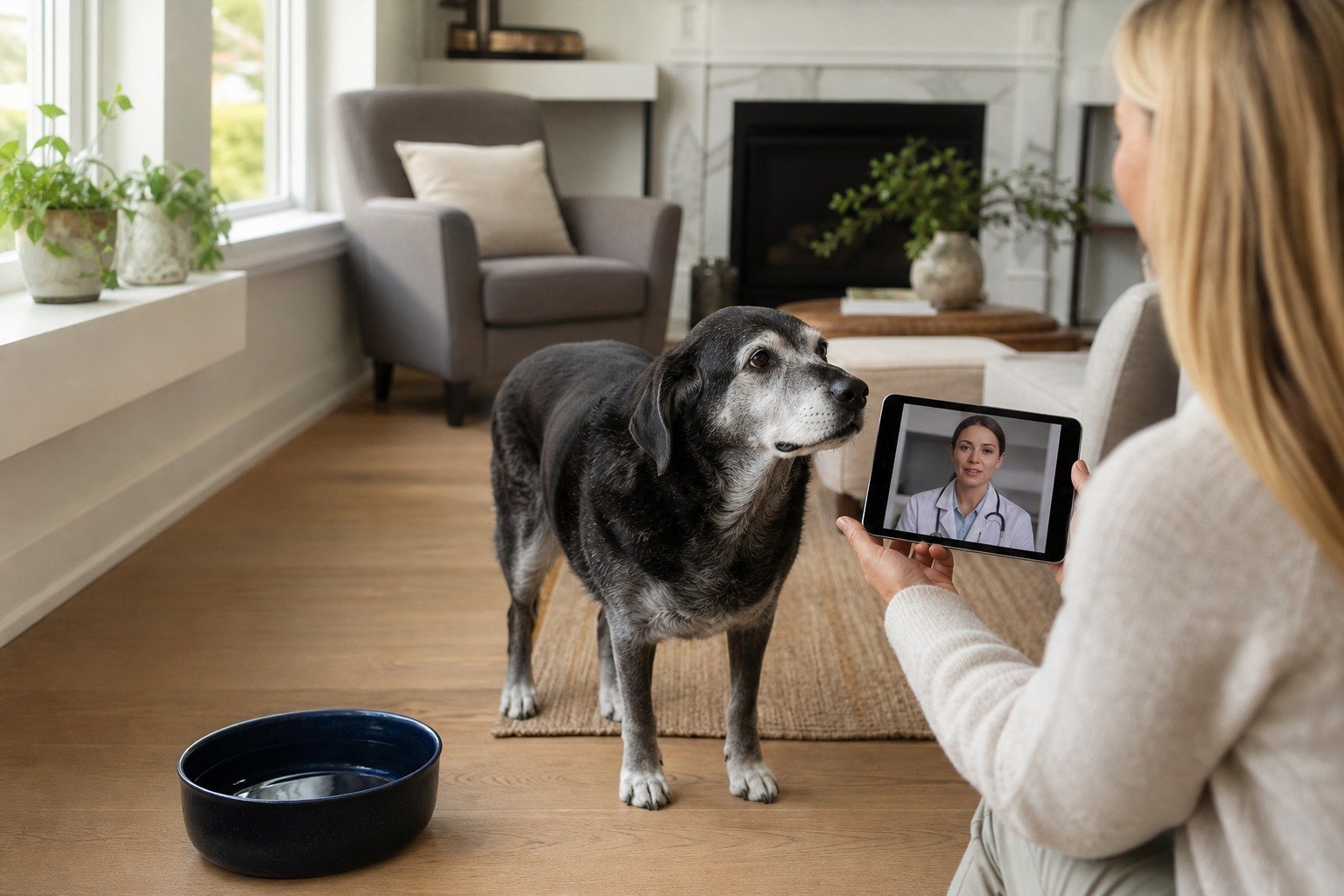
Home observations fill the time between appointments, but they are not a physical examination, diagnostic test, disease stage, pain score, or treatment decision. A senior dog may change in appetite, water intake, elimination, weight, muscle, movement, sleep, behavior, grooming, vision, hearing, breathing, or ability to perform ordinary tasks. One domain can appear stable while another declines. Build a simple repeatable baseline, record meaningful departures and context, and agree with the veterinary team on contact triggers and recheck timing. Do not dismiss a change as normal aging, wait for a universal numeric threshold, or adjust medication, supplements, diet, or exercise from the log alone.
Short answer
Track trends to improve care, not to diagnose
AAHA senior and pain guidance emphasizes owner observations, functional change, repeated assessment, and patient-specific diagnostics. Health-related quality-of-life research can structure broad domains but does not create one universal home cutoff. These tools support communication and reassessment; they do not rule out disease or authorize treatment changes. [1] [2] [3] [4]
- Start with the individual dog's baseline, complete history, and current veterinary plan.
- Use repeated observations to improve a veterinary discussion, not to diagnose or treat at home.
- Keep associations, population findings, and research endpoints within their actual limits.
- Escalate sudden, severe, persistent, progressive, dangerous, or function-limiting changes promptly.
Safety first
Sudden or severe change needs action, not a better spreadsheet
Seek urgent care for breathing difficulty, collapse, seizure, severe pain or weakness, inability to stand, major trauma, repeated unproductive retching, inability to urinate, blue or pale gums, or rapid neurologic change. Contact the veterinarian promptly for persistent appetite, water, elimination, weight, movement, sleep, or behavior changes even when a score remains within a self-selected range.
- Do not delay urgent care while completing a log, changing the environment, or seeking a lower-cost option.
- Do not provoke, corner, restrain, punish, flood, or force exposure to test a behavior or capture a video.
- Do not start, stop, combine, divide, or calculate medication or supplements from this article.
Veterinary note
This article is educational and does not diagnose, treat, prescribe, or replace care from a licensed veterinarian. Your dog’s history, examination, diet, medications, and current signs determine what is appropriate.
Create a whole-dog baseline
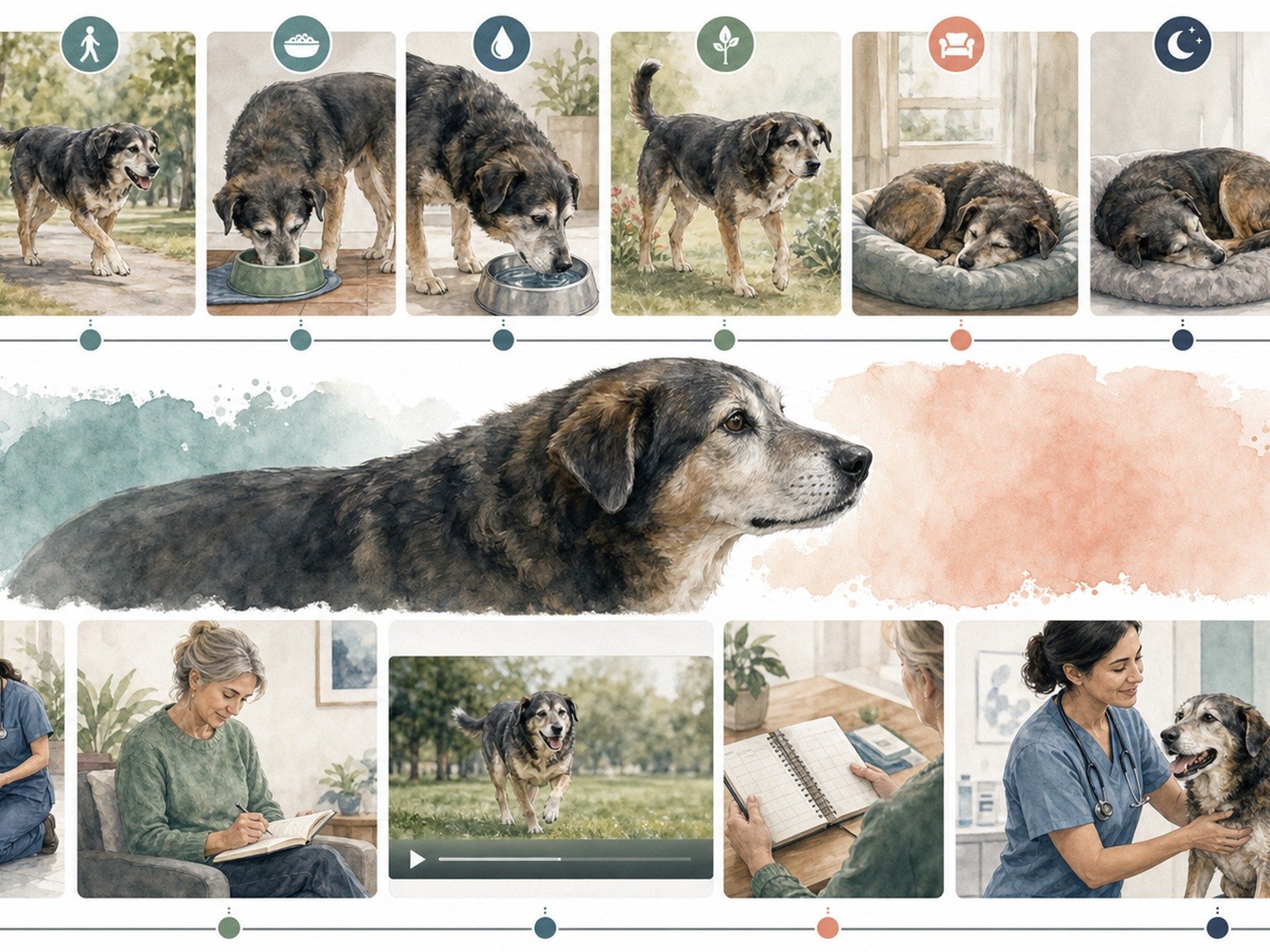
Record measured weight when safely available, body and muscle condition as demonstrated by the veterinary team, appetite, food amount, water, urine, stool, vomiting, rising, gait, stairs, activity, recovery, breathing, cough, sleep, social contact, grooming, skin, vision, hearing, and essential daily tasks.
Note diagnosed conditions, medication and supplement schedules, diet, recent travel, visitors, weather, surface changes, falls, missed doses, and unusual events. Context can help explain variability but cannot prove cause. Include ordinary good days so the record is not built only around problems.
AAHA recommends comprehensive senior history and repeated examination because older dogs may have multiple interacting conditions. [1] A baseline should remain concise enough to use consistently and specific enough to show what changed from this dog's normal.
Choose repeatable observations
Use the same scale when possible and the same plain-language categories. Count only when the veterinary team has asked for a measure and explained technique. Do not invent normal water, breathing, pain, walking, sleep, or weight-change thresholds from another dog or an online chart.
Observe natural tasks such as rising from the usual bed, walking a familiar route, eating, drinking, toileting, settling, and greeting. Never repeat stairs, jumping, handling, or exercise to produce a comparison when the dog hesitates, tires, hurts, or becomes distressed.
A short dated photo or video can add gait, posture, breathing, interaction, or recovery context when recorded safely. Label whether it is representative and what happened before and after. Video cannot palpate, auscultate, perform neurologic testing, or replace examination.
Use quality-of-life tools within their limits
A veterinary-selected quality-of-life or pain instrument can prompt observation across comfort, function, appetite, sleep, interaction, and enjoyment. Use the same validated purpose and instructions. Do not combine questions from different tools or create a diagnosis from the total.
Research on senior-dog health-related quality of life supports multidimensional owner reporting while also showing that instruments, populations, and measurement properties matter. [4] A score should start a discussion, not settle prognosis, medication, euthanasia, or a safe period to wait.
Record the concrete reason behind a changed answer: could not rise without help, left half the meal, woke repeatedly, or stopped joining a familiar activity. Specific function is more actionable than a single label such as bad day.
Send a concise trend and close the loop
Summarize the first change, direction, frequency, duration, affected function, recovery, concurrent signs, medication and supplement context, and representative media. Ask the clinic how to transmit the information and which findings require an appointment, sample, or urgent assessment.
Agree on intended outcomes and recheck timing for each active plan. Track adherence, adverse effects, and whether the targeted function actually changes. Do not stop, stretch, double, divide, or restart medication or add a supplement because a trend moved.
Home monitoring succeeds when it detects meaningful change, improves shared decisions, and prompts timely reassessment. It fails when it creates false reassurance, delays care, or turns the caregiver into the diagnostician. Keep the route back to professional evaluation explicit.
Prepare for a focused veterinary conversation
Bring a concise timeline, short natural-movement or symptom videos when safe, the exact names and photographs of every food, treat, medication, and supplement label, and notes about appetite, water intake, stool, sleep, activity, comfort, and behavior. Include recent injuries, travel, boarding, diet changes, missed medication, and previous test results. A complete record helps the veterinary team separate a repeatable pattern from a single impression.
Decide in advance what you need from the visit: an urgency decision, a diagnosis plan, a nutrition review, a pain or mobility assessment, or a monitored trial. Ask what result would change the plan and what finding would rule an option out. This keeps research and product information in the right role. Evidence can shape questions and expectations, but it cannot determine what is safe for an individual dog without the history and examination.
Owner tool
Build a senior health tracking record
On a phone, swipe across the table to see every column.
| Checkpoint | What to record | Why it helps |
|---|---|---|
| Baseline | Weight, intake, elimination, function, behavior | Defines normal |
| Context | Medication, diet, routine, environment | Explains variability |
| Change | Onset, direction, duration, recovery | Shows trend |
| Review | Outcome, trigger, recheck, questions | Closes loop |
Better questions, calmer next steps
Questions to ask your veterinarian
- Which observations are most useful for this dog?
- How should weight, body, or muscle condition be measured?
- Is a validated pain or quality-of-life tool appropriate?
- Which change should be reported promptly?
- When is the next examination or diagnostic review?
FAQ
Can a tracker diagnose disease?
No. It organizes observations for professional assessment.
How often should I record data?
Use a sustainable schedule agreed with the veterinary team.
Is weight alone enough?
No. Muscle, body condition, intake, and function can change independently.
Can video replace a visit?
No.
Does a good score mean it is safe to wait?
No universal score overrides urgent signs or clinical advice.
Sources
- American Animal Hospital Association: Evaluating the Healthy Senior Pet. Senior history, examination, baseline, and monitoring.
- American Animal Hospital Association: Diagnostic Tests and Recommended Frequencies. Patient-specific diagnostics and recheck planning.
- American Animal Hospital Association: Pain Management in Senior Pets. Owner observation, function, pain assessment, and reassessment.
- Frontiers in Veterinary Science: Health-Related Quality of Life in Senior Dogs. Multidimensional owner reporting and measurement limits.
