

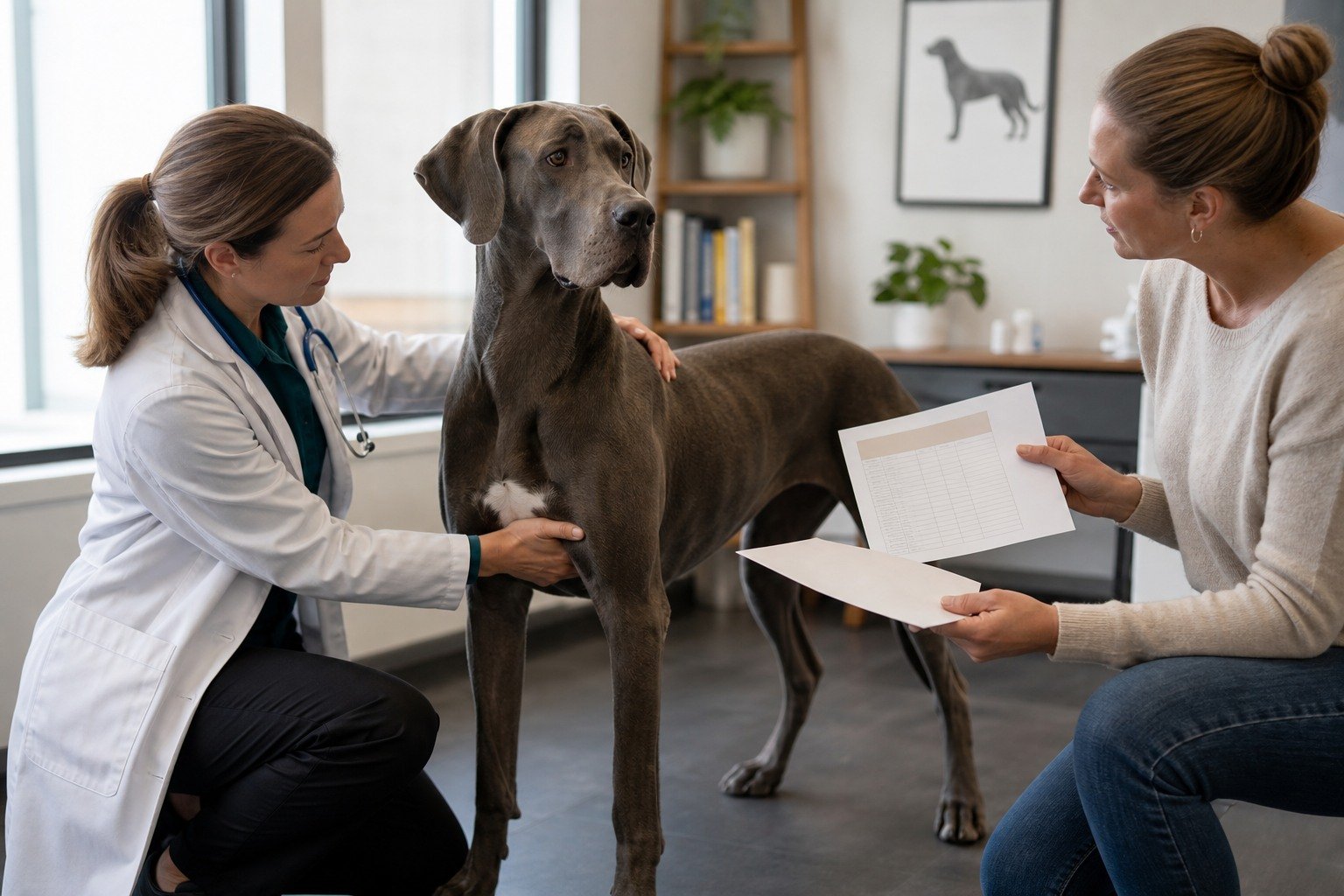
Large and giant dogs are marketed countless joint, calcium, vitamin, fatty-acid, and general-wellness products. Size alone does not prove that any is needed. The most important size-specific issue begins during growth: large and giant puppies can mature later, and excessive energy or calcium can disturb the intended balance of a complete growth diet. Adult decisions still depend on the exact diet, treats, body and muscle condition, activity, diagnoses, medications, laboratory context, and the precise formulation being considered. Evidence for one ingredient or product cannot be transferred automatically to every large dog. Start with a defined problem and a complete exposure inventory, then ask whether food, medical care, rehabilitation, weight management, or another approach addresses the goal more directly.
Short answer
Do not add a supplement simply because the dog is large
AAHA recommends growth-appropriate complete diets, lean body condition, and avoiding excessive calcium during large- and giant-breed growth. Large-breed puppy literature similarly identifies energy and calcium balance as important. These findings support careful nutrition, not routine calcium or joint supplementation. [1] [2]
- Start with the individual dog's baseline, complete diet, health history, and veterinary plan.
- Record exact products, ingredients, timing, purpose, and observed change instead of relying on category labels.
- Keep general evidence separate from a product-specific recommendation or treatment decision.
- Escalate sudden, severe, persistent, or rapidly worsening signs promptly.
Safety first
Growth change, severe pain, weakness, or suspected overdose needs veterinary help
Contact a veterinarian for abnormal growth, persistent lameness, difficulty rising, appetite or weight change, vomiting, diarrhea, weakness, or a possible product reaction. Seek urgent care for collapse, breathing difficulty, severe pain, inability to stand, repeated vomiting, a swollen painful abdomen, unproductive retching, or a significant unintended exposure.
- Do not start, stop, combine, split, or calculate a product or medication from this article.
- Do not use a supplement to delay diagnosis, prescribed care, or urgent veterinary assessment.
- After a possible overdose, wrong-product exposure, or toxic ingestion, contact a veterinarian or animal poison service promptly.
Veterinary note
This article is educational and does not diagnose, treat, prescribe, or replace care from a licensed veterinarian. Your dog’s history, examination, diet, medications, and current signs determine what is appropriate.
Separate puppy growth nutrition from adult supplement marketing
For a growing large or giant puppy, record the exact complete food, life-stage statement, measured amount, treats, chews, toppers, and every supplement. AAHA notes that some large dogs reach skeletal maturity later and recommends maintaining lean body condition while avoiding excessive calcium. [1]
That guidance does not provide an owner-directed calcium amount or prove that a supplement prevents hip or elbow disease. A complete large-breed growth diet is formulated around nutrient balance; adding minerals, vitamins, or calorie-dense extras can change that balance even when the front label sounds supportive.
Growth rate, body condition, gait, appetite, stool, activity, and veterinary findings should be followed over time. Large-breed puppy literature links nutritional excess and calcium imbalance with developmental skeletal risk, but genetics, conformation, loading, injury, and other factors also matter. [2]
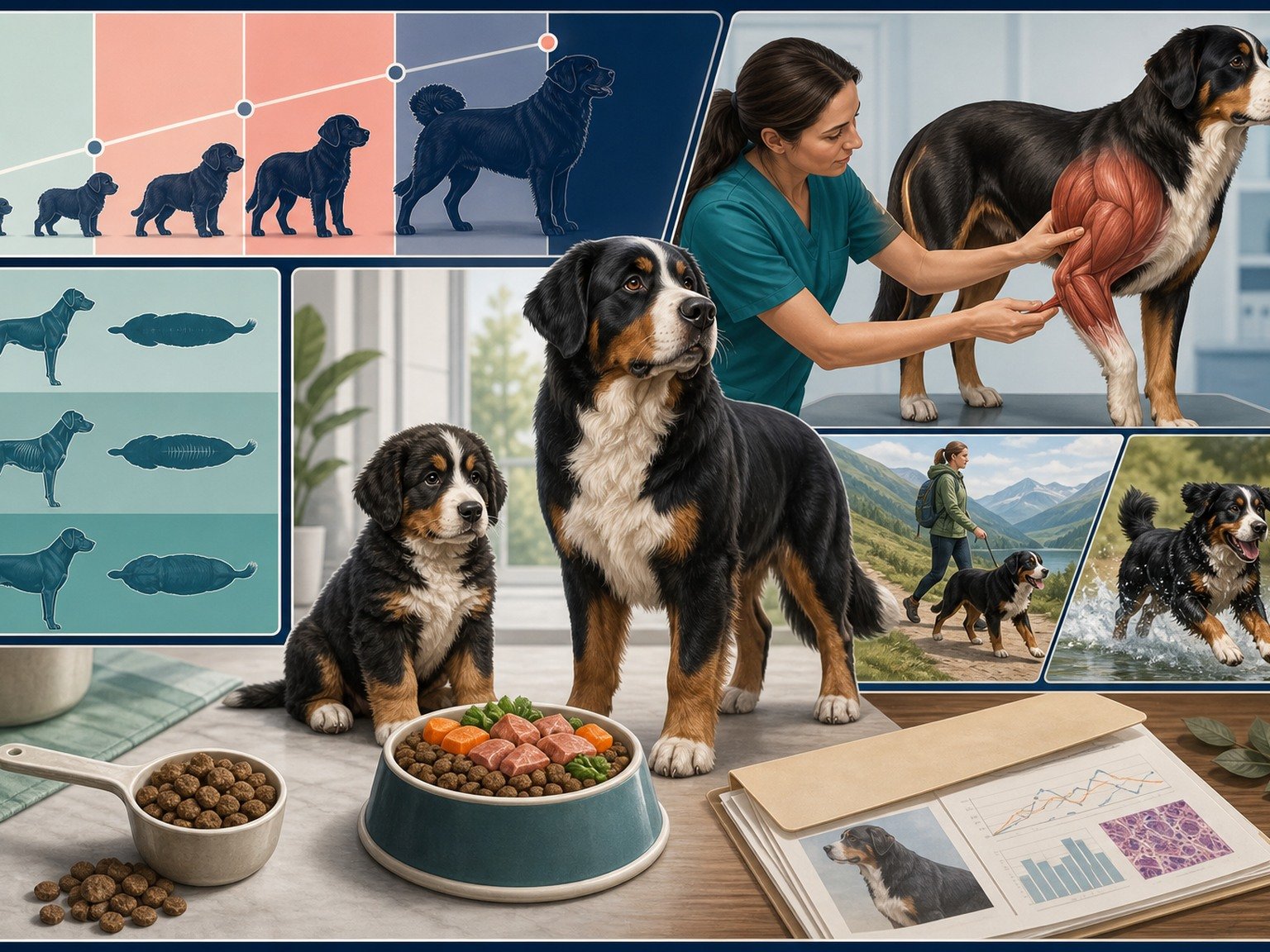
Build one complete large-dog nutrition history
List food, training treats, chews, table food, toppers, supplements, flavored medications, preventives, and products given only occasionally. Photograph every label panel and record the actual amount and schedule. AAHA treats patient, diet, feeding environment, activity, health, and caregiver practice as one nutrition assessment. [3]
Record body weight, body condition, muscle condition, growth or weight trend, appetite, stool, vomiting, skin, gait, rising, recovery, and activity. A large dog can carry excess fat while losing muscle, and scale weight alone cannot explain function or define a supplement need.
Bring diagnoses, prior orthopedic injury, kidney or liver concerns, medications, upcoming procedures, and laboratory results. Size may change practical administration or exposure, but it cannot replace patient-specific safety review or justify scaling another dog's product by weight.
Evaluate the exact formulation and the exact claim
Ask what outcome the product is supposed to change, whether the dog has that problem, and what evidence addresses the same species, life stage, condition, ingredient form, formulation, and outcome. A study of one blend does not validate a different blend or reveal which ingredient caused a result.
Veterinary supplement reviews describe uneven evidence, regulation, formulation, content verification, quality control, and safety. [4] A large-breed label is a marketing category unless the underlying composition, intended use, evidence, and quality information support a meaningful decision.
Do not treat a voluntary quality seal as proof of clinical benefit, and do not treat natural as a safety conclusion. Ask about lot identity, manufacturer contact, testing, adverse-event information, storage, interactions, calories, and how the team will know whether the product should continue.
Choose a monitored plan instead of a size-based stack
Define one problem, baseline, measurable outcome, review date, and adverse signs before adding anything. Starting several products together makes benefit, no change, or an adverse event harder to interpret. Do not stop prescribed care or redesign a regimen without the veterinary team.
Ask whether complete nutrition, body-condition change, pain treatment, rehabilitation, conditioning, environmental access, or diagnosis should come first. A supplement is optional support only when it fits a defined goal; it does not replace those foundations or guarantee prevention.
Use WSAVA nutrition tools to keep body and muscle condition, diet history, and follow-up in the same decision. [5] Reassess as the puppy matures or the adult dog's health, activity, diet, or medication changes. Large size remains context, not a permanent prescription.
Prepare for a focused veterinary conversation
Bring a concise timeline, short natural-movement or symptom videos when safe, the exact names and photographs of every food, treat, medication, and supplement label, and notes about appetite, water intake, stool, sleep, activity, comfort, and behavior. Include recent injuries, travel, boarding, diet changes, missed medication, and previous test results. A complete record helps the veterinary team separate a repeatable pattern from a single impression.
Decide in advance what you need from the visit: an urgency decision, a diagnosis plan, a nutrition review, a pain or mobility assessment, or a monitored trial. Ask what result would change the plan and what finding would rule an option out. This keeps research and product information in the right role. Evidence can shape questions and expectations, but it cannot determine what is safe for an individual dog without the history and examination.
Owner tool
Build a large-breed supplement review
On a phone, swipe across the table to see every column.
| Checkpoint | What to record | Why it helps |
|---|---|---|
| Life stage | Growth status, complete diet, body trend | Protects balance |
| Purpose | Problem, baseline, desired outcome | Defines need |
| Product | Formulation, amount, lot, evidence | Identifies exposure |
| Follow-up | Response, adverse signs, review date | Tests fit |
Better questions, calmer next steps
Questions to ask your veterinarian
- Is there a defined need beyond body size?
- Is the current diet complete for this life stage?
- Could this add excess calcium, calories, or duplicate ingredients?
- What evidence applies to this exact formulation?
- What outcome and review date will determine continuation?
FAQ
Does every large dog need a joint supplement?
No. Need and evidence are individual.
Should I add calcium for stronger puppy bones?
Not to a complete growth diet unless a veterinary nutrition professional identifies a need.
Can I dose by body size?
No universal size-only conversion is established.
Does a large-breed label prove suitability?
No. Review composition, evidence, quality, and patient context.
Can supplements prevent dysplasia?
No product can guarantee prevention of multifactorial developmental disease.
Sources
- American Animal Hospital Association: Age-Specific and Breed-Specific Diets. Large-breed growth, lean body condition, and calcium context.
- Compendium / PubMed: Feeding Large-Breed Puppies. Energy, calcium, growth, and developmental skeletal context.
- American Animal Hospital Association: Gathering a Comprehensive Nutrition History. Complete food, supplement, medication, patient, and caregiver history.
- Nutrition Today: Veterinary Pet Supplements and Nutraceuticals. Evidence, formulation, regulation, quality, and safety limits.
- World Small Animal Veterinary Association: Global Nutrition Guidelines. Individual diet, body condition, muscle condition, and follow-up assessment.
