
Human and dog supplements are not interchangeable categories. In the United States, the human dietary-supplement framework does not create an equivalent animal dietary-supplement category; products marketed for animals are regulated according to composition and intended use as animal food or animal drugs. Exact ingredients, concentrations, excipients, delivery forms, claims, quality, evidence, and patient context vary in both markets. A smaller piece of a human tablet or fraction of a scoop is not a validated canine dose. Xylitol and human multivitamin exposures illustrate why inactive ingredients and combinations matter. Pet labeling also does not guarantee necessity, efficacy, quality, or suitability. A veterinarian may direct a specific human formulation in an individual case, but that decision cannot be generalized.
Short answer
Do not convert a human serving into a dog dose
FDA explains that animal products do not use the same dietary-supplement category as human products. Human multivitamins and supplements can contain ingredient- and formulation-specific hazards, and xylitol may occur in human medicines or supplements. The exact package, amount, timing, and dog must be assessed. [1] [2] [3]
- Record the exact pattern, product, context, timing, and recent changes.
- Use the record to support professional assessment, not to create a diagnosis or protocol at home.
- Bring the complete label, health history, diet, medications, supplements, and prior responses.
- Agree on a review point and clear instructions for urgent changes.
Safety first
Suspected ingestion of a human supplement needs prompt professional guidance
Contact a veterinarian, emergency clinic, or animal poison control center promptly when a dog gets into a human supplement, receives the wrong product, or may have received too much. Do not wait for symptoms, induce vomiting, give food, or calculate a home antidote unless a veterinary professional specifically directs it.
- Do not delay care for sudden, severe, escalating, or function-limiting signs.
- Do not start, stop, combine, divide, or calculate treatment from this article.
- Preserve exact packages, lot information, exposure details, and a concise timeline.
Veterinary note
This article is educational and does not diagnose, treat, prescribe, or replace care from a licensed veterinarian. Your dog’s history, examination, diet, medications, and current signs determine what is appropriate.
Understand the regulatory difference accurately
The U.S. Dietary Supplement Health and Education Act applies to human dietary supplements, not a parallel animal category. FDA evaluates animal products according to their composition, intended use, and claims as animal food or animal drugs. Calling every animal product unregulated is inaccurate. [1]
Regulatory category does not by itself establish clinical benefit, purity, or suitability. Human and pet products can each vary in formulation, manufacturing controls, label clarity, evidence, and quality. Evaluate the exact product rather than assuming one market is always safer.
Claims matter. A product intended to affect disease may enter drug territory, while an ingredient used for animal nutrition has different pathways. Owners do not need to classify the product alone; they need the full label and a professional review.
Compare the complete formulation, not one ingredient
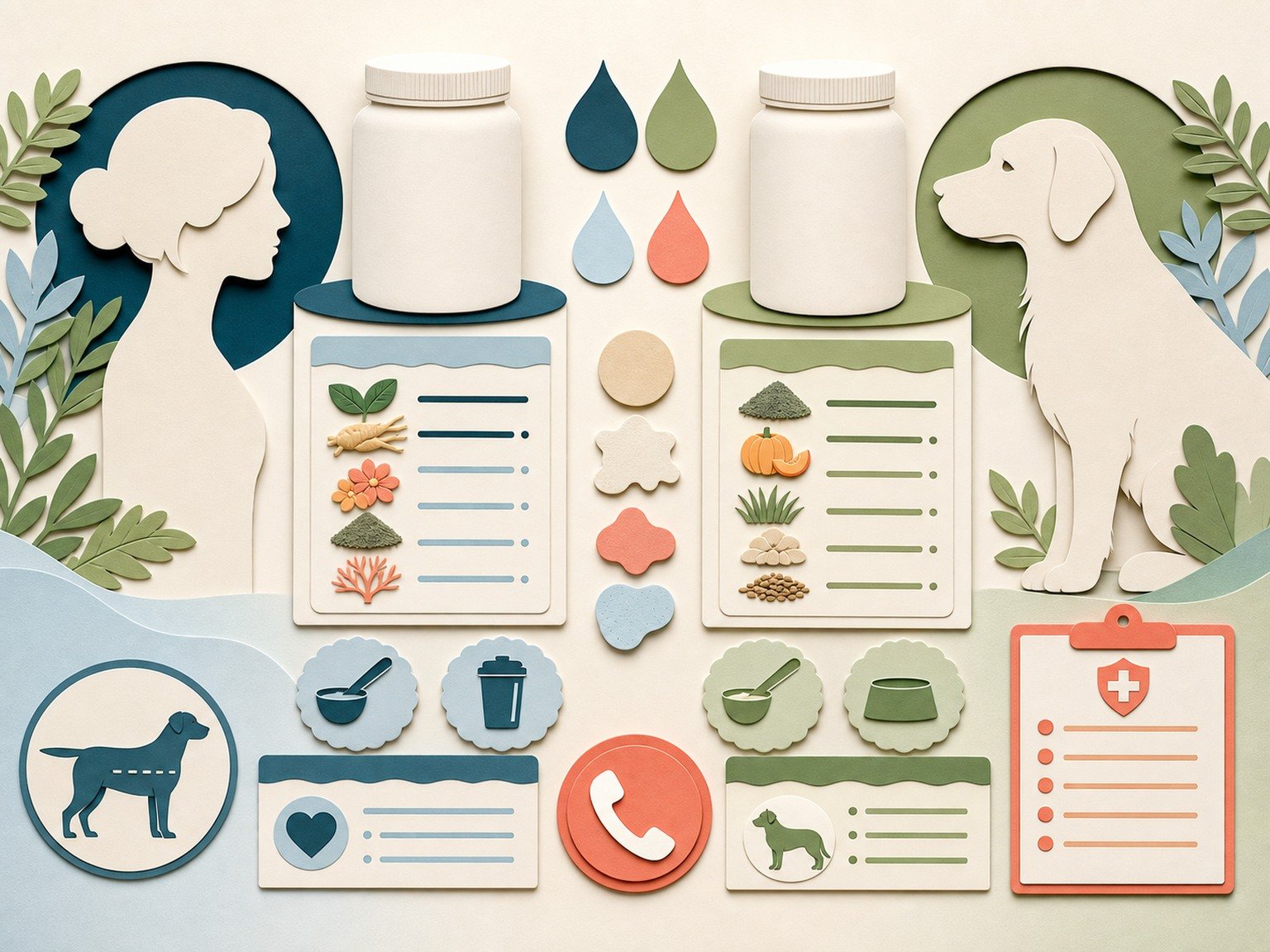
A shared ingredient name can hide different chemical forms, concentrations, sources, combinations, coatings, sweeteners, flavors, oils, binders, or delivery systems. Gummies, liquids, powders, tablets, and chews also create different exposure and measurement risks.
Human multivitamin products may contain vitamins, minerals, stimulants, sweeteners, or combinations that create dog-specific concern. Toxicologic significance depends on the exact formulation, amount, timing, and patient, so a general safe list cannot manage an exposure. [2]
Xylitol is a clear example: it can appear in human medicines and dietary supplements and is toxic to dogs. The lesson is not that every human product contains xylitol; it is that inactive or unexpected ingredients must be checked on the exact package. [3]
Reject dose conversion by body weight alone
A human label serving, tablet, scoop, dropper, or gummy was not designed as a canine dose. Dividing by body weight ignores species response, diet, body and muscle condition, organ function, disease, medications, concurrent products, and the evidence for the intended use.
Do not use teaspoons, pill fragments, kitchen scales, concentration math, or online conversion tables to create a canine regimen. Even when an ingredient is used in both species, the exact formulation and veterinary purpose determine whether use is appropriate.
A veterinarian may sometimes recommend a specific human-labeled product after checking every ingredient and the dog. Record the manufacturer, complete product name, form, concentration, lot, and photograph so a later refill does not silently substitute a different formulation.
Avoid the opposite pet-label myth
A dog image or pet-formulated label does not prove that a product is needed, effective, high quality, free of contaminants, correctly concentrated, or safe with the dog's diet and medications. Veterinary supplement evidence, bioavailability, quality, and safety vary. [4]
Ask what problem is being addressed, what evidence applies to the exact ingredient and formulation, what quality controls are documented, which interactions matter, what outcome will be tracked, and when the plan will be reviewed.
Keep a single reconciliation list for human products, pet products, treats, fortified diets, medications, and topical products. This can reveal duplication and helps emergency teams assess an accidental exposure accurately.
Prepare for a focused veterinary conversation
Bring a concise timeline, short natural-movement or symptom videos when safe, the exact names and photographs of every food, treat, medication, and supplement label, and notes about appetite, water intake, stool, sleep, activity, comfort, and behavior. Include recent injuries, travel, boarding, diet changes, missed medication, and previous test results. A complete record helps the veterinary team separate a repeatable pattern from a single impression.
Decide in advance what you need from the visit: an urgency decision, a diagnosis plan, a nutrition review, a pain or mobility assessment, or a monitored trial. Ask what result would change the plan and what finding would rule an option out. This keeps research and product information in the right role. Evidence can shape questions and expectations, but it cannot determine what is safe for an individual dog without the history and examination.
Owner tool
Compare an exact human or pet product
On a phone, swipe across the table to see every column.
| Checkpoint | Record | Why it helps |
|---|---|---|
| Identity | Name, maker, form, lot, full label | Prevents substitution |
| Formula | Actives, excipients, concentration | Finds hidden differences |
| Patient | Diet, disease, drugs, other products | Frames suitability |
| Purpose | Goal, evidence, measure, review | Avoids indefinite use |
Better questions, calmer next steps
Questions to ask your veterinarian
- What exact formulation are we evaluating?
- Are any excipients or combinations unsafe for this dog?
- Does evidence apply to this form and use?
- Could diet or other products duplicate it?
- What exposure requires emergency guidance?
FAQ
Can I give half a human serving?
No. A fraction of a human serving is not a validated canine dose.
Are human products always more concentrated?
No. Compare the exact formulation.
Are pet products always safer?
No. Pet labeling alone proves neither safety nor efficacy.
Can a veterinarian ever use a human product?
Sometimes, after exact-product and patient review.
Why keep the package?
It preserves ingredient, concentration, lot, and exposure information.
Sources
- U.S. Food and Drug Administration: FDA's Regulation of Pet Food. Animal regulatory framework.
- Merck Veterinary Manual: Toxicoses From Human Multivitamins and Supplements. Ingredient-specific hazards and exposure assessment.
- U.S. Food and Drug Administration: Paws Off! Xylitol Is Toxic to Dogs. Xylitol risk and prompt response.
- Nutrition Today: Veterinary Pet Supplements and Nutraceuticals. Evidence, formulation, quality, and safety variability.
