
There is no universal storage rule for every dog supplement. Powders, oils, liquids, chews, capsules, probiotics, animal-food products, and drug products can have different requirements for temperature, light, moisture, refrigeration, freezing, closure, and after-opening use. Follow the exact label and manufacturer instructions rather than adding a generic cool-dry-place rule. Keep original packaging or preserve the full product name, manufacturer, lot number, and date information so recalls and complaints can be traced. Store products where pets and children cannot access them, and separate look-alike human and pet containers. Packaging damage, abnormal appearance, suspected contamination, overdose, or accidental ingestion should trigger product-specific professional guidance, not a smell test or owner-created shelf-life extension.
Short answer
The exact label controls storage
FDA animal-food guidance supports original packaging or preserved lot information, clean and dry handling, secure closure, and preventing pet access. Those principles help, but numeric or form-specific food guidance cannot be applied automatically to every supplement. Formulation, classification, label, and manufacturer instructions remain controlling. [1] [2] [3]
- Record the exact pattern, product, context, timing, and recent changes.
- Use the record to support professional assessment, not to create a diagnosis or protocol at home.
- Bring the complete label, health history, diet, medications, supplements, and prior responses.
- Agree on a review point and clear instructions for urgent changes.
Safety first
Accidental access, overdose, or illness is an emergency question, not a storage question
Promptly contact a veterinarian, emergency animal hospital, or animal poison control center when a dog gets into a product, receives too much, or develops concerning signs. Do not wait for spoilage clues, induce vomiting, or use a generic discard rule to manage an exposure.
- Do not delay care for sudden, severe, escalating, or function-limiting signs.
- Do not start, stop, combine, divide, or calculate treatment from this article.
- Preserve exact packages, lot information, exposure details, and a concise timeline.
Veterinary note
This article is educational and does not diagnose, treat, prescribe, or replace care from a licensed veterinarian. Your dog’s history, examination, diet, medications, and current signs determine what is appropriate.
Start with formulation and classification
Products marketed as animal supplements may be treated as animal food or animal drugs depending on composition, intended use, and claims. Their storage directions reflect formulation, packaging, stability data, and regulatory context. [1]
Cool, dry, dark, refrigerated, frozen, room-temperature, and after-opening instructions are not interchangeable. Do not refrigerate a product simply because cold seems safer, and do not leave a refrigerated product at room temperature because another supplement allows it.
When directions are unclear, contact the manufacturer using verified information from the package and ask the veterinarian or pharmacist when patient safety is involved. Record the answer and the exact product version.
Storage planning also needs a household handoff. Write down where the product belongs, who administers it, how the container is closed, and whom to contact when a dose, seal, or appearance is uncertain. This reduces improvisation when the usual caregiver is away.
Preserve product identity and traceability
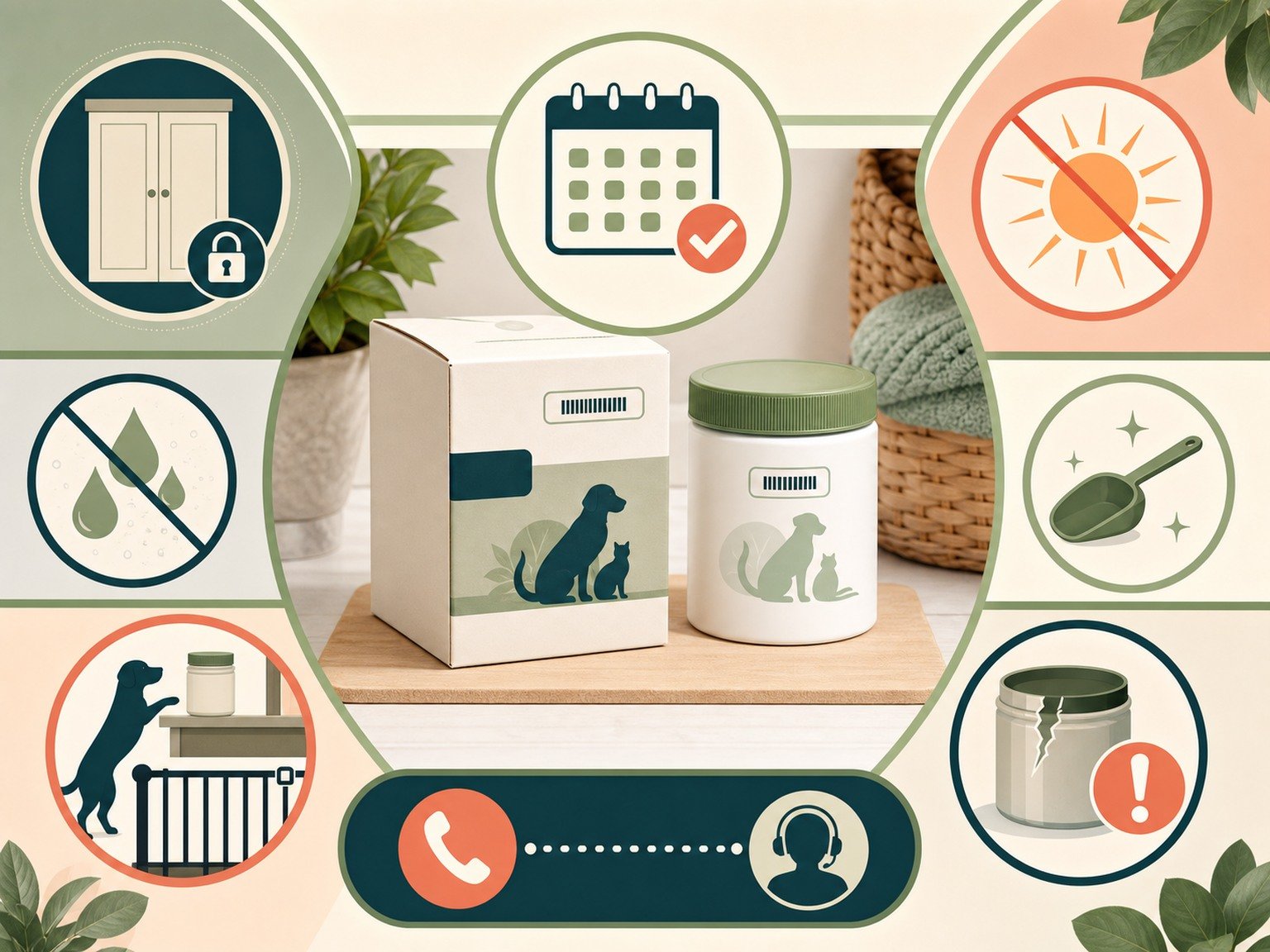
Original packaging often carries the complete name, manufacturer, ingredient panel, directions, lot number, and best-by or expiration information. If a secondary container is required by professional instruction, preserve all identity and traceability information with it.
A lot number identifies a manufacturing batch and can help trace a recall or defect. Photograph the front, back, lot, and date when opening a product, and keep purchase information when available. [3]
Do not combine old and new lots in one container or top off a container without cleaning and drying as directed. Mixing removes traceability and can transfer moisture, residue, or contamination.
Control access and handling
Store products out of reach and behind a secure barrier. Child-resistant or pet-oriented packaging is not guaranteed childproof or petproof. Dogs can chew containers, open bags, climb, or access products after a spill.
Keep hands, measuring tools, and the product area clean and dry where the label calls for it. Use only the supplied or veterinarian-approved measuring device for that exact product, and never return spilled material to the container.
Separate look-alike human and pet products and avoid unmarked pill organizers for supplements. Household members should know who gives each product and record administration to reduce duplication.
Respond to packaging and appearance concerns
Leaking, swelling, broken seals, moisture, clumping, unexpected odor or color, foreign material, or damaged packaging can justify holding the product and contacting the manufacturer or veterinary team. Appearance alone cannot prove safety or danger.
A best-by or expiration date has product-specific meaning. It does not establish immediate toxicity on one side of the date or authorize an owner to extend shelf life. Do not freeze, heat, dry, transfer, or otherwise rescue a questionable product.
For a complaint, preserve the package, lot, date, photographs, storage history, amount used, timing, and observed signs. Keep it inaccessible while awaiting instructions. Acute exposure or illness goes first to veterinary or poison-control help, not a regulator's routine response line. [4]
Prepare for a focused veterinary conversation
Bring a concise timeline, short natural-movement or symptom videos when safe, the exact names and photographs of every food, treat, medication, and supplement label, and notes about appetite, water intake, stool, sleep, activity, comfort, and behavior. Include recent injuries, travel, boarding, diet changes, missed medication, and previous test results. A complete record helps the veterinary team separate a repeatable pattern from a single impression.
Decide in advance what you need from the visit: an urgency decision, a diagnosis plan, a nutrition review, a pain or mobility assessment, or a monitored trial. Ask what result would change the plan and what finding would rule an option out. This keeps research and product information in the right role. Evidence can shape questions and expectations, but it cannot determine what is safe for an individual dog without the history and examination.
Owner tool
Create a product-specific storage record
On a phone, swipe across the table to see every column.
| Checkpoint | Record | Why it helps |
|---|---|---|
| Identity | Product, maker, lot, date, photos | Supports traceability |
| Directions | Temperature, light, moisture, closure | Prevents generic rules |
| Access | Secure location, household roles | Reduces accidents |
| Concern | Damage, change, exposure, contact | Guides response |
Better questions, calmer next steps
Questions to ask your veterinarian
- Which exact storage directions control?
- What should I record after opening?
- How should a damaged package be handled?
- Who should I contact about a lot concern?
- What exposure needs emergency guidance?
FAQ
Should every supplement be refrigerated?
No. Follow the exact label.
Can I transfer it to a prettier jar?
Original packaging best preserves identity and traceability.
Does a date prove immediate danger?
No. Date meaning is product-specific.
Can smell prove a product is safe?
No. Appearance and odor are not safety tests.
What if my dog opens the container?
Seek prompt professional exposure guidance.
Sources
- U.S. Food and Drug Administration: FDA's Regulation of Pet Food. Product classification and label-specific context.
- U.S. Food and Drug Administration: Proper Storage of Pet Food and Treats. Packaging, clean dry storage, closure, and access.
- U.S. Food and Drug Administration: Save Your Pet Food Lot Number. Lot traceability.
- U.S. Food and Drug Administration: Who Do You Call if You Have a Pet Emergency?. Prompt veterinary and poison-control response.
