


Dog supplement questions rarely have universal yes-or-no answers. A veterinary nutritional assessment considers the individual dog, complete diet, feeding management, health, medications, and clinical goal. Products marketed for animals do not occupy the same U.S. regulatory category as human dietary supplements, and evidence, formulation, quality, safety, efficacy, and bioavailability vary. A pet label, natural claim, quality seal, or ingredient study can add information without proving suitability. Human products can present ingredient-specific hazards and must never be converted from a label serving into a canine dose. Use this FAQ to prepare a complete product and exposure record, not to select, stack, dose, or stop products independently.
Short answer
Use the FAQ to prepare better questions, not choose a product
AAHA nutrition guidance begins with an individualized assessment of the animal, diet, feeding management, health, and goals. FDA regulates animal products by composition and intended use rather than under the human dietary-supplement category. Those differences make exact-product and patient context essential. [1] [2]
- Record exact timing, pattern, exposures, diet, products, and recent changes.
- Use the record to prepare for veterinary assessment, not to diagnose or prescribe at home.
- Bring labels, medications, supplements, prior results, and safe photos or video when useful.
- Agree on monitoring, reassessment, and urgent-response instructions.
Safety first
Accidental ingestion, overdose, or acute severe signs needs prompt help
Contact a veterinarian, emergency clinic, or animal poison control center promptly after suspected overdose, access to a human or pet product, or severe vomiting, weakness, tremors, seizures, breathing difficulty, bleeding, collapse, or rapid deterioration. Do not wait for a routine appointment or attempt a home antidote.
- Do not delay care for sudden, severe, escalating, or function-limiting signs.
- Do not start, stop, combine, or calculate treatment from this article.
- Keep a concise timeline and exact product or exposure details available.
Veterinary note
This article is educational and does not diagnose, treat, prescribe, or replace care from a licensed veterinarian. Your dog’s history, examination, diet, medications, and current signs determine what is appropriate.
Does my dog need a supplement?
Need cannot be established from age, breed, a symptom, or a marketing checklist alone. Some dogs have a veterinary indication for a specific nutrient or product, while others receive adequate nutrition from a complete diet and have no established benefit from adding one.
Bring the exact diet, treats, chews, toppers, medications, and supplements. Fortified foods and combination products can duplicate nutrients or active ingredients even when front labels emphasize different purposes.
Ask what clinical or nutritional problem is being addressed, what evidence supports the exact ingredient and formulation, and whether testing or a diet assessment is needed before adding anything. [1]
How should I judge a label, study, or quality claim?
Read the full ingredient panel, active amount, serving tool, directions, warnings, manufacturer, lot, and contact details. A front-label claim or dog image does not reveal excipients, concentration, duplication, or interaction risk.
Ingredient research does not automatically validate every formulation. Species, population, dose form, outcome, duration, comparator, and study quality limit what a result can support. Veterinary supplement evidence and bioavailability vary widely. [4]
A quality program, seal, or independent test may answer a specific manufacturing question. Ask what was tested, how often, for which lot, and whether identity, concentration, contaminants, and stability were included. No seal proves efficacy or universal safety.
Can I use human products, stack supplements, or estimate a dose?
Do not convert a human serving, scoop, drop, gummy, or tablet into a dog dose. Human multivitamins and supplements can contain vitamins, minerals, sweeteners, stimulants, or combinations that require exact-product toxicology assessment. [3]
Stacking can duplicate ingredients, increase exposure, or complicate interpretation. Include prescribed drugs, over-the-counter products, diets, treats, and topicals in one reconciliation list before a new product is considered.
A veterinarian may direct a specific formulation after reviewing the dog. Record the exact product version because ingredients and concentrations can change; do not substitute a similar-looking container without review.
How do I monitor and know when to reassess?
Define a purpose, baseline, target observation, exact product and amount, start date, adherence record, and review point. Vague goals such as wellness make benefit and adverse effects hard to interpret.
Report new or worsening signs promptly. Timing alone does not prove causation, and owners should not run stop-and-restart experiments. The veterinarian must consider disease progression, diet, medications, other products, and measurement limits.
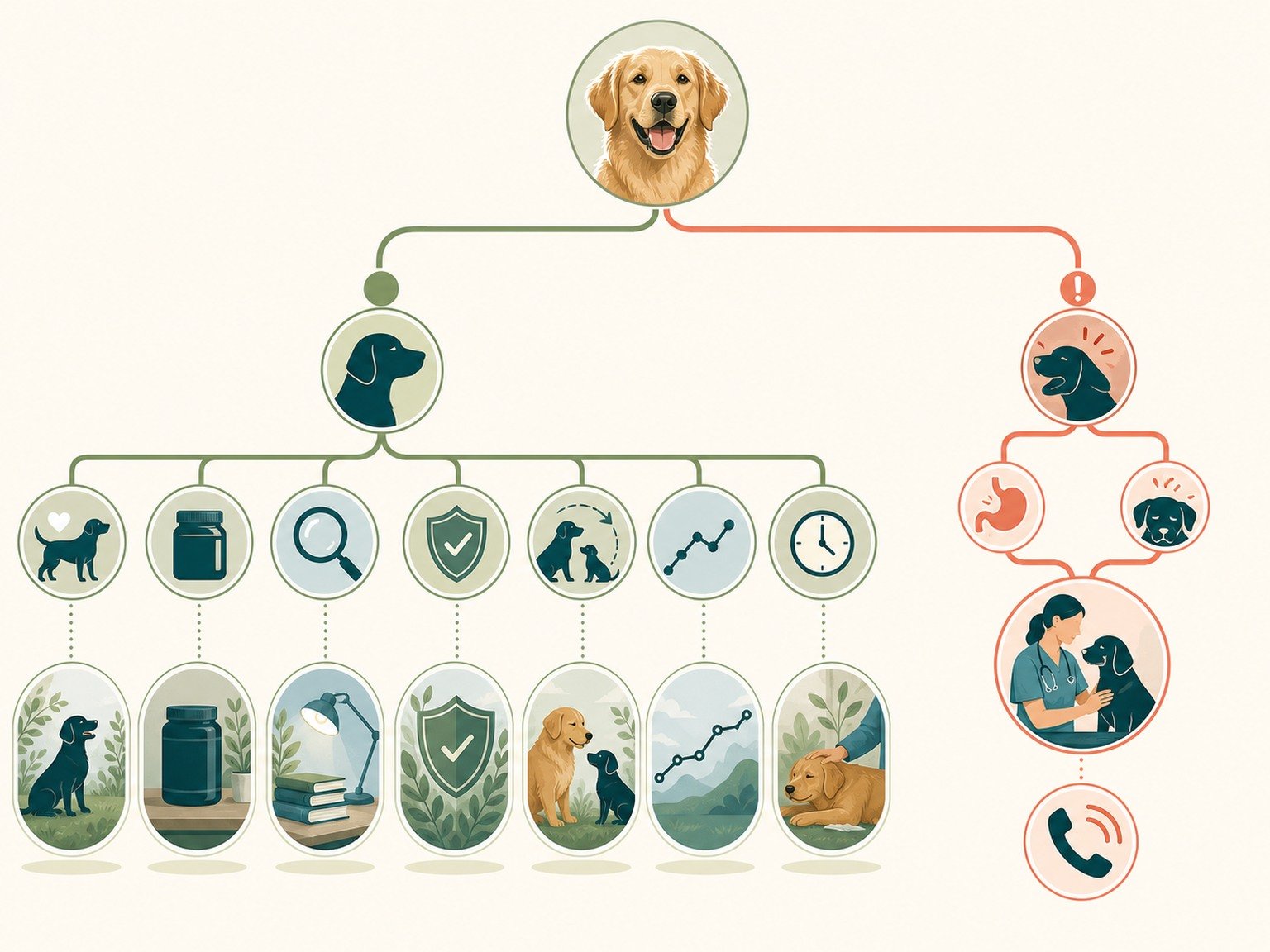
Routine questions can wait for a planned discussion when the dog is stable. Exposure, overdose, or acute severe signs require immediate professional guidance. Write both pathways into the household plan.
Keep the care record current
Keep the supplement record current rather than rebuilding it during a crisis. Photograph every new label, note the date and reason for each change, and remove discontinued items only after preserving the historical entry. Share the same list with the primary veterinarian, emergency clinic, and any specialist so one team does not unknowingly evaluate an incomplete exposure picture. When another caregiver gives products, use one administration log to prevent accidental duplication.
Prepare for a focused veterinary conversation
Bring a concise timeline, short natural-movement or symptom videos when safe, the exact names and photographs of every food, treat, medication, and supplement label, and notes about appetite, water intake, stool, sleep, activity, comfort, and behavior. Include recent injuries, travel, boarding, diet changes, missed medication, and previous test results. A complete record helps the veterinary team separate a repeatable pattern from a single impression.
Decide in advance what you need from the visit: an urgency decision, a diagnosis plan, a nutrition review, a pain or mobility assessment, or a monitored trial. Ask what result would change the plan and what finding would rule an option out. This keeps research and product information in the right role. Evidence can shape questions and expectations, but it cannot determine what is safe for an individual dog without the history and examination.
Owner tool
Build a supplement decision record
On a phone, swipe across the table to see every column.
| Checkpoint | Record | Why it helps |
|---|---|---|
| Purpose | Goal and baseline | Defines the question |
| Product | Full label, lot, form, amount | Identifies exposure |
| Context | Diet, disease, drugs, other products | Finds conflicts |
| Review | Target, timing, changes, urgent plan | Supports decisions |
Better questions, calmer next steps
Questions to ask your veterinarian
- Is a supplement indicated for this dog?
- What evidence applies to this exact formulation?
- What label and quality details matter?
- Could diet, drugs, or other products interact or duplicate it?
- What sign requires urgent help?
FAQ
Does every dog need supplements?
No. Need is individual.
Does a seal prove effectiveness?
No. It answers only defined quality questions.
Can I use a human product?
Only when the veterinarian approves the exact formulation.
How long should I try one?
No universal trial period applies.
Can I stop when I see a change?
Contact the veterinary team rather than running an owner-led test.
Sources
- American Animal Hospital Association: 2021 Nutrition and Weight Management Guidelines. Individualized nutritional assessment.
- U.S. Food and Drug Administration: FDA's Regulation of Pet Food. Animal regulatory framework.
- Merck Veterinary Manual: Toxicoses From Human Multivitamins and Supplements. Exact-product hazards.
- Nutrition Today: Veterinary Pet Supplements and Nutraceuticals. Evidence, formulation, quality, and safety variability.
