


This FAQ is a navigation layer, not a diagnostic or screening schedule. It helps owners name a change, compare it with baseline, identify urgent context, and prepare a narrower veterinary question. It cannot define one age when every dog becomes senior, select tests, interpret results, prescribe diet or exercise, or determine a safe waiting period. Keep dates, sources, and the dog's affected daily function attached to every observation so later changes can be compared accurately without turning a trend into a home diagnosis. AAHA senior guidance supports this longitudinal whole-patient context. [1]
Short answer
A short senior answer still needs the whole dog
AAHA emphasizes individual variation, multimorbidity, history, examination, and patient-specific diagnostics. Quality-of-life research supports multidimensional observation without a universal decision threshold. These sources support careful navigation rather than age-based conclusions. [1] [2] [3] [4]
- Compare the dog with an individual whole-dog baseline.
- Observe ordinary function without provoking pain, fear, fatigue, or a stronger example.
- Treat age, terms, checklists, and population evidence as context rather than diagnosis.
- Escalate sudden, severe, progressive, dangerous, or function-limiting changes promptly.
Safety first
Do not dismiss urgent change as normal aging
Seek urgent care for collapse, breathing difficulty, seizure, severe pain, major trauma, inability to stand, sudden loss of coordination, repeated unproductive retching, a painful distended abdomen, major bleeding, suspected toxin exposure, or new inability to urinate. Contact the veterinarian promptly for rapid or progressive change.
- Do not delay urgent care while completing a log, FAQ, glossary, or routine appointment plan.
- Do not force activity, handling, food, water, or a home test to confirm a concern.
- Do not start, stop, combine, divide, or calculate medication or supplements from this article.
Veterinary note
This article is educational and does not diagnose, treat, prescribe, or replace care from a licensed veterinarian. Your dog’s history, examination, diet, medications, and current signs determine what is appropriate.
Age, screening, and routine visits
When is a dog senior? There is no single birthday for every dog. Size, breed, health, and individual trajectory matter; the clinic can define a useful life-stage plan.
How often are visits and tests needed? Patient risk, history, examination, prior results, medication, and current concerns guide timing. A general guideline is not a prescription for one dog.
Does normal bloodwork mean the dog is healthy? It answers selected questions at one time and must be interpreted with history, examination, urinalysis or other tests when indicated, and trends.
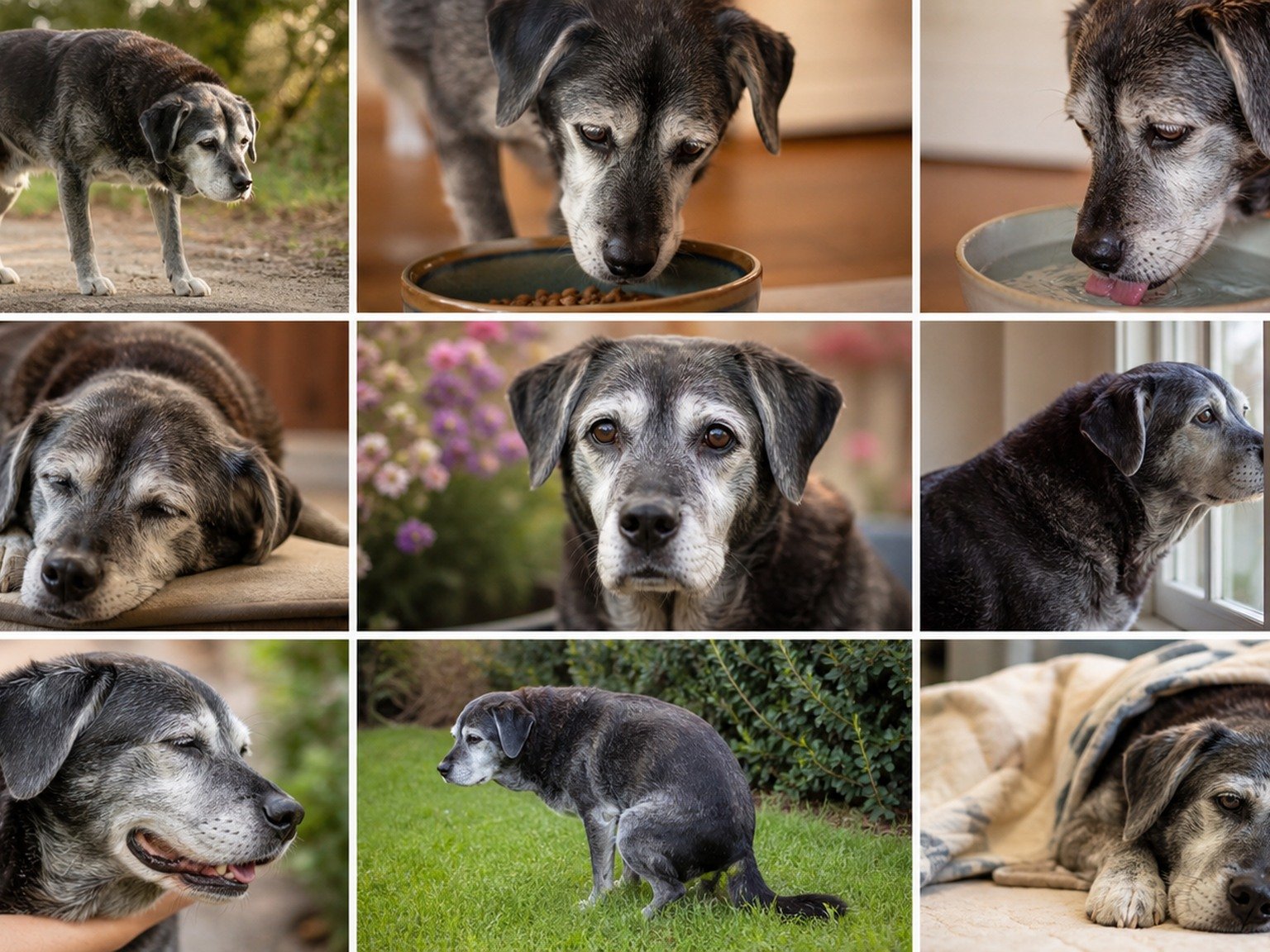
Appetite, water, weight, and elimination
Is less appetite normal? Do not assume so. Dental pain, nausea, organ disease, medication, pain, stress, sensory change, and other factors may contribute.
Is more drinking just age? No. Measure only if the clinic requests and do not restrict water. Increased thirst or urination deserves veterinary context.
Is stable weight enough? No. Muscle loss, body-condition change, fluid shifts, appetite change, and function can matter even when the scale is stable.
Mobility, sleep, senses, and behavior
Is slowing normal? Pain, orthopedic, neurologic, cardiopulmonary, systemic, sensory, cognitive, medication, and environmental factors can overlap.
Are nighttime changes always cognitive decline? No. Pain, urinary need, hearing or vision change, sleep disruption, medication, and disease may contribute.
Should hearing or vision change be tested at home? Observe ordinary function safely; do not startle, obstruct, or provoke the dog. Professional assessment determines meaning.
Food, activity, supplements, and home changes
Does every senior need senior food? No. Complete diet, health, body and muscle condition, appetite, disease, medication, and goals matter.
Should activity always decrease? No universal rule fits every dog. Diagnosis, comfort, conditioning, environment, and professional guidance shape activity.
Do rugs, ramps, beds, or supplements prevent decline? No. Optional tools require fit, safety, evidence, and monitoring and cannot replace indicated care.
Urgency, monitoring, and next steps
Sudden collapse, breathing difficulty, seizure, severe pain, inability to stand, major bleeding, repeated unproductive retching, a painful distended abdomen, toxin concern, or inability to urinate requires urgent care.
Persistent appetite, water, elimination, mobility, sleep, behavior, breathing, weight, or sensory change deserves timely contact even without a crisis.
Ask the clinic what to monitor, what must remain stable, which change triggers earlier contact, and when to recheck. No FAQ can define one safe number of hours or days.
Turn the answer into an accurate history
Write the exact observation, affected daily task, onset, pattern, progression, recovery, and concurrent health or routine change. Avoid replacing the observation with old age.
Bring medication, supplement, diet, and recent-record details. Label short natural video with date and context and never provoke a stronger example.
Choose the narrower senior, mobility, digestive, behavior, or condition guide that matches the question, then use the veterinary team for interpretation.
Dental care, anesthesia, and procedures
Is bad breath normal in seniors? No. Oral pain and disease deserve assessment; age alone does not determine whether a dental procedure or another intervention is appropriate.
Is anesthesia automatically too risky? No universal answer fits every patient. The veterinary team considers the procedure, expected benefit, health status, examination, diagnostics, monitoring, and alternatives.
Ask what risk is being assessed, how it will be reduced, what uncertainty remains, and how recovery will be monitored. A FAQ cannot calculate individual anesthetic risk.
Caregiver burden and changing priorities
Is it wrong to discuss cost, time, lifting limits, medication difficulty, or household stress? No. Feasibility affects safety, adherence, and welfare and should be part of shared planning.
Can priorities change? Yes. New diagnoses, response, adverse effects, caregiver capacity, and the dog's valued activities can shift goals over time.
Ask for staged options, written instructions, and the signs that make the next step more urgent. Do not quietly skip, combine, or alter care because a plan is difficult.
Keep the evidence boundary visible
AAHA frames senior care around the whole patient, individual variation, multimorbidity, and repeated reassessment. That guidance supports the questions in this article but does not prescribe one test, interval, diet, activity plan, or outcome for every older dog. [1]
Prepare for a focused veterinary conversation
Bring a concise timeline, short natural-movement or symptom videos when safe, the exact names and photographs of every food, treat, medication, and supplement label, and notes about appetite, water intake, stool, sleep, activity, comfort, and behavior. Include recent injuries, travel, boarding, diet changes, missed medication, and previous test results. A complete record helps the veterinary team separate a repeatable pattern from a single impression.
Decide in advance what you need from the visit: an urgency decision, a diagnosis plan, a nutrition review, a pain or mobility assessment, or a monitored trial. Ask what result would change the plan and what finding would rule an option out. This keeps research and product information in the right role. Evidence can shape questions and expectations, but it cannot determine what is safe for an individual dog without the history and examination.
Owner tool
Use the FAQ to prepare the next question
On a phone, swipe across the table to see every column.
| Checkpoint | What to record | Why it helps |
|---|---|---|
| Observation | Exact change from baseline | Defines issue |
| Context | Health, routine, products, recovery | Widens causes |
| Urgency | Sudden, severe, progressive signs | Guides contact |
| Next step | Assessment, monitoring, recheck | Routes care |
Better questions, calmer next steps
Questions to ask your veterinarian
- What makes this change urgent?
- Which conditions fit the pattern?
- What is each test intended to answer?
- What should stay stable while waiting?
- When and how should I follow up?
FAQ
Is age a diagnosis?
No.
Can video diagnose cognitive decline?
No.
Should water be limited for accidents?
No.
Does every senior need a new diet?
No.
Can a FAQ replace an exam?
No.
Sources
- American Animal Hospital Association: 2023 Senior Care Guidelines. Whole-patient senior assessment and multimorbidity.
- American Animal Hospital Association: Evaluating the Healthy Senior Pet. History, examination, baseline, and monitoring.
- American Animal Hospital Association: Diagnostic Tests and Recommended Frequencies. Patient-specific diagnostics and monitoring.
- Frontiers in Veterinary Science: Health-Related Quality of Life in Senior Dogs. Multidimensional owner reporting and measurement limits.
