
Natural and synthetic are context-dependent source or manufacturing terms, not clinical verdicts. FDA animal-product classification depends on composition, intended use, and claims rather than a simple source label. Ingredient safety also depends on identity, species, amount, and conditions of use. A botanical mixture can vary in constituents, concentration, processing, contaminants, and interactions. A laboratory-made ingredient can differ in chemical form, purity, stability, bioavailability, and formulation. Neither category is automatically safer, more effective, purer, or more appropriate. The useful questions concern the exact ingredient, formulation, evidence for the intended use, quality controls, contaminants, interactions, concurrent products, and the individual dog's health. A neutral comparison also asks which uncertainties remain and how response or adverse effects will be monitored after any veterinarian-approved choice.
Short answer
Natural and synthetic are not safety rankings
FDA animal-product and ingredient frameworks focus on composition, identity, intended use, species, conditions of use, and claims, not a natural-versus-synthetic marketing label. Veterinary supplement evidence, formulation, quality, bioavailability, and safety vary within both categories. [1] [2] [3]
- Record the exact pattern, product, context, timing, and recent changes.
- Use the record to support professional assessment, not to create a diagnosis or protocol at home.
- Bring the complete label, health history, diet, medications, supplements, and prior responses.
- Agree on a review point and clear instructions for urgent changes.
Safety first
A natural label should never delay help after a suspected reaction or exposure
Contact a veterinarian or animal poison control center promptly for suspected overdose, accidental access, vomiting, weakness, tremors, seizures, breathing difficulty, bleeding, collapse, or rapid deterioration. Keep the exact package. Do not assume a botanical product is harmless or attempt home detoxification.
- Do not delay care for sudden, severe, escalating, or function-limiting signs.
- Do not start, stop, combine, divide, or calculate treatment from this article.
- Preserve exact packages, lot information, exposure details, and a concise timeline.
Veterinary note
This article is educational and does not diagnose, treat, prescribe, or replace care from a licensed veterinarian. Your dog’s history, examination, diet, medications, and current signs determine what is appropriate.
Define the terms before comparing
Natural may refer to a source, extraction process, mixture, flavor, color, or marketing claim. Synthetic may refer to laboratory manufacture or a particular chemical pathway. Without a precise definition, the comparison is too vague to support a safety or efficacy conclusion.
FDA animal-product classification turns on composition, intended use, and claims. An ingredient used in animal food is considered by identity, species, and conditions of use rather than by a broad origin label. [1] [2]
Ask for the exact chemical or botanical identity, part used, extract or form, concentration, other ingredients, intended purpose, and conditions of use. A front-label claim cannot replace this detail.
Marketing may pair natural with images of farms, leaves, or purity and pair synthetic with laboratories or danger. Those visual cues are persuasion, not evidence. Reverse framing can be equally misleading when laboratory manufacture is presented as automatic precision or superiority.
Evaluate botanical complexity without blanket fear
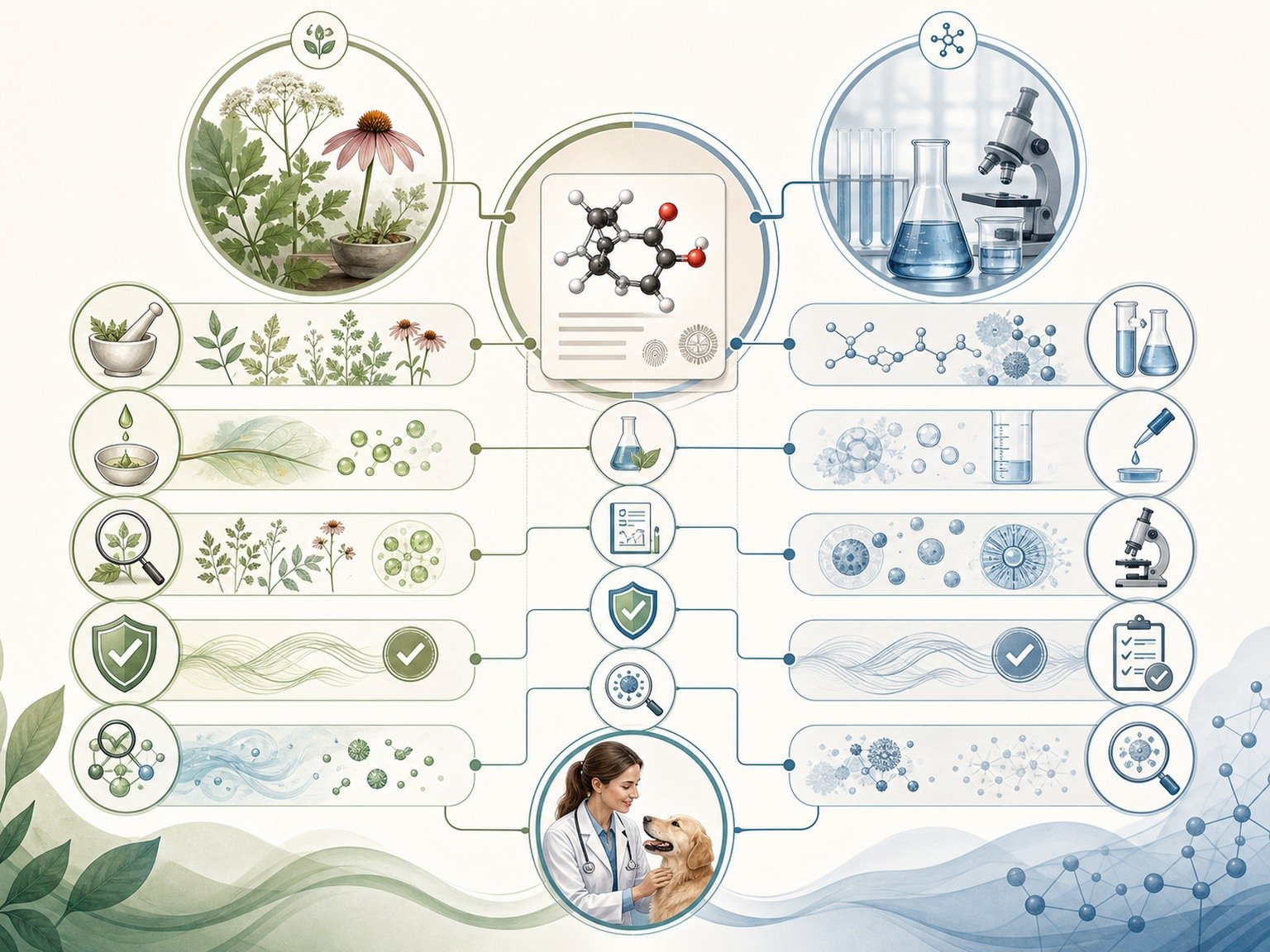
Botanical preparations can contain many constituents, and growing conditions, harvest, plant part, extraction, processing, storage, and formulation can affect composition. Natural variation may matter clinically, but it does not mean every botanical is dangerous.
Peer-reviewed veterinary literature describes possible concerns including toxic constituents, incorrect ingredients, processing or labeling problems, contamination, adulteration, and interactions. Domestic-animal evidence remains limited for many preparations. [4]
A standardized claim can be useful information but does not automatically prove identity, batch consistency, absence of contaminants, bioavailability, clinical benefit, or safety for a dog. Ask what is standardized and how it is verified.
Avoid treating synthetic as a synonym for toxic
A laboratory-made ingredient may be chemically identical, closely related, or materially different from a naturally sourced form. The exact identity and formulation determine whether comparisons are valid. Similar names alone do not prove interchangeability.
Synthetic origin does not establish toxicity, and natural origin does not establish gentleness. Concentration, dose, route, contaminants, stability, metabolism, interactions, and patient health all affect risk.
When two products claim the same ingredient, compare form, concentration, excipients, quality controls, evidence, and intended use. Do not substitute products because one label sounds cleaner or more scientific.
Build a product-and-claim review
Start with the clinical question: what problem or nutritional need is being addressed? Then ask whether evidence applies to dogs, to this formulation and route, and to the claimed outcome. Avoid extrapolating from cell studies, another species, or a different extract.
Ask about identity testing, contaminant and adulterant controls, batch consistency, stability, manufacturing oversight, adverse-event reporting, and interaction information. A certificate or seal should be understood rather than treated as automatic proof.
Finally, place the product in the dog's context: complete diet, diseases, medications, supplements, allergies, age, body and muscle condition, and monitoring plan. Natural-versus-synthetic language is secondary to patient suitability and a defined review point. [3]
Record the exact product version because manufacturers can change sources, concentrations, excipients, or labels. Recheck the formulation rather than assuming a familiar brand name still represents the same exposure.
Prepare for a focused veterinary conversation
Bring a concise timeline, short natural-movement or symptom videos when safe, the exact names and photographs of every food, treat, medication, and supplement label, and notes about appetite, water intake, stool, sleep, activity, comfort, and behavior. Include recent injuries, travel, boarding, diet changes, missed medication, and previous test results. A complete record helps the veterinary team separate a repeatable pattern from a single impression.
Decide in advance what you need from the visit: an urgency decision, a diagnosis plan, a nutrition review, a pain or mobility assessment, or a monitored trial. Ask what result would change the plan and what finding would rule an option out. This keeps research and product information in the right role. Evidence can shape questions and expectations, but it cannot determine what is safe for an individual dog without the history and examination.
Owner tool
Evaluate beyond the source label
On a phone, swipe across the table to see every column.
| Checkpoint | Record | Why it helps |
|---|---|---|
| Identity | Exact form, source, concentration | Defines what is compared |
| Evidence | Species, formulation, use, outcome | Limits claim drift |
| Quality | Testing, contaminants, consistency | Assesses reliability |
| Patient | Diet, disease, drugs, monitoring | Determines suitability |
Better questions, calmer next steps
Questions to ask your veterinarian
- What exactly does natural or synthetic mean here?
- Are the forms chemically and clinically comparable?
- What evidence applies to this exact formulation?
- How are identity and contaminants controlled?
- Why is this appropriate for this dog?
FAQ
Does natural mean safe?
No. Origin alone does not establish safety.
Does synthetic mean toxic?
No. Exact identity and exposure matter.
Are same-named ingredients interchangeable?
Not necessarily; form and formulation may differ.
Does standardized mean proven?
No. Ask what is standardized and verified.
Which category is better?
Neither category supports a blanket ranking.
Sources
- U.S. Food and Drug Administration: FDA's Regulation of Pet Food. Classification by composition, use, and claims.
- U.S. Food and Drug Administration: Animal Food Ingredients. Identity, species, and conditions of use.
- Nutrition Today: Veterinary Pet Supplements and Nutraceuticals. Evidence, formulation, quality, and safety variability.
- Forensic Science, Medicine and Pathology: Potential Side Effects of Herbal Preparations in Domestic Animals. Botanical hazards and evidence limits.
