


A supplement trial should begin with a defined reason, observable baseline, planned review date, and instructions for new signs. Lack of visible improvement does not by itself prove product failure, while a new symptom after starting a product does not by itself prove causation. Both are reasons to document the pattern carefully and involve the veterinary team before changing the active plan or adding another variable. Consistent records make that reassessment more useful and less dependent on memory.
Short answer
Monitor a defined goal and the whole dog
FDA animal adverse-event reporting includes side effects, product defects, medication errors, and lack of effectiveness, while warning that reports alone do not prove causation. Useful assessment combines exact product and exposure information with the dog's health before the event, veterinary findings, tests, diet, medications, supplements, timing, and response. [1] [2]
- Start with the dog's clinical question and complete exposure list.
- Verify the exact product, ingredient amounts, lot, and evidence scope.
- Agree on monitoring, reassessment, and urgent-response instructions before use.
Safety first
Rapid or severe change needs urgent care, not a longer trial
Seek immediate veterinary or poison guidance for collapse, seizures, breathing difficulty, tremors, severe weakness, marked agitation, repeated vomiting with lethargy, inability to stand, abnormal heart rate, yellow or very pale tissues, inability to urinate, or rapid deterioration. Bring the package and complete exposure list.
- Do not use a supplement to delay examination of new, severe, or worsening signs.
- Do not combine, substitute, increase, stop, or restart products without veterinary direction.
- Keep the exact package, lot information, and all labels available for assessment.
Veterinary note
This article is educational and does not diagnose, treat, prescribe, or replace care from a licensed veterinarian. Your dog’s history, examination, diet, medications, and current signs determine what is appropriate.
Define success before the first dose
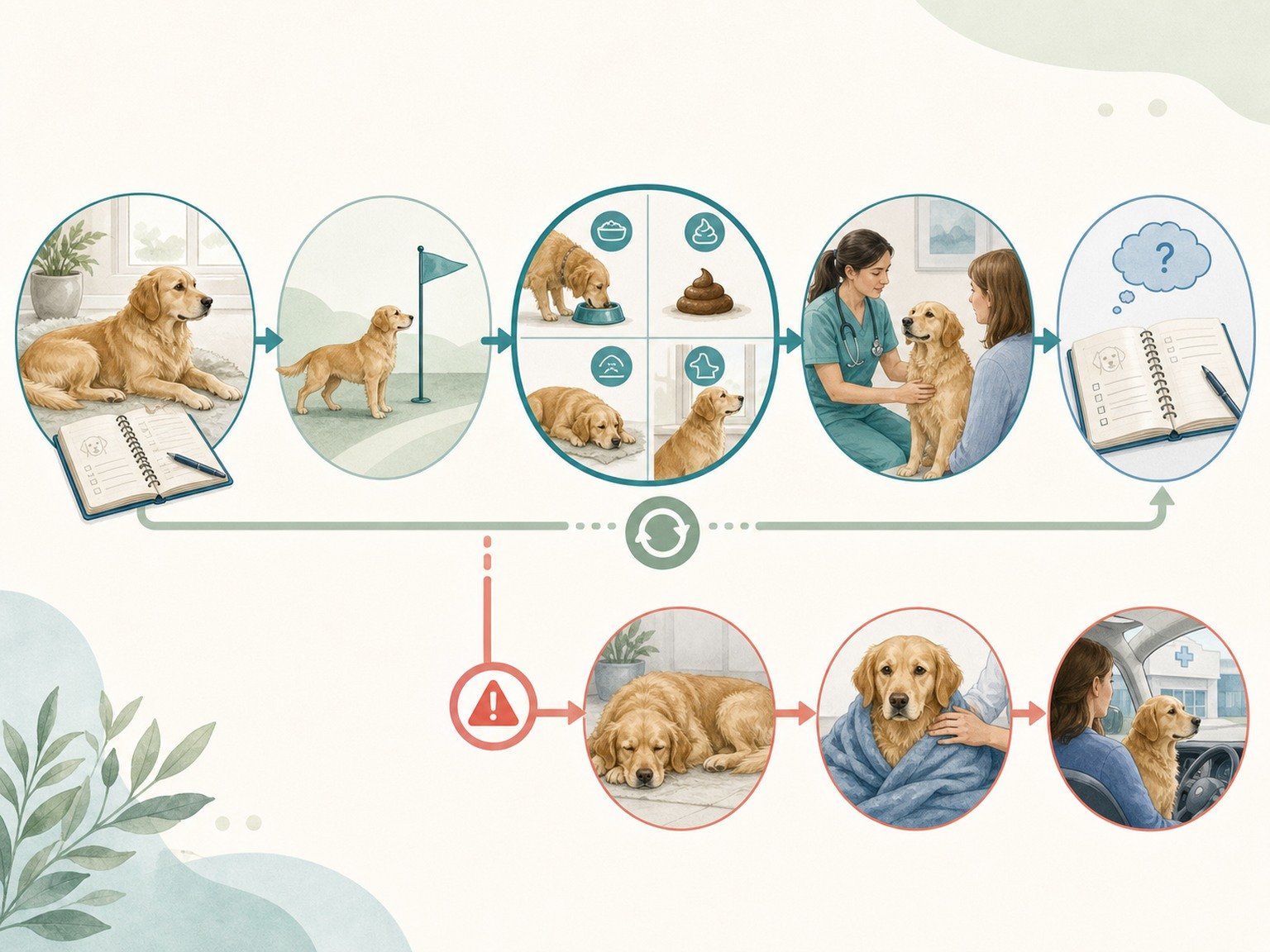
Translate the reason for use into an observable target: stool frequency and consistency, ability to rise, recovery after activity, frequency of a defined fear response, appetite, or another veterinarian-approved measure. Record a baseline before changing several variables.
Agree on the expected review window without assuming one universal trial period. Evidence, condition, formulation, and clinical urgency affect timing. Decide what degree of change would be meaningful and what would trigger earlier reassessment.
A goal should remain connected to diagnosis and standard care. Supplements should not replace evaluation, prescription treatment, nutrition correction, rehabilitation, behavior care, or other indicated support. [4]
Track benefit and broader function
Use the same simple measure at comparable times. Note the target sign, appetite, stool, vomiting, water intake, urination, sleep, activity, comfort, skin, behavior, and medication adherence. Record other changes such as diet, travel, illness, or new treatment.
Day-to-day variation can create false impressions. Look for patterns while respecting urgent signs. Photographs or short videos may help when they are safe, dated, and capture natural behavior rather than a provoked test.
No visible benefit can reflect an incorrect diagnosis, unrealistic target, insufficient evidence, product-quality issue, administration problem, interacting change, or a condition that has progressed. It does not automatically identify which explanation is correct.
Treat new signs as signals, not proof
Potential adverse signs vary with ingredient and exposure. Veterinary toxicology references describe gastrointestinal, neurologic, cardiovascular, metabolic, renal, hepatic, and behavioral effects in different human supplement exposures. Those categories are not a prediction for every dog product; they show why exact formulation matters. [3]
Record onset, timing relative to each exposure, duration, severity, recurrence, concurrent products, missed or repeated doses, and what happened after professional guidance. Do not deliberately re-challenge a dog to prove causation.
Call the veterinary team for new or worsening signs and follow its stop, continue, testing, or emergency instructions. Blanket advice to stop or continue every supplement would be unsafe because the product, condition, and concurrent care differ.
Reassess and report responsibly
At review, compare the baseline with the same outcome measure and discuss adherence, product identity, lot, storage, diet, concurrent treatments, and confounders. Ask whether the goal, diagnosis, or plan should change. A lack of benefit may be clinically important even when no acute adverse signs occur.
FDA accepts reports for side effects, product defects, medication errors, and lack of effectiveness. A useful report includes the dog's pre-event health, exact product names and amounts, dates, veterinary findings, test results, diet, and other exposures. Reporting supports signal detection but does not itself prove that a product caused an event. [1] [2]
Preserve the container, lot number, receipt or source, photographs, and remaining product unless professionals instruct otherwise. The practical endpoint is not a verdict from one observation; it is a documented, patient-specific decision about the next safe step.
Prepare for a focused veterinary conversation
Bring a concise timeline, short natural-movement or symptom videos when safe, the exact names and photographs of every food, treat, medication, and supplement label, and notes about appetite, water intake, stool, sleep, activity, comfort, and behavior. Include recent injuries, travel, boarding, diet changes, missed medication, and previous test results. A complete record helps the veterinary team separate a repeatable pattern from a single impression.
Decide in advance what you need from the visit: an urgency decision, a diagnosis plan, a nutrition review, a pain or mobility assessment, or a monitored trial. Ask what result would change the plan and what finding would rule an option out. This keeps research and product information in the right role. Evidence can shape questions and expectations, but it cannot determine what is safe for an individual dog without the history and examination.
Owner tool
Build a supplement monitoring record
On a phone, swipe across the table to see every column.
| Checkpoint | Record | Why it matters |
|---|---|---|
| Baseline | Target and whole-dog status | Defines comparison |
| Exposure | Product, lot, timing, amount | Tests timing |
| Change | Onset, severity, duration | Supports triage |
| Review | Veterinary findings and next step | Avoids assumptions |
Better questions, calmer next steps
Questions to ask your veterinarian
- What measurable outcome should this product target?
- When should benefit be reassessed?
- Which new signs mean call, stop, or seek emergency help?
- What else could explain the observed change?
- Should this event or lack of effectiveness be reported?
FAQ
How long should every supplement trial last?
There is no universal period; evidence, condition, product, and urgency determine review timing.
Does no improvement prove the product is defective?
No. Several clinical, product, and measurement explanations are possible.
Does a new sign prove the supplement caused it?
No. Timing is important, but causation requires broader assessment.
Should I re-test the product at home?
Do not re-challenge a dog to prove causation without veterinary direction.
Can lack of effectiveness be reported?
Yes. FDA accepts such reports along with side effects, errors, and product problems.
Sources
- U.S. Food and Drug Administration: How to Report Animal Drug and Device Side Effects and Product Problems. Product, exposure, clinical, and reporting information.
- U.S. Food and Drug Administration: Adverse Event Reports for Animal Drugs and Devices. Interpretation limits of spontaneous reports.
- Merck Veterinary Manual: Toxicoses From Human Multivitamins and Supplements. Ingredient-, formulation-, patient-, amount-, and timing-specific exposure risks.
- Veterinary Sciences: Veterinary Pet Supplements and Nutraceuticals. Regulation, evidence, quality-control, and safety limitations.
