


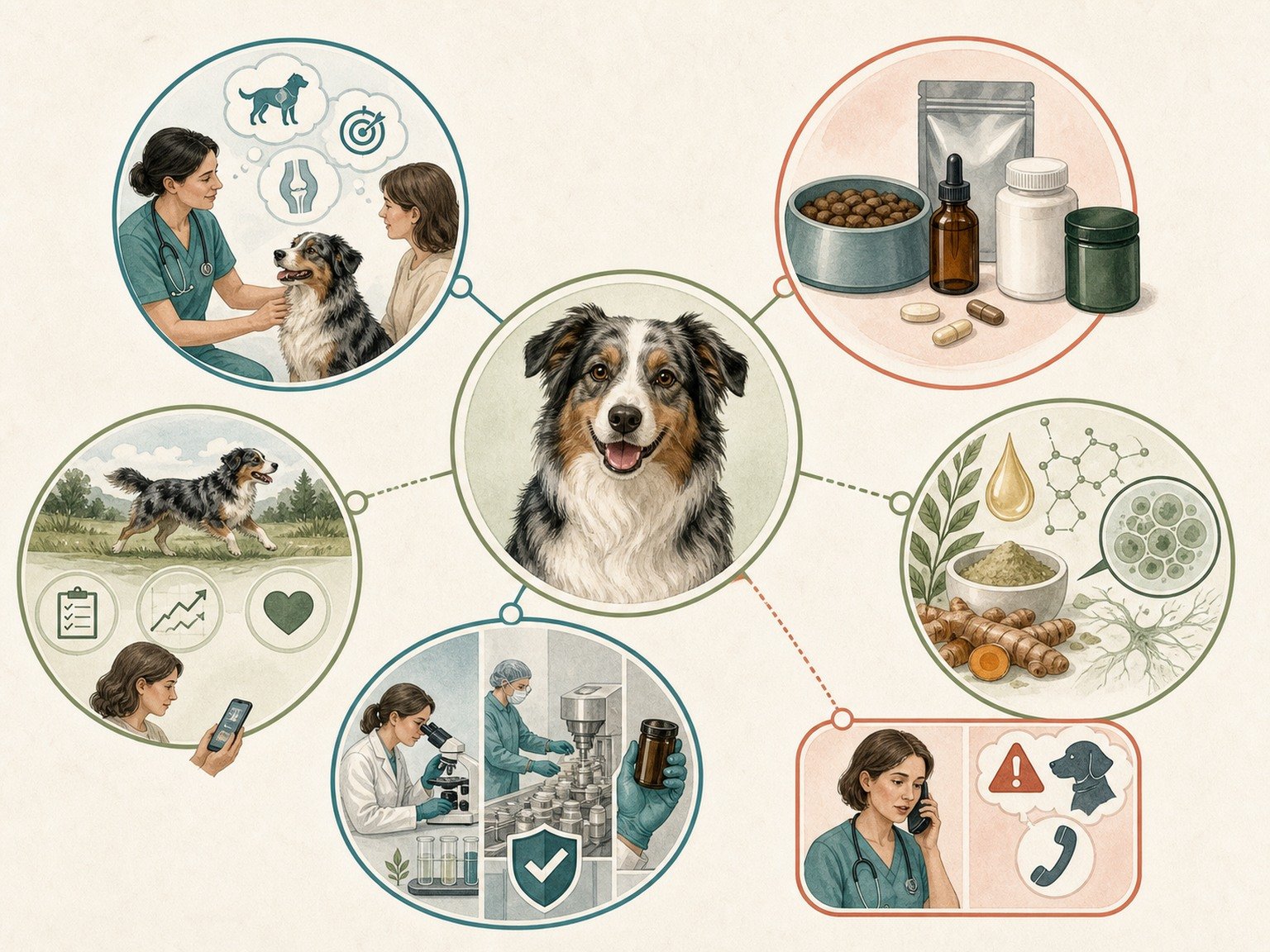
A veterinarian's role is larger than saying yes or no to a bottle. The useful process begins with the dog's health question, current diet, medications, laboratory findings, prior reactions, and treatment goals. It then examines ingredient and formulation evidence, product quality, alternatives, uncertainty, caregiver capacity, monitoring, and the point at which another specialist or poison professional should be involved.
Short answer
Bring the whole care plan, not only the supplement label
Bring the exact product labels, complete food and treat list, medications, diagnoses, laboratory history, allergies, goals, and observations. Together, the owner and veterinary team can decide whether a supplement is needed, what evidence and quality details matter, how it fits other care, and what would trigger reassessment. Veterinary involvement improves the decision process but cannot guarantee benefit or remove every risk. [1] [2] [3]
- Record the exact pattern, products, diet, treatments, and recent changes.
- Separate what the evidence supports from what remains uncertain for this dog.
- Agree on a veterinary reassessment plan and urgent-response instructions.
Safety first
Acute reactions, dosing errors, or unknown exposures need prompt professional help
Contact a veterinarian or animal poison service after a suspected overdose, wrong product, unknown amount, product defect, or unexpected reaction. Seek emergency care for collapse, seizures, breathing difficulty, severe weakness, tremors, repeated vomiting with lethargy, marked agitation, inability to stand, or rapid deterioration.
- Do not use general information to delay evaluation of severe, persistent, or worsening signs.
- Do not start, stop, combine, or calculate treatments from this article.
- Keep exact labels, exposure details, and a concise timeline available for the veterinary team.
Veterinary note
This article is educational and does not diagnose, treat, prescribe, or replace care from a licensed veterinarian. Your dog’s history, examination, diet, medications, and current signs determine what is appropriate.
Start with the health question
State the reason in observable terms rather than beginning with a product claim. A goal might involve a diagnosed condition, a laboratory abnormality, stool pattern, mobility function, or a defined behavior plan. Similar signs can have different causes, and a supplement may be irrelevant or may complicate evaluation when diagnosis is incomplete.
Review what established care, nutrition, rehabilitation, environmental change, behavior support, or medication already addresses the goal. Discuss alternatives and the consequence of doing nothing. A product should not displace indicated treatment merely because it feels natural or easier to obtain.
FDA explains that questions about an animal's health or the specific use of an animal drug, food, or other product belong with the veterinarian. Disease claims and intended use can also affect how a product is regulated. [3]
Reconcile every exposure
List food, treats, flavored preventives, prescriptions, over-the-counter products, chews, powders, oils, and intermittent aids. Photograph every label panel and record what is actually given. Front-label names can hide repeated nutrients, companion ingredients, sweeteners, or overlapping effects.
The veterinarian considers kidney and liver function, gastrointestinal disease, endocrine conditions, allergies, pregnancy status, age, body condition, previous reactions, anesthesia plans, and concurrent treatments. Not every theoretical interaction is clinically established, but uncertainty should be visible rather than treated as proof of safety.
FDA adverse-event guidance asks for health history, diet, veterinary findings, test results, and the complete names and doses of drugs, vitamins, and supplements. The same details strengthen a decision before a concern occurs. [4]
Evaluate evidence and product quality
Ask whether research addresses dogs, the same condition, the exact ingredient and chemical form, comparable formulation, meaningful outcome, appropriate comparator, and relevant duration. Plausibility, testimonials, and evidence from another species or mixture cannot automatically answer the clinical question.
Quality review includes the accountable company, lot traceability, complete label, supplier and manufacturing controls, testing scope, complaint handling, and recall process. A seal, certificate, or laboratory statement has limits: identity testing is not contamination testing, and either is different from clinical efficacy.
Veterinary reviews emphasize wide variation in evidence, quality, safety, regulation, and bioavailability. Critical assessment is patient- and product-specific; it does not create a permanent approval for every lot or future health state. [1] [2]
Share the decision and monitor it
Discuss the expected benefit, uncertainty, cost, burden, alternatives, caregiver ability, and what outcome would be meaningful. The final plan should name product and formulation, purpose, amount and frequency supplied by the veterinarian, storage, missed-dose instructions, baseline, review date, adverse signs, and stop-or-call rules. This article supplies none of those doses.
Use consistent measures and record other changes that could confound interpretation. A lack of benefit does not automatically prove a defective product; a new sign after exposure does not automatically prove causation. Both deserve assessment before another variable is added.
Primary-care veterinarians may consult a board-certified veterinary nutritionist, internal-medicine specialist, neurologist, behaviorist, clinical pharmacologist, toxicologist, or poison service. Referral is not a failure. It matches the question to the expertise and records needed to answer it responsibly.
Prepare for a focused veterinary conversation
Bring a concise timeline, short natural-movement or symptom videos when safe, the exact names and photographs of every food, treat, medication, and supplement label, and notes about appetite, water intake, stool, sleep, activity, comfort, and behavior. Include recent injuries, travel, boarding, diet changes, missed medication, and previous test results. A complete record helps the veterinary team separate a repeatable pattern from a single impression.
Decide in advance what you need from the visit: an urgency decision, a diagnosis plan, a nutrition review, a pain or mobility assessment, or a monitored trial. Ask what result would change the plan and what finding would rule an option out. This keeps research and product information in the right role. Evidence can shape questions and expectations, but it cannot determine what is safe for an individual dog without the history and examination.
Owner tool
Prepare a supplement decision record
On a phone, swipe across the table to see every column.
| Checkpoint | Record | Why it helps |
|---|---|---|
| Goal | Diagnosis and observable target | Clarifies need |
| Inputs | Diet, drugs, supplements, labs | Finds conflicts |
| Evidence | Ingredient, formulation, outcome | Defines scope |
| Plan | Baseline, review, urgent signs | Supports follow-up |
Better questions, calmer next steps
Questions to ask your veterinarian
- Does this dog need a supplement for this goal?
- How does it fit the full diet and treatment plan?
- Does evidence match this formulation and use?
- Which quality details should we verify?
- When should we reassess or seek specialist help?
FAQ
Does veterinary approval guarantee safety?
No. It improves context and monitoring but cannot remove every uncertainty or adverse effect.
What should I bring?
Bring every label, the complete diet and treatment list, history, laboratory results, goals, and observations.
Can the veterinarian identify the best brand?
The veterinarian can assess need, evidence, quality signals, and patient fit without relying on a universal ranking.
When is a specialist useful?
Complex nutrition, toxicity, behavior, neurologic, internal-medicine, or interaction questions may benefit from specialist input.
Is one approval permanent?
No. Health, diet, medications, products, and evidence change, so reassessment matters.
Sources
- American Veterinary Medical Association: Assessing Pet Supplements. Veterinary critical assessment of ingredients, evidence, quality, safety, and context.
- Veterinary Sciences: Veterinary Pet Supplements and Nutraceuticals. Regulation, quality, safety, efficacy, and bioavailability limits.
- U.S. Food and Drug Administration: Animal Food Labeling and Pet Food Claims. Veterinary referral and intended-use regulatory context.
- U.S. Food and Drug Administration: How to Report Animal Drug and Device Side Effects and Product Problems. Clinical and exposure information used in evaluation and reporting.
