


A behavior log is a longitudinal communication tool, not a home diagnostic test. Panting, pacing, hiding, vocalizing, withdrawal, aggression, sleep change, or elimination change can have behavioral and medical explanations. Record what happened before, what the dog visibly did, what happened afterward, duration, recovery, function, and relevant health or routine changes. Compare with the dog's own baseline. Video can add context only when behavior occurs naturally; never recreate a trigger, corner the dog, or continue filming when safety is compromised. The veterinary and behavior teams interpret the record alongside examination, medical rule-outs, and professional assessment.
Short answer
Record observable patterns without scoring a diagnosis
Merck and AAHA guidance emphasize medical contributors and a comprehensive history including onset, frequency, intensity, duration, daily schedule, environment, prior interventions, and response. Antecedent-behavior-consequence context can organize observations, while population studies describe broad patterns only. None validates an owner diagnostic score or universal safe-wait threshold. [1] [2] [3]
- Start with the individual dog's baseline, complete history, and current veterinary plan.
- Use repeated observations to improve a veterinary discussion, not to diagnose or treat at home.
- Keep associations, population findings, and research endpoints within their actual limits.
- Escalate sudden, severe, persistent, progressive, dangerous, or function-limiting changes promptly.
Safety first
Stop tracking and seek help when safety or health changes
Contact the veterinary team promptly for sudden behavior change, serious aggression, self-injury, repeated escape attempts, collapse, severe pain, disorientation, seizure, inability to eat or rest, or progressive deterioration. When a person or animal is in immediate danger, prioritize separation and urgent professional help over documentation.
- Do not delay urgent care while completing a log, testing a setup, or seeking a lower-cost option.
- Do not provoke, corner, restrain, punish, flood, or force exposure to test a behavior or capture a video.
- Do not start, stop, combine, divide, or calculate medication or supplements from this article.
Veterinary note
This article is educational and does not diagnose, treat, prescribe, or replace care from a licensed veterinarian. Your dog’s history, examination, diet, medications, and current signs determine what is appropriate.
Establish the dog's ordinary baseline
Describe sleep, appetite, elimination, activity, social contact, time alone, response to routine sounds, medication, supplements, health, and environment during ordinary days. Baseline is individual and may vary with age, illness, household, and schedule. Include several uneventful days so the record is not built only from episodes that worried the household.
Write neutral observations: lay behind the chair for twenty minutes, paced between door and window, or declined food after the visitor arrived. Avoid inferred motives such as spiteful, protective, guilty, dominant, or traumatized.
AAHA and Merck behavior guidance place history alongside medical assessment because pain, illness, sensory change, medication, and environment can contribute. [1] [2] A log cannot separate these causes by itself. Record recent examination findings or diagnoses when known, but do not reinterpret them through the behavior chart.
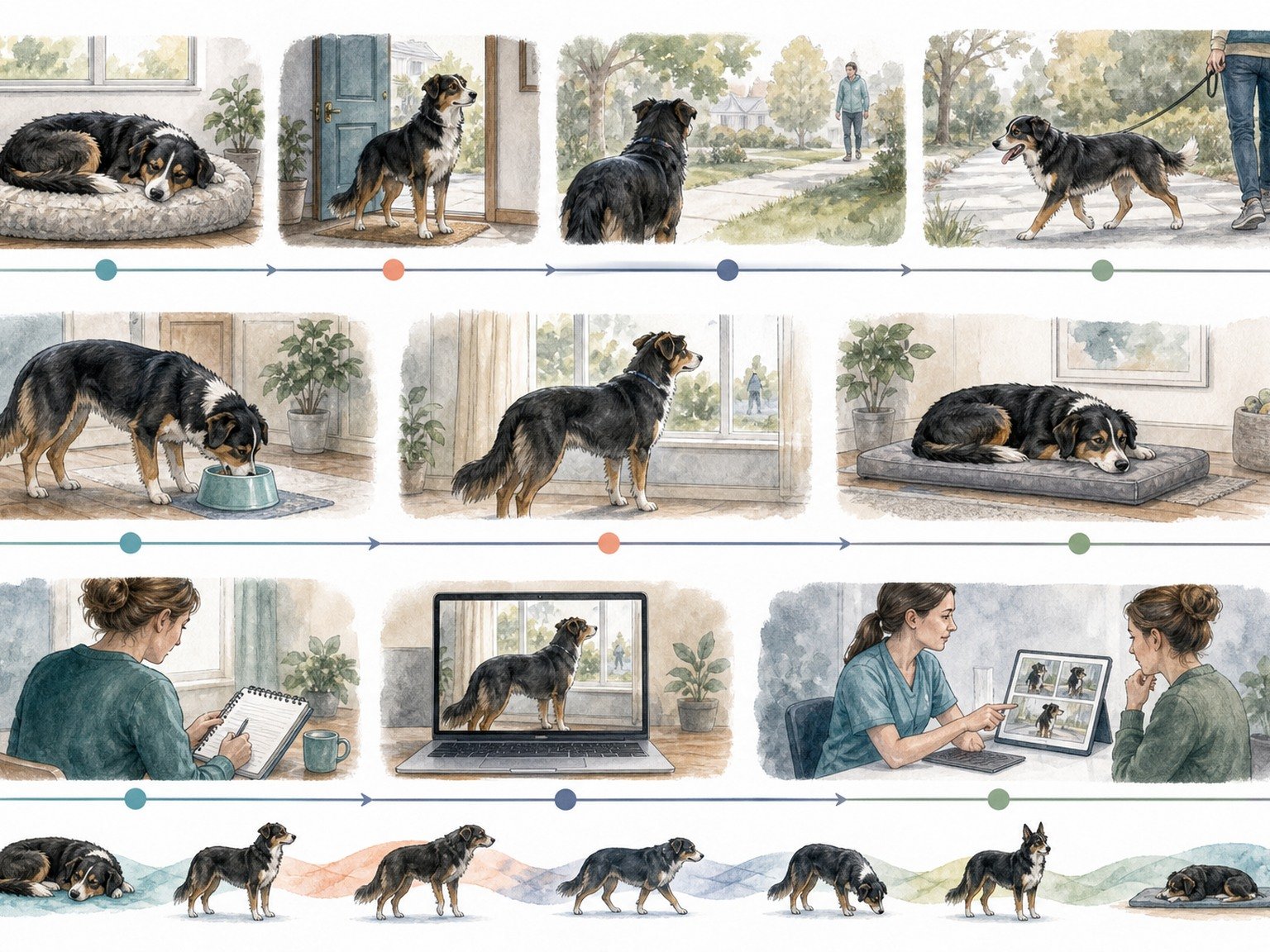
Record before, during, and after
Before: location, people, animals, sounds, activity, routine change, health, sleep, food, and distance. During: posture, movement, orientation, vocalizing, retreat, approach, food response, elimination, aggression, or escape behavior. After: what changed, duration, and recovery toward baseline. Include uneventful recovery periods and household actions so the record does not overrepresent only the most visible moments.
Frequency and intensity trends can support follow-up, but no number here defines anxiety, severity, prognosis, or a safe period to wait. Use the same descriptive categories consistently without inventing a red-yellow-green diagnosis.
Population surveys can show that anxiety-related traits occur together in groups of dogs. [3] They cannot predict an individual dog or convert a checklist into a clinical diagnosis. Their value is population context, not an owner scoring system.
Use video only when it is naturally safe
A brief clip can show context, distance, movement, and recovery that may not occur in the clinic. Record only when the event is already happening and filming does not distract from safety. Stop if risk rises.
Do not knock, leave, approach, handle, expose, restrain, corner, or bring another person or animal closer to capture a stronger response. AVSAB rejects aversive methods and flooding and supports humane management and qualified care. [4]
Protect privacy and provide representative clips rather than hours of footage. Label date, context, and whether the clip shows a typical, mild, or unusual event in your observation, without assigning a diagnosis.
Turn the log into professional questions
Summarize the first change, most affected function, pattern, recovery, concurrent health factors, prior interventions, and response. Bring medication and supplement lists and note any adverse effects or adherence problems.
Ask what medical contributors should be assessed, whether the pattern warrants qualified behavior referral, what management protects safety now, and which outcome should be monitored. Treatment selection remains a professional decision.
Continue tracking within an agreed plan and know the contact triggers. The log succeeds when it improves history, reassessment, and safety, not when it produces a label or persuades the dog to tolerate a recreated trigger.
Prepare for a focused veterinary conversation
Bring a concise timeline, short natural-movement or symptom videos when safe, the exact names and photographs of every food, treat, medication, and supplement label, and notes about appetite, water intake, stool, sleep, activity, comfort, and behavior. Include recent injuries, travel, boarding, diet changes, missed medication, and previous test results. A complete record helps the veterinary team separate a repeatable pattern from a single impression.
Decide in advance what you need from the visit: an urgency decision, a diagnosis plan, a nutrition review, a pain or mobility assessment, or a monitored trial. Ask what result would change the plan and what finding would rule an option out. This keeps research and product information in the right role. Evidence can shape questions and expectations, but it cannot determine what is safe for an individual dog without the history and examination.
Owner tool
Create a behavior pattern log
On a phone, swipe across the table to see every column.
| Checkpoint | What to record | Why it helps |
|---|---|---|
| Baseline | Routine, health, sleep, appetite, social context | Defines normal |
| Before | Place, people, sound, activity, distance | Maps context |
| During and after | Observable behavior, duration, recovery | Shows pattern |
| Review | Change, videos, safety, questions | Supports care |
Better questions, calmer next steps
Questions to ask your veterinarian
- Could pain or illness contribute?
- Which observations are most decision-useful?
- Is this video safe and representative?
- What management protects safety now?
- Which change requires earlier contact?
FAQ
Can a log diagnose anxiety?
No.
Should I use a severity score?
Not as a home diagnosis or wait threshold.
Should I recreate a trigger?
No.
Can panting mean anxiety?
It has multiple possible explanations.
How much video is useful?
Short, safe, representative context is usually more useful than volume.
Sources
- Merck Veterinary Manual: Diagnosis of Behavior Problems in Animals. Medical contributors and comprehensive history.
- American Animal Hospital Association: Canine and Feline Behavior Management Guidelines. Assessment, history, management, and referral.
- Scientific Reports: Prevalence and Comorbidity in Canine Anxiety. Population patterns and individual limits.
- American Veterinary Society of Animal Behavior: Humane Dog Training Position Statement. Humane methods and opposition to aversives and flooding.
