


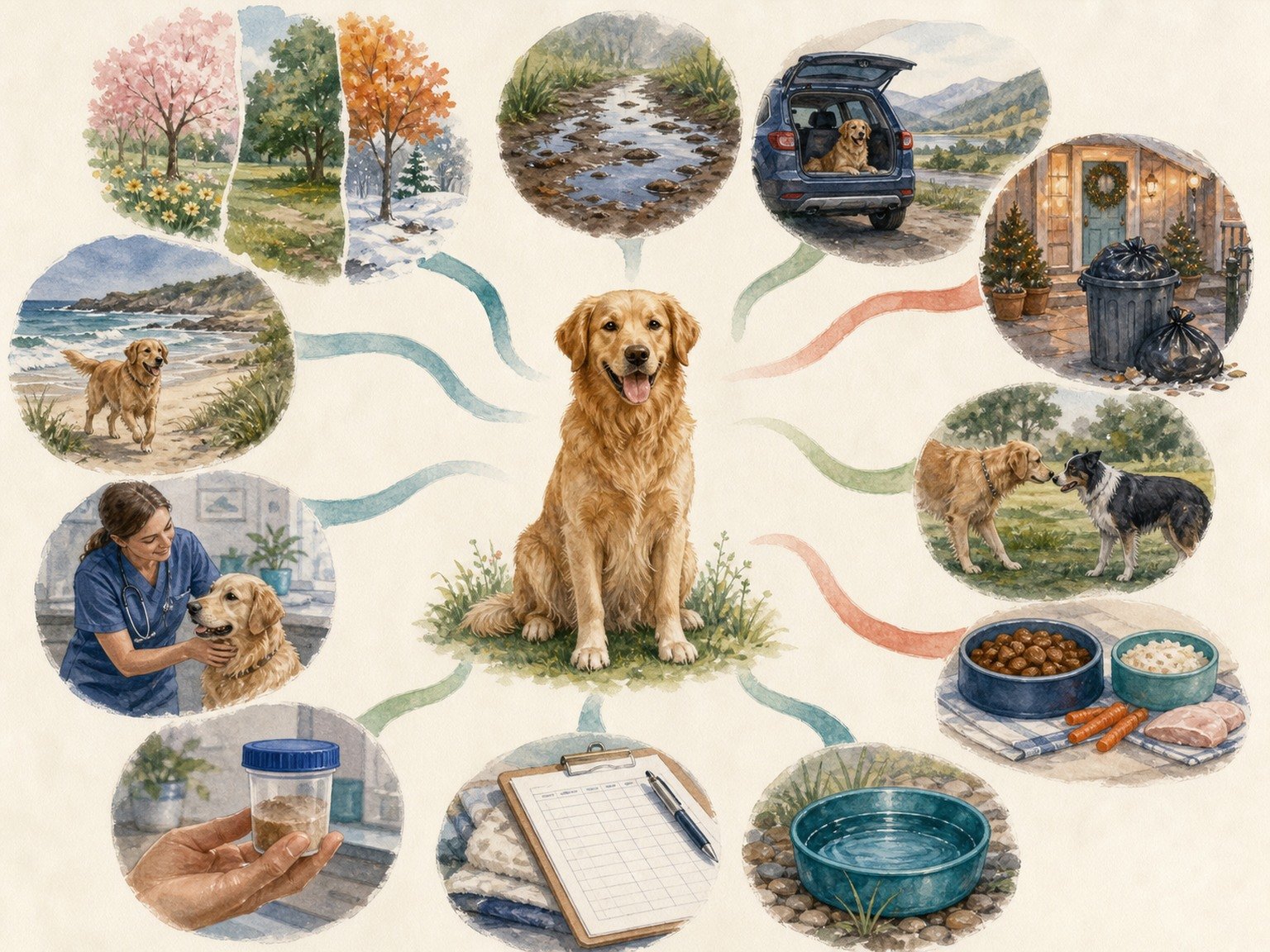
The calendar can change what a dog encounters: standing water, moist soil, wildlife feces, travel, boarding, gatherings, table food, trash, decorations, temperature, activity, stress, parasite exposure, and preventive routines. Those changes can coincide with vomiting, diarrhea, constipation, appetite change, or abdominal discomfort, but season is context rather than a diagnosis. Population parasite data can show broad patterns without predicting one dog's infection. Weather does not prove causation, and a repeated month does not rule out diet, toxin, foreign material, pancreatitis, infection, chronic disease, medication, or another problem. Use a dated exposure and symptom log, preserve packages, follow individualized parasite guidance, and contact the veterinarian for concerning or persistent signs.
Short answer
Track changing exposures, not a presumed seasonal diagnosis
A large U.S. laboratory-data study found different seasonal patterns for common canine intestinal nematodes, while CAPC recommends prevention and testing based on geography, travel, outdoor access, animal contact, and individual health. CDC notes that Giardia can persist in moist cool environments. None identifies one dog's cause from the calendar. [1] [2] [3]
- Start with the individual dog, exact question, complete history, and current veterinary plan.
- Use observations and evidence to improve a veterinary discussion, not to diagnose or treat at home.
- Keep population findings, research endpoints, and product-specific conclusions within their actual limits.
- Escalate sudden, severe, persistent, progressive, or function-limiting signs promptly.
Safety first
Blood, repeated vomiting, severe pain, dehydration, or exposure needs prompt care
Seek urgent care for collapse, severe weakness, repeated vomiting, inability to keep water down, a swollen painful abdomen, unproductive retching, substantial blood, breathing difficulty, suspected toxin or foreign object, or rapid decline. Contact the veterinarian promptly for persistent diarrhea, appetite loss, weight change, pain, fever, or worsening signs.
- Do not delay urgent care while completing a checklist, testing a diet, or seeking a cheaper option.
- Do not start, stop, combine, divide, or calculate medication or supplements from this article.
- After a possible toxin, foreign object, overdose, or hazardous ingestion, contact veterinary or poison help promptly.
Veterinary note
This article is educational and does not diagnose, treat, prescribe, or replace care from a licensed veterinarian. Your dog’s history, examination, diet, medications, and current signs determine what is appropriate.
Map what actually changed with the season
Record travel, boarding, daycare, visitors, new animals, wildlife, scavenging, standing water, snowmelt, yard work, pesticides, holiday food, trash access, decorations, activity, medication, preventives, and diet. Date each exposure instead of writing spring upset or holiday stomach.
Keep the regular food, treat, chew, supplement, and medication record current. Gatherings can create hidden feeding from several people, while travel can change meal timing and water source. A new bag or formulation matters even when the brand name appears unchanged.
Note regional weather and environment without treating them as proof. Moist cool conditions may support longer Giardia persistence, but infection still requires veterinary assessment. [3] Heat can change activity and hydration while storms can alter routine; similar signs can arise through unrelated disease.
Use parasite patterns carefully
A study of more than 39 million U.S. fecal test results found distinct population-level seasonal patterns for roundworm, hookworm, and whipworm prevalence. [4] The dataset describes submitted tests across regions and practices; it cannot diagnose a dog or create a universal monthly calendar.
CAPC recommends year-round broad parasite control and diagnostic testing tailored by the veterinarian to health, geography, travel, lifestyle, and exposure. [1] Follow the dog's plan rather than adding, skipping, or doubling a preventive because the season changed.
If the clinic requests a stool sample, follow its container, amount, timing, and storage instructions. A negative result answers only the tests and sample context used. Record prior dewormers and preventives accurately so the veterinarian can interpret results.
Prevent predictable holiday and outdoor hazards
FDA identifies holiday foods, bones, rich scraps, xylitol-containing items, decorations, trash, and foreign objects as exposure hazards. [2] Secure waste, bags, gifts, guest belongings, compost, and food-preparation areas. Do not rely on a dog having ignored them before.
After a possible ingestion, preserve packaging and contact veterinary or poison help with the exact item, estimated amount, time, dog, and signs. Do not wait for vomiting or diarrhea and do not induce vomiting unless case-specific instructions are given.
Use leash and supervision appropriate to the setting around puddles, feces, carcasses, mushrooms, bait, unfamiliar treats, and communal bowls. Risk reduction is practical, but no home routine guarantees parasite or toxin prevention.
Compare the whole pattern across seasons
Record stool frequency, appearance, blood or mucus, straining, vomiting, appetite, water, urination, pain, energy, weight, medications, food, and recovery. Add photos when useful, but do not use appearance to determine infection or treatment.
If a pattern recurs, bring the prior and current timelines to the veterinarian. Similar dates may reveal a repeated exposure or routine, but they can also be coincidence. Ask which diagnostic questions are reasonable and what would trigger earlier reassessment.
Do not perform a seasonal detox, fasting plan, probiotic rotation, supplement stack, or abrupt diet switch. Keep changes traceable and veterinary-directed so worsening disease is not hidden by several simultaneous experiments.
Prepare for a focused veterinary conversation
Bring a concise timeline, short natural-movement or symptom videos when safe, the exact names and photographs of every food, treat, medication, and supplement label, and notes about appetite, water intake, stool, sleep, activity, comfort, and behavior. Include recent injuries, travel, boarding, diet changes, missed medication, and previous test results. A complete record helps the veterinary team separate a repeatable pattern from a single impression.
Decide in advance what you need from the visit: an urgency decision, a diagnosis plan, a nutrition review, a pain or mobility assessment, or a monitored trial. Ask what result would change the plan and what finding would rule an option out. This keeps research and product information in the right role. Evidence can shape questions and expectations, but it cannot determine what is safe for an individual dog without the history and examination.
Owner tool
Build a seasonal digestive exposure log
On a phone, swipe across the table to see every column.
| Checkpoint | What to record | Why it helps |
|---|---|---|
| Environment | Weather, soil, water, wildlife, travel | Maps exposure |
| Household | Food, guests, trash, routine, products | Finds changes |
| Dog | Stool, vomiting, appetite, pain, weight | Tracks pattern |
| Plan | Prevention, tests, urgent signs, recheck | Guides care |
Better questions, calmer next steps
Questions to ask your veterinarian
- Which seasonal exposures are relevant in this region?
- Does the parasite plan still fit travel and lifestyle?
- What exact food, water, trash, or animal contact changed?
- Which signs require testing or urgent care?
- How should a recurring pattern be investigated?
FAQ
Can weather cause diarrhea?
Timing alone cannot identify cause.
Does every dog need seasonal supplements?
No.
Are parasites only a warm-weather issue?
Risk varies; follow individualized year-round guidance.
Can stool appearance diagnose Giardia?
No.
Should I switch food every season?
Not without a defined reason and plan.
Sources
- Companion Animal Parasite Council: General Guidelines for Dogs and Cats. Individualized testing, prevention, geography, travel, and exposure.
- U.S. Food and Drug Administration: Keep Dogs and Cats Safe From Holiday Hazards. Food, foreign-object, and toxin hazards.
- Centers for Disease Control and Prevention: About Giardia and Pets. Environmental exposure and persistence context.
- Parasites & Vectors: Seasonality of Canine Gastrointestinal Nematodes. Population-level seasonal prevalence patterns and limits.
- Merck Veterinary Manual: Giardiasis in Animals. Transmission, signs, diagnosis, and veterinary management.
