

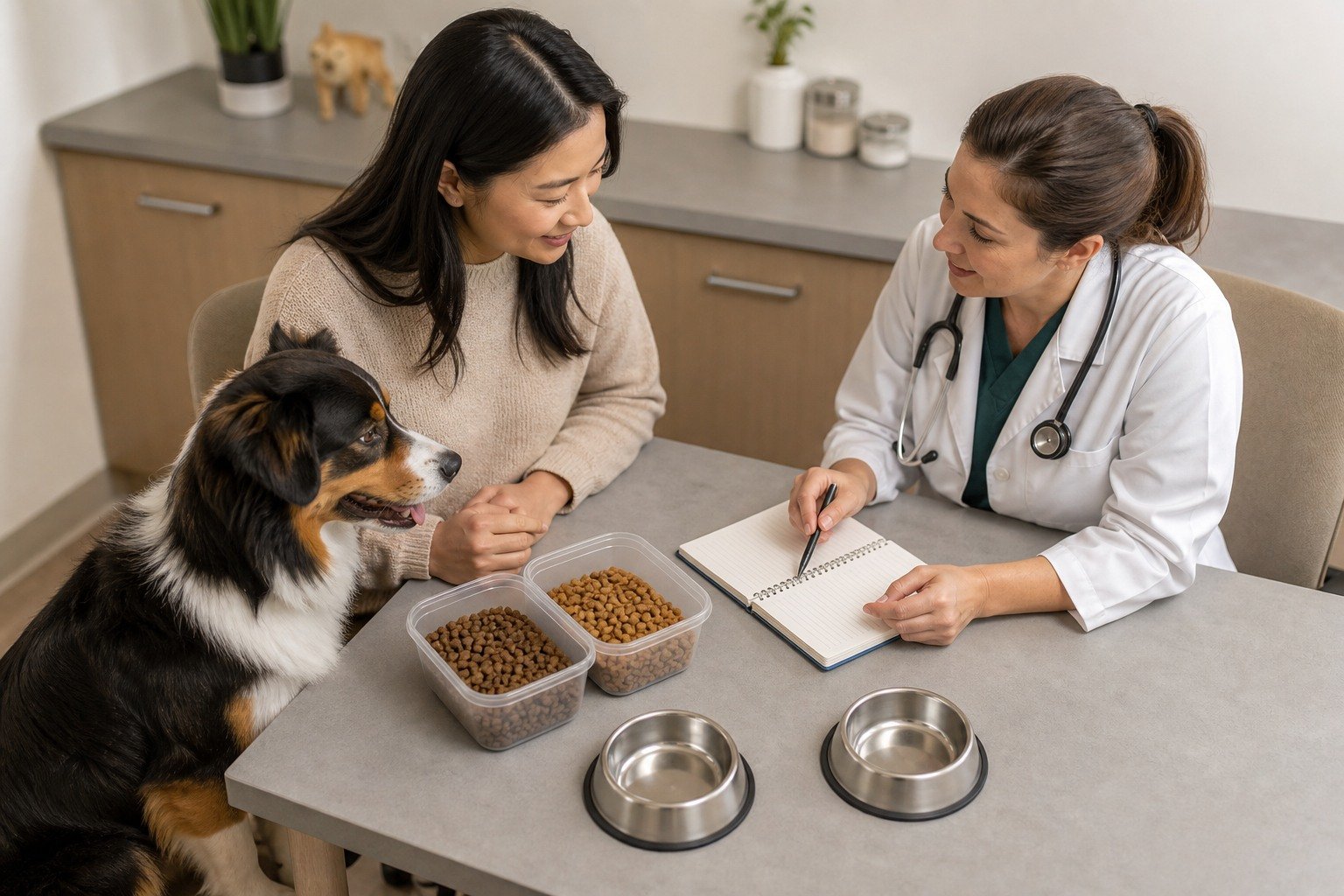
For a routine food change in a healthy dog, the veterinary team may recommend a gradual transition and monitoring plan. A recall, suspected adverse reaction, therapeutic diet, persistent gastrointestinal signs, or other medical reason can require a different approach. Small Beagle studies support context-specific observations about gradual and abrupt changes, not a universal day-by-day formula or guarantee of tolerance. When the situation is not urgent, establish a dated baseline for stool, appetite, measured intake, comfort, and activity before the first change. That comparison is more useful than memory alone and can distinguish a new response from variation that was already present.
Short answer
Match the transition to the reason and the individual dog
AAHA advises avoiding unnecessary frequent food changes and generally transitioning gradually while involving the veterinarian. In small controlled Beagle studies, a tested gradual transition reduced diarrhea relative to abrupt change in puppies, while an abrupt dry-to-canned change in adults produced wetter stool and transient microbiome and metabolite changes. These protocols and effect sizes are not universal instructions. [1] [2] [3]
- Record the exact pattern, products, diet, treatments, and recent changes.
- Separate what the evidence supports from what remains uncertain for this dog.
- Agree on a veterinary reassessment plan and urgent-response instructions.
Safety first
Repeated vomiting, severe diarrhea, pain, or rapid decline needs veterinary care
Contact the veterinary team for persistent or recurrent vomiting or diarrhea, poor appetite, weight loss, blood, pain, lethargy, or suspected adverse reaction. Seek emergency care for collapse, severe weakness, repeated vomiting, profuse or bloody diarrhea, pale gums, a swollen painful abdomen, breathing difficulty, seizures, inability to stand, or rapid decline.
- Do not use general information to delay evaluation of severe, persistent, or worsening signs.
- Do not start, stop, combine, or calculate treatments from this article.
- Keep exact labels, exposure details, and a concise timeline available for the veterinary team.
Veterinary note
This article is educational and does not diagnose, treat, prescribe, or replace care from a licensed veterinarian. Your dog’s history, examination, diet, medications, and current signs determine what is appropriate.
Identify why the food is changing
Routine availability, preference, life stage, calorie need, medical treatment, suspected reaction, and recall are different situations. The reason determines how quickly a decision is needed and whether a routine transition is appropriate.
For a recall or suspected adverse event, use manufacturer, retailer, FDA, and veterinary instructions for the exact product and lot. Do not continue a recalled or concerning food merely to preserve a transition schedule.
Therapeutic diets and controlled food trials are clinical tools. Starting, stopping, mixing, or substituting them without instructions can affect treatment and interpretation. Persistent signs require evaluation rather than serial brand changes. [4]
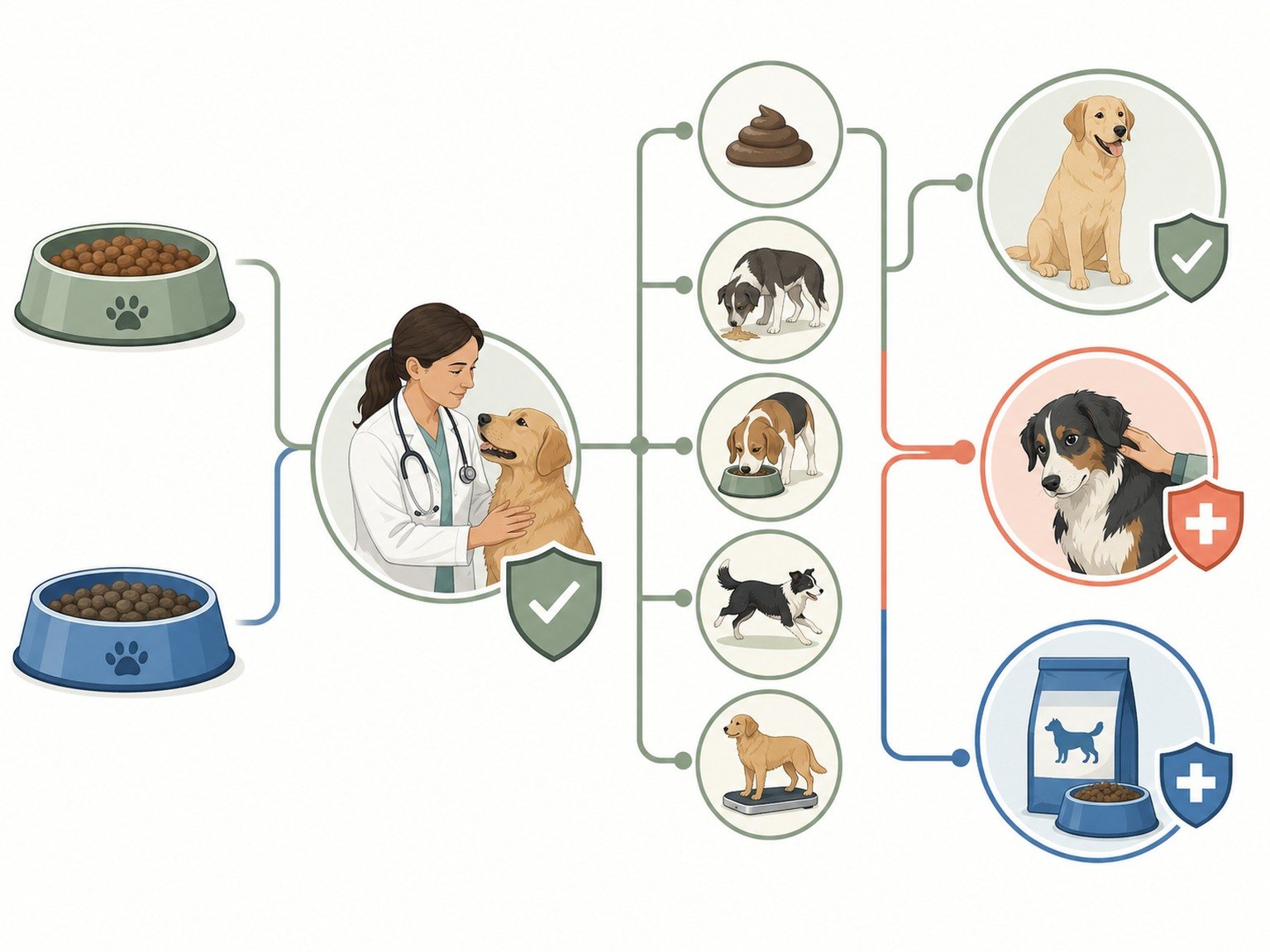
Read transition evidence at the right scale
In 13 healthy Beagle puppies fed two specific diets, the studied gradual transition produced fewer diarrhea episodes than abrupt change. The population, foods, environment, and schedule limit generalization. [2]
In 24 healthy adult Beagles, an abrupt dry-to-canned change produced wetter, less-formed feces and transient microbiome and metabolite changes. A temporary shift is not automatically disease, and the study does not prove that every abrupt change is harmful. [3]
AAHA's owner guidance generally supports gradual transition and avoiding unnecessary frequent changes, while referring diet selection and transition questions to the veterinary team. [1] This article intentionally gives no percentages or calendar.
Make the change observable
Record the exact old and new foods, formulas, lot information, calories, treats, toppers, chews, supplements, medications, and proportions supplied by the veterinary plan. Avoid changing several other variables at the same time.
Track stool frequency and consistency, vomiting, appetite, water intake, activity, comfort, weight, skin signs, and the target outcome. Note timing and recovery. Use the same measures each day rather than relying on a general impression.
Contact the clinic if signs appear or the dog refuses the food. Do not apply a blanket stop, continue, or restart rule from the internet. The product, reason for change, severity, disease, and nutritional needs determine the response.
Avoid the switching cycle
Repeated unsupervised changes can create new stool variation, obscure exposure timing, and make it harder to evaluate chronic enteropathy. ACVIM-endorsed guidance uses structured evaluation and controlled diet response rather than random serial switching. [4]
If a transition does not go as expected, preserve labels and the log. Ask whether the issue is palatability, calorie calculation, feeding amount, food intolerance, concurrent treats, medication, infection, parasites, or another illness.
A gradual plan may reduce digestive upset in some settings but cannot guarantee tolerance or establish that the new food is appropriate. The endpoint is a nutritionally suitable diet the dog can eat and tolerate within the veterinary care plan.
Prepare for a focused veterinary conversation
Bring a concise timeline, short natural-movement or symptom videos when safe, the exact names and photographs of every food, treat, medication, and supplement label, and notes about appetite, water intake, stool, sleep, activity, comfort, and behavior. Include recent injuries, travel, boarding, diet changes, missed medication, and previous test results. A complete record helps the veterinary team separate a repeatable pattern from a single impression.
Decide in advance what you need from the visit: an urgency decision, a diagnosis plan, a nutrition review, a pain or mobility assessment, or a monitored trial. Ask what result would change the plan and what finding would rule an option out. This keeps research and product information in the right role. Evidence can shape questions and expectations, but it cannot determine what is safe for an individual dog without the history and examination.
Owner tool
Build a food-transition log
On a phone, swipe across the table to see every column.
| Checkpoint | Record | Why it helps |
|---|---|---|
| Reason | Routine, recall, reaction, therapy | Determines approach |
| Foods | Exact formulas, lots, plan | Defines exposure |
| Response | Stool, vomit, appetite, weight | Shows pattern |
| Decision | Veterinary check and next step | Avoids random switching |
Better questions, calmer next steps
Questions to ask your veterinarian
- Why is this food change needed?
- Does a routine gradual approach fit this situation?
- What exactly should I track?
- Which signs mean stop and call or seek urgent care?
- Could repeated switching interfere with diagnosis?
FAQ
Is there one safe schedule for every dog?
No. Available studies are narrow, and the reason, foods, health, and response matter.
Can gradual change prevent all digestive signs?
No. It may reduce upset in some settings but cannot guarantee tolerance.
What about a recall?
Follow exact recall and veterinary instructions rather than a routine calendar.
Should I switch again if stool changes?
Contact the veterinary team; repeated switching can obscure the pattern.
Do microbiome changes mean disease?
No. A transient compositional change is not automatically a clinical problem.
Sources
- American Animal Hospital Association: How to Choose the Right Food for Your Pet. General gradual-transition and veterinary-selection guidance.
- Animals: Abrupt Dietary Change and Gradual Transition in Healthy Puppies. Small defined puppy study and generalizability limits.
- Journal of Animal Science: Abrupt Dry-to-Canned Diet Change in Dogs. Stool, microbiome, and metabolite changes in a defined adult cohort.
- Journal of Veterinary Internal Medicine: ACVIM-Endorsed Chronic Inflammatory Enteropathy Guidance. Structured evaluation and controlled diet-trial context.
