

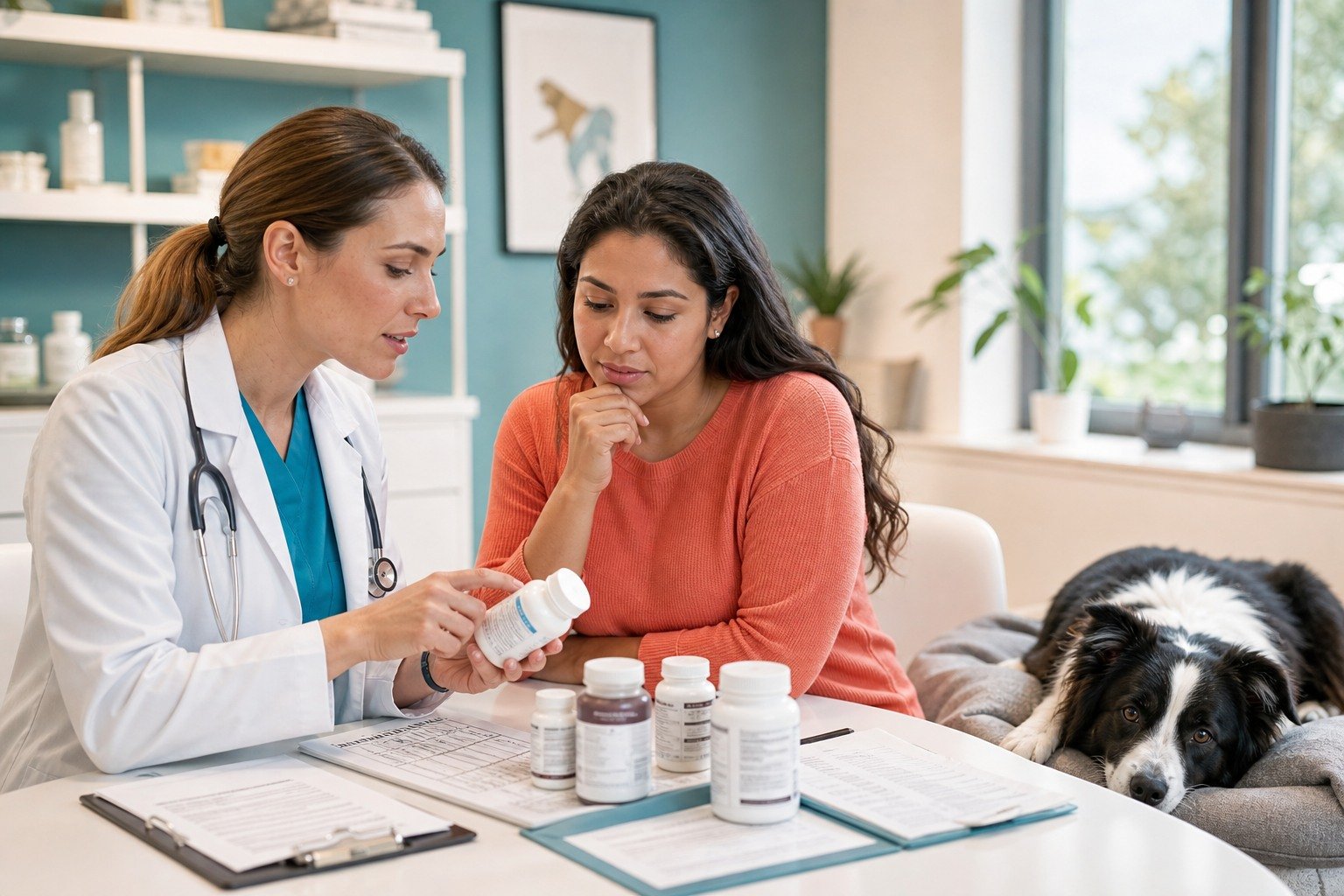
A supplement decision should begin with the dog and a defined clinical or nutritional question, not a trending ingredient. In the United States, products marketed for animals do not share the same legal dietary-supplement category used for people; classification depends on composition, intended use, and claims. Labels, evidence, formulation, manufacturing controls, and safety information vary. An ingredient studied in one formulation, species, population, or outcome does not validate every product that names it. Before starting anything, bring the complete diet, medications, preventives, treats, fortified foods, and supplements. Ask what problem is being addressed, what evidence applies, what risks and interactions matter, what outcome will be tracked, and when the decision will be reviewed.
Short answer
Ask what this exact product is expected to change
A sound decision connects a defined purpose and baseline to evidence for the exact ingredient and formulation, then checks quality, concurrent exposures, patient risks, monitoring, and reassessment. A pet label or wellness claim does not by itself establish need, efficacy, safety, or suitability. [1] [2]
- Record the exact question, baseline, product or exposure, timing, and whole-dog context.
- Use the record to support veterinary assessment, not to diagnose or create a regimen at home.
- Bring the complete diet, labels, medications, supplements, health history, and observed changes.
- Agree on measurable goals, a review point, and clear instructions for urgent changes.
Safety first
Accidental ingestion, overdose, or severe signs needs prompt professional guidance
Contact a veterinarian, emergency clinic, or animal poison control center promptly after a suspected overdose, wrong-product use, or accidental access. Seek urgent care for collapse, seizures, breathing difficulty, severe weakness, persistent vomiting, marked agitation, bleeding, or rapid deterioration. Keep the package and do not induce vomiting unless directed.
- Do not delay care for sudden, severe, escalating, or function-limiting signs.
- Do not start, stop, combine, divide, or calculate treatment from this article.
- Preserve exact packages, lot information, exposure details, and a concise timeline.
Veterinary note
This article is educational and does not diagnose, treat, prescribe, or replace care from a licensed veterinarian. Your dog’s history, examination, diet, medications, and current signs determine what is appropriate.
Define the purpose and baseline
Ask what specific problem, deficiency, diet limitation, or measurable function the supplement is intended to address. General goals such as wellness or support are too vague to judge. A clear purpose may reveal that examination, diagnostic testing, diet correction, or another treatment should come first.
Record the dog's baseline before starting when possible: symptoms, function, appetite, stool, activity, sleep, weight, body and muscle condition, relevant laboratory values, and current care. Without a baseline, ordinary variation can look like benefit or harm.
Ask whether doing nothing, adjusting the complete diet, treating an underlying condition, or changing an existing product is the better next step. Zero supplements is a valid outcome when no product meaningfully improves the plan.
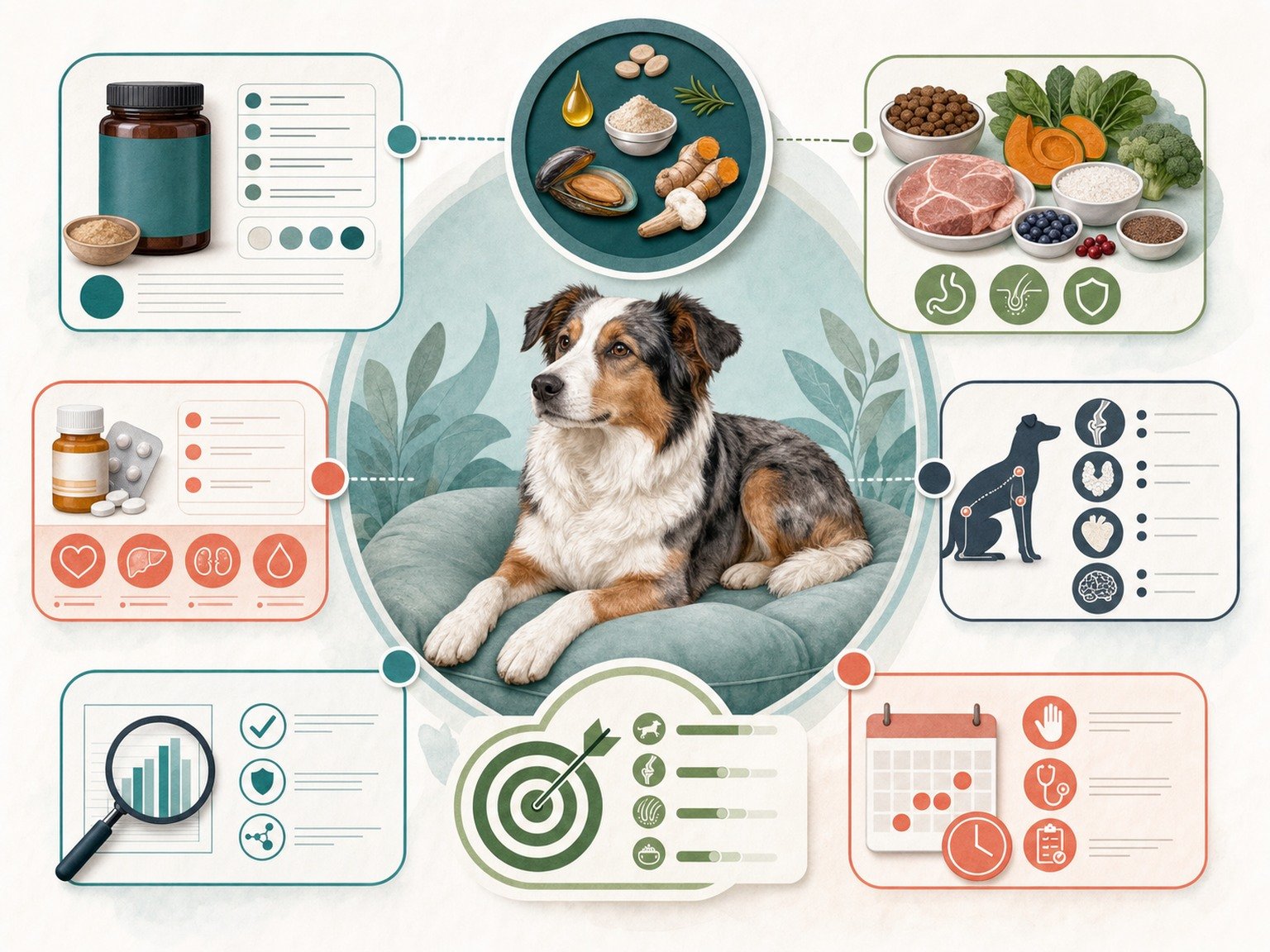
Interrogate the evidence without turning it into a guarantee
Ask whether evidence comes from dogs, from the same condition or population, and from a comparable ingredient form, concentration, combination, and route. Cell, rodent, human, or different-formulation findings may support research but cannot establish a canine outcome. [2]
Ask which endpoint changed and whether that change matters to the dog's comfort, function, disease, or nutritional status. Statistical significance is not always clinical significance, and a study average cannot predict an individual response.
Discuss sample size, duration, comparison group, funding, adverse-event reporting, and uncertainty. The goal is not to demand perfect evidence, but to understand what is known, what remains uncertain, and how much confidence the decision deserves.
Review formulation, quality, and total exposure
Bring photographs of every label panel and the exact product name, maker, form, concentration, serving tool, lot, and expiration or best-by information. Similar front labels can hide different ingredients, amounts, excipients, flavors, or delivery systems.
Ask how identity, purity, contaminants, stability, and batch consistency are assessed. A quality seal or certificate may add information, but it does not prove clinical benefit, freedom from risk, or suitability for a particular dog. [3]
Reconcile the entire diet and every product. Fortified food, treats, multinutrient products, human supplements, medications, and preventives can duplicate ingredients or create interactions. Body size alone cannot convert a human serving into a canine plan.
Create a monitoring and stopping plan
Ask how the product should be administered, stored, and recorded, and what missed-dose instructions apply. Do not improvise splitting, mixing, refrigeration, or substitution; formulation and label directions matter.
Define one or more observable targets, an appropriate review date, and adverse signs that require a call. Decide whether laboratory monitoring is needed and what result would lead to continuation, adjustment, or stopping.
Record who made the decision and keep the exact product linked to the plan. Reassess after changes in diagnosis, diet, medication, pregnancy status, surgery plans, appetite, organ function, or the product formulation. [4]
Prepare for a focused veterinary conversation
Bring a concise timeline, short natural-movement or symptom videos when safe, the exact names and photographs of every food, treat, medication, and supplement label, and notes about appetite, water intake, stool, sleep, activity, comfort, and behavior. Include recent injuries, travel, boarding, diet changes, missed medication, and previous test results. A complete record helps the veterinary team separate a repeatable pattern from a single impression.
Decide in advance what you need from the visit: an urgency decision, a diagnosis plan, a nutrition review, a pain or mobility assessment, or a monitored trial. Ask what result would change the plan and what finding would rule an option out. This keeps research and product information in the right role. Evidence can shape questions and expectations, but it cannot determine what is safe for an individual dog without the history and examination.
Owner tool
Bring a supplement decision brief
On a phone, swipe across the table to see every column.
| Checkpoint | Record | Why it helps |
|---|---|---|
| Purpose | Problem and target outcome | Defines relevance |
| Evidence | Species, formulation, endpoint | Limits extrapolation |
| Exposure | Diet, drugs, supplements, amount | Finds duplication |
| Plan | Monitoring, review, urgent signs | Makes use accountable |
Better questions, calmer next steps
Questions to ask your veterinarian
- What exact goal would this product address?
- What evidence applies to this formulation and dog?
- How are identity and contaminants assessed?
- Could diet, medication, or another product interact or duplicate?
- What outcome and adverse signs should we monitor?
FAQ
Does a dog on a complete diet need supplements?
Not automatically; need depends on the dog and purpose.
Does natural mean safer?
No. Exact identity, exposure, and patient matter.
Can I divide a human serving by weight?
No. That does not create a canine dose.
Does a quality seal prove effectiveness?
No. It does not establish clinical benefit.
How long should a trial last?
The review interval is product- and purpose-specific.
Sources
- U.S. Food and Drug Administration: FDA's Regulation of Pet Food. Composition, intended use, and claims.
- Nutrition Today: Veterinary Pet Supplements and Nutraceuticals. Evidence and formulation variability.
- U.S. Food and Drug Administration: Animal Food Ingredients. Ingredient identity and conditions of use.
- U.S. Food and Drug Administration: Report Animal Drug and Device Problems. Safety, product, and effectiveness reporting.
- Merck Veterinary Manual: Toxicoses From Human Multivitamins and Supplements. Exact-product exposure assessment.
