


Omega-3 is a family of fatty acids, not one interchangeable ingredient. Veterinary research commonly focuses on the long-chain marine fatty acids EPA and DHA, while plant alpha-linolenic acid is not equivalent. Systematic reviews suggest that EPA- and DHA-containing diets or supplements may improve selected osteoarthritis outcomes in some dogs, but studies vary in formulation, dose, background diet, duration, comparator, and endpoint. Evidence for one condition does not prove broad benefits for immunity, cognition, kidneys, heart, skin, or longevity. The total diet and exact product matter, as do calories, oxidation, contaminants, gastrointestinal tolerance, bleeding risk, disease, and concurrent medication. Any trial needs a defined purpose and veterinary monitoring rather than a generic dose copied from a package or website.
Short answer
EPA and DHA evidence is promising for selected uses, not universal
Systematic reviews found supportive but heterogeneous evidence for EPA and DHA in canine osteoarthritis, with differences in study quality, formulation, outcome, and risk of bias. The findings do not validate every fish-oil product, establish a universal dose, or prove benefits for unrelated conditions. [1] [2]
- Record the exact question, baseline, product or exposure, timing, and whole-dog context.
- Use the record to support veterinary assessment, not to diagnose or create a regimen at home.
- Bring the complete diet, labels, medications, supplements, health history, and observed changes.
- Agree on measurable goals, a review point, and clear instructions for urgent changes.
Safety first
Severe vomiting, weakness, bleeding, collapse, or a large accidental exposure needs prompt care
Contact a veterinarian for persistent digestive upset, appetite loss, bruising, bleeding, new weakness, pain, or any concerning change after a product starts. Seek urgent guidance after a large accidental ingestion or for collapse, breathing difficulty, repeated vomiting, uncontrolled bleeding, or rapid deterioration. Keep the exact package and amount available.
- Do not delay care for sudden, severe, escalating, or function-limiting signs.
- Do not start, stop, combine, divide, or calculate treatment from this article.
- Preserve exact packages, lot information, exposure details, and a concise timeline.
Veterinary note
This article is educational and does not diagnose, treat, prescribe, or replace care from a licensed veterinarian. Your dog’s history, examination, diet, medications, and current signs determine what is appropriate.
Define the fatty acid and the clinical question
EPA, DHA, ALA, fish oil, krill oil, algal oil, and omega blends are not interchangeable names. Sources and formulations differ in fatty-acid profile, concentration, other fats, flavorings, antioxidants, contaminants, calories, and stability. Compare actual EPA and DHA information, not only total oil volume.
Ask what outcome is being targeted. Joint comfort, skin disease, a specific nutritional need, and a medical condition involve different evidence and monitoring. A general claim such as whole-body wellness cannot substitute for a defined clinical question.
Review the background diet first. Therapeutic and commercial foods may already contain EPA and DHA, and treats or other supplements may add more. The relevant exposure is the total diet, not the bottle in isolation.
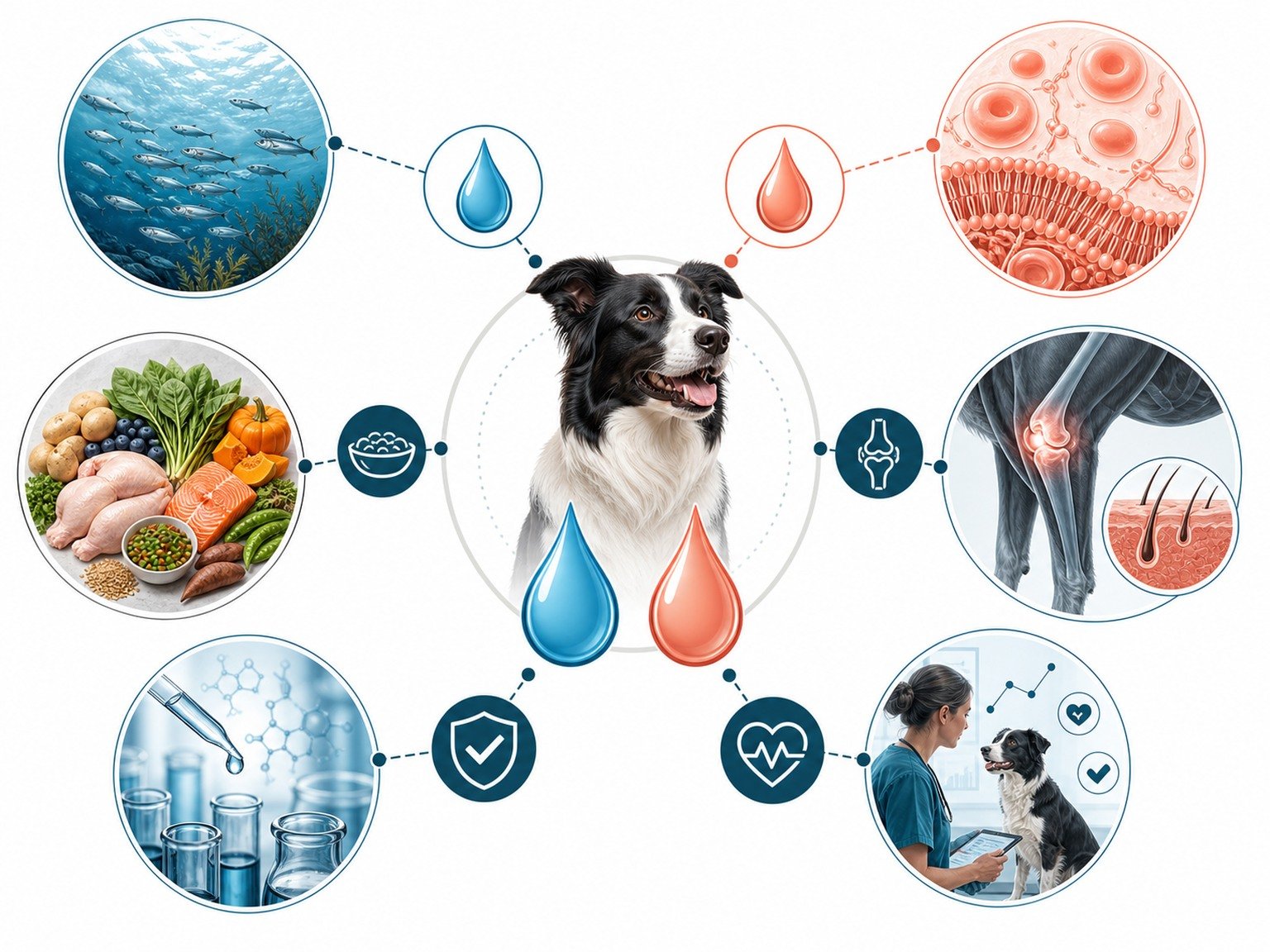
Read osteoarthritis findings with their limits
A 2022 meta-analysis of canine and feline osteoarthritis interventions found a meaningful pain-reducing effect for omega-3-enriched diets or supplements, but the underlying trials varied and did not establish that all products perform alike. [1]
A systematic review of EPA and DHA across companion-animal conditions found the strongest evidence in canine osteoarthritis while emphasizing heterogeneity and evidence gaps for other outcomes. A review is a map of the literature, not an individual prescription. [2]
Joint pain is diagnosed and managed as part of a multimodal plan that may include weight management, tailored activity, environmental adaptation, rehabilitation, and medication. Omega-3 should not delay diagnosis or replace treatment that the veterinarian considers necessary. [3]
Evaluate product quality and administration
Ask for the exact source, EPA and DHA amount, serving unit, storage instructions, expiration, lot, and quality testing. Oils can oxidize, and appearance or smell alone cannot prove safety or potency. Follow the product-specific storage directions.
Do not calculate a dose from a human capsule, teaspoon, body-weight chart, or total fish-oil number. Concentrations differ, and patient factors such as diet, body condition, gastrointestinal disease, pancreatitis history, clotting concerns, surgery, and medication may alter the decision.
Include the calories and the physical administration burden. A product that changes appetite, stool, food acceptance, or weight may undermine the intended plan. Record the exact formulation because substitutions can change exposure.
Monitor benefit and adverse effects separately
Choose a baseline and a small set of outcomes that match the purpose, such as rising, stairs, walk tolerance, scratching, lesion score, or a veterinary laboratory measure. Keep activity and other treatment changes visible so improvement is not automatically attributed to the oil.
Track appetite, vomiting, stool, abdominal discomfort, bruising or bleeding, skin changes, weight, and medication changes. A sign that follows use may be related or unrelated; timing should prompt assessment, not a home rechallenge.
At reassessment, ask whether the target changed meaningfully, whether the product was given consistently, whether adverse effects or interactions emerged, and whether the plan should continue, change, or stop. Do not treat indefinite use as the default. [4]
Prepare for a focused veterinary conversation
Bring a concise timeline, short natural-movement or symptom videos when safe, the exact names and photographs of every food, treat, medication, and supplement label, and notes about appetite, water intake, stool, sleep, activity, comfort, and behavior. Include recent injuries, travel, boarding, diet changes, missed medication, and previous test results. A complete record helps the veterinary team separate a repeatable pattern from a single impression.
Decide in advance what you need from the visit: an urgency decision, a diagnosis plan, a nutrition review, a pain or mobility assessment, or a monitored trial. Ask what result would change the plan and what finding would rule an option out. This keeps research and product information in the right role. Evidence can shape questions and expectations, but it cannot determine what is safe for an individual dog without the history and examination.
Owner tool
Prepare an omega-3 review
On a phone, swipe across the table to see every column.
| Checkpoint | Record | Why it helps |
|---|---|---|
| Identity | Source, EPA, DHA, form, lot | Defines exposure |
| Context | Diet, calories, drugs, disease | Finds risk |
| Outcome | Baseline and target function | Tests relevance |
| Follow-up | Tolerance, change, review date | Guides decision |
Better questions, calmer next steps
Questions to ask your veterinarian
- Which fatty acid and outcome are we targeting?
- How much EPA and DHA is already in the diet?
- What evidence applies to this formulation?
- Which disease, medication, or surgery risks matter?
- How and when will benefit and tolerance be reviewed?
FAQ
Is flaxseed oil the same as fish oil?
No. ALA is not interchangeable with EPA and DHA.
Do omega-3s cure arthritis?
No. They may support selected outcomes in a broader plan.
Can I use a human capsule?
Only if a veterinarian approves the exact formulation.
Does more EPA and DHA work better?
Not as a general rule; more can add risk.
How quickly should I see a result?
The review interval depends on purpose and plan.
Sources
- PLOS One: Efficacy of Osteoarthritis Treatments in Dogs and Cats. Meta-analysis of osteoarthritis interventions.
- Veterinary Medicine and Science: EPA and DHA in Companion Animal Diseases. Systematic review and evidence limits.
- American Animal Hospital Association: Canine Osteoarthritis. Multimodal joint care context.
- Nutrition Today: Veterinary Pet Supplements and Nutraceuticals. Quality, evidence, and safety variability.
- Merck Veterinary Manual: Nutritional Requirements and Related Diseases of Small Animals. Fatty acids within complete nutrition.
