

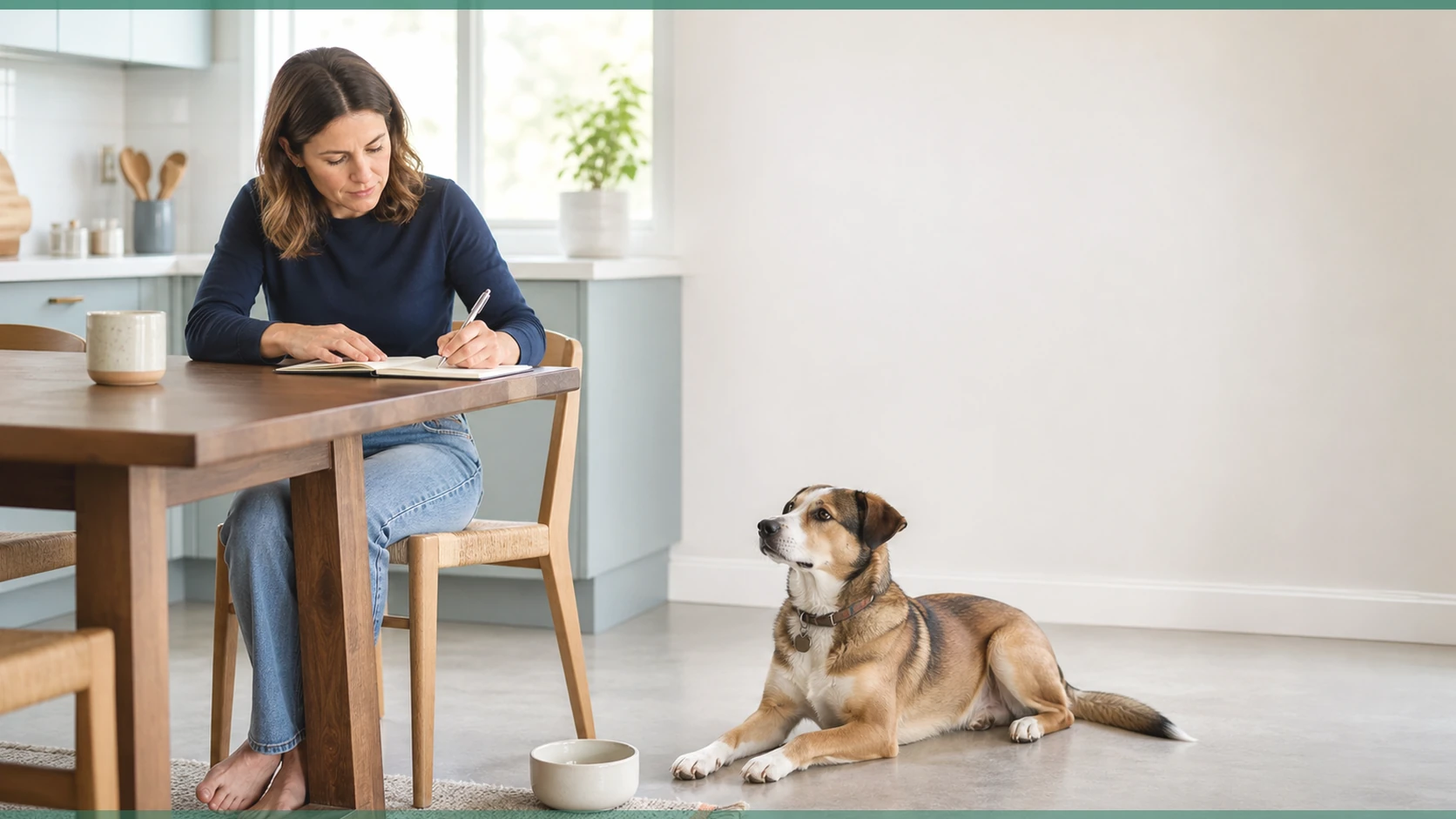
A useful weekly journal does more than collect stool descriptions. It helps you explain what you actually saw, what remains uncertain, and what you want your veterinary team to review.
By the end of a week, your dog’s digestive notes may be spread across a notebook, photographs and a few messages. You remember one softer stool clearly, but not whether it came before the new treat. Another caregiver says everything seemed normal. Now you have information, but not yet a clear account.
This guide helps you turn those scattered observations into a short, honest summary for your veterinary team. It is not another test to pass at home. Keep the original entries; use the weekly review to make them easier to explain. For a broader starting point, see our guide to digestive issues and professional care.
Short answer
Summarize the pattern without filling in the blanks
State which dates you observed, describe the main change with its timing, and list relevant food or care changes. Mark missing information as unknown. Finish with a specific question for the clinic, not a diagnosis. A weekly journal organizes communication; it cannot certify that digestion is healthy or explain the cause of a symptom.
- Keep original notes separate from your interpretation.
- Describe the observations you have, not an imagined complete week.
- Contact the clinic when needed; do not wait for the journal to be finished.
Safety first
A weekly review must never become a reason to delay care
Contact your veterinarian for repeated vomiting, blood or black tarry stool, reduced appetite, unusual lethargy, unexplained weight loss or recurring digestive changes. Vomiting with diarrhea is particularly concerning. Severe abdominal pain, pronounced swelling, collapse or suspected harmful ingestion need urgent help. Do not finish seven days of notes first, withhold food or water as a home test, or change medication while waiting for a clearer pattern.
Veterinary note
This is educational record-organizing guidance, not diagnosis or treatment. Follow your dog’s individual care instructions and HPE’s medical disclaimer.
Start with the question you need help answering
Give the review a purpose before counting entries. Perhaps you need to describe an intermittent change, prepare for an appointment, or explain what happened after the clinic adjusted an existing plan. Write that purpose at the top. It keeps the summary from becoming a list of every ordinary event.
Use a question such as, “What information would help you assess these recurring stool changes?” Avoid a conclusion such as, “The new food caused this.” The first invites assessment. The second treats the explanation as settled before the team has reviewed the dog.
AAHA describes nutrition history as including food, environment, activities and the people involved in feeding. That supports giving the clinic a complete picture, not selecting only the details that fit your first suspicion. A weekend visitor or an uncertain snack can belong in the account without being named as the cause.
Check how much of the week the record actually covers
Put dated entries in order and keep their original wording available. Separate something you saw yourself from a secondhand report. “I saw a soft stool on Wednesday evening” and “the walker mentioned a change sometime Wednesday” do not carry the same timing certainty.
Mark gaps plainly. A blank Tuesday does not mean Tuesday was symptom-free. Likewise, five recorded stools do not necessarily mean your dog passed stool only five times. Shared yards, different walkers and missed entries can all leave an incomplete count.
If you use counts, include their limits: “Five stools described across four observed days; two days have no entries.” Do not convert those notes into a percentage of healthy days, a home risk score or an exact rate that your observations cannot support.
Keep the process manageable. You do not need to recreate every missing detail from memory. Add a later recollection as a later note, with uncertainty attached, instead of rewriting it as an observation made at the time.
Describe the change, then put the context beside it
Choose concrete descriptions already present in your notes: formed or loose, an observed change in frequency, difficulty passing stool, appetite changes, or vomiting. Include when the change was first noticed and what was happening when you last checked. Do not diagnose parasites, food intolerance or infection from appearance.
Next, gather the food and care details that the clinic may need. WSAVA’s short diet-history form includes all foods, amounts, measuring devices, supplements and food used to give medication. You can use those categories to check for omissions without copying the form’s example portions or completing professional examination fields yourself.
Keep events and conclusions separate. “New chew offered Tuesday; loose stool recorded Wednesday” is a timeline. “The chew upset his gut” is an interpretation. Do not offer the chew again to test the theory or start a supplement trial to make the journal more informative.
For complicated holiday or travel notes, our shared log for disrupted weeks covers recording events as they happen. This weekly review is the next step: sorting those records into a useful account.
The retained illustration provides visual context, not a stool-scoring system or a diagnostic sequence. The written journal and your dog’s veterinary assessment remain separate.
Owner tool
Build a short weekly handoff from the original notes
Use this organizer to prepare a message or appointment summary. It is an original HPE communication aid, not a clinical test. Keep the source notes so the team can ask about a particular entry.
| Summary field | Extract from your notes | Leave uncertain when needed |
|---|---|---|
| Main concern | Specific change and why you are contacting the clinic. | The suspected cause. |
| Coverage | Dates observed, observers and missing entries. | What happened during unobserved periods. |
| Timeline | First noticed, later observations and current status. | Whether a gap means improvement. |
| Food context | Current food, measured amounts and known extras. | Unconfirmed snacks or scavenging. |
| Other care | Medication, supplement and routine changes with dates. | A causal link between events. |
| Request | Question, existing appointment and clinic instructions. | Which tests or treatment will be needed. |
A fictional example of the wording might be: “I have notes for five days, with no observations recorded on Tuesday or Friday. One softer stool was noted Wednesday evening; the next recorded stool Thursday was formed. I cannot account for every outing. I have attached the current food information and want to ask what else you need.” This illustrates honest reporting, not a pattern that is safe to leave unassessed.
Prepare the handoff, not a home diagnosis
Ask how the clinic prefers to receive information. If it provides a form, use that format and keep your longer notes as backup. Send the main concern, current condition and time course first, rather than attaching an unexplained collection of photographs.
Photographs can supplement a description, but they cannot replace the dog being assessed. Ask whether a stool sample is needed and follow the clinic’s collection and handling instructions. Do not postpone urgent care while trying to obtain the perfect photograph or sample.
AAHA’s screening guidance combines history with physical assessment and allows the practice team to clarify incomplete diet-history forms. MSD likewise describes the importance of an accurate history alongside examination. Your journal contributes information; it does not decide which examination findings, laboratory tests or treatment are appropriate.
Better questions, calmer next steps
Ask what the next record should capture
- Which parts of this timeline matter most for this dog?
- Do you want a sample, photographs or a particular reporting form?
- What should we record next, and when should we contact you again?
- Which signs should override the planned follow-up date?
FAQ
Should I average the stool descriptions into one weekly score?
Not unless your veterinary team has asked you to use a particular scoring method. An average can hide an isolated concerning event or imply that missing observations were normal. Keep dated descriptions and explain the coverage. Any chart the team supplies should support communication, not become a home diagnosis.
What if several days are missing from the journal?
Say which days are missing and bring the observations you do have. Do not backfill normal entries or delay asking for help until you can produce a complete week. The clinic can tell you whether additional information is useful and how urgently your dog needs assessment.
What if the clinic’s app asks for different information?
Use the clinic’s requested format where possible. Keep your original notes so you can explain details that do not fit its fields. If an app requires a value you do not know, ask how to mark it unknown rather than entering an invented number or description.
Should I wait until the weekly review to mention a new problem?
No. A calendar boundary is not a medical waiting period. Follow your dog’s care instructions and contact the clinic about concerning changes when they occur. Use the safety guidance above for urgent concerns. The summary can be completed later; seeking help does not depend on finishing it.
Make the next conversation clearer
Start with the main question, identify the dates your notes cover, and choose the few entries that describe the change most clearly. Add the current food and care information, keeping unknown details visible. Save the complete journal rather than replacing it with your summary.
An imperfect but accurate account is more useful than a polished story built from guesses. You are helping the team understand what happened, not proving that you should have worked out the cause yourself.
Sources
- AAHA: Comprehensive Nutrition History. Food, caregiver, activity and environment information.
- AAHA: Screening Evaluation. Owner history supports, but does not replace, professional assessment.
- WSAVA: Short Diet History Form. Categories for a complete food and supplement history.
- Cornell: Diarrhea. Warning signs and veterinary assessment, including sample discussion.
- MSD Veterinary Manual: Digestive Disorders of Dogs. Clinical signs, history and examination.
