

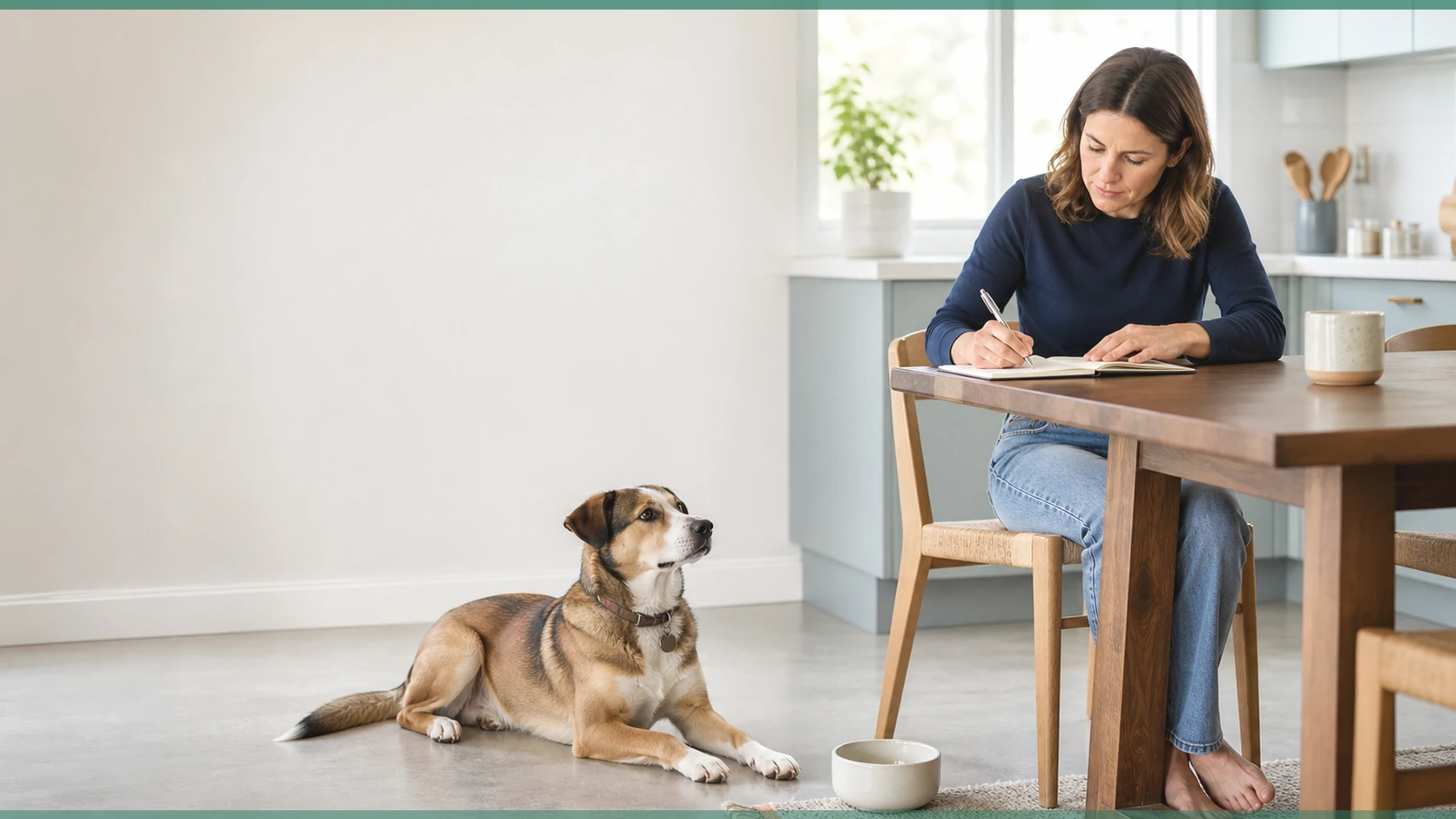
A calm, evidence-aware framework for tracking gut health during festive or non-routine weeks for adult dogs, with practical owner observations and clear professional-care boundaries.
Short answer
Use a repeatable plan and keep veterinary care in the lead
Provide a simple, repeatable worksheet for tracking gut-health markers (appetite, stool, hydration) during non-routine or festive-style feeding or travel weeks. The practical goal is simple: owner can log short-term changes in eating, stool, and water intake around holiday-type or guest-oriented feeding days. Keep veterinary care in the lead, record patterns rather than isolated moments, and stop the routine when pain, distress, or urgent signs appear.
- Record meals, treats, appetite, water, stool, elimination timing, and normal energy.
- Keep portions, meal timing, and approved ingredients consistent enough to interpret response.
- Record frequency, consistency, urgency, straining, leftovers, and food interest.
- Note scavenging, travel, stress, new treats, medications, wildlife, and household illness.
Safety first
Stop the routine when the dog needs professional care
Contact a veterinarian if appetite drops substantially, hydration seems poor, or stool changes are persistent rather than brief and clearly linked to a benign change. Seek urgent care if a dog cannot keep water down, becomes weak or lethargic, has bloody stool or blood in urine, or shows signs of dehydration. If a travel or holiday week causes repeated vomiting, diarrhea, or refusal of food and water, do not wait for the worksheet to resolve the problem.
Veterinary note
Educational information only; contact a veterinarian for diagnosis, treatment, or urgent concerns. This guide supports observation and preparation; it does not diagnose a condition or replace an individualized care plan.
What is reasonably supported
Use repeated observations to improve the veterinary conversation
AVMA advises consulting a veterinarian about preventive care, including vaccinations and parasite prevention, and notes that stool checks… Supports using routine wellness markers and veterinary… A recognized quality-of-life framework for dogs includes hunger and hydration as core monitoring domains. Supports tracking appetite and hydration as welfare… Care guidance for limited-mobility dogs explicitly says urine should be monitored for reduced volume, blood, and odor changes. Supports monitoring elimination-related signs when routine, feeding,…
What remains uncertain
Home observations cannot establish the cause
This record is a non-diagnostic weekly tracking worksheet for appetite, stool, and hydration during holiday, travel, or other non-routine feeding weeks. It does not provide treatment, dosing, or a substitute for veterinary care. It is intended for adult dogs and does not establish disease diagnosis from any single marker. No source provides a single standardized owner log for festive or travel weeks specifically. No source defines exact normal ranges for all dogs because hydration, stool quality, and appetite vary by individual and context.
Establish the usual digestive pattern
Begin with the dog's own normal pattern so a meaningful change is easier to recognize. For tracking gut health during festive or non-routine weeks for adult dogs, the accepted research supports a bounded point: AVMA advises consulting a veterinarian about preventive care, including vaccinations and parasite prevention, and notes that stool checks are part of parasite prevention planning. Supports using routine wellness markers and veterinary guidance when routines change. This evidence guides observation and a veterinary conversation; it does not establish a diagnosis, treatment response, or guaranteed result.
In practice, record meals, treats, appetite, water, stool, elimination timing, and normal energy. Record the date, frequency, context, and related changes. Normal varies among dogs and cannot be inferred from one bowel movement. Compare the dog with their own baseline and contact the veterinary team when the pattern is persistent, progressive, painful, or joined by the red-flag signs above.
Change one controllable factor at a time
Separate observation from interpretation: describe what happened before deciding what it might mean. For tracking gut health during festive or non-routine weeks for adult dogs, the accepted research supports a bounded point: A recognized quality-of-life framework for dogs includes hunger and hydration as core monitoring domains. Supports tracking appetite and hydration as welfare markers. This evidence guides observation and a veterinary conversation; it does not establish a diagnosis, treatment response, or guaranteed result.
In practice, keep portions, meal timing, and approved ingredients consistent enough to interpret response. Record the date, frequency, context, and related changes. Do not make several diet or supplement changes together. Compare the dog with their own baseline and contact the veterinary team when the pattern is persistent, progressive, painful, or joined by the red-flag signs above.
Describe stool and appetite precisely
Consistency improves the value of a home record, even when the measurement is simple. For tracking gut health during festive or non-routine weeks for adult dogs, the accepted research supports a bounded point: Care guidance for limited-mobility dogs explicitly says urine should be monitored for reduced volume, blood, and odor changes. Supports monitoring elimination-related signs when routine, feeding, or activity patterns change. This evidence guides observation and a veterinary conversation; it does not establish a diagnosis, treatment response, or guaranteed result.
In practice, record frequency, consistency, urgency, straining, leftovers, and food interest. Record the date, frequency, context, and related changes. Owner descriptions support care but do not diagnose a cause. Compare the dog with their own baseline and contact the veterinary team when the pattern is persistent, progressive, painful, or joined by the red-flag signs above.
Include exposure and routine context
The setting around a sign can matter as much as the sign itself. For tracking gut health during festive or non-routine weeks for adult dogs, the accepted research supports a bounded point: AVMA advises consulting a veterinarian about preventive care, including vaccinations and parasite prevention, and notes that stool checks are part of parasite prevention planning. Supports using routine wellness markers and veterinary guidance when routines change. This evidence guides observation and a veterinary conversation; it does not establish a diagnosis, treatment response, or guaranteed result.
In practice, note scavenging, travel, stress, new treats, medications, wildlife, and household illness. Record the date, frequency, context, and related changes. Apparently minor exposures can matter. Compare the dog with their own baseline and contact the veterinary team when the pattern is persistent, progressive, painful, or joined by the red-flag signs above.
Protect hydration and food safety
A checklist supports attention; it does not prove that a risk is gone or explain a medical concern. For tracking gut health during festive or non-routine weeks for adult dogs, the accepted research supports a bounded point: A recognized quality-of-life framework for dogs includes hunger and hydration as core monitoring domains. Supports tracking appetite and hydration as welfare markers. This evidence guides observation and a veterinary conversation; it does not establish a diagnosis, treatment response, or guaranteed result.
In practice, keep fresh water available and store, prepare, and transition food safely. Record the date, frequency, context, and related changes. Never restrict water or use fasting without veterinary direction. Compare the dog with their own baseline and contact the veterinary team when the pattern is persistent, progressive, painful, or joined by the red-flag signs above.
Watch the whole dog
Shared language and one current record help multiple caregivers act consistently. For tracking gut health during festive or non-routine weeks for adult dogs, the accepted research supports a bounded point: Care guidance for limited-mobility dogs explicitly says urine should be monitored for reduced volume, blood, and odor changes. Supports monitoring elimination-related signs when routine, feeding, or activity patterns change. This evidence guides observation and a veterinary conversation; it does not establish a diagnosis, treatment response, or guaranteed result.
In practice, connect digestive signs with weight, comfort, behavior, vomiting, and recovery. Record the date, frequency, context, and related changes. Persistent or combined signs deserve veterinary assessment. Compare the dog with their own baseline and contact the veterinary team when the pattern is persistent, progressive, painful, or joined by the red-flag signs above.
Owner tool
Tracking Gut Health During Festive or Non-Routine Weeks for Adult Dogs
Use this worksheet as a repeatable record for tracking gut health during festive or non-routine weeks for adult dogs. Mark what is normal, what changed, and what needs veterinary guidance.
| Checkpoint | Owner action | Safety boundary |
|---|---|---|
| Establish the usual digestive pattern | record meals, treats, appetite, water, stool, elimination timing, and normal energy | Normal varies among dogs and cannot be inferred from one bowel movement |
| Change one controllable factor at a time | keep portions, meal timing, and approved ingredients consistent enough to interpret response | Do not make several diet or supplement changes together |
| Describe stool and appetite precisely | record frequency, consistency, urgency, straining, leftovers, and food interest | Owner descriptions support care but do not diagnose a cause |
| Include exposure and routine context | note scavenging, travel, stress, new treats, medications, wildlife, and household illness | Apparently minor exposures can matter |
| Protect hydration and food safety | keep fresh water available and store, prepare, and transition food safely | Never restrict water or use fasting without veterinary direction |
| Watch the whole dog | connect digestive signs with weight, comfort, behavior, vomiting, and recovery | Persistent or combined signs deserve veterinary assessment |
| Prepare a useful clinic record | bring dates, photos when appropriate, food labels, amounts, medications, supplements, and travel history | Blood, repeated vomiting, severe pain, weakness, or dehydration can be urgent |
A three-step next action
Observe
Complete the tracking gut health during festive or non-routine weeks for adult dogs review without provoking a symptom or forcing the dog through difficulty.
Record
Keep dates, measurements, photographs, short natural-behavior videos, product labels, and caregiver notes together.
Escalate
Share the concise pattern with the veterinary team and seek urgent care for severe or rapidly worsening signs.
Prepare for the visit
Questions to take to your veterinarian
- Which parts of this tracking gut health during festive or non-routine weeks for adult dogs plan matter most for this dog?
- What findings need a routine appointment, a same-day call, or emergency care?
- Could current diagnoses, medications, diet, supplements, pain, vision, hearing, or mobility change the plan?
- What should I measure at home, and how often should I reassess it?
- Which change should make me stop the routine and contact you sooner?
Bring the dated observation log, relevant photos or short videos, and a complete list of foods, treats, medications, and supplements. Do not change the routine solely to produce evidence for the visit.
Frequently asked questions
Can this guide diagnose a health or behavior problem?
No. It organizes observations and questions; diagnosis requires veterinary assessment.
How often should I repeat the routine?
Use the interval recommended by the veterinary team and repeat sooner after a meaningful change.
Should I change several things at once?
Usually not unless the veterinary team directs it. Multiple changes make response and risk harder to interpret.
What should I bring to the appointment?
Bring the dated log, relevant photos or videos, and complete food, medication, supplement, and product information.
Sources
- Common-sense measures to protect your dog, yourself and others in canine social settings, American Veterinary Medical Association. AVMA advises consulting a veterinarian about preventive care, including vaccinations and parasite prevention, and notes that stool checks are part of parasite prevention planning.
- Quality of Life at the End of Life for Your Dog, VCA Animal Hospitals. A recognized quality-of-life framework for dogs includes hunger and hydration as core monitoring domains.
- Caring For a Pet with Limited Mobility, BVNS Down Dog Care. Care guidance for limited-mobility dogs explicitly says urine should be monitored for reduced volume, blood, and odor changes.
Medical disclaimer
Educational information only; contact a veterinarian for diagnosis, treatment, or urgent concerns. If your dog is showing severe, sudden, or rapidly worsening signs, seek urgent veterinary care.
