


Valerian appears in some products marketed for canine calm, but marketing familiarity is not ingredient-specific evidence. The directly relevant trial in this research packet tested a combination containing tryptophan, valerian, and passiflora, not valerian alone. That distinction controls what can be claimed about benefit, safety, interactions, formulation, and dose.
Short answer
Current canine evidence does not establish valerian alone as an effective treatment
A randomized double-blind placebo-controlled study enrolled 44 dogs and evaluated a multi-ingredient supplement around fireworks. Some measures differed between groups, but the formulation, small sample, concurrent advice, and manufacturer involvement limit interpretation. The study cannot isolate valerian or establish a valerian-only recommendation, safety profile, or dose. [1]
- Do not translate a combination-product result into a claim that valerian alone works.
- Review the dog's diagnosis, medications, supplements, health conditions, product composition, and quality controls with a veterinarian.
- Use veterinary and behavior care for the underlying problem; a supplement does not replace safety planning or treatment.
Safety first
Herbal does not mean interaction-free or appropriate for every dog
Contact a veterinarian or animal poison service promptly after suspected overdose, accidental ingestion, collapse, marked sedation, agitation, tremors, vomiting, diarrhea, breathing difficulty, weakness, altered coordination, or another acute change. Bring the package or ingredient list when available.
- Do not combine valerian with sedating medication, anesthesia plans, or other calming products without veterinary review.
- Do not use human tinctures, gummies, blends, or products that may contain alcohol, xylitol, cannabinoids, or undisclosed ingredients.
- Do not stop prescribed behavior medication or delay assessment in favor of a supplement trial.
Veterinary note
This article is educational and does not diagnose, treat, prescribe, or replace care from a licensed veterinarian. Your dog’s history, examination, diet, medications, and current signs determine what is appropriate.
Ask the ingredient-specific question
An ingredient claim requires evidence for the exact ingredient, formulation, population, comparison, duration, outcome, and safety monitoring. If a study tests several active ingredients together, it cannot reveal which component mattered, whether components interacted, or whether one ingredient alone would produce the same result.
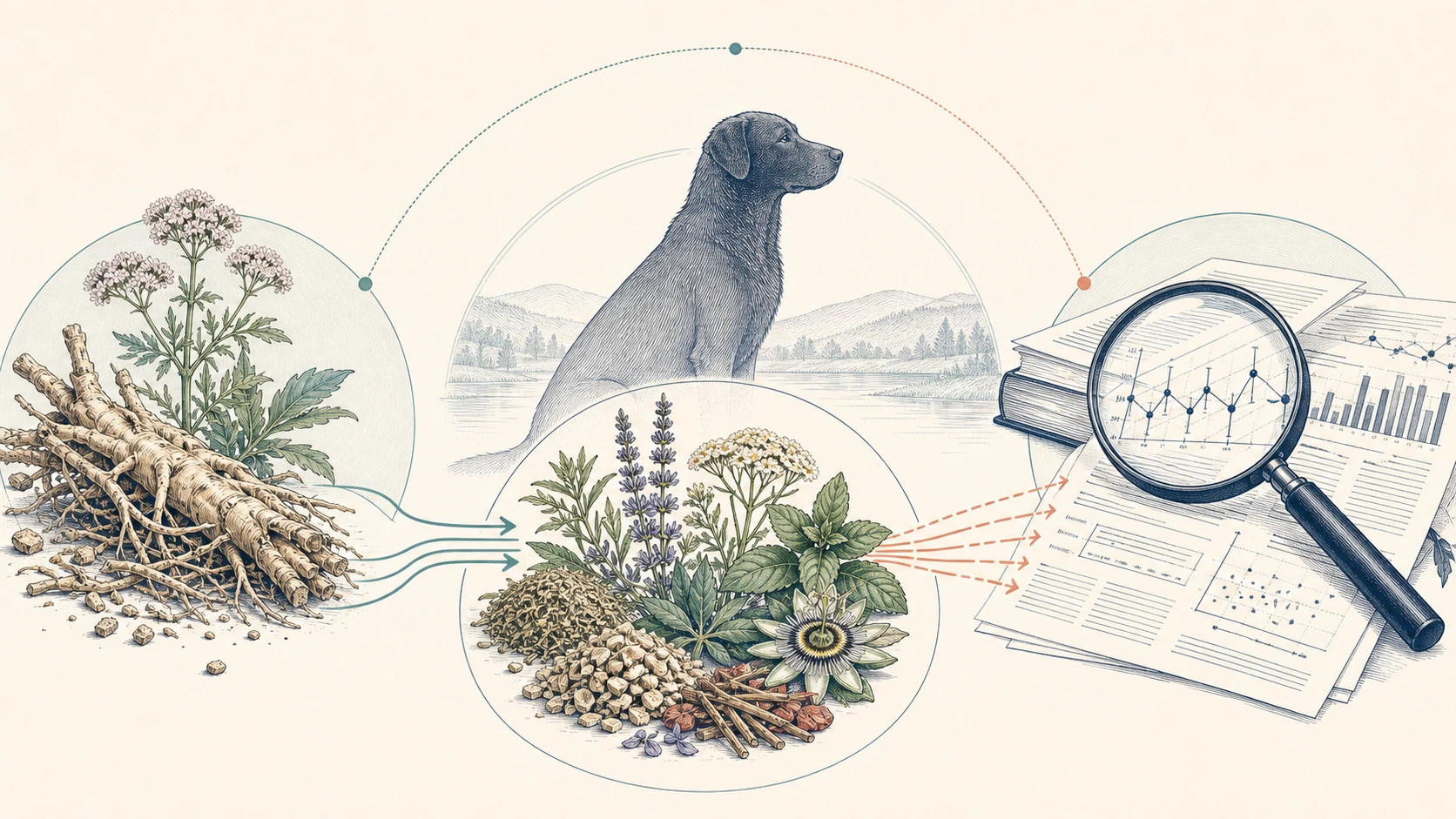
The 44-dog fireworks study evaluated tryptophan, valerian, and passiflora together. Behavioral advice accompanied the intervention, and manufacturer involvement was reported. Those features do not erase the findings, but they narrow the inference. The appropriate conclusion is that the combination warrants further study, not that valerian is proven. [1]
Separate outcome signals from clinical certainty
Small trials are vulnerable to baseline imbalance, variable owner reporting, multiple outcome comparisons, adherence differences, and chance findings. Physiological measures may add context but do not automatically represent a meaningful improvement in fear, safety, recovery, or quality of life. Replication by independent groups strengthens confidence.
A broad review of canine noise-fear interventions describes a mixed evidence base and emphasizes multimodal assessment and management. An ingredient should therefore be compared with established safety planning, behavior work, and veterinarian-directed treatment rather than presented as a stand-alone natural alternative. [2]
Account for product quality and regulatory context
Pet supplements can vary in ingredient identity, concentration, contaminants, stability, and evidence. A veterinary nutraceutical review notes uneven quality, safety, and efficacy data across products. A label does not prove that the contents match a research formulation, and a seal or test may address only selected quality questions. [3]
In the United States, products intended for animals do not occupy a dietary-supplement category equivalent to the human category. Intended use and claims affect regulatory treatment. This makes careful label review, manufacturer documentation, lot information, and adverse-event reporting especially important without turning those checks into an endorsement. [4]
Make the veterinary conversation specific
Bring the complete ingredient list, amount per unit, lot, formulation, intended use, and all current medications and supplements. Explain the target sign: fireworks panic, travel distress, sleep disruption, separation-related behavior, pain-associated restlessness, or something else. Different problems require different assessments.
Ask whether sedation could mask distress without improving emotion, whether interactions or organ disease alter risk, how long a trial would be evaluated, which outcome matters, and what adverse signs mean stop. This article provides no dose because the packet does not establish a canine valerian dose, product equivalence, or a safe universal regimen.
The article remains distinct from the general calming-supplement overview by answering one narrow question: what does current canine evidence establish about valerian itself? At present, the answer is limited. Evidence for a combination is not valerian-alone evidence, and uncertainty should remain visible in the decision. [1] [3] [5]
Prepare for a focused veterinary conversation
Bring a concise timeline, short natural-movement or symptom videos when safe, the exact names and photographs of every food, treat, medication, and supplement label, and notes about appetite, water intake, stool, sleep, activity, comfort, and behavior. Include recent injuries, travel, boarding, diet changes, missed medication, and previous test results. A complete record helps the veterinary team separate a repeatable pattern from a single impression.
Decide in advance what you need from the visit: an urgency decision, a diagnosis plan, a nutrition review, a pain or mobility assessment, or a monitored trial. Ask what result would change the plan and what finding would rule an option out. This keeps research and product information in the right role. Evidence can shape questions and expectations, but it cannot determine what is safe for an individual dog without the history and examination.
Owner tool
Read valerian evidence at the correct level
On a phone, swipe across the table to see every column.
| Evidence question | What is known | What is not established |
|---|---|---|
| Ingredient | Valerian included in a combination | Valerian-only effect |
| Population | Small fireworks-related dog trial | All anxiety conditions |
| Product | One studied formulation | Other labels or batches |
| Safety | Trial observations | Universal dose and interactions |
Better questions, calmer next steps
Questions to ask your veterinarian
- What condition or behavior are we actually trying to address?
- Does any evidence test this exact ingredient and formulation?
- Could current medications or health conditions change risk?
- What quality documentation and adverse-event contact exist?
- Which outcome and stop signs would define a responsible trial?
FAQ
Does the combination trial prove valerian works?
No. It cannot isolate valerian from the other ingredients or concurrent advice.
Is valerian safe because it is herbal?
No. Herbal ingredients can cause adverse effects, interactions, and formulation problems.
What dose should a dog receive?
This evidence packet does not establish a safe universal canine dose; consult the veterinarian.
Can valerian replace behavior medication?
No. Do not stop or replace prescribed treatment without veterinary direction.
Are human valerian products suitable?
Not automatically; they may contain inappropriate ingredients, concentrations, solvents, or sweeteners.
Sources
- Veterinary Sciences: Behavioral and Physiological Effects of a Multi-Ingredient Fireworks Supplement. Combination trial findings and attribution limits.
- Frontiers in Veterinary Science: Therapy and Prevention of Noise Fears in Dogs. Comparative intervention evidence and limitations.
- Veterinary Sciences: Veterinary Pet Supplements and Nutraceuticals. Evidence, quality, safety, and oversight limitations.
- U.S. Food and Drug Administration: Animal Foods and Feeds. U.S. animal-product regulatory context.
- Cornell University College of Veterinary Medicine: Fear of Fireworks and Thunderstorms. Vet-first safety and behavior-care context.
