

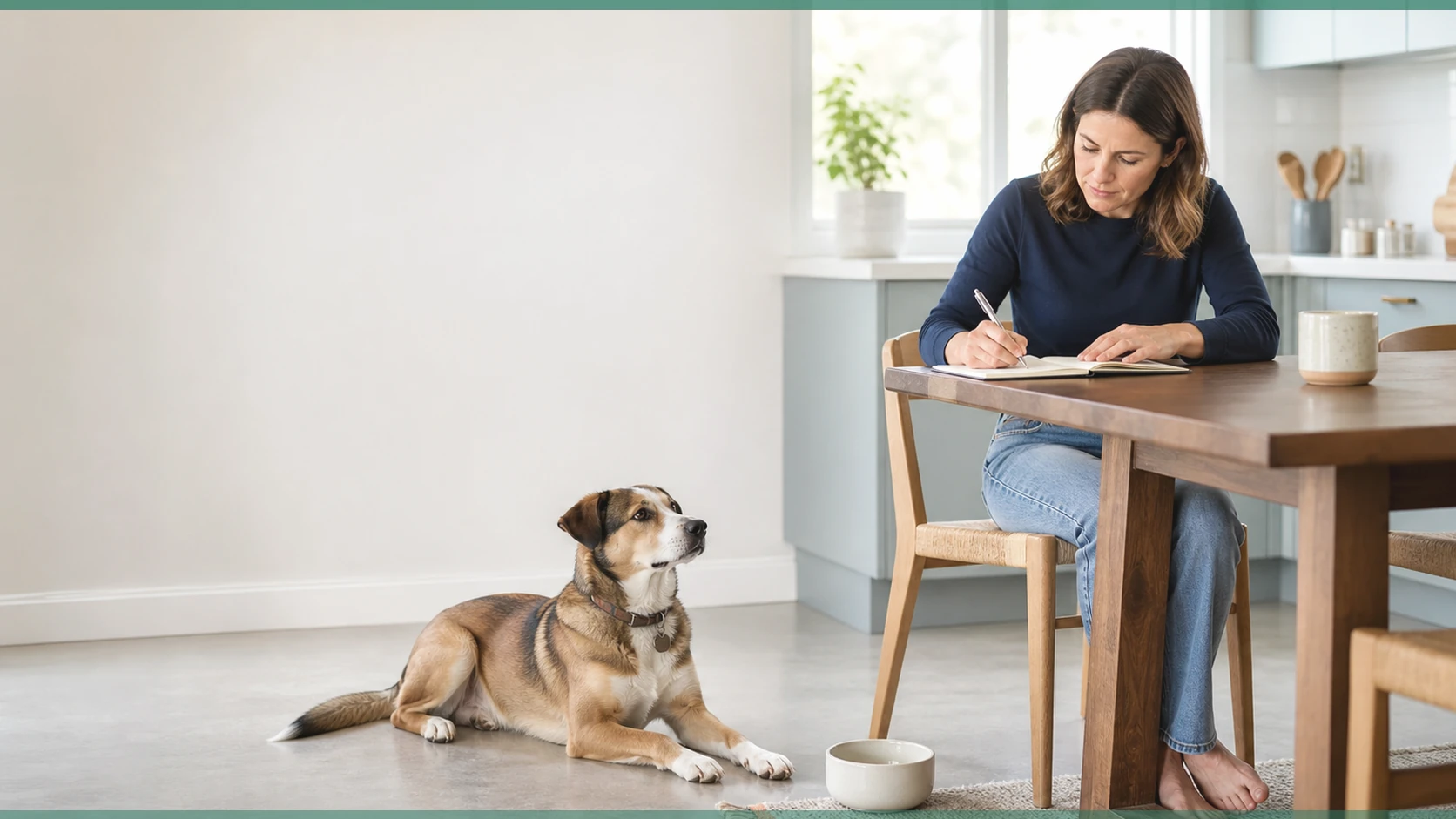
Once the feeding plan is agreed, the everyday task is getting the intended food into the right bowl, in the right amount, without guesswork between caregivers. This guide helps you turn those instructions into a practical meal-preparation routine.
You have the food your veterinary team recommended and a schedule that fits your household. Then dinner gets busy. Someone uses a different scoop, a prepared container goes unlabeled, or two people both assume the other has fed the dog. These are preparation problems, not proof that you chose the wrong diet.
This page starts after the feeding decisions have been made. If you still need to choose how often or when to feed, begin with our guide to choosing a meal schedule for sensitive digestion. Here, the aim is to carry out that plan accurately for a clinically stable adult dog, not create another one.
Short answer
Separate preparing a meal from serving it
Check the exact food and written portion instructions before you start. Measure using the agreed units, identify whose meal it is, and mark it served only when it reaches that dog. A ready container is not evidence that a meal was eaten. This is household organization, not a treatment for digestive symptoms.
- Use one current instruction sheet, not several remembered versions.
- Keep preparation, serving and intake as separate entries.
- Ask about unclear amounts instead of quietly changing the allowance.
Safety first
An unwell dog needs more than a tidier feeding station
Repeated vomiting, black or bloody stool, reduced appetite, recurring diarrhea or unexplained weight loss need veterinary attention. Vomiting with diarrhea or unusual lethargy deserves prompt contact. Collapse, severe abdominal pain or pronounced abdominal swelling need urgent assessment. Do not keep rearranging portions to explain these signs, impose fasting, or withhold water while waiting for the routine to work.
Veterinary note
This is educational guidance for carrying out existing instructions, not diagnosis or treatment. Prescribed diet and medication directions take priority. Read HPE’s medical disclaimer.
Check what the instruction actually says
Before organizing containers, put the current instructions beside the actual food. Confirm the product name, recipe and format. A bag and a can sharing a brand name are not interchangeable portions. If your plan includes more than one food, ask for each amount to be written separately.
Read the amount aloud with its unit: grams, a specified measuring cup, part of a particular can, or another clearly defined measure. Then check whether it means each meal or the whole day. “One cup” without that distinction leaves too much room for interpretation.
AAHA recommends specific feeding plans that account for the diet, amount, frequency and extras. Those guidelines do not provide an individual prescription for your dog’s digestive history. The useful preparation step is checking that you understand the prescription you already have.
If you are still working out the amount itself, use our overview of dog food portion sizes to prepare questions for your team. Do not use today’s empty container, appetite or feeding-chart estimate to create a new target here.
Measure the instruction without changing it
A mug, a rounded scoop and a marked measuring cup can all look like “a cup” in conversation. Choose the measure specified in the plan and keep it with the instructions. Ask the clinic to clarify an imprecise scoop description rather than expecting every caregiver to interpret it the same way.
If the instruction is in grams, use a suitable scale according to its directions. Check its unit setting and account for the empty container before adding food. That is a way to carry out a gram instruction, not a reason to convert a cup-based plan using an internet average. If the instrument cannot measure the intended amount reliably, ask for help.
For mixed meals, keep each component identifiable during preparation. Do not replace an agreed amount of one food with the same volume of another and assume the meal is equivalent. Likewise, do not estimate medication or supplement doses with the food scoop.
A simple check is to read the prepared portion back against the written instruction before putting it away. You are checking whether the task matches the plan, not whether the bowl looks generous enough. If the numbers disagree, pause the disputed preparation and clarify them; do not independently reduce or increase the dog’s daily food.
Prepare only what you can identify and store properly
Organizing ahead should make the next meal clearer, not create a row of mystery containers. Identify the dog, intended meal and contents. If food is removed from its original packaging, keep the product information available. A label such as “dinner ready” is more useful than an unlabeled bowl beside the sink.
FDA advises clean hands and clean bowls and measuring utensils, with a separate scoop rather than using the feeding bowl to scoop food. It also advises secure storage, retaining dry food in its original bag, and promptly refrigerating or discarding unused canned or pouched food. Follow the exact product’s preparation and storage directions.
Do not assume a whole week of assembled meals is suitable for every food. Wet, dry and mixed meals can have different handling requirements. Our separate food-storage and handling guide covers the wider setup. This page does not set a universal make-ahead shelf life or recommend leaving prepared food out until the dog wants it.
The retained illustration provides visual context only; it does not demonstrate measuring, specify a recipe or calculate portions. Use the amounts and food choices agreed for your dog.
Owner tool
A check sheet for one meal, not another feeding plan
Keep this beside the existing schedule. Its job is to show where a meal is in the process. It does not decide what the dog needs or prove that digestive symptoms are controlled.
| Stage | Record or check | Do not assume |
|---|---|---|
| Instructions checked | Dog, exact food, portion, unit and current plan date. | A familiar-looking package is the same recipe. |
| Prepared | Measured contents, intended meal and preparer initials. | Food prepared means food served. |
| Stored | Location and handling directions for this food. | Every meal can wait on the counter. |
| Served | Actual serving time, correct dog and feeder initials. | An empty container proves the dog ate. |
| After the meal | Approximate amount left and any concern to report. | Leftovers should automatically be added to dinner. |
For example, one caregiver might write “prepared, refrigerated as directed” while another later records “served; some left.” Neither needs to recreate a digestive diary. The distinction simply prevents a preparation note from being mistaken for a completed feeding.
At serving time, check the dog as well as the label
In a multi-dog household, confirm which dog receives the prepared meal. Notice if another animal reaches the bowl or if food is spilled. Record uncertainty honestly instead of guessing that the intended portion was eaten. The veterinary team needs the actual picture, including access to another pet’s food.
Keep the agreed meal time and any medication-linked instructions intact. Do not turn an interrupted afternoon into a new rule about feeding before or after exercise. If activity or work regularly conflicts with the plan, return to the scheduling discussion rather than improvising an interval.
When a meal is late, partly eaten or possibly served twice, use the clinic’s instructions for that situation. If you have none, contact the team for advice. This guide cannot tell you to skip, double, replace or redistribute a meal safely for an individual dog.
Better questions, calmer next steps
Ask about the gaps in the preparation instructions
- Does this amount mean each meal or the whole day?
- Can you clarify the measuring unit and each component of a mixed meal?
- How should we handle a delayed, unfinished or possibly duplicated feeding?
- Which extras are already included, and which storage directions apply?
FAQ
What if the cup amount and gram amount seem different?
First check that both refer to the same product and the same period: one meal or one day. Do not average them or choose whichever makes the bowl look right. Ask the clinic or manufacturer to clarify product-specific measurement information, with your veterinary team confirming the feeding instruction.
Can I prepare seven days of meals at once?
Only if the food’s handling instructions and your dog’s plan support that arrangement. Organization does not establish shelf life. Start by checking the exact label and any manufacturer directions for opened or mixed food. Avoid making a large batch whose contents or storage requirements you cannot verify.
Where do training food and medication treats belong?
Keep the team-approved extras visible in the existing plan, separately identified from the meal. AAHA includes snacks and food used with medication in feeding recommendations. Do not remove a prescribed medication vehicle or substitute something new to make your portions easier. Discuss uncertain extras with the team.
What if nobody knows whether breakfast was served?
Check the prepared portion and the feeding record, and ask the other caregiver. Do not use begging or a clean bowl as proof either way. If uncertainty remains, follow the veterinary team’s missed-or-duplicate-meal advice. For next time, separate “prepared” from “served” where both caregivers can see it.
Make the next bowl easier to get right
Choose one point of confusion at your feeding station: unclear units, an unlabeled portion or a preparation note that looks like a feeding confirmation. Fix that point without redesigning the dog’s diet. A useful routine makes the agreed instructions easier to follow and mistakes easier to explain.
If your dog remains uncomfortable despite clear preparation, bring the concern back to your veterinarian. Accurate measuring is useful information, not proof that the symptoms must have another simple household solution.
Sources
- AAHA: Feeding Plans. Specific feeding instructions and extras; healthy-patient guidance, not an individual digestive treatment.
- AAHA: Comprehensive Nutrition History. Food, caregivers, activities and environmental context.
- FDA: Safe Handling of Pet Food and Treats. Preparation, cleaning and storage precautions.
- Cornell: Diarrhea. Appetite changes and concerning digestive signs.
- MSD Veterinary Manual: Digestive Disorders of Dogs. Symptoms that require professional assessment.
