


A feeding schedule has to work for the dog at the bowl and the people filling it. Start with the current food allowance, identify what needs to change, and ask your veterinary team which options fit your dog.
When your dog has a history of digestive trouble, breakfast can come with questions. Would an earlier meal help? Is dinner too large? Should you offer lunch, or would that simply add another opportunity for the family to feed twice?
You do not need to solve every question by changing the food. You also do not need to keep moving meals around in search of a perfect hour. This guide helps you prepare a manageable schedule for a clinically stable adult dog. For ongoing symptoms, begin with our guide to digestive issues and veterinary care, rather than treating the calendar as the cause.
Short answer
Choose the number of meals separately from the amount of food
Many adult dogs eat two meals daily, but digestive history, medications and individual needs can change the plan. More meals should divide an agreed daily food allowance, not silently increase it. There is no single meal count or clock time that treats every sensitive stomach.
- Confirm the daily amount before discussing a different meal pattern.
- Choose times that caregivers can reliably cover.
- Use veterinary instructions for symptoms or condition-specific feeding needs.
Safety first
Do not use a new timetable to explain away illness
Contact your veterinarian promptly for repeated vomiting, bloody or black tarry stool, reduced appetite, weight loss or recurring digestive trouble. Marked weakness, collapse, severe pain or a swollen painful abdomen need urgent assessment. Vomiting together with diarrhea can be especially concerning. Do not complete a home schedule experiment before seeking help, withhold water, or impose fasting without veterinary direction.
Veterinary note
This is educational planning guidance, not a diagnosis or treatment. Your dog’s prescribed feeding and medication instructions take priority. See HPE’s medical disclaimer.
First, name the decision you are trying to make
“Sensitive digestion” describes a concern; it does not identify its cause. Before choosing a schedule, put your question into one sentence: “We need a feeding pattern that everyone can follow,” or “My dog regularly leaves part of dinner and I need advice.” Those are different problems.
Make three separate notes:
- Frequency: how many feeding opportunities the dog currently has.
- Timing: when those meals are actually offered, including weekends.
- Amount: the food offered over the whole day, including extras.
If the problem is a missed caregiver handoff, improve the handoff before buying a new food. If it is repeated vomiting, pain or poor appetite, that is a clinical question. A clock cannot tell you whether a symptom reflects the food, a medication, another exposure or an underlying illness.
AAHA’s nutrition-history guidance includes the people, food and environment involved in feeding. Give your team an ordinary-day picture, not the schedule you wish the household followed. An honest account is useful, not an admission of failure.
Compare realistic patterns without declaring one the winner
Keeping the existing pattern
If an established plan is working, convenience or a social-media trend alone is not a reason to replace it. Ask whether the concern is new, and whether the veterinary team wants the schedule changed at all. Sometimes the useful improvement is documenting what already happens.
Discussing two meals or smaller divided meals
VCA describes two daily meals as a common adult-dog recommendation, while recognizing individual exceptions. Smaller, more frequent meals may be appropriate for some dogs, but “more frequent” is not automatically gentler or better. Ask which pattern fits your dog’s history and how the current daily amount would be distributed.
Also test the proposal against a normal Tuesday. Who would serve lunch? What happens when that person is out? A schedule requiring an unavailable caregiver is not a reliable household plan. Raise that constraint with the clinic rather than inventing a substitute meal or interval yourself.
A dog who grazes
Describe grazing accurately: food offered, food remaining, access by other pets and any unrecorded top-ups. Do not assume an apparently full bowl means the dog has eaten enough. Ask whether the current arrangement should stay or change; avoid suddenly restricting access to force a new habit in a dog with feeding concerns.
Keep the daily food total visible
Adding a meal and adding food are not the same decision. AAHA recommends a specific feeding plan covering the food, amount, frequency and extras. Ask for clear units, not just “one scoop,” particularly when caregivers use different containers.
Here is a bookkeeping example, not a feeding prescription: if the team has already set a daily amount, dividing that amount into three meals means the three portions together still equal that allowance. It does not mean keeping both old meals unchanged and adding a full lunch.
Write down approved training rewards, food used with medication and other extras as well. Do not remove prescribed food or medication vehicles to make the numbers look neater. If the allowance is unclear, ask the clinic to reconcile it before you redistribute portions. You do not need a new calorie formula from an article.
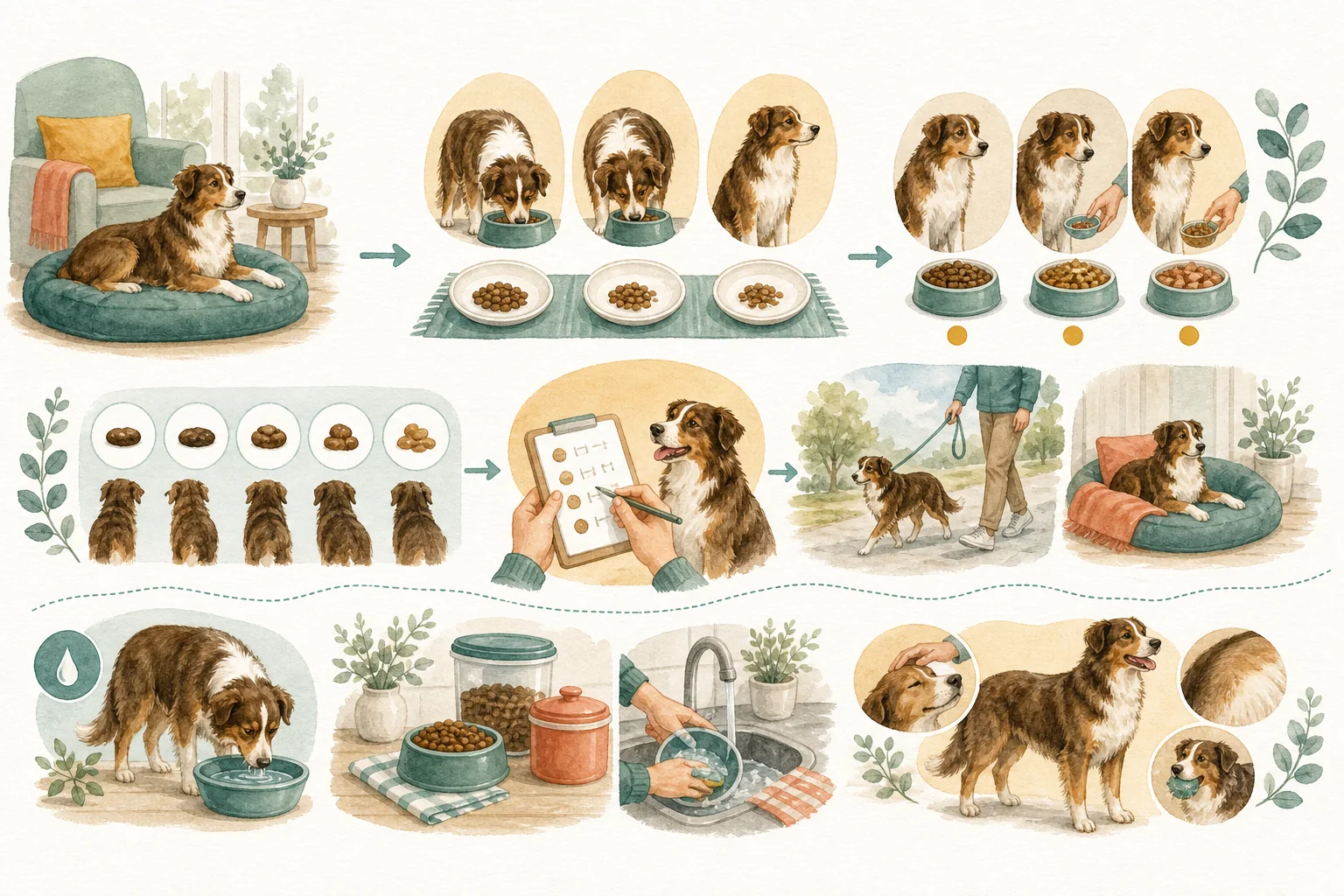
The illustration is an overview, not a portion chart, recommended ingredient list or required sequence of meals. Use your dog’s own feeding instructions for amounts and food choices.
Owner tool
Build one caregiver-ready schedule card
Complete this card with the veterinary team’s instructions where needed. It is a household organizer, not a clinical test. Leave unknown answers marked “ask the clinic” instead of turning guesses into rules.
| Decision | Write down | Confirm before changing |
|---|---|---|
| Daily allowance | Exact food and total amount, with clear units. | Does the team need to review the amount? |
| Meal pattern | Agreed number of meals and each portion. | Do all portions add up correctly? |
| Timing and cover | Agreed times, named feeder and backup person. | Do medication instructions constrain timing? |
| Completion | Meal offered, approximate amount eaten, feeder initials. | Who handles a missed or unfinished meal? |
| Follow-up | Clinic contact, review plan and stop signs. | Which change needs an earlier call? |
Keep one current copy where feeding happens. For example, a caregiver can initial “breakfast offered” rather than sending an ambiguous “done” message. That small distinction lets the next person check what happened without assuming the whole bowl was eaten.
Make timing workable without inventing medical rules
Tell the team about work shifts, school runs, walks and bedtime before agreeing on times. There is no need to copy another household’s breakfast hour. If a prescribed schedule conflicts with work, ask for an acceptable alternative or a backup-care arrangement.
Do not move meals that are linked to insulin or other medication without checking the prescribing team’s instructions. Puppies, pregnant or nursing dogs, and dogs with diagnosed disease need plans suited to those circumstances; this adult-dog guide does not supply them.
Preparation matters too. FDA guidance calls for clean bowls and utensils and prompt refrigeration or disposal of unused canned or pouched food. Do not assume a timer makes any food safe to leave out. Follow the product’s storage directions and confirm suitability before relying on an automatic feeder.
Know what would make you contact the clinic again
Agree on follow-up before changing the routine. Ask what to do if the dog declines a meal, eats only part of it or develops a new sign. Avoid an automatic “double the next meal” rule or repeated schedule changes based on one difficult evening.
A note such as “dinner offered later than planned; half remained” is clearer than “late dinners cause trouble.” If a different schedule seems helpful, describe that observation without treating it as a diagnosis or proof that a digestive problem has resolved.
When several caregivers or an unusual week complicate the picture, use the separate guide to tracking gut health during disrupted routines. Keep this page’s schedule card focused on who feeds, when and how much.
Better questions, calmer next steps
Take these questions to your veterinary team
- Is changing frequency appropriate, or do these symptoms need assessment first?
- What daily amount, meal portions and timing do you recommend for this dog?
- What should we do about a refused, delayed or unfinished meal?
- Do medications or a prescribed diet change the plan?
- When should we review it, and which signs mean calling sooner?
FAQ
Are three meals always better than two for sensitive digestion?
No universal advantage is established for every dog described as sensitive. Ask what changing the frequency is intended to accomplish for your dog. Any agreed additional meal should be part of the daily allowance, not an unexplained extra portion.
Does research mean I should switch to once-daily feeding?
No. The 2022 Dog Aging Project analysis found associations, not proof that one feeding pattern caused better health. Dogs with illness might already have been fed more often, and calorie intake was not measured. The authors cautioned against using the study to change feeding or clinical care. It is not a fasting prescription.
Should I add a bedtime snack if my dog vomits early?
Do not assume the timing explains the vomiting. Tell the veterinarian when it happens, what it looks like and whether appetite or behavior has changed. A snack or different schedule may be part of an individualized plan, but this guide cannot determine the cause or prescribe that change.
What if weekends make the schedule difficult?
Include weekends when discussing the plan, rather than presenting an ideal weekday routine. Ask which flexibility is acceptable and arrange backup feeding when necessary. Keep any medication-linked requirements intact. A written plan should reflect the care you can deliver, not require anyone to conceal ordinary household constraints.
Your next step: clarify one plan, not ten possibilities
Write down the current daily allowance, actual meal pattern and the specific question you want answered. Use those details to agree on a schedule, including how caregivers record meals and handle a problem. You are aiming for a plan the household understands, not perfect obedience to a stranger’s clock.
If feeding changes have become a response to continuing symptoms, bring that pattern back to the clinic. You have not failed because timing alone did not solve it.
Sources
- VCA: Feeding Times and Frequency for Your Dog. General guidance and individual exceptions.
- AAHA: Feeding Plans. Amount, frequency and extras; healthy-patient scope.
- AAHA: Comprehensive Nutrition History. Food, caregivers and environmental context.
- Cornell: Diarrhea. Signs needing veterinary attention.
- FDA: Safe Handling of Pet Food and Treats. Preparation, cleaning and storage.
- Bray and colleagues, GeroScience, 2022. Observational feeding-frequency research and its limitations.
- MSD Veterinary Manual: Digestive Disorders of Dogs. Signs and the need for clinical assessment.
