

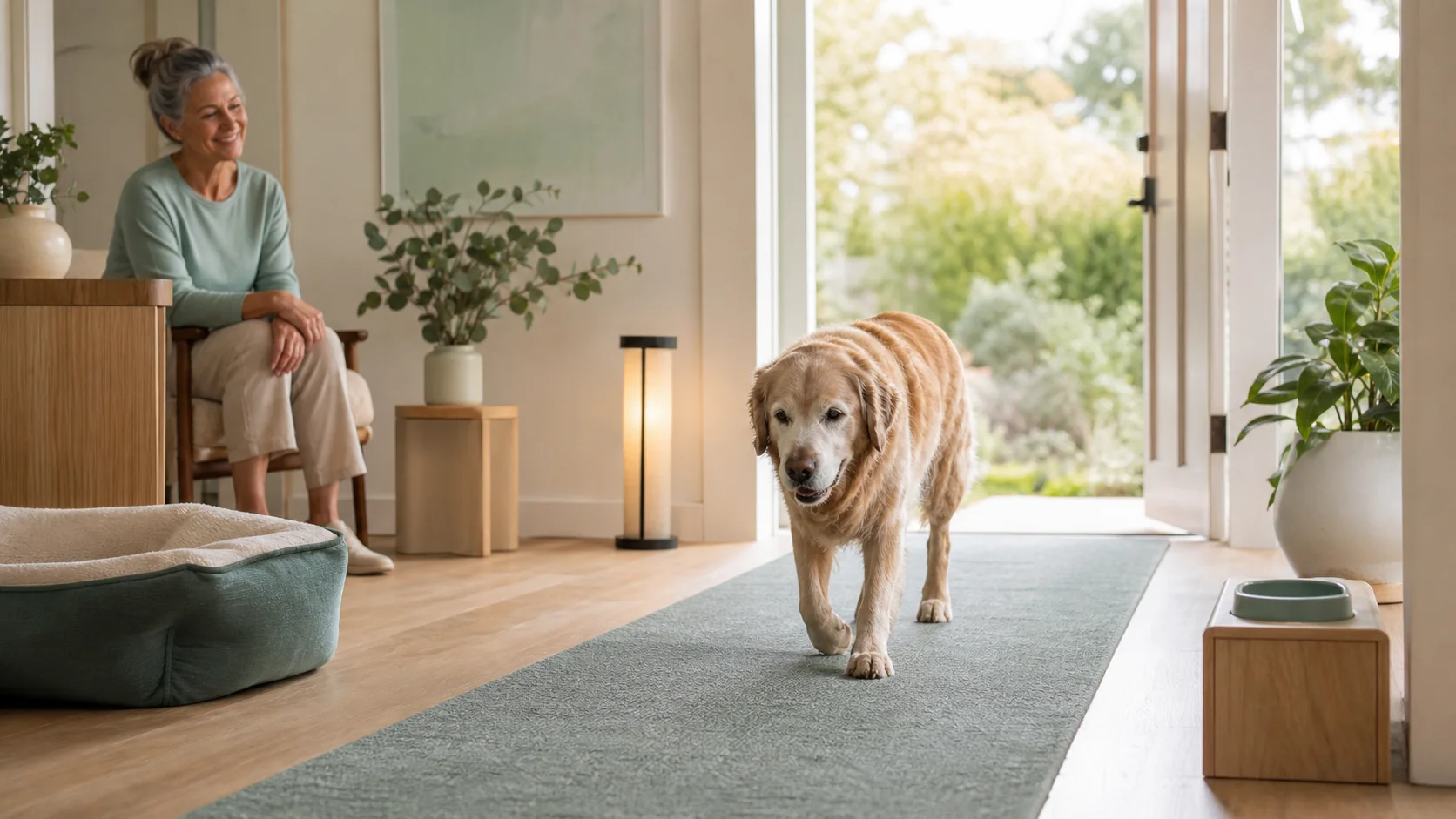
A practical indoor-and-outdoor safety review for reducing avoidable effort and hazards while preserving a senior dog's comfort, choices, and connection.
Short answer
Improve traction, access, lighting, and supervision before adding complexity
Senior and mobility-limited dogs may have less margin for slippery floors, stairs, clutter, poor lighting, heat, and uneven ground. A home audit can reduce common hazards, but modifications should match the individual dog's mobility, vision, cognition, size, and veterinary plan.
- Create non-slip routes between rest, water, food, and bathroom access.
- Block unsafe stairs and fit ramps or support devices with professional guidance.
- Keep exits, yards, and emergency routes accessible in all weather.
- Treat repeated slips, stumbles, navigation trouble, or new nighttime restlessness as reasons for veterinary assessment.
Safety first
A fall or sudden mobility loss needs prompt care
Contact a veterinarian immediately after a significant fall, stair tumble, sudden inability to stand or walk, severe pain, bleeding, head trauma, suspected fracture, or paralysis. Repeated minor slips, new navigation problems, or getting stuck behind furniture also warrant veterinary evaluation and a renewed home audit.
Veterinary note
Educational information only; contact a veterinarian for diagnosis, treatment, or urgent concerns. This guide supports observation and preparation; it does not diagnose a condition or replace an individualized care plan.
What is reasonably supported
Use repeated observations to improve the veterinary conversation
Senior-care and hazard-preparedness guidance supports non-slip flooring, accessible resting areas, ramps or steps when appropriate, manageable nail length, secure household hazards, and environmental adjustments for changes in mobility, vision, hearing, or cognition.
What remains uncertain
Home observations cannot establish the cause
No modification guarantees that a fall or injury will not occur. The safest layout, ramp angle, harness, exercise level, and assistance method vary with the dog's condition and the home, and some changes require veterinary rehabilitation or mobility-device expertise.
Walk the dog's daily route
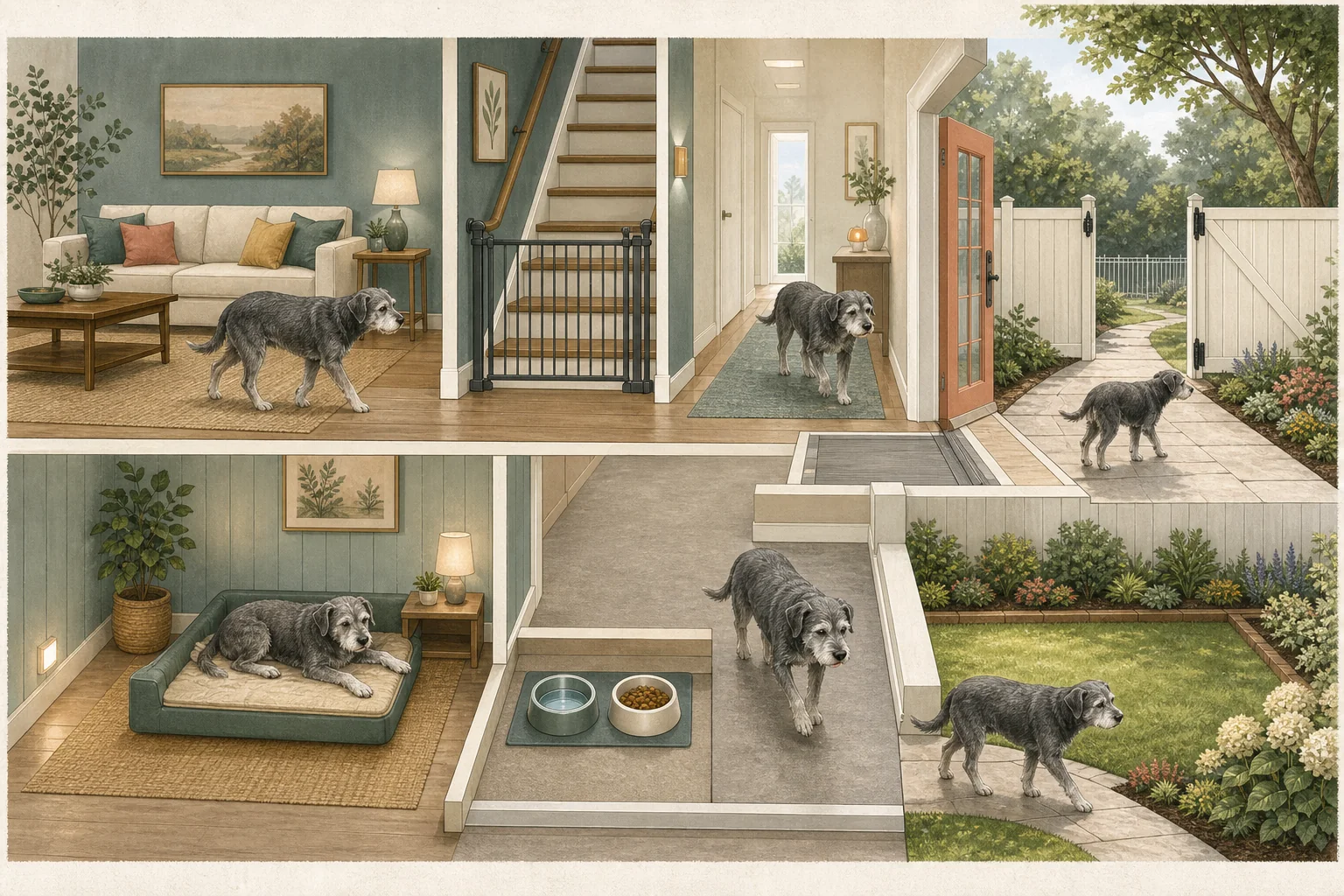
Start at the main sleeping area and follow the path to water, food, the exit, bathroom area, and family spaces. Look from the dog's height for tight turns, unstable rugs, cords, sharp corners, and places where furniture narrows the route.
Observe the route during the day and at night. A dog may manage a surface when alert but struggle when tired, hurried, or waking. Record where paws slide, hesitation occurs, or the dog seeks a wall for support rather than assuming the problem is stubbornness.
Create continuous traction
Use stable non-slip runners or mats to connect important destinations instead of placing isolated islands of traction. Secure edges so they do not curl or shift, and keep surfaces dry. Test the route while the dog turns, rises, and approaches bowls.
Maintain nails and paw fur according to veterinary or grooming guidance because overgrown nails or excess fur can affect footing. Do not use adhesive products, booties, or surface coatings without considering skin, fit, heat, and the dog's ability to adapt safely.
Manage stairs, furniture, and elevation
Block unsupervised stairs when a dog cannot use them reliably. Move essential activities to one level when possible. Prevent jumping from beds, sofas, porches, and vehicles if it causes pain, hesitation, or instability.
Ramps and steps must be wide, stable, grippy, and suitable for the height and dog. Introduce them gradually with calm support. A steep, narrow, or shifting ramp can create a new hazard, so ask the veterinary or rehabilitation team about fit and training when mobility is significantly limited.
Improve rest, bowls, and nighttime access
Provide an accessible resting area that supports comfortable repositioning without requiring a high step. Keep the dog near family life while also offering quiet rest. Avoid unattended human heating pads because burns can occur, especially when sensation or mobility is reduced.
Place stable food and water bowls on traction and where the dog can approach without tight turns. Add gentle night lighting along the route to water and the exit. Reduce clutter and keep furniture placement consistent for dogs with vision or cognitive changes.
Audit the yard and weather plan
Check gates, steps, decks, mud, ice, holes, roots, gravel, steep slopes, pools, and toxic plants. Create a short supervised bathroom route with secure traction and enough room to turn. Recheck after storms, landscaping, or seasonal change.
Plan for heat, cold, rain, and snow before they arrive. Keep towels, traction supplies, a fitted support harness if approved, and an alternative indoor or covered route ready. Do not leave a mobility-limited dog unattended near water, stairs, wildlife, or unstable ground.
Prepare for changes and emergencies
Keep the leash, current medication list, veterinary contacts, blanket, and transport plan accessible. Practice how two adults would guide the dog through the primary and backup exits without lifting unsafely or pulling on the collar.
Reaudit after a fall, new diagnosis, vision or hearing change, cognitive signs, weight change, or altered medication. A home that worked six months ago may no longer match the dog's abilities. Environmental adjustment and medical reassessment should move together.
Owner tool
Home and yard mobility-safety audit
Mark each zone as clear, needs repair, or needs professional guidance. Recheck after any mobility change.
| Zone | Look for | Safer direction |
|---|---|---|
| Daily route | Slips, clutter, tight turns | Continuous clear traction |
| Stairs | Unsupervised access, hesitation | Gate, relocate routine, seek guidance |
| Rest | High entry, unstable bedding | Accessible stable support |
| Bowls | Sliding, awkward posture | Stable placement on traction |
| Night | Dark route, moved furniture | Gentle lighting and consistency |
| Yard | Mud, ice, holes, plants, water | Supervised short clear route |
| Exit | Narrow path, no transport plan | Primary and backup accessible routes |
A three-step next action
Watch one full route
Observe the dog moving between rest, water, exit, and family spaces without prompting.
Fix simple hazards
Secure rugs, clear clutter, improve lighting, and block unsafe access.
Escalate the difficult choices
Ask the veterinary or rehabilitation team about ramps, harnesses, activity, and major layout changes.
Prepare for the visit
Questions to take to your veterinarian
- Which movements or surfaces should this dog avoid?
- Would a ramp, steps, or fitted support harness be appropriate?
- Could pain, vision, neurologic, or cognitive change explain the new difficulty?
- How should activity and nail care be adjusted?
- What is the safest transport method during an emergency?
Bring the dated observation log, relevant photos or short videos, and a complete list of foods, treats, medications, and supplements. Do not change the routine solely to produce evidence for the visit.
Frequently asked questions
Are rugs enough to prevent falls?
They may improve traction if secured, but they do not address pain, weakness, vision, cognition, or every hazard.
Should every senior dog use a ramp?
No. Suitability depends on the dog, height, surface, angle, stability, and training.
Why is my dog suddenly getting stuck behind furniture?
Navigation difficulty can have medical, sensory, or cognitive causes and should be discussed with a veterinarian.
Can I use a human heating pad on the bed?
Unattended human heating pads can cause burns. Ask the veterinary team about safe comfort options.
Sources
- AAHA Senior Care Guidelines – Your Senior Pet, American Animal Hospital Association. AAHA senior pet guidance encourages owners to **provide orthopedic bedding, avoid unattended use of human heating pads, and manage nail length** to reduce discomfort and prevent mobility-related injuries in older pets.
- 2023 AAHA Senior Care Guidelines for Dogs and Cats, American Animal Hospital Association. AAHA senior-care guidelines recommend environmental modifications such as **non-slip flooring, ramps or steps, and easy access to resting areas** to support mobility and safety in aging pets.
- Pet Hazard Preparedness, American Veterinary Medical Association. AVMA hazard-preparedness materials advise owners to **identify household hazards (chemicals, medications, electrical cords, choking hazards) and secure or restrict access**, which is especially important for pets with impaired mobility or cognition who may not avoid dangers effectively.
- Senior Pet Care FAQ, American Veterinary Medical Association. AVMA senior pet FAQs note that aging pets may develop **arthritis, vision or hearing loss, and cognitive changes**, and recommend that owners **adjust the home environment** (e.g., easier access, reduced obstacles) to maintain safety and comfort.
- Toxic and Non-Toxic Plants, ASPCA Animal Poison Control Center. ASPCA’s toxic plant lists highlight that many **indoor and outdoor plants** can be harmful to dogs, so yard and garden safety audits should include **identifying and managing access to toxic species**.
- Toxic and Non-Toxic Plants – Dogs, ASPCA Animal Poison Control Center. ASPCA’s toxic plant lists highlight that many **indoor and outdoor plants** can be harmful to dogs, so yard and garden safety audits should include **identifying and managing access to toxic species**.
Medical disclaimer
Educational information only; contact a veterinarian for diagnosis, treatment, or urgent concerns. If your dog is showing severe, sudden, or rapidly worsening signs, seek urgent veterinary care.
