


Glucosamine and chondroitin are familiar joint-supplement ingredients, but familiarity is not the same as proven clinical benefit. Canine trials have used different chemical forms, combinations, products, comparators, durations, and outcome measures, producing evidence that is limited and sometimes conflicting.
Short answer
The current evidence does not support a guaranteed benefit
Glucosamine and chondroitin have plausible biological roles and are widely used, yet reviews of canine osteoarthritis studies describe sparse, heterogeneous, and low-quality evidence. A 2022 systematic review and meta-analysis found a marked non-effect for chondroitin-glucosamine products in pain outcomes, while an earlier canine review found conflicting trials and insufficient evidence for confident recommendations. [1] [2]
- A positive laboratory mechanism does not prove that an oral product improves pain or mobility in a dog.
- Combination formulas make it hard to know which ingredient, if any, produced an observed result.
- Do not replace proven veterinary pain management or delay diagnosis while waiting for a supplement response.
Safety first
A supplement trial is not an emergency plan
Contact a veterinarian promptly for sudden non-weight-bearing lameness, severe pain, major swelling, trauma, inability to stand, neurologic signs, collapse, or rapid decline. A dog already receiving pain medication needs veterinary guidance before any product is added or changed.
- Do not stop prescribed medication because a supplement label claims natural joint support.
- Do not use a human combination product without checking every active and inactive ingredient with the veterinarian.
- Report vomiting, diarrhea, poor appetite, unusual bruising, weakness, or any new sign after starting a product.
Veterinary note
This article is educational and does not diagnose, treat, prescribe, or replace care from a licensed veterinarian. Your dog’s history, examination, diet, medications, and current signs determine what is appropriate.
What the ingredients are supposed to represent
Glucosamine is an amino sugar involved in pathways related to glycosaminoglycans, while chondroitin sulfate is a sulfated glycosaminoglycan found in cartilage and other connective tissues. Those biological descriptions explain why researchers became interested in them. They do not establish that an orally administered commercial product reaches a joint in a clinically meaningful form or improves a dog's function.
Products may use different glucosamine salts, chondroitin sources, purity standards, amounts, and companion ingredients. This matters because a trial of one defined formulation cannot automatically validate every product that lists similar words on the label. [1]
Why the canine trials do not tell one simple story
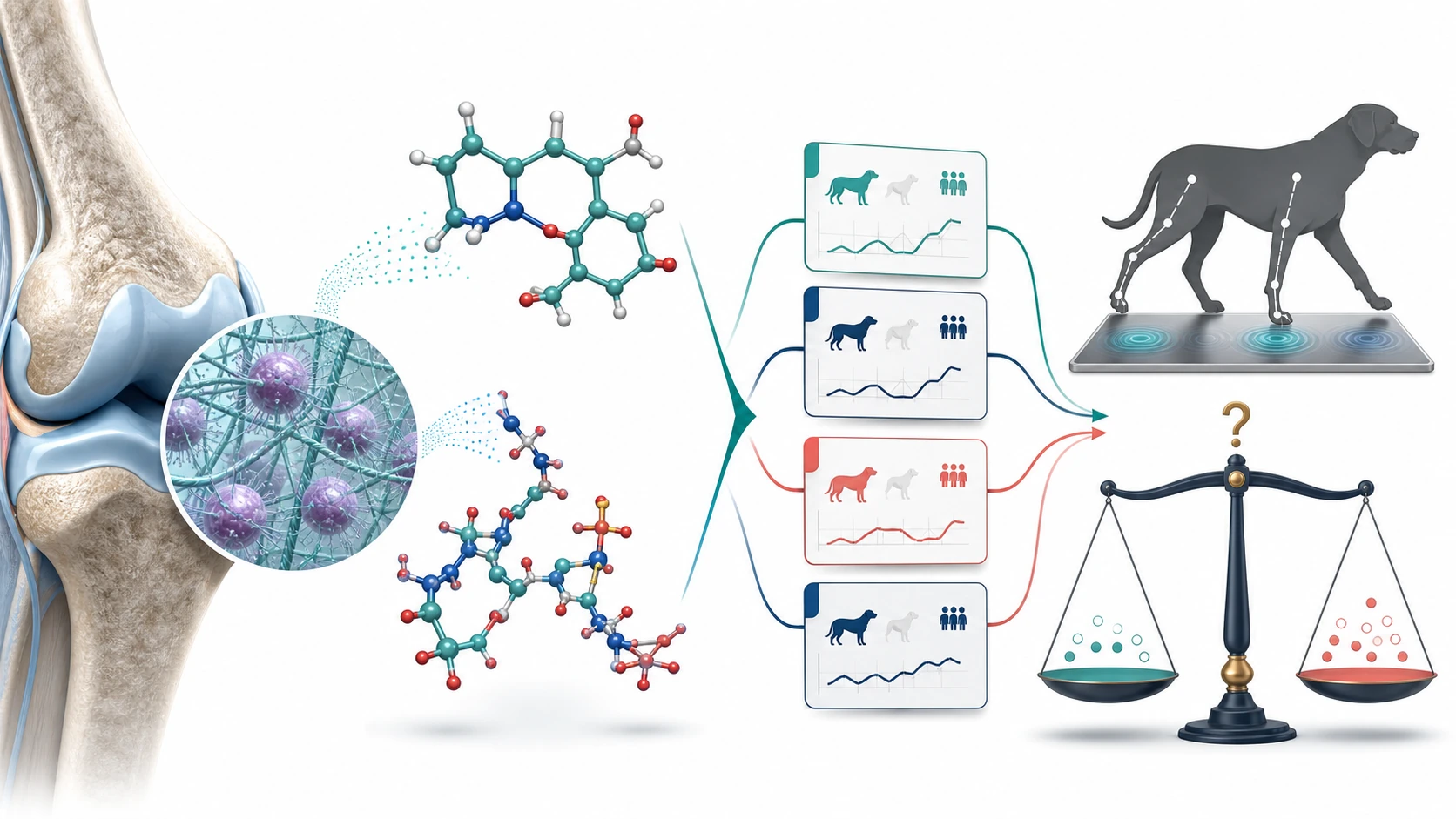
The 2017 canine review identified few controlled trials, different formulas, conflicting results, and design limitations. Some studies compared combination products with an anti-inflammatory drug; others used placebo or baseline comparisons. Subjective lameness and pain scores, veterinarian assessments, and objective force-plate measures did not always agree. [1]
The 2022 systematic review evaluated a larger nutraceutical literature and concluded that chondroitin-glucosamine products showed a marked lack of analgesic efficacy in canine and feline osteoarthritis. That conclusion is about evidence for pain outcomes in affected animals, not proof that every molecule lacks every biological effect. It does mean public claims should remain cautious. [2]
Evidence quality belongs in the owner decision
Ask whether a recommendation is based on a randomized controlled canine trial, a laboratory model, another species, an uncontrolled case series, or ingredient theory. Also ask whether the study product matches the proposed product and whether the outcomes were meaningful to owners: rising, walking, stairs, play, pain interference, or objective limb loading.
Industry funding does not automatically invalidate a study, but funding, sample size, masking, attrition, comparator choice, and selective outcomes should be visible. A transparent summary should acknowledge uncertainty rather than turning one favorable result into a universal promise.
How to discuss an optional trial safely
The first question is whether the dog has a diagnosis and an adequate multimodal pain plan. The veterinarian may prioritize body-weight management, controlled activity, rehabilitation, environmental changes, approved medications, or treatment of an underlying orthopedic problem. Supplements should not displace those decisions. [3] [4]
If a trial is still reasonable, record the exact product and lot, ingredient forms, all other medications and supplements, the target outcome, baseline mobility, observation period, and stop rules. Animal supplement regulation differs from the human dietary-supplement framework, which is another reason to evaluate manufacturing and claims carefully. [5]
Prepare for a focused veterinary conversation
Bring a concise timeline, short natural-movement or symptom videos when safe, the exact names and photographs of every food, treat, medication, and supplement label, and notes about appetite, water intake, stool, sleep, activity, comfort, and behavior. Include recent injuries, travel, boarding, diet changes, missed medication, and previous test results. A complete record helps the veterinary team separate a repeatable pattern from a single impression.
Decide in advance what you need from the visit: an urgency decision, a diagnosis plan, a nutrition review, a pain or mobility assessment, or a monitored trial. Ask what result would change the plan and what finding would rule an option out. This keeps research and product information in the right role. Evidence can shape questions and expectations, but it cannot determine what is safe for an individual dog without the history and examination.
Owner tool
Read a joint-supplement claim like a study reviewer
On a phone, swipe across the table to see every column.
| Question | Stronger evidence | Warning sign |
|---|---|---|
| Who was studied? | Client-owned dogs with defined disease | Cells, rodents, or unspecified pets presented as canine proof |
| What was tested? | A clearly identified formulation | A broad ingredient name used to validate every product |
| What changed? | Validated function, pain, or objective gait outcome | Only a laboratory marker or testimonial |
| Compared with what? | Placebo or appropriate active comparator | Before-and-after claim without a control |
Better questions, calmer next steps
Questions to ask your veterinarian
- What diagnosis and primary pain plan are we treating?
- How strong is the canine evidence for this exact formulation?
- Could any ingredient conflict with medications, disease, diet, or another supplement?
- Which functional outcome should improve, and how will we measure it?
- When should we stop the product or choose a different plan?
FAQ
Do glucosamine and chondroitin rebuild cartilage in dogs?
Commercial claims may imply this, but current clinical evidence does not establish that oral products rebuild damaged canine joint cartilage or reverse osteoarthritis.
Why do some studies sound positive?
Trials differ in formulation, design, comparator, duration, and outcomes. A positive result for one combination does not prove every product works.
Are these ingredients harmless because they are natural?
No product is risk-free. Tolerance, inactive ingredients, contamination, interactions, and the dog's conditions all matter.
How long should I try a joint supplement?
There is no universal trial length. Set the target, timing, and stop rules with the veterinarian instead of using a generic online schedule.
Can a supplement replace an NSAID or other pain treatment?
Do not stop or replace prescribed treatment without veterinary direction. Osteoarthritis management is usually multimodal.
Sources
- Open Veterinary Journal: Glucosamine and Chondroitin Use in Canines for Osteoarthritis: A Review. Critical review of sparse and conflicting canine trials.
- Frontiers in Veterinary Science: Systematic Review and Meta-Analysis of Enriched Diets and Nutraceuticals. Comparative evidence for pain outcomes, including chondroitin-glucosamine products.
- American College of Veterinary Surgeons: Osteoarthritis in Dogs. Diagnosis and multimodal management context.
- Cornell University College of Veterinary Medicine: How Joint Supplements Can Help with Orthopedic Conditions. Veterinary overview of ingredient evidence and product discussion.
- FDA: FDA's Regulation of Pet Food. Regulatory distinction for products marketed as animal supplements.
