


Fiber is not one ingredient with one predictable effect. Different fibers hold water, add bulk, form gels, or provide fermentable material for colonic microbes. That variety explains why one dog may improve on a carefully selected fiber strategy while another develops softer stool, gas, poor appetite, or an unbalanced diet.
Short answer
The useful question is not simply whether fiber is good
The better question is which fiber property fits the dog's nutritional goal. Solubility describes whether a fiber disperses in water. Fermentability describes how readily colonic microbes use it. Viscosity describes gel formation. These traits overlap, so labels such as soluble and insoluble are helpful starting points rather than complete predictions.
- Whole-diet formulation matters more than adding a spoonful of a fashionable ingredient.
- Stool quality, appetite, body weight, gas, urgency, and comfort are practical response measures.
- Persistent diarrhea, constipation, weight loss, vomiting, or pain needs veterinary assessment before experimentation.
Safety first
Do not use fiber to mask a potentially serious digestive problem
Call a veterinarian promptly for repeated vomiting, blood in stool or vomit, black stool, a painful or swollen abdomen, marked weakness, collapse, inability to keep water down, suspected obstruction or toxin exposure, or rapidly worsening diarrhea. Puppies, small dogs, seniors, and dogs with chronic disease can dehydrate or decline faster.
- Do not add bulky fiber when obstruction, severe constipation, or painful defecation is possible.
- Do not replace a complete and balanced diet with pumpkin, bran, vegetables, or homemade mixtures.
- Stop a new addition and contact the clinic if signs worsen, appetite falls, or new vomiting, pain, or lethargy appears.
Veterinary note
This article is educational and does not diagnose, treat, prescribe, or replace care from a licensed veterinarian. Your dog’s history, examination, diet, medications, and current signs determine what is appropriate.
Fiber describes function, not one food
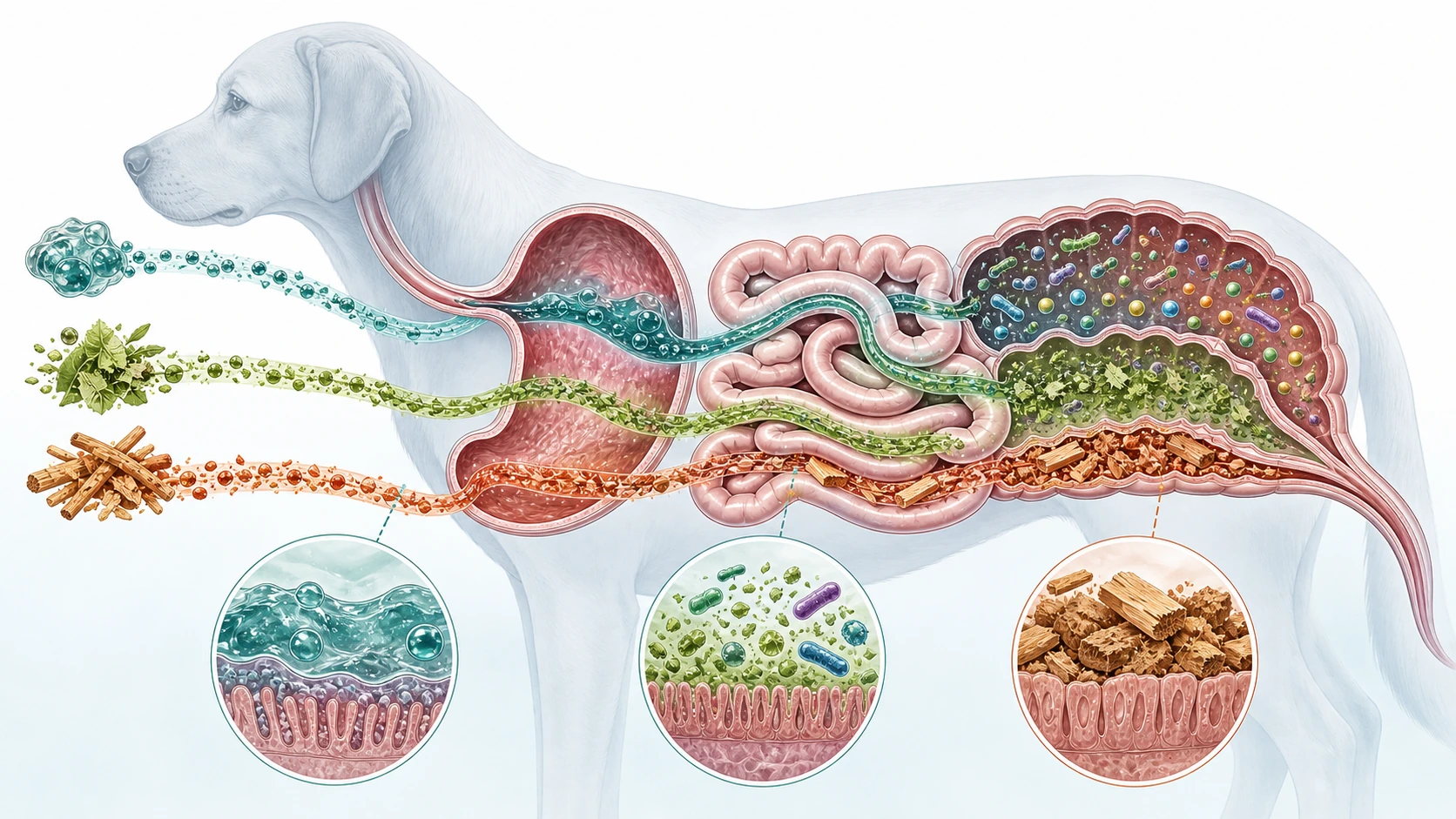
Dietary fiber includes carbohydrate structures that resist digestion by a dog's own small-intestinal enzymes. Some reach the colon largely intact and add bulk. Others are fermented by microbes, producing metabolites including short-chain fatty acids. The result depends on the source, processing, amount, other ingredients, and the individual dog's digestive system. [1] [2]
Soluble fiber can dissolve or disperse in water, and some soluble fibers form viscous gels. Insoluble fiber generally contributes more physical bulk. Fermentability is a separate property: some fibers are rapidly fermented, some slowly, and some minimally. A mixed-fiber diet can therefore behave differently from a single isolated ingredient even when package labels show similar crude-fiber numbers. [3]
What fiber can change
Fiber can influence fecal bulk, water distribution, intestinal transit, microbial fermentation, stool consistency, and energy density. Research in healthy adult dogs shows that the source of fiber can produce different effects on digestibility, fecal metabolites, and microbial composition. That finding argues against treating every fiber source as interchangeable. [1]
In clinical nutrition, a veterinarian may consider fiber within a broader plan for some large-bowel signs, constipation patterns, weight-management goals, or other nutritional needs. The correct strategy is condition-specific. A dog with one type of diarrhea may not need the same diet as a dog with constipation, and either dog may have a cause that fiber alone cannot address. [2] [4]
Why more is not automatically better
A poorly matched or abrupt fiber increase may cause gas, bloating, urgency, softer stool, larger stools, reduced nutrient digestibility, or lower food acceptance. Extra fiber also changes the diet's calorie density and may displace essential nutrients when owners add large amounts of unbalanced foods. The ideal intake for dogs is not a universal household measure. [1] [3]
Water access matters, especially when stool becomes bulkier. So do medications, existing gastrointestinal disease, pancreatic function, body condition, and the rest of the diet. Photograph labels and record all foods, chews, treats, powders, and table foods before asking the veterinarian whether a fiber trial makes sense.
How to evaluate a veterinary-guided trial
Change one planned variable at a time unless the veterinarian directs otherwise. Record the exact diet or ingredient, start date, stool frequency and consistency, straining, urgency, gas, appetite, water intake, body weight, and comfort. A consistent log is more useful than relying on one unusually good or bad bowel movement.
Ask what outcome would count as improvement, how long the observation window should be, and what signs mean stop and call. WSAVA nutrition tools emphasize a complete diet history and individualized nutritional assessment; those principles are more reliable than choosing fiber from an online list alone. [5]
Prepare for a focused veterinary conversation
Bring a concise timeline, short natural-movement or symptom videos when safe, the exact names and photographs of every food, treat, medication, and supplement label, and notes about appetite, water intake, stool, sleep, activity, comfort, and behavior. Include recent injuries, travel, boarding, diet changes, missed medication, and previous test results. A complete record helps the veterinary team separate a repeatable pattern from a single impression.
Decide in advance what you need from the visit: an urgency decision, a diagnosis plan, a nutrition review, a pain or mobility assessment, or a monitored trial. Ask what result would change the plan and what finding would rule an option out. This keeps research and product information in the right role. Evidence can shape questions and expectations, but it cannot determine what is safe for an individual dog without the history and examination.
Owner tool
Match the observation to the question
On a phone, swipe across the table to see every column.
| Observation | Useful detail | Why it matters |
|---|---|---|
| Stool pattern | Frequency, consistency, urgency, mucus, straining | Distinguishes a trend from one isolated stool |
| Diet exposure | Main food, treats, chews, table foods, fiber additions | Reveals the whole formula and recent variables |
| Whole-dog response | Appetite, gas, comfort, water intake, weight | Identifies tolerance problems or broader illness |
| Trial boundaries | Start date, intended goal, review date, stop signs | Prevents an indefinite home experiment |
Better questions, calmer next steps
Questions to ask your veterinarian
- What digestive or nutritional problem are we trying to solve?
- Would a complete therapeutic diet be safer or more predictable than adding an isolated fiber?
- Which fiber properties fit this dog's stool pattern, body condition, and medical history?
- What should I record, and when should we reassess?
- Which changes mean I should stop the trial and call sooner?
FAQ
Is pumpkin a complete fiber plan for dogs?
No. Pumpkin contributes fiber and other nutrients, but it does not replace a complete and balanced diet or a diagnosis. Its effect varies with the amount, product, dog, and rest of the diet.
Are soluble and insoluble fiber opposites?
They describe different water behavior, but fermentability and viscosity also matter. A fiber can be soluble yet ferment at a different rate than another soluble fiber.
Can fiber help every dog with diarrhea?
No. Diarrhea has many possible causes, and some require testing or urgent care. A veterinarian may use a particular diet or fiber strategy only after considering the pattern and the whole dog.
Can too much fiber cause problems?
Yes. An unsuitable amount or source may increase gas, stool volume, urgency, poor appetite, or nutrient dilution. More is not automatically better.
Should I add fiber when my dog is constipated?
Contact your veterinarian first when constipation is persistent, painful, recurrent, or accompanied by vomiting, lethargy, appetite loss, or abdominal discomfort. Obstruction and other causes must not be missed.
Sources
- Animals: The Impact of Fiber Source on Digestive Function, Fecal Microbiota, and Immune Response in Adult Dogs. Fiber-source differences in digestibility, fermentation, and microbial effects.
- Veterinary Clinics of North America: Nutritional Management of Gastrointestinal Disease. Clinical context for fiber in gastrointestinal nutrition and the uncertainty around ideal type and amount.
- Nutrients: Alternative Dietary Fiber Sources in Companion Animal Nutrition. Fiber properties, ingredients, and physiological effects in companion-animal diets.
- Frontiers in Veterinary Science: The Role of Carbohydrates in Canine and Feline Nutrition. Current review of carbohydrate and fiber roles in canine nutrition.
- WSAVA: Global Nutrition Guidelines and Toolkit. Individualized nutritional assessment and complete diet-history tools.
