


A calm, evidence-aware framework for seasonal and life-stage supplement review for dogs, with practical owner observations and clear professional-care boundaries.
Short answer
Use a repeatable plan and keep veterinary care in the lead
Guide owners on when to reassess supplement needs across seasons, life stages, and health transitions, emphasizing vet consultation and non-product behavioral and environ… The practical goal is simple: owners learn a structured, vet-first rhythm for reviewing and updating supplements rather than chasing single-issue trends or symptoms Keep veterinary care in the lead, record patterns rather than isolated moments, and stop the routine when pain, distress, or urgent signs appear.
- Write the specific owner question, current veterinary plan, and outcome that would be observed.
- Record brand-free ingredient names, amounts, serving instructions, frequency, and who gives each product.
- Separate supported uses, limited evidence, marketing language, and unanswered safety questions.
- Include diagnoses, age, weight, diet, allergies, laboratory monitoring, medications, and upcoming procedures.
Safety first
Stop the routine when the dog needs professional care
Owners should contact their veterinarian promptly before starting or stopping supplements if a dog has a diagnosed condition, is on prescription medications, or is entering a new life stage such as senior or pregnancy. Sudden vomiting, diarrhea, lethargy, loss of appetite, difficulty walking, or behavior changes soon after adding a new supplement warrant urgent veterinary assessment. If a dog ingests more supplement than intended, or a product not meant for pets, owners should contact a veterinarian, pet poison helpline, or emergency clinic immediately.
Veterinary note
Educational information only; contact a veterinarian for diagnosis, treatment, or urgent concerns. This guide supports observation and preparation; it does not diagnose a condition or replace an individualized care plan.
What is reasonably supported
Use repeated observations to improve the veterinary conversation
Veterinary associations advise that owners discuss any supplement-whether for joints, skin, gut, or calming-with their veterinarian at regular intervals, because needs change… AVMA’s consumer pages on supplements and nutraceuticals for pets stress… Regulators highlight that many dog supplements are regulated more like foods than drugs, so labels may not guarantee efficacy or rigorous safety… FDA consumer updates on animal supplements and dog supplements explain… Professional guidelines recommend that supplements be considered mainly when a specific deficiency, disease risk, or therapeutic goal is identified, and that they… The AVMA Guidelines for Use of Nutritional Supplements in Dogs… Veterinary nutrition specialists emphasize that most healthy dogs receiving a complete and balanced diet usually do not need extra vitamins or minerals,… UC Davis Nutrition Support Services FAQs note that commercial complete…
What remains uncertain
Home observations cannot establish the cause
Guidance focuses on when and how to reassess supplements, not on recommending specific products or doses. Owners should view supplements as one tool within a broader plan that includes diet, behavior, environment, and veterinary care. Evidence for many pet supplements is limited; decisions should be individualized and regularly revisited. High-quality, long-term trials on many canine supplements across life stages are limited, so benefit-risk assessments often rely on expert opinion and extrapolation. Sources emphasize general principles for supplement use and regulation but provide few season-specific or event-specific decision trees for owners.
Define the decision before the product
Begin with the dog's own normal pattern so a meaningful change is easier to recognize. For seasonal and life-stage supplement review for dogs, the accepted research supports a bounded point: Veterinary associations advise that owners discuss any supplement-whether for joints, skin, gut, or calming-with their veterinarian at regular intervals, because needs change with age, season, activity level, and underlying health,… AVMA’s consumer pages on supplements and nutraceuticals for pets stress that these products are not benign,… This evidence guides observation and a veterinary conversation; it does not establish a diagnosis, treatment response, or guaranteed result.
In practice, write the specific owner question, current veterinary plan, and outcome that would be observed. Record the date, frequency, context, and related changes. A supplement should not be used to replace diagnosis or treatment. Compare the dog with their own baseline and contact the veterinary team when the pattern is persistent, progressive, painful, or joined by the red-flag signs above.
Inventory every ingredient and dose
Separate observation from interpretation: describe what happened before deciding what it might mean. For seasonal and life-stage supplement review for dogs, the accepted research supports a bounded point: Regulators highlight that many dog supplements are regulated more like foods than drugs, so labels may not guarantee efficacy or rigorous safety testing, making periodic vet-led reviews of ongoing use… FDA consumer updates on animal supplements and dog supplements explain that these products generally do not… This evidence guides observation and a veterinary conversation; it does not establish a diagnosis, treatment response, or guaranteed result.
In practice, record brand-free ingredient names, amounts, serving instructions, frequency, and who gives each product. Record the date, frequency, context, and related changes. Multi-ingredient products can create hidden duplication. Compare the dog with their own baseline and contact the veterinary team when the pattern is persistent, progressive, painful, or joined by the red-flag signs above.
Review evidence and uncertainty
Consistency improves the value of a home record, even when the measurement is simple. For seasonal and life-stage supplement review for dogs, the accepted research supports a bounded point: Professional guidelines recommend that supplements be considered mainly when a specific deficiency, disease risk, or therapeutic goal is identified, and that they be reassessed as diet, life stage, and health… The AVMA Guidelines for Use of Nutritional Supplements in Dogs and Cats advise that supplements be… This evidence guides observation and a veterinary conversation; it does not establish a diagnosis, treatment response, or guaranteed result.
In practice, separate supported uses, limited evidence, marketing language, and unanswered safety questions. Record the date, frequency, context, and related changes. Natural and premium do not establish benefit or safety. Compare the dog with their own baseline and contact the veterinary team when the pattern is persistent, progressive, painful, or joined by the red-flag signs above.
Check individual risk
The setting around a sign can matter as much as the sign itself. For seasonal and life-stage supplement review for dogs, the accepted research supports a bounded point: Veterinary nutrition specialists emphasize that most healthy dogs receiving a complete and balanced diet usually do not need extra vitamins or minerals, and that life-stage or condition changes (such as… UC Davis Nutrition Support Services FAQs note that commercial complete diets are formulated to meet most… This evidence guides observation and a veterinary conversation; it does not establish a diagnosis, treatment response, or guaranteed result.
In practice, include diagnoses, age, weight, diet, allergies, laboratory monitoring, medications, and upcoming procedures. Record the date, frequency, context, and related changes. Interaction and contamination risk varies by dog and product. Compare the dog with their own baseline and contact the veterinary team when the pattern is persistent, progressive, painful, or joined by the red-flag signs above.
Introduce only with a clear plan
A checklist supports attention; it does not prove that a risk is gone or explain a medical concern. For seasonal and life-stage supplement review for dogs, the accepted research supports a bounded point: Veterinary associations advise that owners discuss any supplement-whether for joints, skin, gut, or calming-with their veterinarian at regular intervals, because needs change with age, season, activity level, and underlying health,… AVMA’s consumer pages on supplements and nutraceuticals for pets stress that these products are not benign,… This evidence guides observation and a veterinary conversation; it does not establish a diagnosis, treatment response, or guaranteed result.
In practice, agree on timing, observation, stop rules, and follow-up with the veterinary team. Record the date, frequency, context, and related changes. Starting several products together prevents useful interpretation. Compare the dog with their own baseline and contact the veterinary team when the pattern is persistent, progressive, painful, or joined by the red-flag signs above.
Track benefit and adverse change
Shared language and one current record help multiple caregivers act consistently. For seasonal and life-stage supplement review for dogs, the accepted research supports a bounded point: Regulators highlight that many dog supplements are regulated more like foods than drugs, so labels may not guarantee efficacy or rigorous safety testing, making periodic vet-led reviews of ongoing use… FDA consumer updates on animal supplements and dog supplements explain that these products generally do not… This evidence guides observation and a veterinary conversation; it does not establish a diagnosis, treatment response, or guaranteed result.
In practice, use the same practical measure and record digestive, behavior, appetite, skin, and energy changes. Record the date, frequency, context, and related changes. Absence of an obvious reaction does not prove safety. Compare the dog with their own baseline and contact the veterinary team when the pattern is persistent, progressive, painful, or joined by the red-flag signs above.
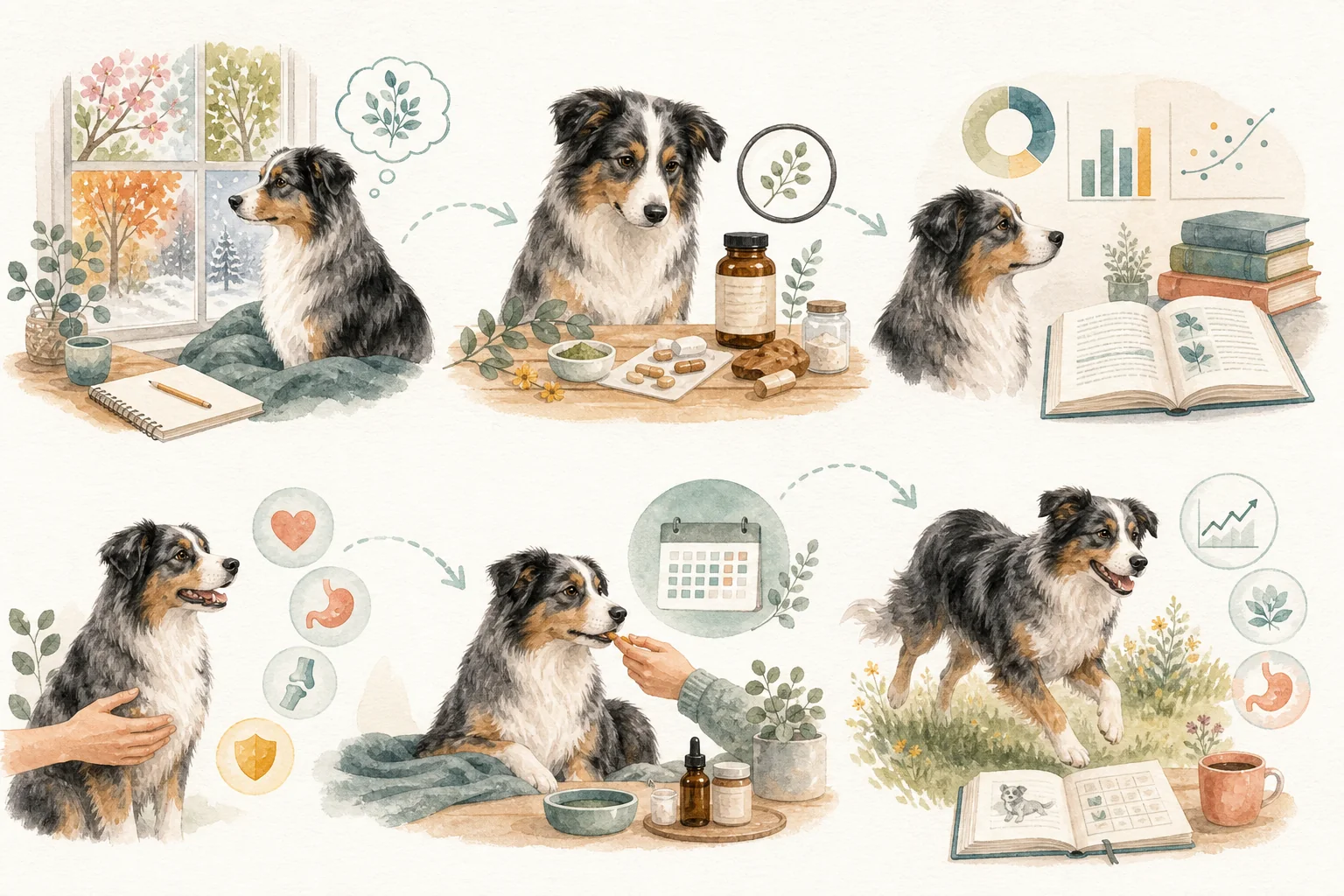
Owner tool
Seasonal and Life-Stage Supplement Review for Dogs
Use this preventivecareguide as a repeatable record for seasonal and life-stage supplement review for dogs. Mark what is normal, what changed, and what needs veterinary guidance.
| Checkpoint | Owner action | Safety boundary |
|---|---|---|
| Define the decision before the product | write the specific owner question, current veterinary plan, and outcome that would be observed | A supplement should not be used to replace diagnosis or treatment |
| Inventory every ingredient and dose | record brand-free ingredient names, amounts, serving instructions, frequency, and who gives each product | Multi-ingredient products can create hidden duplication |
| Review evidence and uncertainty | separate supported uses, limited evidence, marketing language, and unanswered safety questions | Natural and premium do not establish benefit or safety |
| Check individual risk | include diagnoses, age, weight, diet, allergies, laboratory monitoring, medications, and upcoming procedures | Interaction and contamination risk varies by dog and product |
| Introduce only with a clear plan | agree on timing, observation, stop rules, and follow-up with the veterinary team | Starting several products together prevents useful interpretation |
| Track benefit and adverse change | use the same practical measure and record digestive, behavior, appetite, skin, and energy changes | Absence of an obvious reaction does not prove safety |
| Reassess and simplify | bring the complete product list and notes to scheduled reviews and health transitions | Continue only when purpose, safety, and oversight remain clear |
A three-step next action
Observe
Complete the seasonal and life-stage supplement review for dogs review without provoking a symptom or forcing the dog through difficulty.
Record
Keep dates, measurements, photographs, short natural-behavior videos, product labels, and caregiver notes together.
Escalate
Share the concise pattern with the veterinary team and seek urgent care for severe or rapidly worsening signs.
Prepare for the visit
Questions to take to your veterinarian
- Which parts of this seasonal and life-stage supplement review for dogs plan matter most for this dog?
- What findings need a routine appointment, a same-day call, or emergency care?
- Could current diagnoses, medications, diet, supplements, pain, vision, hearing, or mobility change the plan?
- What should I measure at home, and how often should I reassess it?
- Which change should make me stop the routine and contact you sooner?
Bring the dated observation log, relevant photos or short videos, and a complete list of foods, treats, medications, and supplements. Do not change the routine solely to produce evidence for the visit.
Frequently asked questions
Can this guide diagnose a health or behavior problem?
No. It organizes observations and questions; diagnosis requires veterinary assessment.
How often should I repeat the routine?
Use the interval recommended by the veterinary team and repeat sooner after a meaningful change.
Should I change several things at once?
Usually not unless the veterinary team directs it. Multiple changes make response and risk harder to interpret.
What should I bring to the appointment?
Bring the dated log, relevant photos or videos, and complete food, medication, supplement, and product information.
Sources
- Supplements and nutraceuticals for pets, American Veterinary Medical Association. Veterinary associations advise that owners discuss any supplement—whether for joints, skin, gut, or calming—with their veterinarian at regular intervals, because needs change with age, season, activity level, and underlying health,…
- What You Should Know About Dog Supplements, U.S. Food and Drug Administration. Regulators highlight that many dog supplements are regulated more like foods than drugs, so labels may not guarantee efficacy or rigorous safety testing, making periodic vet‑led reviews of ongoing use…
- Nutrition Support Services FAQs, UC Davis School of Veterinary Medicine. Veterinary nutrition specialists emphasize that most healthy dogs receiving a complete and balanced diet usually do not need extra vitamins or minerals, and that life‑stage or condition changes (such as…
- AVMA Guidelines for Use of Nutritional Supplements in Dogs and Cats, American Veterinary Medical Association. Professional guidelines recommend that supplements be considered mainly when a specific deficiency, disease risk, or therapeutic goal is identified, and that they be reassessed as diet, life stage, and health…
Medical disclaimer
Educational information only; contact a veterinarian for diagnosis, treatment, or urgent concerns. If your dog is showing severe, sudden, or rapidly worsening signs, seek urgent veterinary care.
