


A calm, evidence-aware framework for notice early weight and posture changes in middle-aged and senior dogs, with practical owner observations and clear professional-care boundaries.
Short answer
Use a repeatable plan and keep veterinary care in the lead
Teach owners how to spot very early shifts in weight and posture that may presage overt obesity or loss of muscle in middle-aged and senior dogs. The practical goal is simple: owner can detect subtle changes in their dog’s silhouette and posture and understand when to seek vet-guided weight management. Keep veterinary care in the lead, record patterns rather than isolated moments, and stop the routine when pain, distress, or urgent signs appear.
- Record the dog's normal appetite, movement, sleep, interaction, elimination, and comfort.
- Compare rising, turning, walking, eating, grooming, and settling under similar conditions.
- Record when the change began, how often it appears, and whether recovery is slower.
- Check traction, lighting, temperature, access, bedding, noise, and household disruption.
Safety first
Stop the routine when the dog needs professional care
If a dog shows sudden lameness, severe difficulty standing or walking, collapse, or signs of intense pain (such as crying out when moving or being touched), owners should seek emergency or urgent veterinary care rather than continue home monitoring. Rapid, unexplained weight loss or gain in a middle-aged or senior dog, especially accompanied by changes in appetite, drinking, or behavior, warrants prompt veterinary evaluation. Any noticeable change in posture combined with neurological signs such as knuckling, dragging limbs, or loss of bladder/bowel control should be treated as an emergency and assessed by a veterinarian immediately.
Veterinary note
Educational information only; contact a veterinarian for diagnosis, treatment, or urgent concerns. This guide supports observation and preparation; it does not diagnose a condition or replace an individualized care plan.
What is reasonably supported
Use repeated observations to improve the veterinary conversation
WSAVA and pet-obesity resources describe standardized body-condition scoring systems where small shifts away from an ideal score (typically 4-5/9) reflect changes in… These systems support early recognition of weight trends, but owners… VCA obesity guidance explains that early excess weight may first appear as a less-defined waist, decreased ability to feel ribs, and a… Owners are encouraged to watch for these subtle shape changes,… Arthritis references note that early joint disease in dogs may show as mild stiffness, reluctance to jump or climb stairs, or changes… These signs overlap with other conditions, so owners should treat…
What remains uncertain
Home observations cannot establish the cause
Helps owners notice very early changes in body weight, body condition, and posture in middle-aged and senior dogs using visual and tactile cues and general aging guidance. Does not diagnose obesity, sarcopenia, arthritis, or other specific conditions; any concern should lead to veterinary assessment. Avoids providing calorie targets, exercise prescriptions, or specific treatment plans; focuses on observation and awareness. Sources provide descriptive criteria for body condition and arthritis signs but do not define thresholds for "very early" changes; early detection strategies must be extrapolated from these broader descriptions. There is limited direct guidance on linking subtle posture changes to muscle loss versus joint disease; differentiating these causes generally requires veterinary examination.
Define the senior dog's baseline
Begin with the dog's own normal pattern so a meaningful change is easier to recognize. For noticing early weight and posture changes in middle-aged and senior dogs, the accepted research supports a bounded point: WSAVA and pet-obesity resources describe standardized body-condition scoring systems where small shifts away from an ideal score (typically 4-5/9) reflect changes in fat coverage over ribs, waist definition, and abdominal… These systems support early recognition of weight trends, but owners commonly underestimate condition; any persistent shift… This evidence guides observation and a veterinary conversation; it does not establish a diagnosis, treatment response, or guaranteed result.
In practice, record the dog's normal appetite, movement, sleep, interaction, elimination, and comfort. Record the date, frequency, context, and related changes. Aging alone does not explain a new decline. Compare the dog with their own baseline and contact the veterinary team when the pattern is persistent, progressive, painful, or joined by the red-flag signs above.
Observe function in familiar tasks
Separate observation from interpretation: describe what happened before deciding what it might mean. For noticing early weight and posture changes in middle-aged and senior dogs, the accepted research supports a bounded point: VCA obesity guidance explains that early excess weight may first appear as a less-defined waist, decreased ability to feel ribs, and a more rounded abdomen, even before weight-related health problems… Owners are encouraged to watch for these subtle shape changes, but diagnosis of obesity and planning… This evidence guides observation and a veterinary conversation; it does not establish a diagnosis, treatment response, or guaranteed result.
In practice, compare rising, turning, walking, eating, grooming, and settling under similar conditions. Record the date, frequency, context, and related changes. Do not repeatedly force a difficult task for evidence. Compare the dog with their own baseline and contact the veterinary team when the pattern is persistent, progressive, painful, or joined by the red-flag signs above.
Track direction and recovery
Consistency improves the value of a home record, even when the measurement is simple. For noticing early weight and posture changes in middle-aged and senior dogs, the accepted research supports a bounded point: Arthritis references note that early joint disease in dogs may show as mild stiffness, reluctance to jump or climb stairs, or changes in gait and posture (such as weight-shifting or… These signs overlap with other conditions, so owners should treat them as cues to seek veterinary… This evidence guides observation and a veterinary conversation; it does not establish a diagnosis, treatment response, or guaranteed result.
In practice, record when the change began, how often it appears, and whether recovery is slower. Record the date, frequency, context, and related changes. One good day does not erase a progressive trend. Compare the dog with their own baseline and contact the veterinary team when the pattern is persistent, progressive, painful, or joined by the red-flag signs above.
Review the daily environment
The setting around a sign can matter as much as the sign itself. For noticing early weight and posture changes in middle-aged and senior dogs, the accepted research supports a bounded point: WSAVA and pet-obesity resources describe standardized body-condition scoring systems where small shifts away from an ideal score (typically 4-5/9) reflect changes in fat coverage over ribs, waist definition, and abdominal… These systems support early recognition of weight trends, but owners commonly underestimate condition; any persistent shift… This evidence guides observation and a veterinary conversation; it does not establish a diagnosis, treatment response, or guaranteed result.
In practice, check traction, lighting, temperature, access, bedding, noise, and household disruption. Record the date, frequency, context, and related changes. Environmental support does not rule out pain or disease. Compare the dog with their own baseline and contact the veterinary team when the pattern is persistent, progressive, painful, or joined by the red-flag signs above.
Reconcile food, medication, and supplements
A checklist supports attention; it does not prove that a risk is gone or explain a medical concern. For noticing early weight and posture changes in middle-aged and senior dogs, the accepted research supports a bounded point: VCA obesity guidance explains that early excess weight may first appear as a less-defined waist, decreased ability to feel ribs, and a more rounded abdomen, even before weight-related health problems… Owners are encouraged to watch for these subtle shape changes, but diagnosis of obesity and planning… This evidence guides observation and a veterinary conversation; it does not establish a diagnosis, treatment response, or guaranteed result.
In practice, keep one current list with amounts, timing, missed doses, and recent changes. Record the date, frequency, context, and related changes. Never correct uncertainty by guessing or stacking products. Compare the dog with their own baseline and contact the veterinary team when the pattern is persistent, progressive, painful, or joined by the red-flag signs above.
Protect choice and comfort
Shared language and one current record help multiple caregivers act consistently. For noticing early weight and posture changes in middle-aged and senior dogs, the accepted research supports a bounded point: Arthritis references note that early joint disease in dogs may show as mild stiffness, reluctance to jump or climb stairs, or changes in gait and posture (such as weight-shifting or… These signs overlap with other conditions, so owners should treat them as cues to seek veterinary… This evidence guides observation and a veterinary conversation; it does not establish a diagnosis, treatment response, or guaranteed result.
In practice, adjust the routine to current ability while preserving gentle activity and social contact. Record the date, frequency, context, and related changes. Withdrawal or irritability may signal discomfort. Compare the dog with their own baseline and contact the veterinary team when the pattern is persistent, progressive, painful, or joined by the red-flag signs above.
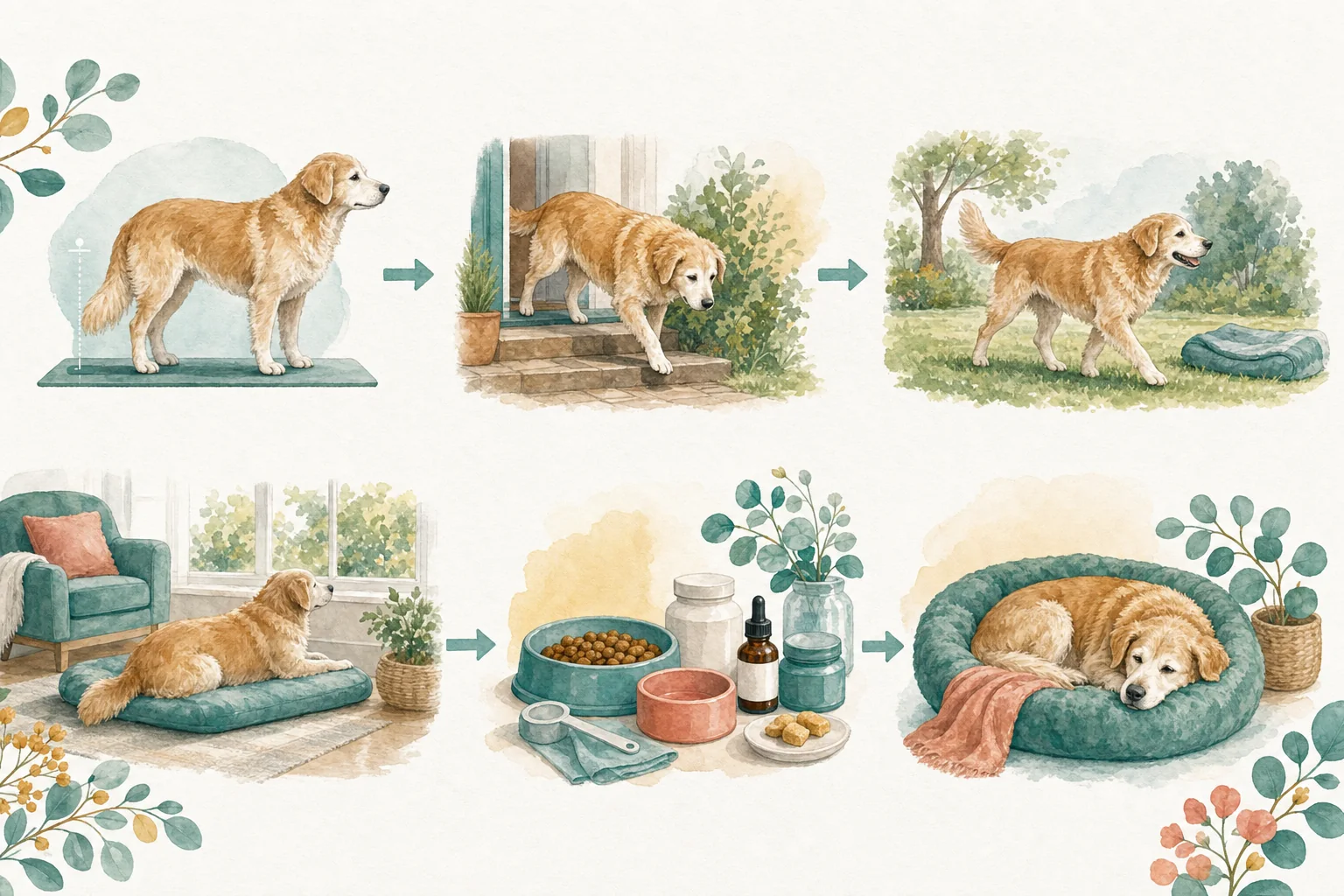
Owner tool
Noticing Early Weight and Posture Changes in Middle-Aged and Senior Dogs
Use this guide as a repeatable record for notice early weight and posture changes in middle-aged and senior dogs. Mark what is normal, what changed, and what needs veterinary guidance.
| Checkpoint | Owner action | Safety boundary |
|---|---|---|
| Define the senior dog's baseline | record the dog's normal appetite, movement, sleep, interaction, elimination, and comfort | Aging alone does not explain a new decline |
| Observe function in familiar tasks | compare rising, turning, walking, eating, grooming, and settling under similar conditions | Do not repeatedly force a difficult task for evidence |
| Track direction and recovery | record when the change began, how often it appears, and whether recovery is slower | One good day does not erase a progressive trend |
| Review the daily environment | check traction, lighting, temperature, access, bedding, noise, and household disruption | Environmental support does not rule out pain or disease |
| Reconcile food, medication, and supplements | keep one current list with amounts, timing, missed doses, and recent changes | Never correct uncertainty by guessing or stacking products |
| Protect choice and comfort | adjust the routine to current ability while preserving gentle activity and social contact | Withdrawal or irritability may signal discomfort |
| Bring a concise pattern to the clinic | share dated notes, measurements, photographs, videos, and the complete product list | Rapid decline or emergency signs need immediate care |
A three-step next action
Observe
Complete the noticing early weight and posture changes in middle-aged and senior dogs review without provoking a symptom or forcing the dog through difficulty.
Record
Keep dates, measurements, photographs, short natural-behavior videos, product labels, and caregiver notes together.
Escalate
Share the concise pattern with the veterinary team and seek urgent care for severe or rapidly worsening signs.
Prepare for the visit
Questions to take to your veterinarian
- Which parts of this noticing early weight and posture changes in middle-aged and senior dogs plan matter most for this dog?
- What findings need a routine appointment, a same-day call, or emergency care?
- Could current diagnoses, medications, diet, supplements, pain, vision, hearing, or mobility change the plan?
- What should I measure at home, and how often should I reassess it?
- Which change should make me stop the routine and contact you sooner?
Bring the dated observation log, relevant photos or short videos, and a complete list of foods, treats, medications, and supplements. Do not change the routine solely to produce evidence for the visit.
Frequently asked questions
Can this guide diagnose a health or behavior problem?
No. It organizes observations and questions; diagnosis requires veterinary assessment.
How often should I repeat the routine?
Use the interval recommended by the veterinary team and repeat sooner after a meaningful change.
Should I change several things at once?
Usually not unless the veterinary team directs it. Multiple changes make response and risk harder to interpret.
What should I bring to the appointment?
Bring the dated log, relevant photos or videos, and complete food, medication, supplement, and product information.
Sources
- Body Condition Score Chart – Dog, World Small Animal Veterinary Association. WSAVA and pet‑obesity resources describe standardized body‑condition scoring systems where small shifts away from an ideal score (typically 4–5/9) reflect changes in fat coverage over ribs, waist definition, and abdominal…
- Dog Body Condition Scoring | Assess Your Dog's Weight, Association for Pet Obesity Prevention. WSAVA and pet‑obesity resources describe standardized body‑condition scoring systems where small shifts away from an ideal score (typically 4–5/9) reflect changes in fat coverage over ribs, waist definition, and abdominal…
- Arthritis in Dogs, MSD Veterinary Manual. Arthritis references note that early joint disease in dogs may show as mild stiffness, reluctance to jump or climb stairs, or changes in gait and posture (such as weight‑shifting or…
- Obesity in Dogs, VCA Animal Hospitals. VCA obesity guidance explains that early excess weight may first appear as a less‑defined waist, decreased ability to feel ribs, and a more rounded abdomen, even before weight‑related health problems…
Medical disclaimer
Educational information only; contact a veterinarian for diagnosis, treatment, or urgent concerns. If your dog is showing severe, sudden, or rapidly worsening signs, seek urgent veterinary care.
