

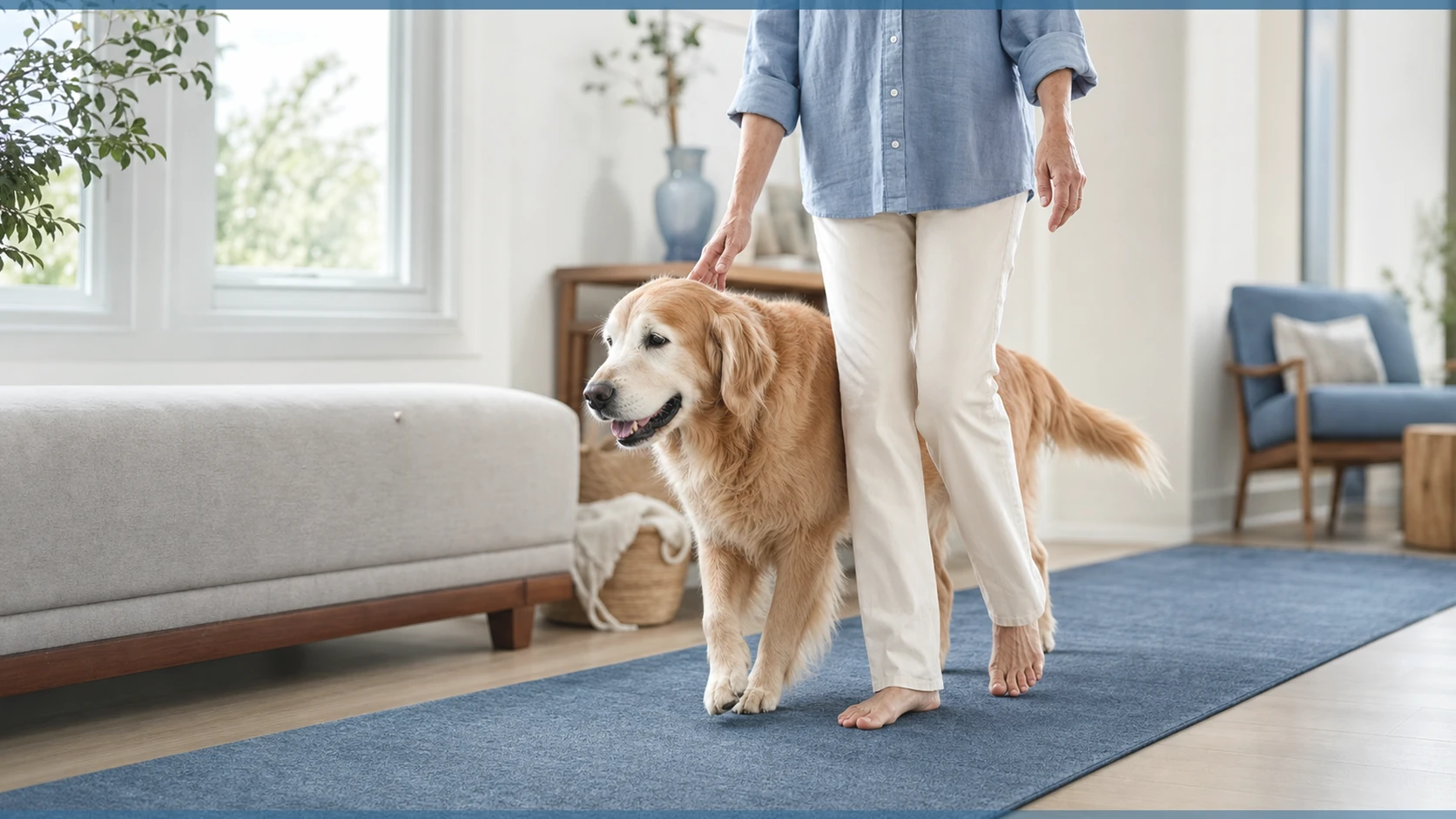
A calm, evidence-aware framework for weekly joint comfort and activity tracking for adult dogs at home, with practical owner observations and clear professional-care boundaries.
Short answer
Use a repeatable plan and keep veterinary care in the lead
Provide a vet-first, non-diagnostic weekly home worksheet that helps owners track subtle changes in joint comfort, exercise tolerance, and low-impact activity for adult dogs, anchored to seasonal or event-based shifts. The practical goal is simple: owners can consistently log joint-related observations aligned with activity and season without over-interpreting symptoms. Keep veterinary care in the lead, record patterns rather than isolated moments, and stop the routine when pain, distress, or urgent signs appear.
- Record ordinary rising, walking, turning, stairs, play, rest, and recovery under familiar conditions.
- Watch natural starts, stops, turns, posture changes, and willingness to use each limb.
- Note stiffness, hesitation, licking, sleep disruption, irritability, and changes in social interaction.
- Check traction, thresholds, stairs, ramps, vehicle entry, bedding, and the route to food and toileting.
Safety first
Stop the routine when the dog needs professional care
Instruct owners to seek prompt veterinary care if they record sudden non-weight-bearing lameness, repeated collapsing, inability to stand, or marked pain responses during movement, rather than relying on ongoing worksheet tracking. Recommend urgent veterinary assessment if an adult dog shows rapidly worsening stiffness, swelling of joints, or reluctance to move even for toileting, which may indicate more serious disease. Advise contacting a veterinarian if behavior changes such as aggression, withdrawal, or vocalizing are noted alongside joint discomfort, as pain-related distress can require timely intervention.
Veterinary note
Educational information only; contact a veterinarian for diagnosis, treatment, or urgent concerns. This guide supports observation and preparation; it does not diagnose a condition or replace an individualized care plan.
What is reasonably supported
Use repeated observations to improve the veterinary conversation
A recent review on multimodal management of canine osteoarthritis recommends monitoring activity levels, comfort, and functional abilities over… The review focuses on dogs with osteoarthritis;… WSAVA-affiliated osteoarthritis guidance introduces owner questionnaires and activity assessment tools to capture everyday mobility and discomfort, supporting structured… These tools are designed for OA management;… JAVMA reviews on healthy aging and common physical changes in older dogs describe progressive stiffness, reduced activity, and… These papers address aging dogs broadly; while… Guidance on caring for pets with limited mobility recommends environmental adjustments, controlled low-impact activity, and close observation of… The document focuses on already mobility-compromised pets;…
What remains uncertain
Home observations cannot establish the cause
This weekly worksheet is intended for observational tracking of joint comfort and activity; it cannot diagnose osteoarthritis or other musculoskeletal disease. Owners should not use changes recorded on the sheet to adjust medications, supplements, or exercise intensity without veterinary guidance. The template does not differentiate normal aging from pathology and should not delay veterinary assessment of concerning joint or mobility signs. Evidence specifically validating weekly home jointcomfort logs as improving outcomes for adult dogs is limited; usefulness is inferred from osteoarthritis assessment tools. Sources focus mainly on diagnosed osteoarthritis or aging dogs, so extrapolation to all adult dogs with subtle changes may not be exact.
Establish the dog's movement baseline
Begin with the dog's own normal pattern so a meaningful change is easier to recognize. For weekly joint comfort and activity tracking for adult dogs at home, the accepted research supports a bounded point: A recent review on multimodal management of canine osteoarthritis recommends monitoring activity levels, comfort, and functional abilities over time, suggesting that owner observations of exercise tolerance… The review focuses on dogs with osteoarthritis; applying similar tracking to adult dogs… This evidence guides observation and a veterinary conversation; it does not establish a diagnosis, treatment response, or guaranteed result.
In practice, record ordinary rising, walking, turning, stairs, play, rest, and recovery under familiar conditions. Record the date, frequency, context, and related changes. A home movement record cannot diagnose pain or joint disease. Compare the dog with their own baseline and contact the veterinary team when the pattern is persistent, progressive, painful, or joined by the red-flag signs above.
Observe transitions and weight bearing
Separate observation from interpretation: describe what happened before deciding what it might mean. For weekly joint comfort and activity tracking for adult dogs at home, the accepted research supports a bounded point: WSAVA-affiliated osteoarthritis guidance introduces owner questionnaires and activity assessment tools to capture everyday mobility and discomfort, supporting structured weekly notes about walking distance, reluctance to jump,… These tools are designed for OA management; using their concepts in a generic… This evidence guides observation and a veterinary conversation; it does not establish a diagnosis, treatment response, or guaranteed result.
In practice, watch natural starts, stops, turns, posture changes, and willingness to use each limb. Record the date, frequency, context, and related changes. Do not force a difficult movement or repeatedly test a painful task. Compare the dog with their own baseline and contact the veterinary team when the pattern is persistent, progressive, painful, or joined by the red-flag signs above.
Connect movement with comfort
Consistency improves the value of a home record, even when the measurement is simple. For weekly joint comfort and activity tracking for adult dogs at home, the accepted research supports a bounded point: JAVMA reviews on healthy aging and common physical changes in older dogs describe progressive stiffness, reduced activity, and altered gait as typical findings that warrant monitoring… These papers address aging dogs broadly; while they support monitoring, they do not… This evidence guides observation and a veterinary conversation; it does not establish a diagnosis, treatment response, or guaranteed result.
In practice, note stiffness, hesitation, licking, sleep disruption, irritability, and changes in social interaction. Record the date, frequency, context, and related changes. Mobility and behavior changes may reflect pain or another health problem. Compare the dog with their own baseline and contact the veterinary team when the pattern is persistent, progressive, painful, or joined by the red-flag signs above.
Review surfaces and access
The setting around a sign can matter as much as the sign itself. For weekly joint comfort and activity tracking for adult dogs at home, the accepted research supports a bounded point: Guidance on caring for pets with limited mobility recommends environmental adjustments, controlled low-impact activity, and close observation of comfort to reduce stress and injury, which can… The document focuses on already mobility-compromised pets; generalizing its principles to milder joint… This evidence guides observation and a veterinary conversation; it does not establish a diagnosis, treatment response, or guaranteed result.
In practice, check traction, thresholds, stairs, ramps, vehicle entry, bedding, and the route to food and toileting. Record the date, frequency, context, and related changes. Environmental support does not replace veterinary assessment. Compare the dog with their own baseline and contact the veterinary team when the pattern is persistent, progressive, painful, or joined by the red-flag signs above.
Track activity and recovery together
A checklist supports attention; it does not prove that a risk is gone or explain a medical concern. For weekly joint comfort and activity tracking for adult dogs at home, the accepted research supports a bounded point: A recent review on multimodal management of canine osteoarthritis recommends monitoring activity levels, comfort, and functional abilities over time, suggesting that owner observations of exercise tolerance… The review focuses on dogs with osteoarthritis; applying similar tracking to adult dogs… This evidence guides observation and a veterinary conversation; it does not establish a diagnosis, treatment response, or guaranteed result.
In practice, record duration, intensity, terrain, weather, and how the dog moves later that day and the next morning. Record the date, frequency, context, and related changes. More activity is not always better when recovery is worsening. Compare the dog with their own baseline and contact the veterinary team when the pattern is persistent, progressive, painful, or joined by the red-flag signs above.
Reconcile weight, food, medications, and supplements
Shared language and one current record help multiple caregivers act consistently. For weekly joint comfort and activity tracking for adult dogs at home, the accepted research supports a bounded point: WSAVA-affiliated osteoarthritis guidance introduces owner questionnaires and activity assessment tools to capture everyday mobility and discomfort, supporting structured weekly notes about walking distance, reluctance to jump,… These tools are designed for OA management; using their concepts in a generic… This evidence guides observation and a veterinary conversation; it does not establish a diagnosis, treatment response, or guaranteed result.
In practice, keep one current list and discuss every product or change with the veterinary team. Record the date, frequency, context, and related changes. Never change prescribed care or stack joint products without guidance. Compare the dog with their own baseline and contact the veterinary team when the pattern is persistent, progressive, painful, or joined by the red-flag signs above.
Owner tool
Weekly Joint Comfort and Activity Tracking for Adult Dogs at Home
Use this trackingtemplate as a repeatable record for weekly joint comfort and activity tracking for adult dogs at home. Mark what is normal, what changed, and what needs veterinary guidance.
| Checkpoint | Owner action | Safety boundary |
|---|---|---|
| Establish the dog's movement baseline | record ordinary rising, walking, turning, stairs, play, rest, and recovery under familiar conditions | A home movement record cannot diagnose pain or joint disease |
| Observe transitions and weight bearing | watch natural starts, stops, turns, posture changes, and willingness to use each limb | Do not force a difficult movement or repeatedly test a painful task |
| Connect movement with comfort | note stiffness, hesitation, licking, sleep disruption, irritability, and changes in social interaction | Mobility and behavior changes may reflect pain or another health problem |
| Review surfaces and access | check traction, thresholds, stairs, ramps, vehicle entry, bedding, and the route to food and toileting | Environmental support does not replace veterinary assessment |
| Track activity and recovery together | record duration, intensity, terrain, weather, and how the dog moves later that day and the next morning | More activity is not always better when recovery is worsening |
| Reconcile weight, food, medications, and supplements | keep one current list and discuss every product or change with the veterinary team | Never change prescribed care or stack joint products without guidance |
| Prepare a focused veterinary handoff | share dated observations, short natural-movement videos, current products, and the dog's functional priorities | Sudden inability to bear weight, severe pain, trauma, collapse, or rapid decline needs prompt care |
A three-step next action
Observe
Complete the weekly joint comfort and activity tracking for adult dogs at home review without provoking a symptom or forcing the dog through difficulty.
Record
Keep dates, measurements, photographs, short natural-behavior videos, product labels, and caregiver notes together.
Escalate
Share the concise pattern with the veterinary team and seek urgent care for severe or rapidly worsening signs.
Prepare for the visit
Questions to take to your veterinarian
- Which parts of this weekly joint comfort and activity tracking for adult dogs at home plan matter most for this dog?
- What findings need a routine appointment, a same-day call, or emergency care?
- Could current diagnoses, medications, diet, supplements, pain, vision, hearing, or mobility change the plan?
- What should I measure at home, and how often should I reassess it?
- Which change should make me stop the routine and contact you sooner?
Bring the dated observation log, relevant photos or short videos, and a complete list of foods, treats, medications, and supplements. Do not change the routine solely to produce evidence for the visit.
Frequently asked questions
Can this guide diagnose a health or behavior problem?
No. It organizes observations and questions; diagnosis requires veterinary assessment.
How often should I repeat the routine?
Use the interval recommended by the veterinary team and repeat sooner after a meaningful change.
Should I change several things at once?
Usually not unless the veterinary team directs it. Multiple changes make response and risk harder to interpret.
What should I bring to the appointment?
Bring the dated log, relevant photos or videos, and complete food, medication, supplement, and product information.
Sources
- Caring For a Pet with Limited Mobility, BVNS Down Dog Care. Guidance on caring for pets with limited mobility recommends environmental adjustments, controlled low-impact activity, and close observation of comfort to reduce stress and injury, which can be reflected in weekly…
- A proposed framework for practical multimodal management of canine osteoarthritis, Frontiers in Veterinary Science (via PubMed Central). A recent review on multimodal management of canine osteoarthritis recommends monitoring activity levels, comfort, and functional abilities over time, suggesting that owner observations of exercise tolerance and stiffness can inform…
- Common physical and functional changes associated with aging in dogs, Journal of the American Veterinary Medical Association (JAVMA). JAVMA reviews on healthy aging and common physical changes in older dogs describe progressive stiffness, reduced activity, and altered gait as typical findings that warrant monitoring and veterinary evaluation, reinforcing…
- Canine Osteoarthritis: Xpertise Vetoquinol – Clinical and Owner Assessment Tools and Management Principles, World Small Animal Veterinary Association / Vetoquinol expert group. WSAVA-affiliated osteoarthritis guidance introduces owner questionnaires and activity assessment tools to capture everyday mobility and discomfort, supporting structured weekly notes about walking distance, reluctance to jump, or play changes.
Medical disclaimer
Educational information only; contact a veterinarian for diagnosis, treatment, or urgent concerns. If your dog is showing severe, sudden, or rapidly worsening signs, seek urgent veterinary care.
