


A calm, evidence-aware owner framework for senior energy and routine awareness, with clear professional-care boundaries and practical observations to bring to the veterinary team.
Short answer
Use a repeatable plan and keep veterinary care in the lead
Use familiar daily activities to notice gradual changes in stamina, sleep, appetite, interaction, and recovery while avoiding the assumption that every decline is normal aging.
- Use the same greeting, walk, meal, and rising task.
- Record start, duration, stopping, and recovery.
- Note daytime sleep, nighttime waking, pacing, and settling.
- Record intake and related weight or elimination change.
Safety first
Stop the checklist when the dog needs professional care
Owners should schedule prompt veterinary evaluation if a senior dog shows persistent lethargy, marked decrease in activity, loss of interest in usual walks or play, or notable changes in sleep-wake cycles over several days. Urgent or emergency veterinary care is warranted if a dog develops collapse, severe weakness, labored breathing, repeated vomiting or diarrhea, or sudden refusal to eat or drink, as these can indicate serious metabolic or organ-system disease.
Veterinary note
Educational information only; contact a veterinarian for diagnosis, treatment, or urgent concerns. This guide supports observation and preparation; it does not diagnose a condition or replace an individualized care plan.
What is reasonably supported
Use repeated observations to improve the veterinary conversation
Veterinary association guidance notes that changes in activity level, sleep patterns, appetite, or drinking habits in older pets can signal underlying health problems and should prompt veterinary evaluation. AVMA explains that some changes are part of normal aging while others reflect disease; only… Senior-dog care resources recommend monitoring day-to-day behaviors such as willingness to exercise, ability to rise, interest in family interaction, and toileting habits, and reporting any notable shifts to the veterinary… VCA emphasizes regular checkups and individualized care plans; it does not ask owners to interpret… A veterinary association paper on healthy aging highlights that early recognition of subtle functional changes—including endurance, mobility, and daily routines—can support timely detection of age-related diseases. The article is aimed at veterinarians and underscores the need for professional assessment; it does… Senior-pet care recommendations advise more frequent veterinary examinations (often at least twice yearly) for older dogs, in part because owners may notice small changes in energy or routines that benefit… AAHA presents these visit intervals as general guidance; actual frequency should be tailored to the…
What remains uncertain
Home observations cannot establish the cause
Guidance focuses on observing changes in energy and daily rhythm in senior dogs as cues to seek veterinary advice; it does not define diagnostic criteria for specific diseases. Owners should not self-diagnose metabolic or organ-system conditions based on routine changes alone. This packet does not prescribe medication schedules or detailed exercise programs; those must be individualized by a veterinarian.
Choose repeatable reference activities
A useful review begins with the dog's own normal pattern, because comparison with a generic ideal can hide meaningful individual change. Research selected for this guide supports a bounded point: Veterinary association guidance notes that changes in activity level, sleep patterns, appetite, or drinking habits in older pets can signal underlying health problems and should prompt veterinary evaluation. AVMA explains that some changes are part of normal aging while others reflect disease; only a veterinarian can distinguish between… This informs careful observation and veterinary discussion, not diagnosis or a guaranteed result.
In practice, use the same greeting, walk, meal, and rising task. Record the date, frequency, context, and related changes that matter to this task. One unusual day is not a diagnosis. Contact the veterinary team when the pattern is persistent, progressive, painful, or joined by the red-flag signs above.
Describe energy precisely
The safest approach separates observation from interpretation: owners document what happened, while the veterinary team evaluates possible causes. Research selected for this guide supports a bounded point: Senior-dog care resources recommend monitoring day-to-day behaviors such as willingness to exercise, ability to rise, interest in family interaction, and toileting habits, and reporting any notable shifts to the veterinary team. VCA emphasizes regular checkups and individualized care plans; it does not ask owners to interpret specific patterns as particular diagnoses. This informs careful observation and veterinary discussion, not diagnosis or a guaranteed result.
In practice, record start, duration, stopping, and recovery. Record the date, frequency, context, and related changes that matter to this task. Low energy can reflect many medical or environmental factors. Contact the veterinary team when the pattern is persistent, progressive, painful, or joined by the red-flag signs above.
Compare sleep and wake patterns
Consistency makes the record more useful. Use the same route, measure, timing, or description when practical and note unusual circumstances. Research selected for this guide supports a bounded point: A veterinary association paper on healthy aging highlights that early recognition of subtle functional changes—including endurance, mobility, and daily routines—can support timely detection of age-related diseases. The article is aimed at veterinarians and underscores the need for professional assessment; it does not provide lay diagnostic rules. This informs careful observation and veterinary discussion, not diagnosis or a guaranteed result.
In practice, note daytime sleep, nighttime waking, pacing, and settling. Record the date, frequency, context, and related changes that matter to this task. Sleep change may involve pain, cognition, illness, or routine. Contact the veterinary team when the pattern is persistent, progressive, painful, or joined by the red-flag signs above.
Connect appetite and water
Small environmental details can change what the owner sees, so include weather, visitors, travel, food changes, medication timing, and household disruption. Research selected for this guide supports a bounded point: Senior-pet care recommendations advise more frequent veterinary examinations (often at least twice yearly) for older dogs, in part because owners may notice small changes in energy or routines that benefit from professional review. AAHA presents these visit intervals as general guidance; actual frequency should be tailored to the dog’s health status and veterinarian’s… This informs careful observation and veterinary discussion, not diagnosis or a guaranteed result.
In practice, record intake and related weight or elimination change. Record the date, frequency, context, and related changes that matter to this task. Normal appetite does not rule out disease. Contact the veterinary team when the pattern is persistent, progressive, painful, or joined by the red-flag signs above.
Observe interaction
A checklist is a prompt for attention, not proof that risk has been removed or that a medical concern has been explained. Research selected for this guide supports a bounded point: Veterinary association guidance notes that changes in activity level, sleep patterns, appetite, or drinking habits in older pets can signal underlying health problems and should prompt veterinary evaluation. AVMA explains that some changes are part of normal aging while others reflect disease; only a veterinarian can distinguish between… This informs careful observation and veterinary discussion, not diagnosis or a guaranteed result.
In practice, notice greeting, play, withdrawal, irritability, or confusion. Record the date, frequency, context, and related changes that matter to this task. Behavior change deserves context and veterinary attention. Contact the veterinary team when the pattern is persistent, progressive, painful, or joined by the red-flag signs above.
Use short videos
When several caregivers are involved, shared terms and one current record reduce missed steps, duplicate care, and conflicting impressions. Research selected for this guide supports a bounded point: Senior-dog care resources recommend monitoring day-to-day behaviors such as willingness to exercise, ability to rise, interest in family interaction, and toileting habits, and reporting any notable shifts to the veterinary team. VCA emphasizes regular checkups and individualized care plans; it does not ask owners to interpret specific patterns as particular diagnoses. This informs careful observation and veterinary discussion, not diagnosis or a guaranteed result.
In practice, capture natural movement or hesitation without provoking it. Record the date, frequency, context, and related changes that matter to this task. Do not repeat a difficult task for evidence. Contact the veterinary team when the pattern is persistent, progressive, painful, or joined by the red-flag signs above.
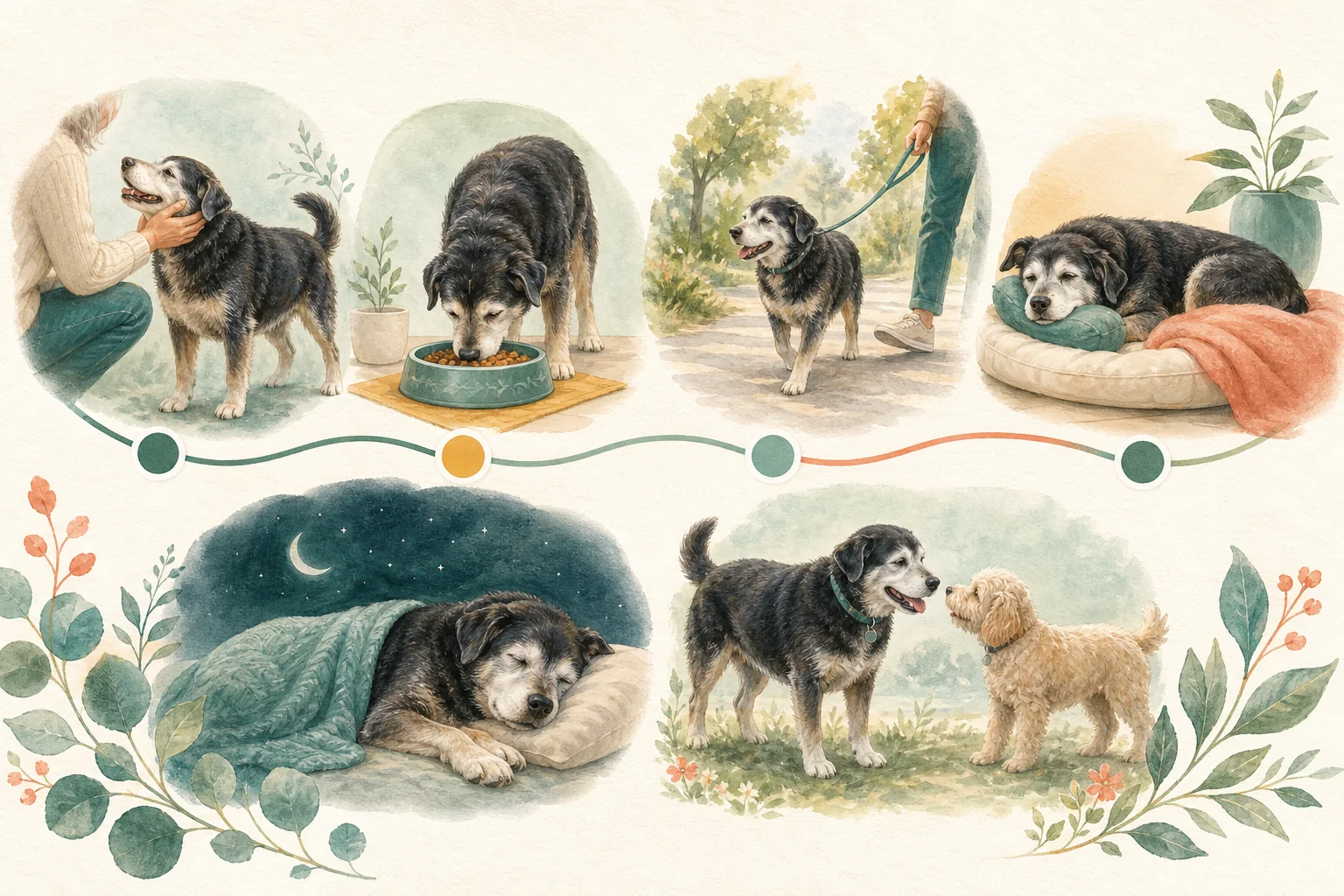
Owner tool
Early Energy and Routine Changes in Senior Dogs
Use this senior energy and routine awareness as a repeatable owner record. Mark what is normal, what changed, and what needs veterinary guidance.
| Checkpoint | Owner action | Boundary |
|---|---|---|
| Choose repeatable reference activities | use the same greeting, walk, meal, and rising task | One unusual day is not a diagnosis |
| Describe energy precisely | record start, duration, stopping, and recovery | Low energy can reflect many medical or environmental factors |
| Compare sleep and wake patterns | note daytime sleep, nighttime waking, pacing, and settling | Sleep change may involve pain, cognition, illness, or routine |
| Connect appetite and water | record intake and related weight or elimination change | Normal appetite does not rule out disease |
| Observe interaction | notice greeting, play, withdrawal, irritability, or confusion | Behavior change deserves context and veterinary attention |
| Use short videos | capture natural movement or hesitation without provoking it | Do not repeat a difficult task for evidence |
| Escalate progressive change | summarize dates, direction, and combined signs | Collapse, breathing difficulty, severe weakness, or confusion is urgent |
A three-step next action
Observe
Complete the senior energy and routine awareness without provoking a symptom or forcing the dog through difficulty.
Record
Keep dates, measurements, photographs, short natural-behavior videos, product labels, and caregiver notes together.
Escalate
Share the concise pattern with the veterinary team and seek urgent care for severe or rapidly worsening signs.
Prepare for the visit
Questions to take to your veterinarian
- Which parts of this senior energy and routine awareness are most important for this dog?
- What findings need a routine appointment, a same-day call, or emergency care?
- Could current diagnoses, medications, diet, supplements, pain, vision, hearing, or mobility change the plan?
- What should I measure at home, and how often should I reassess it?
- Which change should make me stop the routine and contact you sooner?
Bring the dated observation log, relevant photos or short videos, and a complete list of foods, treats, medications, and supplements. Do not change the routine solely to produce evidence for the visit.
Frequently asked questions
Can this checklist diagnose a health problem?
No. It organizes observations and questions; diagnosis requires veterinary assessment.
How often should I repeat it?
Use the interval recommended by the veterinary team and repeat sooner after a meaningful change.
Should I change several things at once?
Usually not unless the veterinary team directs it. Multiple changes make response and risk harder to interpret.
What should I bring to the appointment?
Bring the dated log, relevant photos or videos, and complete food, medication, supplement, and product information.
Sources
- Aging pets, American Veterinary Medical Association. Veterinary association guidance notes that **changes in activity level, sleep patterns, appetite, or drinking habits** in older pets can signal underlying health problems and should prompt veterinary evaluation.
- Senior Dog Care, VCA Animal Hospitals. Senior-dog care resources recommend **monitoring day-to-day behaviors** such as willingness to exercise, ability to rise, interest in family interaction, and toileting habits, and reporting any notable shifts to the veterinary…
- Defining healthy aging in older dogs and differentiating age-related changes from disease, Journal of the American Veterinary Medical Association (JAVMA). A veterinary association paper on healthy aging highlights that **early recognition of subtle functional changes**—including endurance, mobility, and daily routines—can support timely detection of age-related diseases.
- Supporting Your Senior Pet: Veterinary Care Recommendations, American Animal Hospital Association. Senior-pet care recommendations advise **more frequent veterinary examinations (often at least twice yearly)** for older dogs, in part because owners may notice small changes in energy or routines that benefit…
Medical disclaimer
Educational information only; contact a veterinarian for diagnosis, treatment, or urgent concerns. If your dog is showing severe, sudden, or rapidly worsening signs, seek urgent veterinary care.
