


A calm, evidence-aware framework for emergency prep mini-checklist for senior dogs in multi-pet homes, with practical owner observations and clear professional-care boundaries.
Short answer
Use a repeatable plan and keep veterinary care in the lead
Provide a concise emergency prep mini-checklist specifically for senior dogs living in multi-pet homes, without duplicating broader home-audit pieces. The practical goal is simple: quickly prepare essential actions, supplies, and communication plans for senior dogs when living with other pets during emergencies. Keep veterinary care in the lead, record patterns rather than isolated moments, and stop the routine when pain, distress, or urgent signs appear.
- Follow the dog through sleeping, feeding, toileting, play, travel, and family spaces.
- Secure gaps, chemicals, foods, cords, elevation, unstable objects, and escape points.
- Check traction, thresholds, stairs, ramps, doors, and turning space.
- Review heat, cold, airflow, surface temperature, weather, wildlife, and household products.
Safety first
Stop the routine when the dog needs professional care
If a senior dog has trouble breathing, collapses, shows confusion, or cannot stand during an emergency, owners should seek immediate veterinary or emergency animal care rather than relying solely on home measures. If a disaster warning is issued and a senior dog cannot be safely evacuated due to health or mobility problems, owners should contact their veterinarian or local animal emergency services as early as possible to discuss options. Any sudden change in a senior dog’s behavior following a disaster-such as extreme anxiety, refusal to eat or drink, or persistent hiding-warrants prompt consultation with a veterinarian to rule out medical issues.
Veterinary note
Educational information only; contact a veterinarian for diagnosis, treatment, or urgent concerns. This guide supports observation and preparation; it does not diagnose a condition or replace an individualized care plan.
What is reasonably supported
Use repeated observations to improve the veterinary conversation
Emergency planning for pets should include a ready-to-go kit with food, water, medications, copies of medical records, and sturdy leashes or carriers… Based on federal emergency preparedness guidance for pets; applies broadly… Owners are advised to keep a written emergency plan that covers how pets will be handled if the owner is away, and… Draws on veterinary association guidance for general emergency preparedness and… In emergencies, pets should ideally evacuate with the family because they may not survive if left behind; keeping identification up to date… CDC public-health guidance emphasizes evacuation and identification for all pets;… For senior dogs, emergency kits should also account for reduced mobility and chronic conditions by including items such as non-slip bedding, ramps… Senior care recommendations from a veterinary hospital are adapted for…
What remains uncertain
Home observations cannot establish the cause
Checklist is focused on emergency preparation steps owners can reasonably do at home; it does not replace individualized advice from a veterinarian or local emergency management professionals. Guidance is tailored to senior dogs in multi-pet homes but stays general; it is not specific to any breed, medical condition, or region. Evacuation and sheltering recommendations are limited to household-level planning and do not address complex disaster-response logistics. None of the selected sources specifically address multi-pet household dynamics, so recommendations about separating or identifying multiple animals are extrapolated from general pet-preparedness guidance. Sources do not provide senior-dog-specific evacuation packing lists, so the need for medications, mobility aids, and comfort items for older dogs is inferred from general senior care guidance.
Map the real daily route
Begin with the dog's own normal pattern so a meaningful change is easier to recognize. For emergency prep mini-checklist for senior dogs in multi-pet homes, the accepted research supports a bounded point: Emergency planning for pets should include a ready-to-go kit with food, water, medications, copies of medical records, and sturdy leashes or carriers labeled with your contact information, so senior dogs… Based on federal emergency preparedness guidance for pets; applies broadly and is not tailored to specific… This evidence guides observation and a veterinary conversation; it does not establish a diagnosis, treatment response, or guaranteed result.
In practice, follow the dog through sleeping, feeding, toileting, play, travel, and family spaces. Record the date, frequency, context, and related changes. A room that looks safe from adult height may not be safe for the dog. Compare the dog with their own baseline and contact the veterinary team when the pattern is persistent, progressive, painful, or joined by the red-flag signs above.
Remove preventable access
Separate observation from interpretation: describe what happened before deciding what it might mean. For emergency prep mini-checklist for senior dogs in multi-pet homes, the accepted research supports a bounded point: Owners are advised to keep a written emergency plan that covers how pets will be handled if the owner is away, and for senior dogs this plan should highlight mobility… Draws on veterinary association guidance for general emergency preparedness and senior pet care; individual dogs may… This evidence guides observation and a veterinary conversation; it does not establish a diagnosis, treatment response, or guaranteed result.
In practice, secure gaps, chemicals, foods, cords, elevation, unstable objects, and escape points. Record the date, frequency, context, and related changes. Supervision alone cannot correct every physical hazard. Compare the dog with their own baseline and contact the veterinary team when the pattern is persistent, progressive, painful, or joined by the red-flag signs above.
Improve footing and transitions
Consistency improves the value of a home record, even when the measurement is simple. For emergency prep mini-checklist for senior dogs in multi-pet homes, the accepted research supports a bounded point: In emergencies, pets should ideally evacuate with the family because they may not survive if left behind; keeping identification up to date and having photos of each pet helps reunite… CDC public-health guidance emphasizes evacuation and identification for all pets; does not specifically distinguish senior dogs… This evidence guides observation and a veterinary conversation; it does not establish a diagnosis, treatment response, or guaranteed result.
In practice, check traction, thresholds, stairs, ramps, doors, and turning space. Record the date, frequency, context, and related changes. An aid must fit the dog and be introduced safely. Compare the dog with their own baseline and contact the veterinary team when the pattern is persistent, progressive, painful, or joined by the red-flag signs above.
Control climate and exposure
The setting around a sign can matter as much as the sign itself. For emergency prep mini-checklist for senior dogs in multi-pet homes, the accepted research supports a bounded point: For senior dogs, emergency kits should also account for reduced mobility and chronic conditions by including items such as non-slip bedding, ramps or slings if used at home, and any… Senior care recommendations from a veterinary hospital are adapted for emergency-kit planning; owners should confirm with… This evidence guides observation and a veterinary conversation; it does not establish a diagnosis, treatment response, or guaranteed result.
In practice, review heat, cold, airflow, surface temperature, weather, wildlife, and household products. Record the date, frequency, context, and related changes. Risk changes with season, location, health, and mobility. Compare the dog with their own baseline and contact the veterinary team when the pattern is persistent, progressive, painful, or joined by the red-flag signs above.
Coordinate every caregiver
A checklist supports attention; it does not prove that a risk is gone or explain a medical concern. For emergency prep mini-checklist for senior dogs in multi-pet homes, the accepted research supports a bounded point: Emergency planning for pets should include a ready-to-go kit with food, water, medications, copies of medical records, and sturdy leashes or carriers labeled with your contact information, so senior dogs… Based on federal emergency preparedness guidance for pets; applies broadly and is not tailored to specific… This evidence guides observation and a veterinary conversation; it does not establish a diagnosis, treatment response, or guaranteed result.
In practice, use one current plan for access, handling, feeding, products, and emergency contacts. Record the date, frequency, context, and related changes. Conflicting routines increase missed steps and duplicate care. Compare the dog with their own baseline and contact the veterinary team when the pattern is persistent, progressive, painful, or joined by the red-flag signs above.
Test the plan without stressing the dog
Shared language and one current record help multiple caregivers act consistently. For emergency prep mini-checklist for senior dogs in multi-pet homes, the accepted research supports a bounded point: Owners are advised to keep a written emergency plan that covers how pets will be handled if the owner is away, and for senior dogs this plan should highlight mobility… Draws on veterinary association guidance for general emergency preparedness and senior pet care; individual dogs may… This evidence guides observation and a veterinary conversation; it does not establish a diagnosis, treatment response, or guaranteed result.
In practice, walk through barriers, transport, exits, and backup arrangements calmly. Record the date, frequency, context, and related changes. Never create an exposure or emergency as a test. Compare the dog with their own baseline and contact the veterinary team when the pattern is persistent, progressive, painful, or joined by the red-flag signs above.
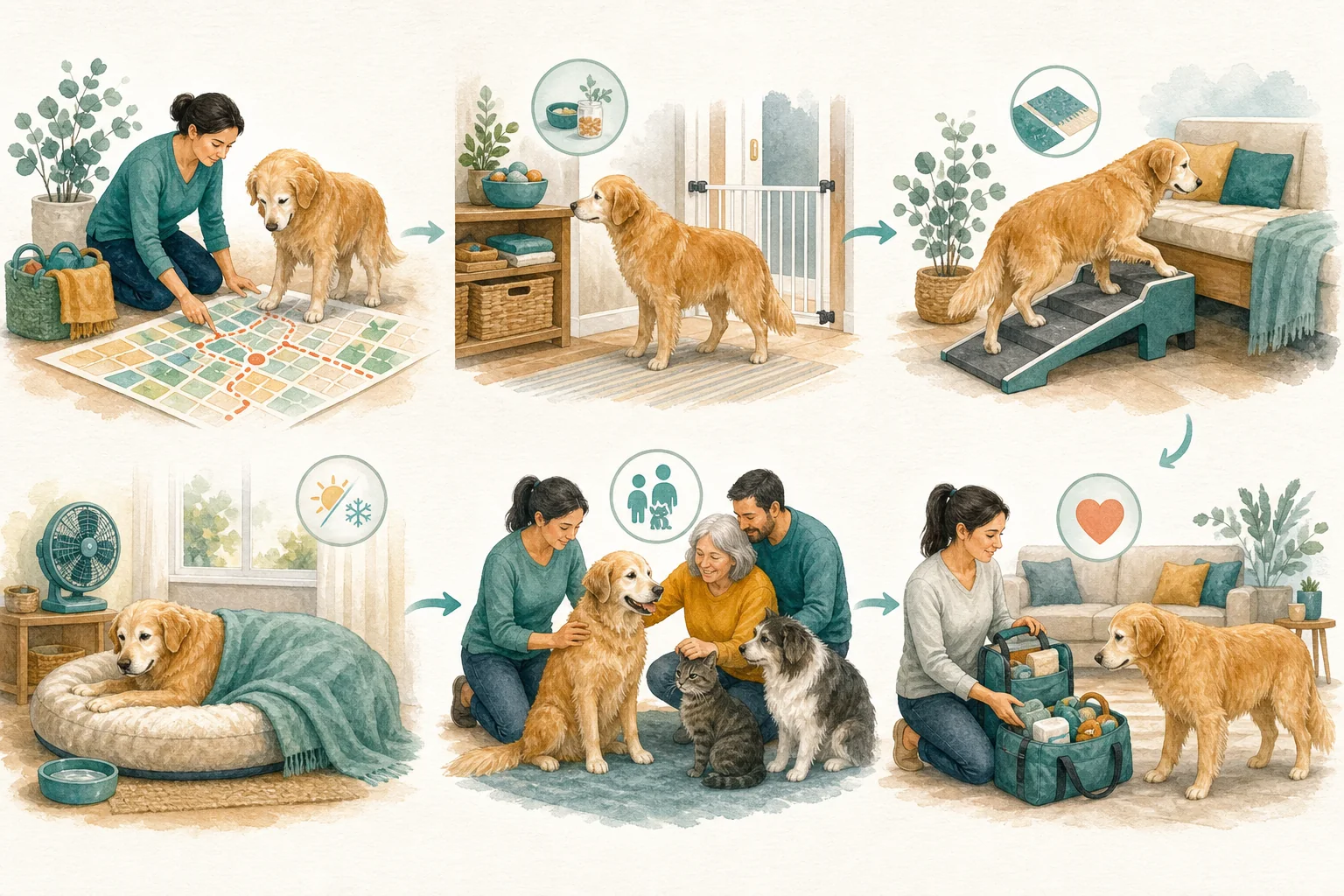
Owner tool
Emergency Prep Mini-Checklist for Senior Dogs in Multi-Pet Homes
Use this preventivecareguide as a repeatable record for emergency prep mini-checklist for senior dogs in multi-pet homes. Mark what is normal, what changed, and what needs veterinary guidance.
| Checkpoint | Owner action | Safety boundary |
|---|---|---|
| Map the real daily route | follow the dog through sleeping, feeding, toileting, play, travel, and family spaces | A room that looks safe from adult height may not be safe for the dog |
| Remove preventable access | secure gaps, chemicals, foods, cords, elevation, unstable objects, and escape points | Supervision alone cannot correct every physical hazard |
| Improve footing and transitions | check traction, thresholds, stairs, ramps, doors, and turning space | An aid must fit the dog and be introduced safely |
| Control climate and exposure | review heat, cold, airflow, surface temperature, weather, wildlife, and household products | Risk changes with season, location, health, and mobility |
| Coordinate every caregiver | use one current plan for access, handling, feeding, products, and emergency contacts | Conflicting routines increase missed steps and duplicate care |
| Test the plan without stressing the dog | walk through barriers, transport, exits, and backup arrangements calmly | Never create an exposure or emergency as a test |
| Prepare for failure and escalation | keep labels, identification, records, contacts, and a safe transport method ready | Suspected poisoning, heat illness, trauma, or collapse requires prompt care |
A three-step next action
Observe
Complete the emergency prep mini-checklist for senior dogs in multi-pet homes review without provoking a symptom or forcing the dog through difficulty.
Record
Keep dates, measurements, photographs, short natural-behavior videos, product labels, and caregiver notes together.
Escalate
Share the concise pattern with the veterinary team and seek urgent care for severe or rapidly worsening signs.
Prepare for the visit
Questions to take to your veterinarian
- Which parts of this emergency prep mini-checklist for senior dogs in multi-pet homes plan matter most for this dog?
- What findings need a routine appointment, a same-day call, or emergency care?
- Could current diagnoses, medications, diet, supplements, pain, vision, hearing, or mobility change the plan?
- What should I measure at home, and how often should I reassess it?
- Which change should make me stop the routine and contact you sooner?
Bring the dated observation log, relevant photos or short videos, and a complete list of foods, treats, medications, and supplements. Do not change the routine solely to produce evidence for the visit.
Frequently asked questions
Can this guide diagnose a health or behavior problem?
No. It organizes observations and questions; diagnosis requires veterinary assessment.
How often should I repeat the routine?
Use the interval recommended by the veterinary team and repeat sooner after a meaningful change.
Should I change several things at once?
Usually not unless the veterinary team directs it. Multiple changes make response and risk harder to interpret.
What should I bring to the appointment?
Bring the dated log, relevant photos or videos, and complete food, medication, supplement, and product information.
Sources
- Pets and Animals in Emergencies, Ready.gov (U.S. DHS). Emergency planning for pets should include a ready‑to‑go kit with food, water, medications, copies of medical records, and sturdy leashes or carriers labeled with your contact information, so senior dogs…
- Pets and Emergencies, Centers for Disease Control and Prevention. In emergencies, pets should ideally evacuate with the family because they may not survive if left behind; keeping identification up to date and having photos of each pet helps reunite…
- Senior Dog Care – Special Considerations, VCA Animal Hospitals. For senior dogs, emergency kits should also account for reduced mobility and chronic conditions by including items such as non‑slip bedding, ramps or slings if used at home, and any…
- Senior Pet Care FAQ, American Veterinary Medical Association. Owners are advised to keep a written emergency plan that covers how pets will be handled if the owner is away, and for senior dogs this plan should highlight mobility…
Medical disclaimer
Educational information only; contact a veterinarian for diagnosis, treatment, or urgent concerns. If your dog is showing severe, sudden, or rapidly worsening signs, seek urgent veterinary care.
