


A calm, evidence-aware framework for integrate parasite prevention with grooming and lifestyle in dogs, with practical owner observations and clear professional-care boundaries.
Short answer
Use a repeatable plan and keep veterinary care in the lead
Provide a structured, non-diagnostic framework for owners to map their dog’s parasite-prevention schedule to grooming and activity. The practical goal is simple: owner can align external-parasite prevention with grooming, exercise, and seasonal changes. Keep veterinary care in the lead, record patterns rather than isolated moments, and stop the routine when pain, distress, or urgent signs appear.
- Follow the dog through sleeping, feeding, toileting, play, travel, and family spaces.
- Secure gaps, chemicals, foods, cords, elevation, unstable objects, and escape points.
- Check traction, thresholds, stairs, ramps, doors, and turning space.
- Review heat, cold, airflow, surface temperature, weather, wildlife, and household products.
Safety first
Stop the routine when the dog needs professional care
Owners should contact a veterinarian promptly if a dog shows vomiting, diarrhea, tremors, weakness, or behavior changes after a parasite-prevention product or if ticks, fleas, or worms are observed despite being on prevention.[1][5][11] Urgent or emergency veterinary evaluation is needed if a dog develops seizures, collapse, severe breathing difficulty, or facial swelling following administration of any parasite-control product, as these may indicate serious adverse reactions.
Veterinary note
Educational information only; contact a veterinarian for diagnosis, treatment, or urgent concerns. This guide supports observation and preparation; it does not diagnose a condition or replace an individualized care plan.
What is reasonably supported
Use repeated observations to improve the veterinary conversation
CAPC general guidelines recommend year-round broad-spectrum parasite prevention for most dogs, tailored by a veterinarian to local risks,… CAPC emphasizes that prevention choices and intervals… The AAHA Canine Life Stage Guidelines outline age- and lifestyle-specific parasite-control recommendations, noting that indoor/outdoor access, travel, and… AAHA advises veterinarians to customize parasite-control plans;… WSAVA Principles of Wellness call for routine parasite prevention and testing as part of global wellness care and… WSAVA notes that wellness plans, including parasite… AVMA guidance on parasite prevention for pets advises that veterinarians choose appropriate products and schedules based on species,… AVMA recommends contacting a veterinarian immediately if…
What remains uncertain
Home observations cannot establish the cause
This framework integrates record-keeping for parasite prevention with grooming and lifestyle; it does not recommend specific products, schedules, or guarantee complete parasite protection.[1][4][11] Guidance is generalized and may not match local parasite risks or individual medical needs; veterinarians must tailor prevention plans based on region, lifestyle, and health status.[1][4][6] Expert guidelines emphasize year-round, risk-based parasite prevention and environmental management, but they provide limited detail on pairing medication schedules with everyday grooming routines in owner-facing templates.[1][4][11] There is limited direct research on the impact of structured, lifestyle-linked parasite journals on adherence or health outcomes; recommendations are largely derived from best-practice prevention principles.[1][4][6]
Map the real daily route
Begin with the dog's own normal pattern so a meaningful change is easier to recognize. For integrating parasite prevention with grooming and lifestyle in dogs, the accepted research supports a bounded point: CAPC general guidelines recommend year-round broad-spectrum parasite prevention for most dogs, tailored by a veterinarian to local risks, and stress environmental measures such as prompt feces… CAPC emphasizes that prevention choices and intervals must be determined with a veterinarian;… This evidence guides observation and a veterinary conversation; it does not establish a diagnosis, treatment response, or guaranteed result.
In practice, follow the dog through sleeping, feeding, toileting, play, travel, and family spaces. Record the date, frequency, context, and related changes. A room that looks safe from adult height may not be safe for the dog. Compare the dog with their own baseline and contact the veterinary team when the pattern is persistent, progressive, painful, or joined by the red-flag signs above.
Remove preventable access
Separate observation from interpretation: describe what happened before deciding what it might mean. For integrating parasite prevention with grooming and lifestyle in dogs, the accepted research supports a bounded point: The AAHA Canine Life Stage Guidelines outline age- and lifestyle-specific parasite-control recommendations, noting that indoor/outdoor access, travel, and region affect risk and that regular veterinary visits… AAHA advises veterinarians to customize parasite-control plans; owners should document products used, timing,… This evidence guides observation and a veterinary conversation; it does not establish a diagnosis, treatment response, or guaranteed result.
In practice, secure gaps, chemicals, foods, cords, elevation, unstable objects, and escape points. Record the date, frequency, context, and related changes. Supervision alone cannot correct every physical hazard. Compare the dog with their own baseline and contact the veterinary team when the pattern is persistent, progressive, painful, or joined by the red-flag signs above.
Improve footing and transitions
Consistency improves the value of a home record, even when the measurement is simple. For integrating parasite prevention with grooming and lifestyle in dogs, the accepted research supports a bounded point: WSAVA Principles of Wellness call for routine parasite prevention and testing as part of global wellness care and highlight the importance of integrating environmental management and… WSAVA notes that wellness plans, including parasite strategies, must be individualized by veterinary… This evidence guides observation and a veterinary conversation; it does not establish a diagnosis, treatment response, or guaranteed result.
In practice, check traction, thresholds, stairs, ramps, doors, and turning space. Record the date, frequency, context, and related changes. An aid must fit the dog and be introduced safely. Compare the dog with their own baseline and contact the veterinary team when the pattern is persistent, progressive, painful, or joined by the red-flag signs above.
Control climate and exposure
The setting around a sign can matter as much as the sign itself. For integrating parasite prevention with grooming and lifestyle in dogs, the accepted research supports a bounded point: AVMA guidance on parasite prevention for pets advises that veterinarians choose appropriate products and schedules based on species, age, health, and environment, and encourages owners to… AVMA recommends contacting a veterinarian immediately if a dog experiences vomiting, diarrhea, neurologic… This evidence guides observation and a veterinary conversation; it does not establish a diagnosis, treatment response, or guaranteed result.
In practice, review heat, cold, airflow, surface temperature, weather, wildlife, and household products. Record the date, frequency, context, and related changes. Risk changes with season, location, health, and mobility. Compare the dog with their own baseline and contact the veterinary team when the pattern is persistent, progressive, painful, or joined by the red-flag signs above.
Coordinate every caregiver
A checklist supports attention; it does not prove that a risk is gone or explain a medical concern. For integrating parasite prevention with grooming and lifestyle in dogs, the accepted research supports a bounded point: CAPC general guidelines recommend year-round broad-spectrum parasite prevention for most dogs, tailored by a veterinarian to local risks, and stress environmental measures such as prompt feces… CAPC emphasizes that prevention choices and intervals must be determined with a veterinarian;… This evidence guides observation and a veterinary conversation; it does not establish a diagnosis, treatment response, or guaranteed result.
In practice, use one current plan for access, handling, feeding, products, and emergency contacts. Record the date, frequency, context, and related changes. Conflicting routines increase missed steps and duplicate care. Compare the dog with their own baseline and contact the veterinary team when the pattern is persistent, progressive, painful, or joined by the red-flag signs above.
Test the plan without stressing the dog
Shared language and one current record help multiple caregivers act consistently. For integrating parasite prevention with grooming and lifestyle in dogs, the accepted research supports a bounded point: The AAHA Canine Life Stage Guidelines outline age- and lifestyle-specific parasite-control recommendations, noting that indoor/outdoor access, travel, and region affect risk and that regular veterinary visits… AAHA advises veterinarians to customize parasite-control plans; owners should document products used, timing,… This evidence guides observation and a veterinary conversation; it does not establish a diagnosis, treatment response, or guaranteed result.
In practice, walk through barriers, transport, exits, and backup arrangements calmly. Record the date, frequency, context, and related changes. Never create an exposure or emergency as a test. Compare the dog with their own baseline and contact the veterinary team when the pattern is persistent, progressive, painful, or joined by the red-flag signs above.
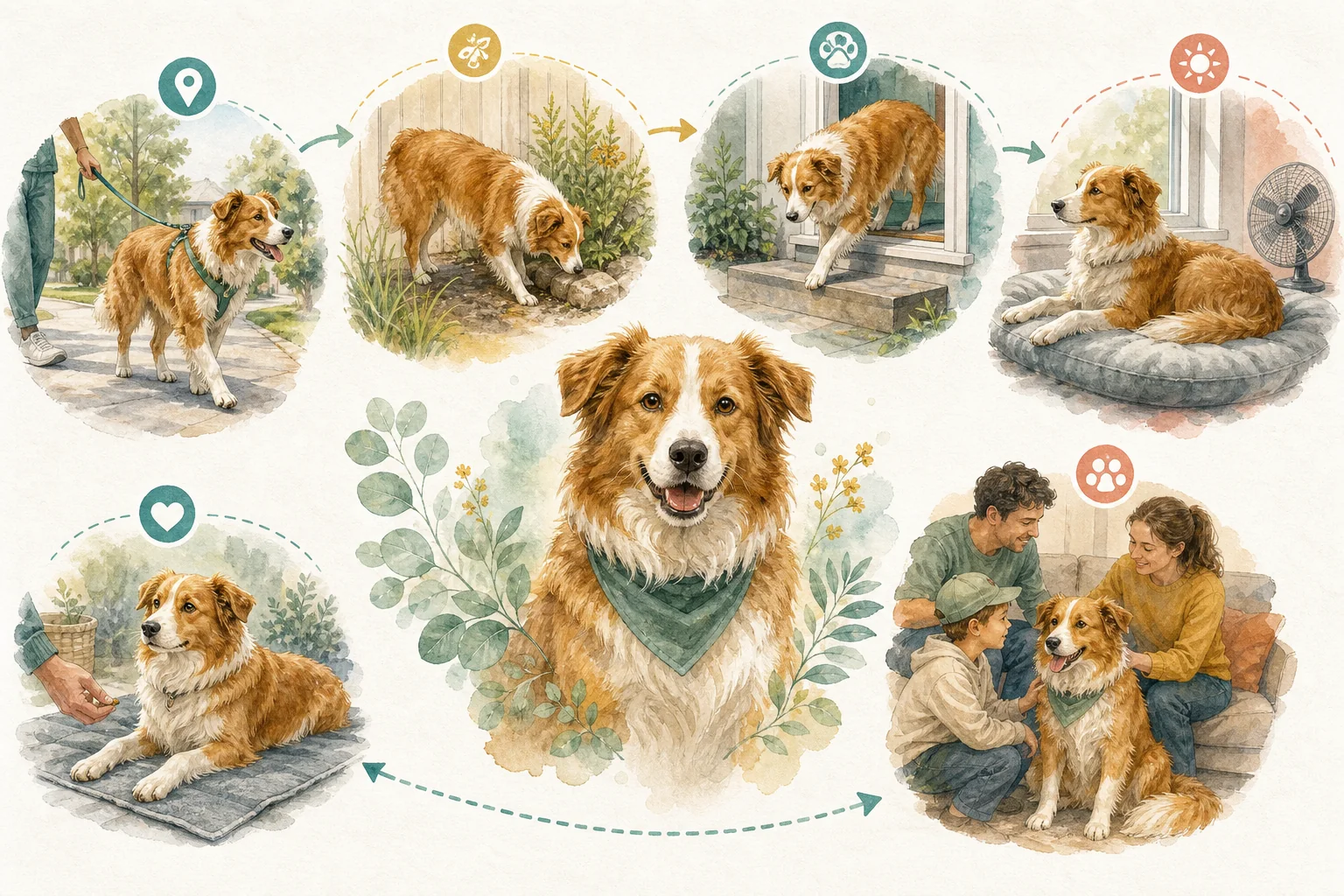
Owner tool
Integrating Parasite Prevention With Grooming and Lifestyle in Dogs
Use this guide as a repeatable record for integrate parasite prevention with grooming and lifestyle in dogs. Mark what is normal, what changed, and what needs veterinary guidance.
| Checkpoint | Owner action | Safety boundary |
|---|---|---|
| Map the real daily route | follow the dog through sleeping, feeding, toileting, play, travel, and family spaces | A room that looks safe from adult height may not be safe for the dog |
| Remove preventable access | secure gaps, chemicals, foods, cords, elevation, unstable objects, and escape points | Supervision alone cannot correct every physical hazard |
| Improve footing and transitions | check traction, thresholds, stairs, ramps, doors, and turning space | An aid must fit the dog and be introduced safely |
| Control climate and exposure | review heat, cold, airflow, surface temperature, weather, wildlife, and household products | Risk changes with season, location, health, and mobility |
| Coordinate every caregiver | use one current plan for access, handling, feeding, products, and emergency contacts | Conflicting routines increase missed steps and duplicate care |
| Test the plan without stressing the dog | walk through barriers, transport, exits, and backup arrangements calmly | Never create an exposure or emergency as a test |
| Prepare for failure and escalation | keep labels, identification, records, contacts, and a safe transport method ready | Suspected poisoning, heat illness, trauma, or collapse requires prompt care |
A three-step next action
Observe
Complete the integrating parasite prevention with grooming and lifestyle in dogs review without provoking a symptom or forcing the dog through difficulty.
Record
Keep dates, measurements, photographs, short natural-behavior videos, product labels, and caregiver notes together.
Escalate
Share the concise pattern with the veterinary team and seek urgent care for severe or rapidly worsening signs.
Prepare for the visit
Questions to take to your veterinarian
- Which parts of this integrating parasite prevention with grooming and lifestyle in dogs plan matter most for this dog?
- What findings need a routine appointment, a same-day call, or emergency care?
- Could current diagnoses, medications, diet, supplements, pain, vision, hearing, or mobility change the plan?
- What should I measure at home, and how often should I reassess it?
- Which change should make me stop the routine and contact you sooner?
Bring the dated observation log, relevant photos or short videos, and a complete list of foods, treats, medications, and supplements. Do not change the routine solely to produce evidence for the visit.
Frequently asked questions
Can this guide diagnose a health or behavior problem?
No. It organizes observations and questions; diagnosis requires veterinary assessment.
How often should I repeat the routine?
Use the interval recommended by the veterinary team and repeat sooner after a meaningful change.
Should I change several things at once?
Usually not unless the veterinary team directs it. Multiple changes make response and risk harder to interpret.
What should I bring to the appointment?
Bring the dated log, relevant photos or videos, and complete food, medication, supplement, and product information.
Sources
- Parasite Control – 2019 AAHA Canine Life Stage Guidelines, American Animal Hospital Association (AAHA). The AAHA Canine Life Stage Guidelines outline age- and lifestyle-specific parasite-control recommendations, noting that indoor/outdoor access, travel, and region affect risk and that regular veterinary visits should review prevention and…
- Parasite Prevention for Pets, American Veterinary Medical Association. AVMA guidance on parasite prevention for pets advises that veterinarians choose appropriate products and schedules based on species, age, health, and environment, and encourages owners to follow label directions carefully…
- WSAVA Principles of Wellness, World Small Animal Veterinary Association (WSAVA). WSAVA Principles of Wellness call for routine parasite prevention and testing as part of global wellness care and highlight the importance of integrating environmental management and hygiene with medical prophylaxis.[6]
- CAPC General Guidelines, Companion Animal Parasite Council. CAPC general guidelines recommend year-round broad-spectrum parasite prevention for most dogs, tailored by a veterinarian to local risks, and stress environmental measures such as prompt feces removal and limiting exposure…
Medical disclaimer
Educational information only; contact a veterinarian for diagnosis, treatment, or urgent concerns. If your dog is showing severe, sudden, or rapidly worsening signs, seek urgent veterinary care.
