

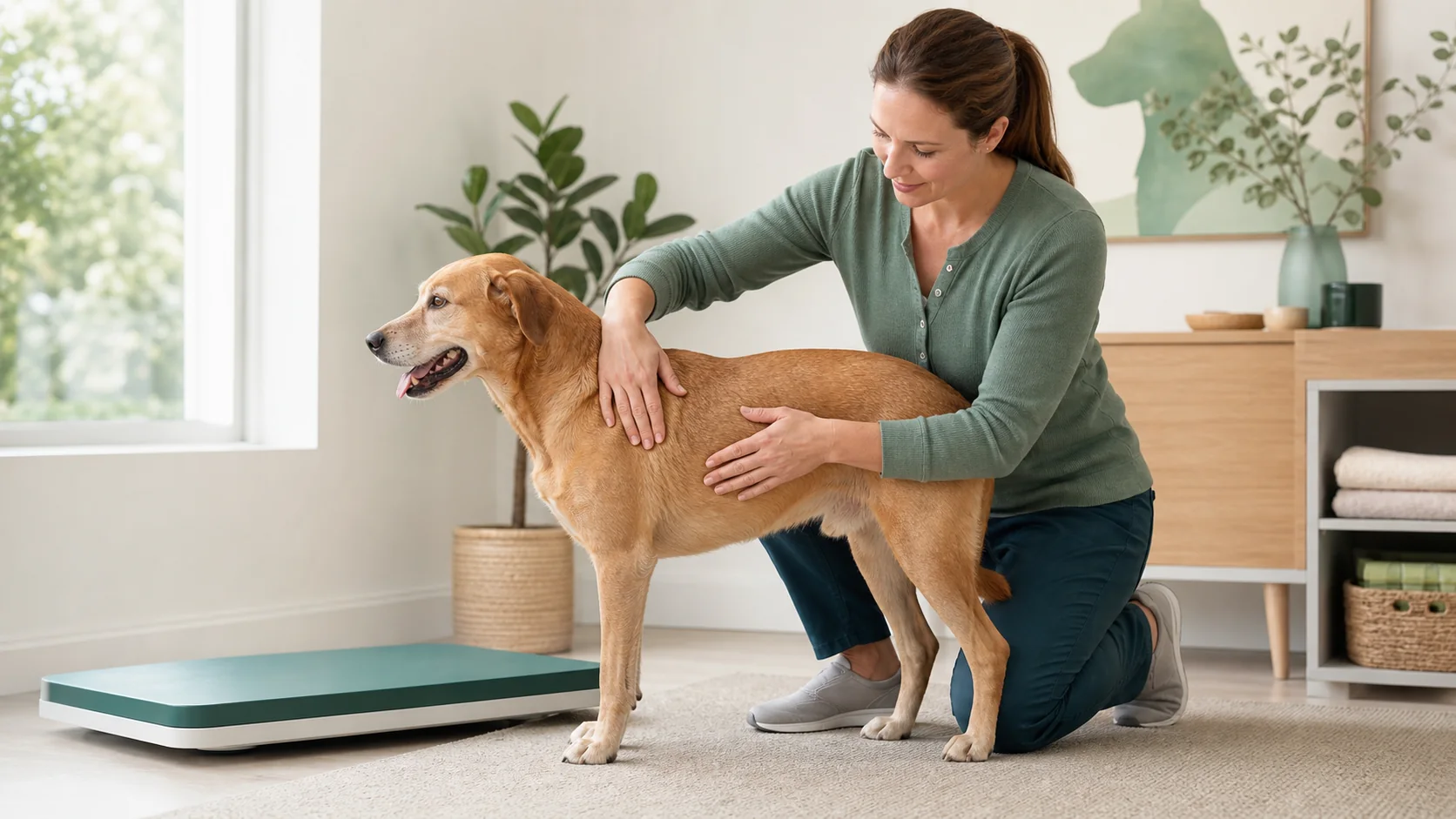
A calm, evidence-aware owner framework for dog body condition tracking, with clear professional-care boundaries and practical observations to bring to the veterinary team.
Short answer
Use a repeatable plan and keep veterinary care in the lead
Use a veterinary body-condition scale, consistent visual and hands-on observation, weight trend, and muscle notes to support nutrition conversations without reducing health to one number.
- Ask the veterinary team to demonstrate the body-condition system.
- Observe waist behind the ribs under normal posture.
- Look for abdominal contour without forcing stance.
- Assess coverage using the veterinary demonstration.
Safety first
Stop the checklist when the dog needs professional care
Any at-home body condition estimate that appears markedly underweight or overweight (for example, very prominent bones, lack of waist with sagging abdomen, or heavy fat deposits) should prompt a non-urgent but timely veterinary assessment rather than self-man- Sudden or unexplained weight loss or gain, changes in appetite, or signs of pain (such as reluctance to move, difficulty rising, or vocalizing when touched) while monitoring body condition warrant prompt veterinary evaluation. If a dog resists touch, appears distressed during hands-on checks, or shows breathing difficulty or collapse associated with weight or body-condition concerns, owners should seek urgent veterinary or emergency care immediately rather than continue home scoring
Veterinary note
Educational information only; contact a veterinarian for diagnosis, treatment, or urgent concerns. This guide supports observation and preparation; it does not diagnose a condition or replace an individualized care plan.
What is reasonably supported
Use repeated observations to improve the veterinary conversation
Standardized body condition scoring systems (such as the WSAVA 9-point chart) use combined visual and hands-on assessment of ribs, waist, and abdominal tuck to estimate a dog’s body fat and… Owners can use these charts at home to estimate body condition, but scores should be… Client-education resources from major veterinary organizations explain that a healthy dog typically has ribs that are easily felt with a thin fat covering, a visible waist when viewed from above,… These descriptions give owners practical touch-and-look reference points, but individual dogs may differ by breed… Current nutrition and weight-management guidance recommends that dogs at risk of weight gain or loss be monitored over time with repeated BCS checks and weight measurements, and that trends—rather than… Sources describe regular rechecks as important for early detection of obesity or under-condition but do…
What remains uncertain
Home observations cannot establish the cause
Supports owners in visually and hands-on assessing and tracking their dog’s body condition score (BCS) and weight trends at home as a screening tool, not a substitute for veterinary assessment. Focuses on practical frequency and method of at-home checks, and how to prepare information for veterinary review; does not set individual targets or give feeding/weight-loss instructions. Applies to generally healthy dogs; dogs with existing medical conditions, unexplained weight change, or pain require individualized veterinary guidance.
Learn the chosen scale
A useful review begins with the dog's own normal pattern, because comparison with a generic ideal can hide meaningful individual change. Research selected for this guide supports a bounded point: Standardized body condition scoring systems (such as the WSAVA 9-point chart) use combined visual and hands-on assessment of ribs, waist, and abdominal tuck to estimate a dog’s body fat and are considered a validated health-monitoring… Owners can use these charts at home to estimate body condition, but scores should be treated as screening values and… This informs careful observation and veterinary discussion, not diagnosis or a guaranteed result.
In practice, ask the veterinary team to demonstrate the body-condition system. Record the date, frequency, context, and related changes that matter to this task. Different charts may use different numeric ranges. Contact the veterinary team when the pattern is persistent, progressive, painful, or joined by the red-flag signs above.
View the dog from above
The safest approach separates observation from interpretation: owners document what happened, while the veterinary team evaluates possible causes. Research selected for this guide supports a bounded point: Client-education resources from major veterinary organizations explain that a healthy dog typically has ribs that are easily felt with a thin fat covering, a visible waist when viewed from above, and a tucked-up abdomen when… These descriptions give owners practical touch-and-look reference points, but individual dogs may differ by breed and age; persistent uncertainty or… This informs careful observation and veterinary discussion, not diagnosis or a guaranteed result.
In practice, observe waist behind the ribs under normal posture. Record the date, frequency, context, and related changes that matter to this task. Coat and body shape can obscure visual cues. Contact the veterinary team when the pattern is persistent, progressive, painful, or joined by the red-flag signs above.
View from the side
Consistency makes the record more useful. Use the same route, measure, timing, or description when practical and note unusual circumstances. Research selected for this guide supports a bounded point: Current nutrition and weight-management guidance recommends that dogs at risk of weight gain or loss be monitored over time with repeated BCS checks and weight measurements, and that trends—rather than single values—guide discussions with the… Sources describe regular rechecks as important for early detection of obesity or under-condition but do not mandate a specific home… This informs careful observation and veterinary discussion, not diagnosis or a guaranteed result.
In practice, look for abdominal contour without forcing stance. Record the date, frequency, context, and related changes that matter to this task. Breed shape does not eliminate the need for hands-on assessment. Contact the veterinary team when the pattern is persistent, progressive, painful, or joined by the red-flag signs above.
Feel the ribs gently
Small environmental details can change what the owner sees, so include weather, visitors, travel, food changes, medication timing, and household disruption. Research selected for this guide supports a bounded point: Standardized body condition scoring systems (such as the WSAVA 9-point chart) use combined visual and hands-on assessment of ribs, waist, and abdominal tuck to estimate a dog’s body fat and are considered a validated health-monitoring… Owners can use these charts at home to estimate body condition, but scores should be treated as screening values and… This informs careful observation and veterinary discussion, not diagnosis or a guaranteed result.
In practice, assess coverage using the veterinary demonstration. Record the date, frequency, context, and related changes that matter to this task. Pressing hard or using one body area can mislead. Contact the veterinary team when the pattern is persistent, progressive, painful, or joined by the red-flag signs above.
Track weight and muscle separately
A checklist is a prompt for attention, not proof that risk has been removed or that a medical concern has been explained. Research selected for this guide supports a bounded point: Client-education resources from major veterinary organizations explain that a healthy dog typically has ribs that are easily felt with a thin fat covering, a visible waist when viewed from above, and a tucked-up abdomen when… These descriptions give owners practical touch-and-look reference points, but individual dogs may differ by breed and age; persistent uncertainty or… This informs careful observation and veterinary discussion, not diagnosis or a guaranteed result.
In practice, use the same scale and note spine, shoulders, hips, and thighs. Record the date, frequency, context, and related changes that matter to this task. Stable weight can coexist with muscle loss. Contact the veterinary team when the pattern is persistent, progressive, painful, or joined by the red-flag signs above.
Record photographs consistently
When several caregivers are involved, shared terms and one current record reduce missed steps, duplicate care, and conflicting impressions. Research selected for this guide supports a bounded point: Current nutrition and weight-management guidance recommends that dogs at risk of weight gain or loss be monitored over time with repeated BCS checks and weight measurements, and that trends—rather than single values—guide discussions with the… Sources describe regular rechecks as important for early detection of obesity or under-condition but do not mandate a specific home… This informs careful observation and veterinary discussion, not diagnosis or a guaranteed result.
In practice, use similar angle, lighting, and posture. Record the date, frequency, context, and related changes that matter to this task. Photos support comparison but do not replace examination. Contact the veterinary team when the pattern is persistent, progressive, painful, or joined by the red-flag signs above.
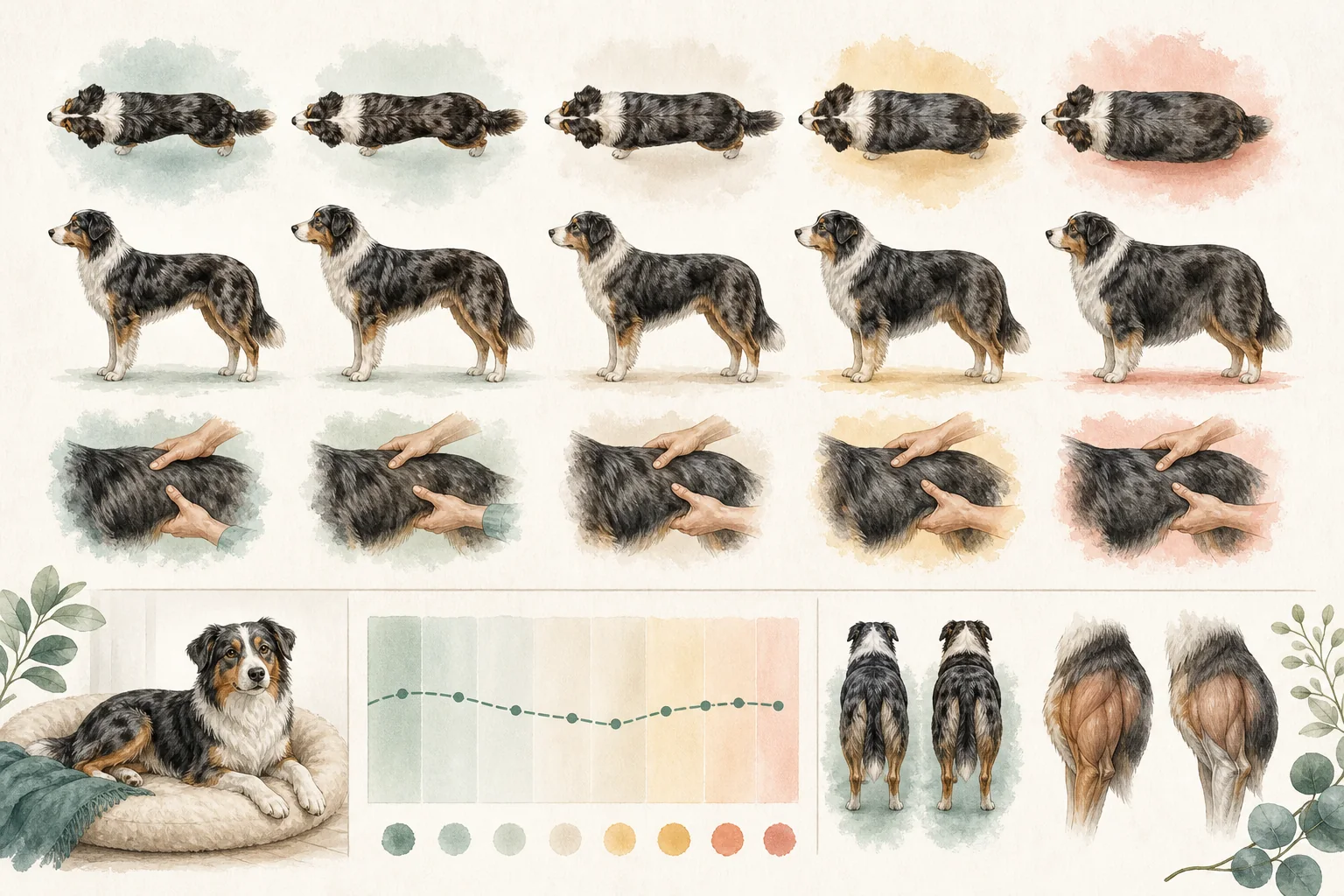
Owner tool
Assessing and Tracking Dog Body Condition at Home
Use this dog body condition tracking as a repeatable owner record. Mark what is normal, what changed, and what needs veterinary guidance.
| Checkpoint | Owner action | Boundary |
|---|---|---|
| Learn the chosen scale | ask the veterinary team to demonstrate the body-condition system | Different charts may use different numeric ranges |
| View the dog from above | observe waist behind the ribs under normal posture | Coat and body shape can obscure visual cues |
| View from the side | look for abdominal contour without forcing stance | Breed shape does not eliminate the need for hands-on assessment |
| Feel the ribs gently | assess coverage using the veterinary demonstration | Pressing hard or using one body area can mislead |
| Track weight and muscle separately | use the same scale and note spine, shoulders, hips, and thighs | Stable weight can coexist with muscle loss |
| Record photographs consistently | use similar angle, lighting, and posture | Photos support comparison but do not replace examination |
| Review nutrition changes professionally | bring food amounts, treats, activity, and health history | Rapid weight change or appetite change needs evaluation |
A three-step next action
Observe
Complete the dog body condition tracking without provoking a symptom or forcing the dog through difficulty.
Record
Keep dates, measurements, photographs, short natural-behavior videos, product labels, and caregiver notes together.
Escalate
Share the concise pattern with the veterinary team and seek urgent care for severe or rapidly worsening signs.
Prepare for the visit
Questions to take to your veterinarian
- Which parts of this dog body condition tracking are most important for this dog?
- What findings need a routine appointment, a same-day call, or emergency care?
- Could current diagnoses, medications, diet, supplements, pain, vision, hearing, or mobility change the plan?
- What should I measure at home, and how often should I reassess it?
- Which change should make me stop the routine and contact you sooner?
Bring the dated observation log, relevant photos or short videos, and a complete list of foods, treats, medications, and supplements. Do not change the routine solely to produce evidence for the visit.
Frequently asked questions
Can this checklist diagnose a health problem?
No. It organizes observations and questions; diagnosis requires veterinary assessment.
How often should I repeat it?
Use the interval recommended by the veterinary team and repeat sooner after a meaningful change.
Should I change several things at once?
Usually not unless the veterinary team directs it. Multiple changes make response and risk harder to interpret.
What should I bring to the appointment?
Bring the dated log, relevant photos or videos, and complete food, medication, supplement, and product information.
Sources
- Body Condition Score Chart – Dog, World Small Animal Veterinary Association. Standardized **body condition scoring** systems (such as the WSAVA 9‑point chart) use combined visual and hands‑on assessment of ribs, waist, and abdominal tuck to estimate a dog’s body fat and…
- Body Condition Scoring in Dogs, VCA Animal Hospitals. Client‑education resources from major veterinary organizations explain that a healthy dog typically has ribs that are easily felt with a thin fat covering, a visible waist when viewed from above,…
- Your Dog's Healthy Weight, American Veterinary Medical Association. Client‑education resources from major veterinary organizations explain that a healthy dog typically has ribs that are easily felt with a thin fat covering, a visible waist when viewed from above,…
- AAHA Nutrition and Weight Management Guidelines, American Animal Hospital Association. Current nutrition and weight‑management guidance recommends that dogs at risk of weight gain or loss be monitored over time with **repeated BCS checks and weight measurements**, and that trends—rather than…
Medical disclaimer
Educational information only; contact a veterinarian for diagnosis, treatment, or urgent concerns. If your dog is showing severe, sudden, or rapidly worsening signs, seek urgent veterinary care.
