A calm, evidence-aware owner framework for cleaning and garden product prevention, with clear professional-care boundaries and practical observations to bring to the veterinary team.
Short answer
Use a repeatable plan and keep veterinary care in the lead
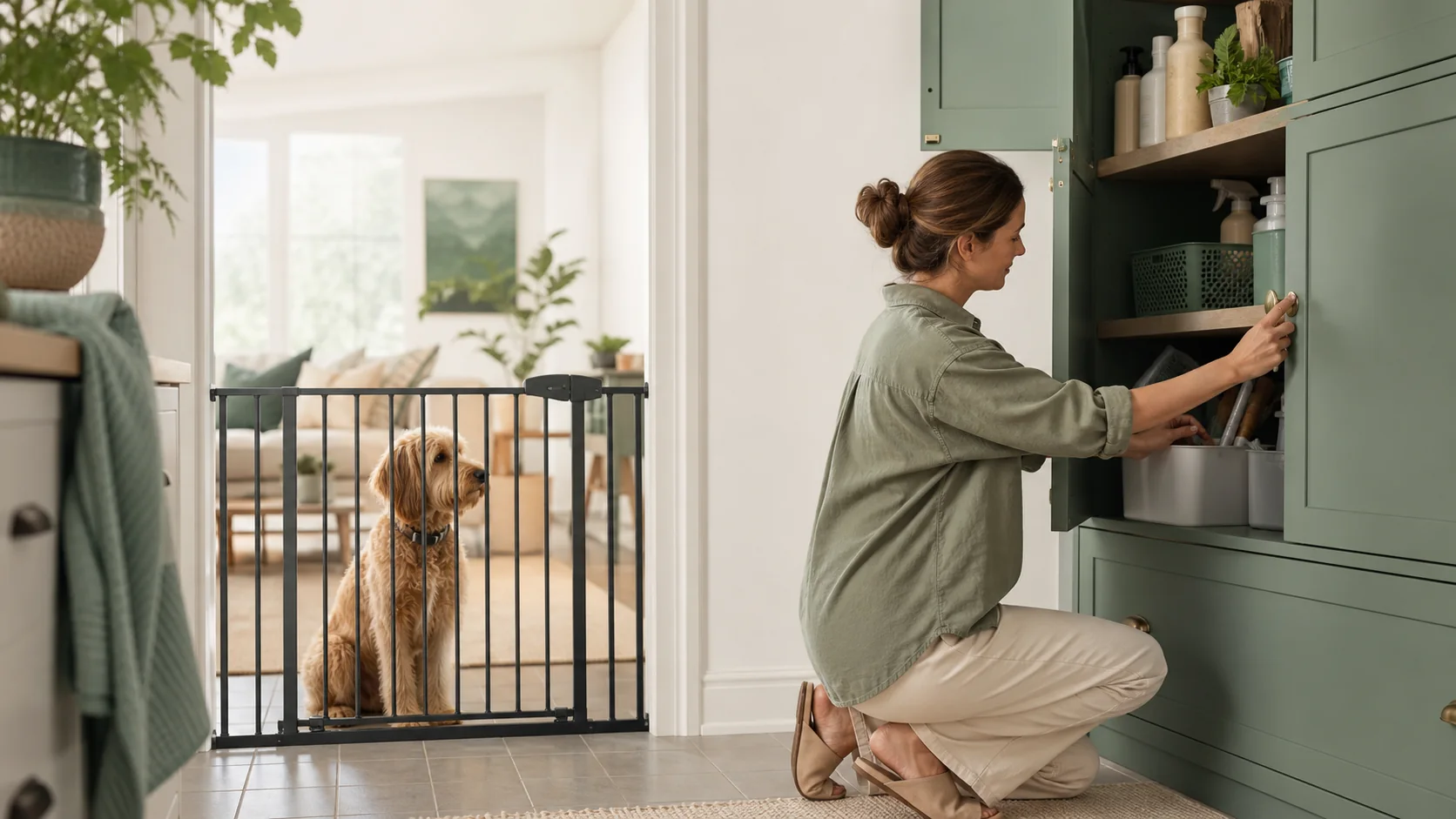
Use closed storage, barriers, original labels, supervised use, spill control, and exposure-response planning for household and garden chemicals.
- Include cleaners, detergents, pesticides, fertilizers, fuels, paint, and pest products.
- Preserve labels and never transfer chemicals into food or drink containers.
- Choose cabinets or locked areas the dog cannot access.
- Use barriers until surfaces are dry and the area is ventilated as directed.
Safety first
Stop the checklist when the dog needs professional care
Owners should seek immediate veterinary or poison-control assistance if a dog is seen ingesting or chewing cleaning solutions, detergents, bleach, fertilizers, pesticides, or unknown garden products, even before signs appear. Urgent care is warranted if, after possible exposure, a dog develops vomiting, diarrhea, drooling, difficulty breathing, tremors, seizures, collapse, or chemical burns on the mouth or skin, as these may indicate serious poisoning or caustic injury. Owners should not attempt to make a dog vomit or give home remedies for chemical or garden-product ingestion unless explicitly directed by a veterinarian or poison-control professional.
Veterinary note
Educational information only; contact a veterinarian for diagnosis, treatment, or urgent concerns. This guide supports observation and preparation; it does not diagnose a condition or replace an individualized care plan.
What is reasonably supported
Use repeated observations to improve the veterinary conversation
Household-hazard guidance warns that cleaning products, detergents, and other chemicals should be stored securely out of pets’ reach, ideally in closed cabinets or areas the dog cannot access, to prevent… AVMA lists typical hazards but notes that individual households may have additional risky items; owners… Springtime hazard information highlights that fertilizers, pesticides, and certain garden products can be toxic to pets and should be used and stored following label directions, kept in original containers, and… Guidance emphasizes prevention but does not describe treatment; suspected exposures require prompt veterinary or poison-control… Poison-prevention resources recommend keeping all potential toxins, including medications, chemicals, and garden supplies, in secured locations, and educating all family members not to leave products where pets can reach them. AVMA notes that even well-secured homes cannot eliminate all risk, so owners should know emergency… Poison-control plant lists show that many ornamental and garden plants are toxic to dogs, underscoring the importance of controlling access to garden beds and potted plants as part of overall… ASPCA provides examples of toxic and non-toxic plants but advises contacting a veterinarian or poison-control…
What remains uncertain
Home observations cannot establish the cause
Guidance focuses on preventing dogs’ access to household cleaning chemicals and garden products; it does not provide treatment advice for poisonings. Owners should not rely solely on storage practices if a dog has strong chewing or digging habits; supervision and training are also important. This packet does not list all possible hazardous substances and cannot replace poison-control or veterinary consultation in emergencies.
Inventory the products
A useful review begins with the dog's own normal pattern, because comparison with a generic ideal can hide meaningful individual change. Research selected for this guide supports a bounded point: Household-hazard guidance warns that cleaning products, detergents, and other chemicals should be stored securely out of pets’ reach, ideally in closed cabinets or areas the dog cannot access, to prevent accidental ingestion or contact. AVMA lists typical hazards but notes that individual households may have additional risky items; owners must remain vigilant and adapt… This informs careful observation and veterinary discussion, not diagnosis or a guaranteed result.
In practice, include cleaners, detergents, pesticides, fertilizers, fuels, paint, and pest products. Record the date, frequency, context, and related changes that matter to this task. Hazards may be stored outside their usual room. Contact the veterinary team when the pattern is persistent, progressive, painful, or joined by the red-flag signs above.
Keep original containers
The safest approach separates observation from interpretation: owners document what happened, while the veterinary team evaluates possible causes. Research selected for this guide supports a bounded point: Springtime hazard information highlights that fertilizers, pesticides, and certain garden products can be toxic to pets and should be used and stored following label directions, kept in original containers, and restricted from pet-accessible areas. Guidance emphasizes prevention but does not describe treatment; suspected exposures require prompt veterinary or poison-control advice. This informs careful observation and veterinary discussion, not diagnosis or a guaranteed result.
In practice, preserve labels and never transfer chemicals into food or drink containers. Record the date, frequency, context, and related changes that matter to this task. Unlabeled mixtures complicate emergency response. Contact the veterinary team when the pattern is persistent, progressive, painful, or joined by the red-flag signs above.
Use closed latched storage
Consistency makes the record more useful. Use the same route, measure, timing, or description when practical and note unusual circumstances. Research selected for this guide supports a bounded point: Poison-prevention resources recommend keeping all potential toxins, including medications, chemicals, and garden supplies, in secured locations, and educating all family members not to leave products where pets can reach them. AVMA notes that even well-secured homes cannot eliminate all risk, so owners should know emergency contacts and act quickly if… This informs careful observation and veterinary discussion, not diagnosis or a guaranteed result.
In practice, choose cabinets or locked areas the dog cannot access. Record the date, frequency, context, and related changes that matter to this task. A high open shelf is not always secure. Contact the veterinary team when the pattern is persistent, progressive, painful, or joined by the red-flag signs above.
Separate the dog during use
Small environmental details can change what the owner sees, so include weather, visitors, travel, food changes, medication timing, and household disruption. Research selected for this guide supports a bounded point: Poison-control plant lists show that many ornamental and garden plants are toxic to dogs, underscoring the importance of controlling access to garden beds and potted plants as part of overall outdoor chemical and plant safety. ASPCA provides examples of toxic and non-toxic plants but advises contacting a veterinarian or poison-control center if a dog ingests… This informs careful observation and veterinary discussion, not diagnosis or a guaranteed result.
In practice, use barriers until surfaces are dry and the area is ventilated as directed. Record the date, frequency, context, and related changes that matter to this task. Supervision does not make direct contact safe. Contact the veterinary team when the pattern is persistent, progressive, painful, or joined by the red-flag signs above.
Control spills and waste
A checklist is a prompt for attention, not proof that risk has been removed or that a medical concern has been explained. Research selected for this guide supports a bounded point: Household-hazard guidance warns that cleaning products, detergents, and other chemicals should be stored securely out of pets’ reach, ideally in closed cabinets or areas the dog cannot access, to prevent accidental ingestion or contact. AVMA lists typical hazards but notes that individual households may have additional risky items; owners must remain vigilant and adapt… This informs careful observation and veterinary discussion, not diagnosis or a guaranteed result.
In practice, clean promptly and secure used cloths, packaging, and rinse water. Record the date, frequency, context, and related changes that matter to this task. Residue can remain attractive or irritating. Contact the veterinary team when the pattern is persistent, progressive, painful, or joined by the red-flag signs above.
Audit the yard after work
When several caregivers are involved, shared terms and one current record reduce missed steps, duplicate care, and conflicting impressions. Research selected for this guide supports a bounded point: Springtime hazard information highlights that fertilizers, pesticides, and certain garden products can be toxic to pets and should be used and stored following label directions, kept in original containers, and restricted from pet-accessible areas. Guidance emphasizes prevention but does not describe treatment; suspected exposures require prompt veterinary or poison-control advice. This informs careful observation and veterinary discussion, not diagnosis or a guaranteed result.
In practice, remove granules, containers, tools, and treated access. Record the date, frequency, context, and related changes that matter to this task. Weather and irrigation can move materials. Contact the veterinary team when the pattern is persistent, progressive, painful, or joined by the red-flag signs above.
Owner tool
Securing Cleaning and Garden Products From Dogs
Use this cleaning and garden product prevention as a repeatable owner record. Mark what is normal, what changed, and what needs veterinary guidance.
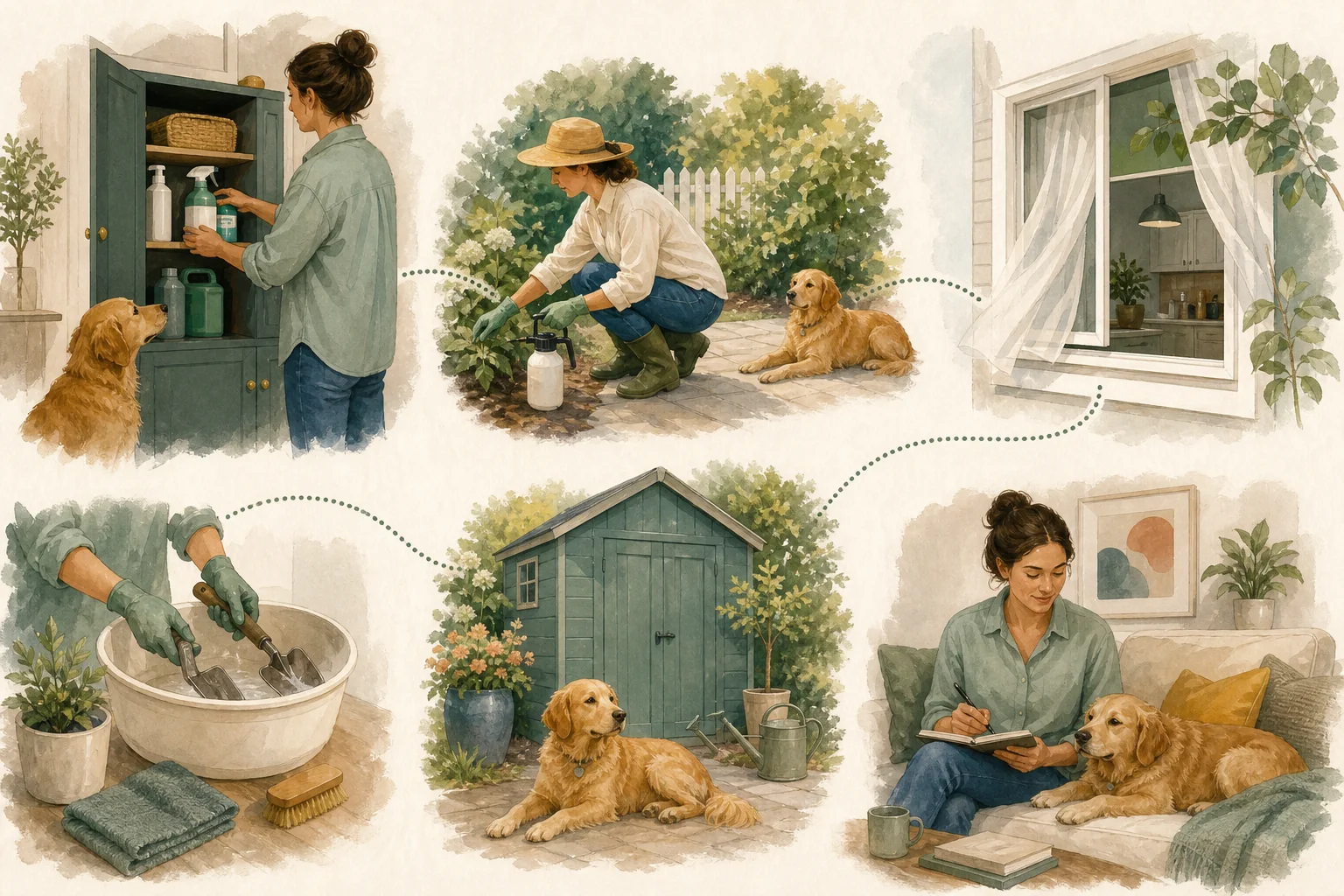
| Checkpoint | Owner action | Boundary |
|---|---|---|
| Inventory the products | include cleaners, detergents, pesticides, fertilizers, fuels, paint, and pest products | Hazards may be stored outside their usual room |
| Keep original containers | preserve labels and never transfer chemicals into food or drink containers | Unlabeled mixtures complicate emergency response |
| Use closed latched storage | choose cabinets or locked areas the dog cannot access | A high open shelf is not always secure |
| Separate the dog during use | use barriers until surfaces are dry and the area is ventilated as directed | Supervision does not make direct contact safe |
| Control spills and waste | clean promptly and secure used cloths, packaging, and rinse water | Residue can remain attractive or irritating |
| Audit the yard after work | remove granules, containers, tools, and treated access | Weather and irrigation can move materials |
| Prepare for exposure | save contacts and preserve the exact container | Do not induce vomiting or improvise an antidote |
A three-step next action
Observe
Complete the cleaning and garden product prevention without provoking a symptom or forcing the dog through difficulty.
Record
Keep dates, measurements, photographs, short natural-behavior videos, product labels, and caregiver notes together.
Escalate
Share the concise pattern with the veterinary team and seek urgent care for severe or rapidly worsening signs.
Prepare for the visit
Questions to take to your veterinarian
- Which parts of this cleaning and garden product prevention are most important for this dog?
- What findings need a routine appointment, a same-day call, or emergency care?
- Could current diagnoses, medications, diet, supplements, pain, vision, hearing, or mobility change the plan?
- What should I measure at home, and how often should I reassess it?
- Which change should make me stop the routine and contact you sooner?
Bring the dated observation log, relevant photos or short videos, and a complete list of foods, treats, medications, and supplements. Do not change the routine solely to produce evidence for the visit.
Frequently asked questions
Can this checklist diagnose a health problem?
No. It organizes observations and questions; diagnosis requires veterinary assessment.
How often should I repeat it?
Use the interval recommended by the veterinary team and repeat sooner after a meaningful change.
Should I change several things at once?
Usually not unless the veterinary team directs it. Multiple changes make response and risk harder to interpret.
What should I bring to the appointment?
Bring the dated log, relevant photos or videos, and complete food, medication, supplement, and product information.
Sources
- Household hazards, American Veterinary Medical Association. Household-hazard guidance warns that **cleaning products, detergents, and other chemicals** should be stored securely out of pets’ reach, ideally in **closed cabinets or areas the dog cannot access**, to prevent…
- Springtime Hazards for Pets, American Veterinary Medical Association. Springtime hazard information highlights that **fertilizers, pesticides, and certain garden products** can be toxic to pets and should be **used and stored following label directions, kept in original containers, and…
- Poison Prevention for Dogs and Cats, American Veterinary Medical Association (AVMA). Poison-prevention resources recommend **keeping all potential toxins, including medications, chemicals, and garden supplies, in secured locations**, and educating all family members not to leave products where pets can reach them.
- Toxic and Non-Toxic Plants – Dogs, ASPCA Animal Poison Control Center. Poison-control plant lists show that many **ornamental and garden plants** are toxic to dogs, underscoring the importance of **controlling access to garden beds and potted plants** as part of overall…
Medical disclaimer
Educational information only; contact a veterinarian for diagnosis, treatment, or urgent concerns. If your dog is showing severe, sudden, or rapidly worsening signs, seek urgent veterinary care.
