A first dog can make every package promise feel urgent. Start somewhere calmer: identify the dog's complete food, treats, chews, medications, preventives, health history, current signs, and veterinary plan before deciding whether a supplement question exists. Most decisions are not a contest between brands. They ask whether a defined patient goal is present, whether nutrition or medical assessment comes first, whether evidence matches an exact finished product, what risks and interactions matter, and how response will be monitored. Zero supplements is a valid outcome when no product meaningfully improves the plan.
Short answer
A supplement is an optional exposure, not a routine requirement
FDA does not regulate animal supplements as one special human-style category. AAFCO and AAHA place decisions within the complete diet and whole patient, while veterinary reviews warn that ingredient evidence may not validate a finished product. New owners need an inventory and a clinical question before a shopping list. [1] [2] [3] [4]
- Start with the individual dog's baseline, complete diet, health history, and current veterinary plan.
- Use exact terms, labels, dates, and observations without turning them into a home diagnosis or prescription.
- Keep population evidence, regulatory categories, ingredients, and finished products within their actual limits.
- Escalate sudden, severe, persistent, progressive, dangerous, or function-limiting change promptly.
Safety first
New symptoms need assessment before a new product
Seek urgent care for collapse, breathing difficulty, seizure, severe pain or weakness, repeated unproductive retching, a painful distended abdomen, inability to stand, major bleeding, facial swelling with breathing concerns, or suspected toxin exposure. Contact the veterinarian promptly for persistent vomiting, diarrhea, appetite change, lethargy, or a reaction after any exposure.
- Do not delay urgent care while completing a glossary, FAQ, product record, or observation log.
- Do not start, stop, combine, divide, increase, decrease, or rechallenge medication or supplements from this article.
- Do not use a human product, leftover prescription, online dose conversion, or supplement as a substitute for indicated care.
Veterinary note
This article is educational and does not diagnose, treat, prescribe, or replace care from a licensed veterinarian. Your dog’s history, examination, diet, medications, and current signs determine what is appropriate.
Start with food, history, and the actual question
Record the complete and balanced main diet, exact amounts, treats, chews, table foods, flavored medications, preventives, and current supplements. Photograph labels. A front-panel phrase cannot reveal the total nutrient and active-compound exposure.
Write the concern as an observable question: a diagnosed condition, a diet gap identified by the veterinary team, a monitored functional goal, or uncertainty about an existing product. General wellness is too vague to define benefit or interpret change.
Ask whether examination, diagnostics, diet correction, medication, behavior care, rehabilitation, or environmental support should come first. A supplement cannot safely stand in for the missing assessment.

Separate ingredient interest from finished-product evidence
A study may evaluate one ingredient, extraction method, formulation, dose, species, condition, population, and endpoint. It does not automatically support every chew, powder, blend, or label claim that contains the same ingredient.
For the exact product, ask for identity, amount, formulation, lot information, quality controls, contaminant testing, storage, expiration, and evidence that matches the intended goal. A certificate or seal has a defined scope and is not proof of clinical effectiveness.
Check who funded the evidence, whether outcomes mattered to dogs and caregivers, how adverse events and dropouts were handled, and whether the comparison and duration fit the question.
Build a one-change monitoring plan
If the veterinarian supports a trial, record the exact product and instructions, starting baseline, target outcome, observation method, review date, and stop/contact signs. Do not improvise a dose from weight charts or human directions.
Keep clinically appropriate variables stable and record adherence, diet, medication, activity, illness, travel, and other changes. Improvement after a start is association, not automatic proof of cause; no change does not by itself establish failure.
Report adverse observations and preserve the package and lot information. Do not stop and restart or increase an amount to test causation unless the veterinary team specifically directs it.
Avoid first-owner shortcuts
Do not assume a multivitamin is harmless insurance, that natural means safe, that more ingredients mean broader support, or that a recommendation from another dog's owner applies to this dog.
Do not stack a probiotic, calming aid, joint product, vitamin, oil, and herbal blend before one clear question is evaluated. Overlap can increase exposure and make both benefit and harm harder to interpret.
Use selection criteria before any optional example: defined goal, exact label, evidence match, quality documentation, interaction review, feasible administration, monitoring, and a reassessment point. This article intentionally includes zero commercial links.
Keep the evidence and product boundary visible
FDA explains that animal products are categorized through composition and intended use rather than a special human-style dietary-supplement category. A label word such as natural, wellness, veterinary, premium, or clinical does not establish safety, effectiveness, regulatory approval, or suitability for one dog. [1]
AAFCO and AAHA place supplement questions beside the complete diet, medical history, medications, body and muscle condition, environment, and veterinary assessment. Adding nutrients or active compounds can be unnecessary, duplicative, excessive, or difficult to interpret when the full exposure list is missing. [2] [3]
Veterinary reviews identify gaps between ingredient research and the exact finished product sold to an owner. Species, condition, population, formulation, dose, manufacturing, quality testing, outcome, duration, adverse-event capture, and conflicts all shape what a study can support. [4]
Prepare for a focused veterinary conversation
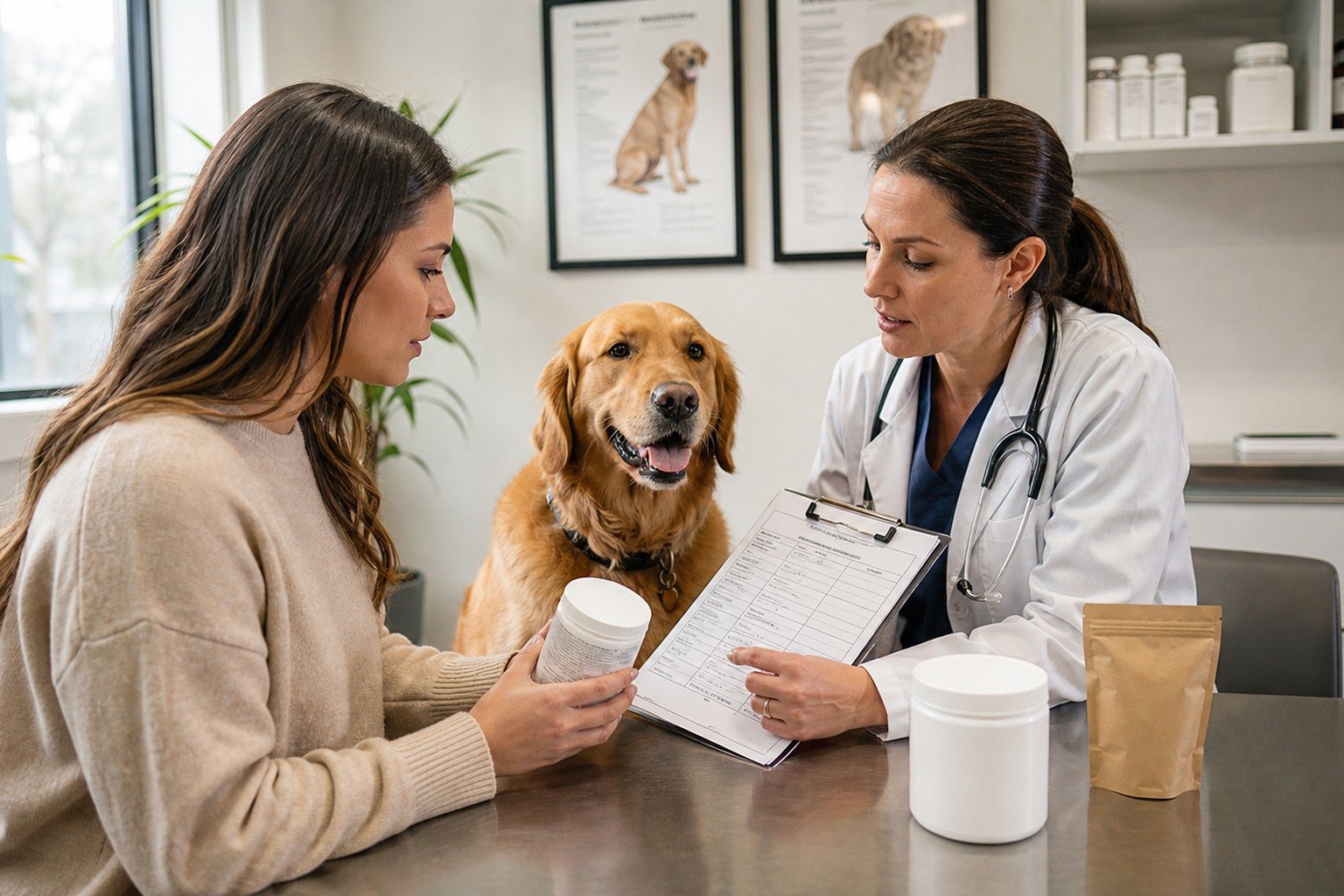
Bring a concise timeline, short natural-movement or symptom videos when safe, the exact names and photographs of every food, treat, medication, and supplement label, and notes about appetite, water intake, stool, sleep, activity, comfort, and behavior. Include recent injuries, travel, boarding, diet changes, missed medication, and previous test results. A complete record helps the veterinary team separate a repeatable pattern from a single impression.
Decide in advance what you need from the visit: an urgency decision, a diagnosis plan, a nutrition review, a pain or mobility assessment, or a monitored trial. Ask what result would change the plan and what finding would rule an option out. This keeps research and product information in the right role. Evidence can shape questions and expectations, but it cannot determine what is safe for an individual dog without the history and examination.
Owner tool
Build a first supplement decision record
On a phone, swipe across the table to see every column.
| Checkpoint | What to record | Why it helps |
|---|---|---|
| Inventory | Food, treats, medications, every supplement | Maps total exposure |
| Goal | Defined patient question and baseline | Prevents vague use |
| Evidence | Species, product, outcome, limits | Controls claims |
| Plan | Instructions, monitoring, stop rule | Supports review |
Better questions, calmer next steps
Questions to ask your veterinarian
- Does my dog have a defined reason to consider this?
- Should nutrition or diagnostic work come first?
- Does evidence match the exact finished product?
- What interactions or duplicate exposures matter?
- How and when will we reassess?
FAQ
Does every dog need a supplement?
No.
Is a multivitamin good insurance?
Not automatically; complete diets and total exposure matter.
Can I use a human product?
Not without veterinary direction.
Does natural mean safe?
No.
Should I buy before the appointment?
Usually bring the exact candidate label for review first.
Sources
- U.S. Food and Drug Administration: FDA's Regulation of Pet Food. Animal-food, intended-use, and animal-drug boundaries.
- Association of American Feed Control Officials: Supplements. Complete-diet context, labels, excess exposure, and veterinary involvement.
- American Animal Hospital Association: Nutritional Risk Factors. Whole-patient nutrition, medication, supplement, and environment assessment.
- Nutrition Today: Veterinary Pet Supplements and Nutraceuticals. Regulatory, quality, safety, efficacy, and finished-product evidence limits.
