


Dog supplement research is expanding, but more studies do not automatically mean clearer answers. Owners will see laboratory experiments, small pilot trials, microbiome findings, company-funded studies, conference abstracts, and polished summaries that all sound scientific while answering very different questions. The useful question is not whether a study is new. It is whether the tested product was clearly identified, the comparison was fair, the dogs resembled the population of interest, the outcome mattered to canine health or function, harms were captured, and another team could reproduce the work. Research can inform a veterinary conversation without turning a preliminary signal into a treatment instruction. Read the complete paper when possible, distinguish statistical change from meaningful clinical benefit, and look for the total evidence across studies. A transparent null result can be more informative than an exciting claim built on unclear methods.
Short answer
Look for a complete evidence chain, not a futuristic claim
ARRIVE 2.0 identifies study design, sample size, inclusion criteria, randomization, blinding, outcome measures, statistics, animal details, procedures, and results as essential information for appraising animal research. These reporting elements help readers assess reliability; they do not guarantee that a supplement works. [1]
- Start with the dog's history, complete diet, current treatment, and the exact question being asked.
- Separate an observed association from evidence that an intervention causes a useful clinical outcome.
- Use measurable observations and a planned review instead of testimonials or vague wellness claims.
- Contact a veterinarian promptly when signs are severe, escalating, persistent, or affecting normal function.
Safety first
New evidence never replaces care for a dog who is unwell
Contact a veterinarian for vomiting, diarrhea, appetite loss, pain, weakness, tremors, abnormal bleeding, jaundice, collapse, breathing change, or a new sign after a product starts. After a suspected overdose or wrong product, bring the container and seek prompt professional guidance. Do not wait for research news or use an online study to manage an emergency.
- Do not use this article to diagnose a condition or calculate treatment.
- Do not delay care for collapse, breathing difficulty, severe pain, repeated vomiting, blood, or rapid decline.
- Do not start, stop, combine, or replace veterinary treatment based on a product claim.
Veterinary note
This article is educational and does not diagnose, treat, prescribe, or replace care from a licensed veterinarian. Your dog’s history, examination, diet, medications, and current signs determine what is appropriate.
First ask exactly what product and question were studied
A named ingredient is not enough. Record chemical or biological identity, amount, formulation, excipients, lot testing, storage, and whether the study product matches what an owner could actually obtain. Probiotics may be strain-specific; extracts can differ by source and processing; combination products cannot automatically support claims for each component.
A useful research question specifies the dogs, intervention, comparator, outcome, and timeframe. A study of healthy laboratory dogs, a cell culture, or a stool metabolite cannot by itself establish benefit for client-owned dogs with a diagnosed disease.
FDA explains that animal products are regulated according to composition and intended use, and disease-treatment claims can place a product in animal-drug territory. Scientific language in advertising is not evidence of approval, safety, or effectiveness. [2]
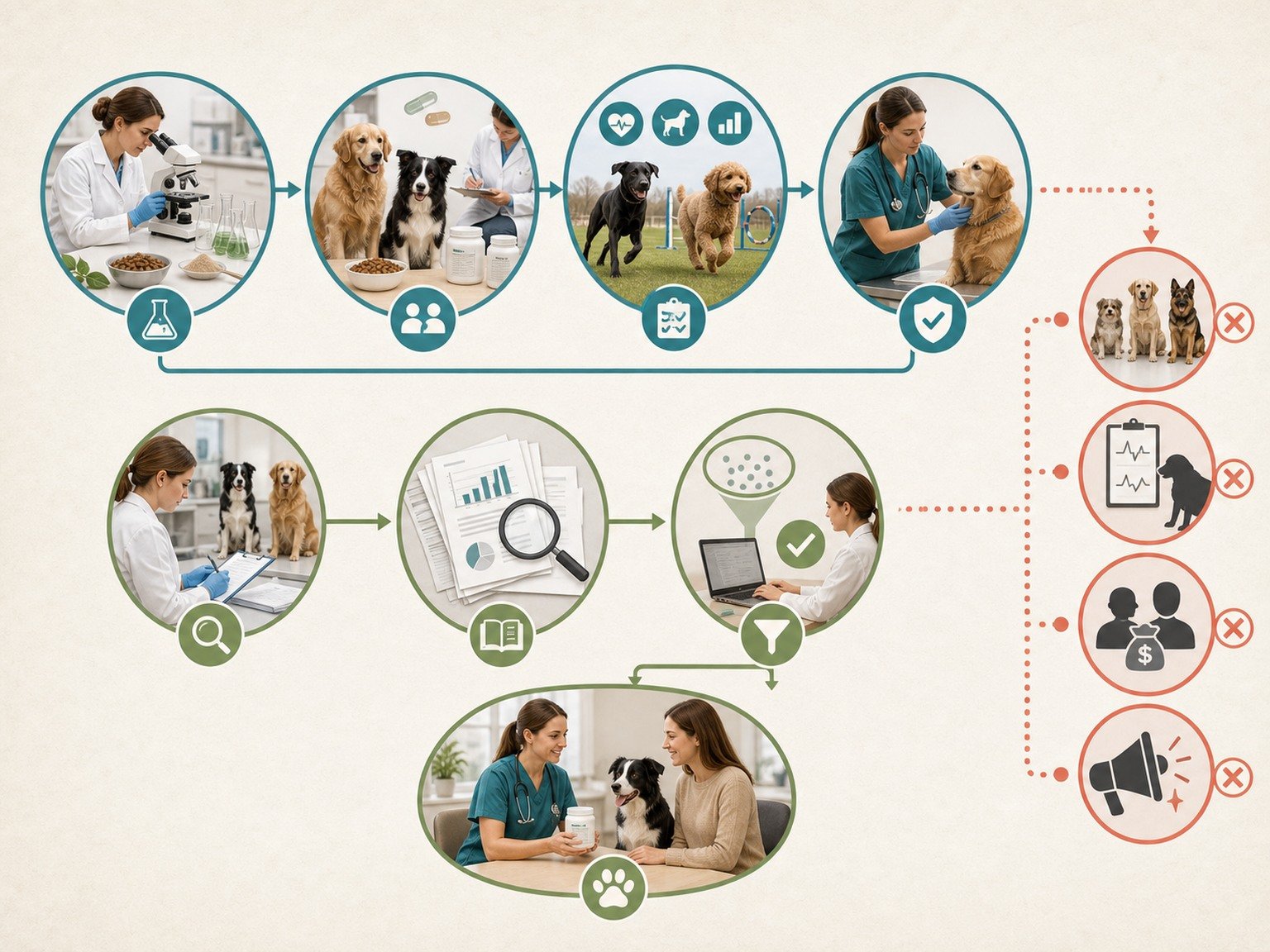
Inspect design choices that reduce bias
Look for a prospectively stated primary outcome, justified sample size, eligibility rules set before results were known, randomized allocation, an appropriate control or comparator, and blinding of caregivers and outcome assessors when feasible. Attrition and excluded data should be explained by group.
Check the experimental unit. Multiple measurements from one dog do not create multiple independent dogs. Small samples can miss harms, exaggerate effects, or produce unstable estimates; a statistically significant result can still be too small or indirect to matter clinically.
ARRIVE recommends reporting exact group sizes, exclusions, effect estimates, variability, protocol registration, conflicts of interest, and data access. Use those details to grade confidence, not as a checkbox that converts exploratory work into proof. [1]
Prefer outcomes that matter to dogs and caregivers
Biomarkers, microbiome composition, antioxidant measures, and laboratory values can help explain biology, but a change is not automatically an improvement. Ask whether the direction is known to be beneficial and whether it corresponds to comfort, mobility, stool quality, appetite, disease control, or another validated canine outcome.
Compare the effect with the control group, not only with the treated group's baseline. Look for absolute change, confidence intervals, responder definitions, and whether the planned primary outcome succeeded. Be cautious when a summary highlights only favorable secondary outcomes.
The follow-up period should fit the claim. Short tolerance studies cannot establish long-term safety, prevention, or durability. Results from one breed, age, diet, or disease stage may not generalize to another.
Demand safety reporting, replication, and clinical context
Every study should describe expected and unexpected adverse events, withdrawals, concurrent diets and treatments, laboratory monitoring when relevant, and who funded or analyzed the work. Absence of a reported event is not the same as evidence that no event occurred.
Independent replication, larger multisite trials, transparent protocols, and systematic reviews can strengthen confidence. Agreement across different teams and settings matters more than repeated promotional summaries of the same underlying study. [4]
FDA provides a pathway for reporting suspected animal drug and device problems. Owners should preserve the exact product, lot, timing, other exposures, veterinary findings, and outcome after a suspected event; real-world reports can identify safety signals but do not alone prove causation. [3]
Prepare for a focused veterinary conversation
Bring a concise timeline, short natural-movement or symptom videos when safe, the exact names and photographs of every food, treat, medication, and supplement label, and notes about appetite, water intake, stool, sleep, activity, comfort, and behavior. Include recent injuries, travel, boarding, diet changes, missed medication, and previous test results. A complete record helps the veterinary team separate a repeatable pattern from a single impression.
Decide in advance what you need from the visit: an urgency decision, a diagnosis plan, a nutrition review, a pain or mobility assessment, or a monitored trial. Ask what result would change the plan and what finding would rule an option out. This keeps research and product information in the right role. Evidence can shape questions and expectations, but it cannot determine what is safe for an individual dog without the history and examination.
Owner tool
Use an evidence watchlist
On a phone, swipe across the table to see every column.
| Checkpoint | What to record | Why it matters |
|---|---|---|
| Identity | Exact formula, amount, testing, lot | Connects claim to product |
| Design | Groups, randomization, blinding, sample | Limits bias |
| Outcome | Canine function, effect size, timeframe | Tests relevance |
| Safety | Events, withdrawals, interactions | Reveals risk |
| Replication | Independent studies and reviews | Tests durability |
Better questions, calmer next steps
Questions to ask your veterinarian
- Does the study product match the product being discussed?
- Was the main outcome chosen before results were analyzed?
- Is the change clinically meaningful for dogs like mine?
- Were adverse events and concurrent treatments fully reported?
- Has an independent team replicated the finding?
FAQ
Does a peer-reviewed paper prove a supplement works?
No. Peer review is one filter; design, results, limitations, and replication still matter.
Is a microbiome change a health benefit?
Not automatically. It needs a validated connection to a meaningful canine outcome.
Are company-funded studies unusable?
No, but funding, protocol control, analysis, and publication rights should be transparent.
Does no reported harm mean a product is safe?
No. Sample size, duration, monitoring, and reporting quality limit what can be concluded.
What should owners watch next?
Better product characterization, preregistration, meaningful outcomes, safety data, and independent replication.
Sources
- ARRIVE Guidelines: The ARRIVE Guidelines 2.0. Transparent design and reporting elements for animal research.
- U.S. Food and Drug Administration: FDA's Regulation of Pet Food. Animal food, supplement, intended-use, and drug context.
- U.S. Food and Drug Administration: How to Report Animal Drug and Device Side Effects. Adverse-event reporting and evidence details.
- PLOS Biology: The ARRIVE Guidelines 2.0. Bias, sample, outcomes, adverse events, and reporting detail.
- World Small Animal Veterinary Association: Global Nutrition Toolkit. Nutrition and product evaluation questions.
