


This glossary translates common canine digestive-health terms into careful owner language. It is a reference layer, not a condition guide or diagnostic tool. Definitions can simplify a record, but their patient-specific meaning depends on history, examination, source, methods, and clinical context. A microbiome or dysbiosis term does not establish a universal test or supplement need. A diagnostic term does not tell an owner which test should happen next. Use the entries to read veterinary notes, preserve accurate observations, and ask how a term applies to the individual dog.
Short answer
Definitions improve questions; they do not interpret the patient
MSD describes digestive anatomy, signs, and the vomiting-regurgitation distinction. Chronic-enteropathy literature explains evolving terminology and microbiome complexity. AAHA defines nutrition assessment across patient, diet, body, and muscle context. These sources support plain-language translation while preserving professional interpretation. [1] [2] [3] [4]
- Start with the individual dog's baseline, complete history, and current veterinary plan.
- Observe ordinary function without provoking pain, distress, or a stronger example.
- Use terms, population evidence, tools, and studies only within their intended limits.
- Escalate sudden, severe, persistent, progressive, dangerous, or function-limiting changes promptly.
Safety first
A glossary cannot downgrade an urgent sign
Seek urgent care for collapse, severe weakness, pale gums, repeated unproductive retching, a painful distended abdomen, major bleeding, breathing difficulty, suspected obstruction or toxin exposure, or inability to keep water down. Contact the veterinarian promptly for repeated vomiting or diarrhea, blood, pain, dehydration concerns, appetite or weight change, or progressive decline.
- Do not delay urgent care while completing a log, reading definitions, or waiting for a routine appointment.
- Do not manipulate joints, force activity, or repeat a painful movement for testing or video.
- Do not start, stop, combine, divide, or calculate medication or supplements from this article.
Veterinary note
This article is educational and does not diagnose, treat, prescribe, or replace care from a licensed veterinarian. Your dog’s history, examination, diet, medications, and current signs determine what is appropriate.
Digestive anatomy and function terms
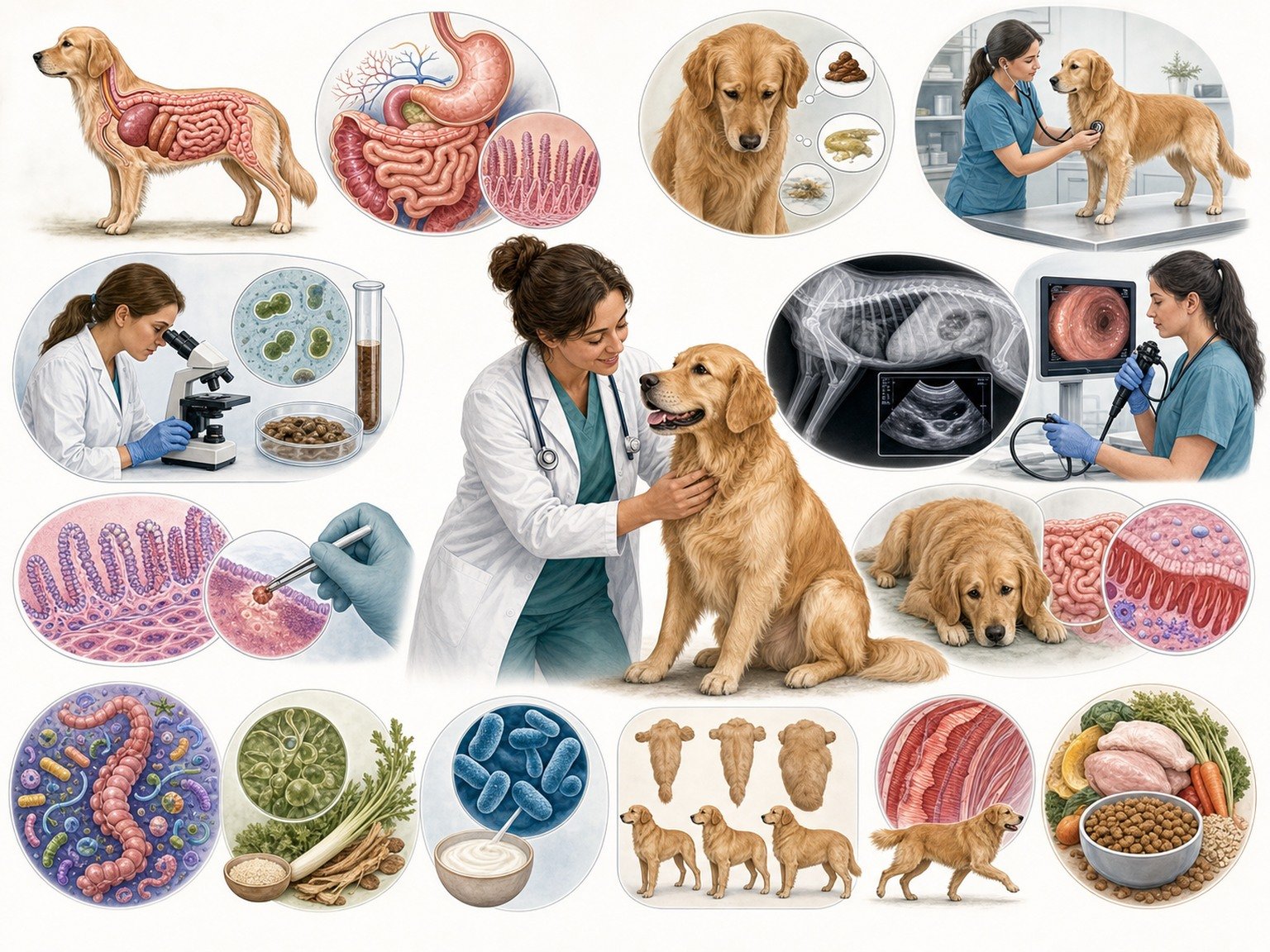
Gastrointestinal tract: the passage from mouth through esophagus, stomach, intestines, rectum, and anus. Digestive organs such as liver and pancreas also contribute. Digestion breaks food into usable components; absorption moves nutrients, water, and other substances across the intestinal lining.
Motility: coordinated movement that advances contents. Gastric emptying: movement from stomach into small intestine. Small intestine: major site of digestion and absorption. Large intestine or colon: involved in water handling, fermentation, storage, and stool formation.
Mucosa: inner lining of the gastrointestinal tract. Permeability: how substances cross a barrier; the word alone does not diagnose leaky gut. Microvilli and villi: structures that increase absorptive surface. These definitions do not determine whether a structure is abnormal in one dog. [1]
Owner-observed sign terms
Vomiting: active expulsion that may include nausea, salivation, retching, or abdominal effort. Regurgitation: often passive return of material from the esophagus. Record what was observed and timing; owners should not use the distinction to rule out urgency. [2]
Diarrhea: increased stool water, frequency, volume, or urgency depending on context. Constipation: difficult, infrequent, or incomplete passage of stool. Tenesmus: repeated straining. Melena: dark digested blood; hematochezia: visible fresh blood. Both require veterinary context.
Anorexia means loss of appetite, not a behavioral diagnosis. Dysphagia means difficulty swallowing. Abdominal pain, distention, dehydration, weight loss, and poor body or muscle condition are findings with multiple possible causes, not standalone diagnoses.
Examination and diagnostic terms
CBC evaluates blood-cell information; chemistry profiles assess selected organ, protein, electrolyte, and metabolic measures. Urinalysis and fecal testing answer different questions. No panel rules out every digestive or nondigestive cause.
Radiography uses X-rays; ultrasonography uses sound waves; endoscopy uses a camera to view accessible internal surfaces; biopsy collects tissue for microscopic evaluation. Sedation, anesthesia, sampling, and test selection are patient-specific decisions.
Sensitivity, specificity, reference interval, false positive, and false negative describe test performance and interpretation limits. A result must be read with pretest likelihood, sample quality, timing, clinical signs, and other findings.
Chronic-enteropathy, microbiome, and nutrition terms
Chronic enteropathy is an umbrella used for persistent or recurrent gastrointestinal disease after appropriate evaluation; classification and terminology continue to evolve. Diet-responsive and immunosuppressant-responsive labels describe response patterns in selected contexts, not owner-led home tests. [3]
Microbiome refers to microbial communities and their genetic material; microbiota refers to organisms. Dysbiosis describes altered community patterns but does not by itself establish cause, diagnosis, or a universal treatment. Association is not causation.
Prebiotic: a substrate selectively used by host microorganisms that confers a health benefit under a specific definition. Probiotic: live microorganisms that confer a health benefit when administered adequately, with effects depending on strain and product. Complete and balanced, body condition, and muscle condition are nutrition terms requiring full diet and patient context. [4]
Use the glossary inside a real veterinary conversation
Copy the exact term, surrounding sentence, date, and source rather than bringing an isolated word. A term in a laboratory report, imaging report, research paper, product claim, or discharge note may carry a different level of certainty and a different purpose.
Ask whether the word describes an owner observation, examination finding, test result, differential possibility, confirmed diagnosis, response classification, risk factor, or treatment goal. These categories should not be collapsed. For example, diarrhea is a sign; chronic enteropathy is a clinical umbrella; diet-responsive describes response in a defined process.
Record the veterinarian's patient-specific explanation and what remains uncertain. Ask what next observation, examination, test, or response would change interpretation. A useful glossary ends with a better question and an accurate record, not an owner-created label.
Prepare for a focused veterinary conversation
Bring a concise timeline, short natural-movement or symptom videos when safe, the exact names and photographs of every food, treat, medication, and supplement label, and notes about appetite, water intake, stool, sleep, activity, comfort, and behavior. Include recent injuries, travel, boarding, diet changes, missed medication, and previous test results. A complete record helps the veterinary team separate a repeatable pattern from a single impression.
Decide in advance what you need from the visit: an urgency decision, a diagnosis plan, a nutrition review, a pain or mobility assessment, or a monitored trial. Ask what result would change the plan and what finding would rule an option out. This keeps research and product information in the right role. Evidence can shape questions and expectations, but it cannot determine what is safe for an individual dog without the history and examination.
Owner tool
Use a term without overinterpreting it
On a phone, swipe across the table to see every column.
| Checkpoint | What to record | Why it helps |
|---|---|---|
| Term | Exact source and wording | Preserves meaning |
| Context | Sign, test, record, research | Sets scope |
| Limit | What it does not establish | Controls certainty |
| Question | How it applies to this dog | Routes review |
Better questions, calmer next steps
Questions to ask your veterinarian
- How is this term being used in this record?
- Does it describe a sign, finding, diagnosis, or response?
- What test or evidence supports the interpretation?
- What uncertainty remains?
- Which narrower guide or follow-up question comes next?
FAQ
Is dysbiosis a diagnosis?
Not by itself.
Does regurgitation mean the stomach is normal?
No.
Does biopsy always diagnose the cause?
No test answers every question.
Does probiotic mean every product works?
No; effects are strain- and product-specific.
Can a glossary choose treatment?
No.
Sources
- MSD Veterinary Manual: Introduction to Digestive Disorders of Dogs. Anatomy, signs, and diagnostic context.
- MSD Veterinary Manual: Vomiting in Dogs. Vomiting, regurgitation, and evaluation.
- Frontiers in Veterinary Science: Canine Chronic Enteropathy: Current State and Emerging Concepts. Enteropathy terminology and microbiome complexity.
- American Animal Hospital Association: Nutrition and Weight Management Guidelines. Nutrition, body, muscle, and patient assessment.
