

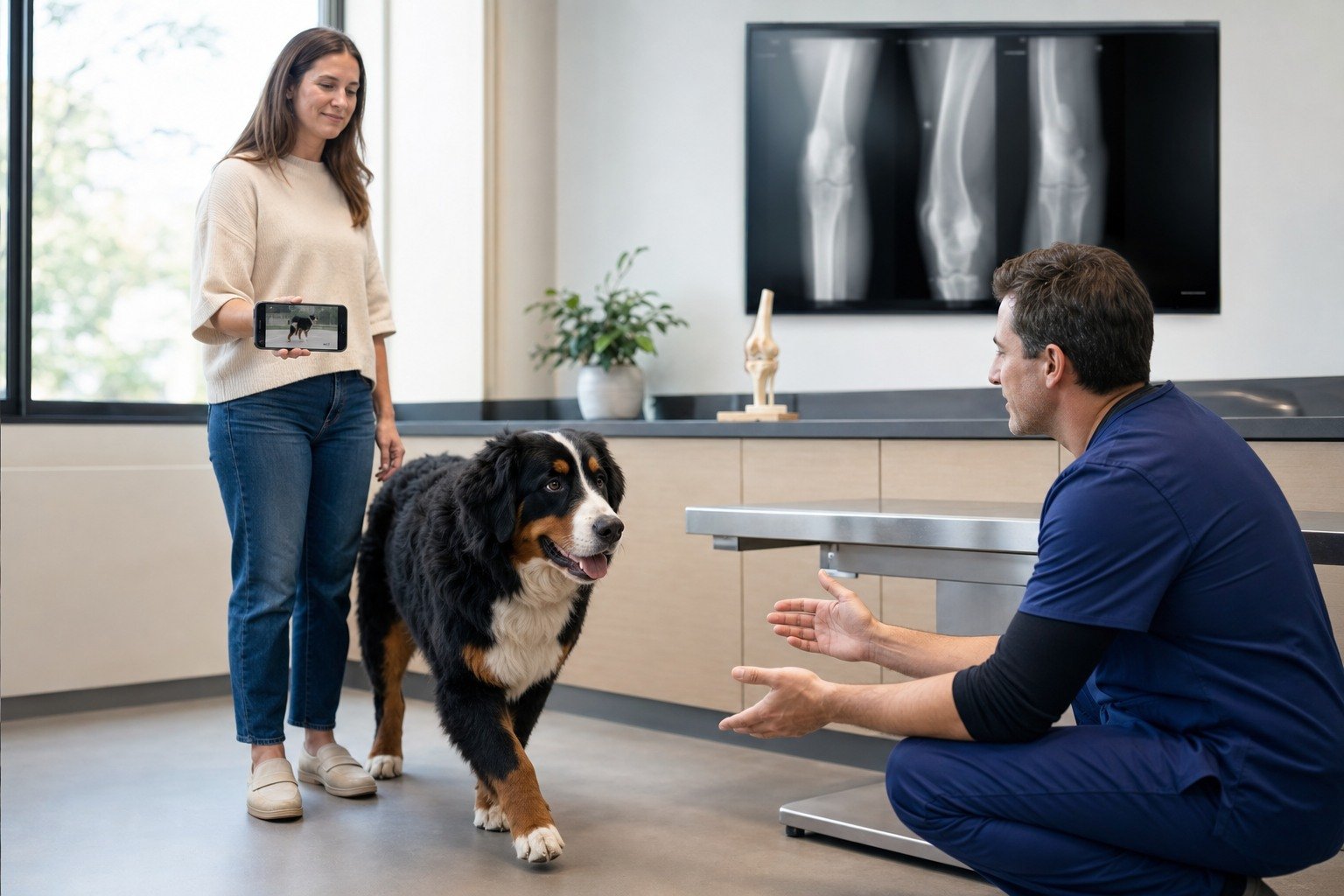
Elbow dysplasia is not one identical condition. It groups several developmental elbow abnormalities, including medial coronoid disease, ununited anconeal process, osteochondrosis, and joint incongruity. Large and giant breeds are often represented, but size and breed do not diagnose a dog. Forelimb lameness, stiffness, reduced exercise tolerance, or pain can also arise from other joints, soft tissues, nerves, feet, infection, or systemic disease. Veterinary history, gait and orthopedic examination, radiographs, and selected advanced imaging are used to define the problem before care decisions. Owners can strengthen that process by preserving early videos, imaging, medication response, growth and body-condition records, and the exact activities that changed. Those details help the clinician distinguish development, current pain, secondary osteoarthritis, and unrelated forelimb problems.
Short answer
The umbrella name does not identify the lesion
Cornell and ACVS describe elbow dysplasia as a developmental orthopedic group rather than a single uniform disease. Presentation varies by abnormality, age, severity, and secondary osteoarthritis. An owner cannot determine which structure is involved from toe position, a limp, an online diagram, or a breed label. Examination and imaging must answer the actual diagnostic question. [1] [2]
- Record context, frequency, duration, recovery, function, and recent change.
- Treat the article as preparation for professional assessment, not a diagnostic test.
- Agree on monitoring, reassessment, and urgent-response instructions with the veterinary team.
- Bring calm-day and difficult-day observations to each follow-up.
Safety first
New or severe forelimb lameness needs veterinary assessment
Contact a veterinarian for recurring or persistent limping, stiffness, swelling, pain, reduced activity, or difficulty rising. Seek urgent or emergency care after major trauma, for sudden non-weight-bearing lameness, severe pain, inability to stand, dragging or knuckling paws, collapse, breathing difficulty, or rapid deterioration.
- Do not delay care for severe, persistent, escalating, or function-limiting signs.
- Do not start, stop, combine, or calculate treatment from this article.
- Preserve dated observations, safe videos, labels, prior records, and the dog's full health context.
Veterinary note
This article is educational and does not diagnose, treat, prescribe, or replace care from a licensed veterinarian. Your dog’s history, examination, diet, medications, and current signs determine what is appropriate.
Understand the elbow-dysplasia umbrella
The canine elbow combines the humerus, radius, and ulna. Developmental mismatch or abnormal bone and cartilage processes can affect joint loading. The abnormalities grouped under elbow dysplasia may occur alone or together, and secondary osteoarthritis can add pain and functional change over time. [1] [2]
Etiology is multifactorial. Genetic susceptibility, growth, conformation, biomechanics, and other influences are discussed in the literature, but no single event or owner choice explains every dog. The umbrella term should not be used to assign blame or promise prevention. [3]
A dog may show signs when young, later in life, intermittently, or after arthritis becomes more important. Lack of an obvious early limp does not prove normal elbows, and an early limp does not reveal prognosis without assessment.
Turn forelimb changes into useful history
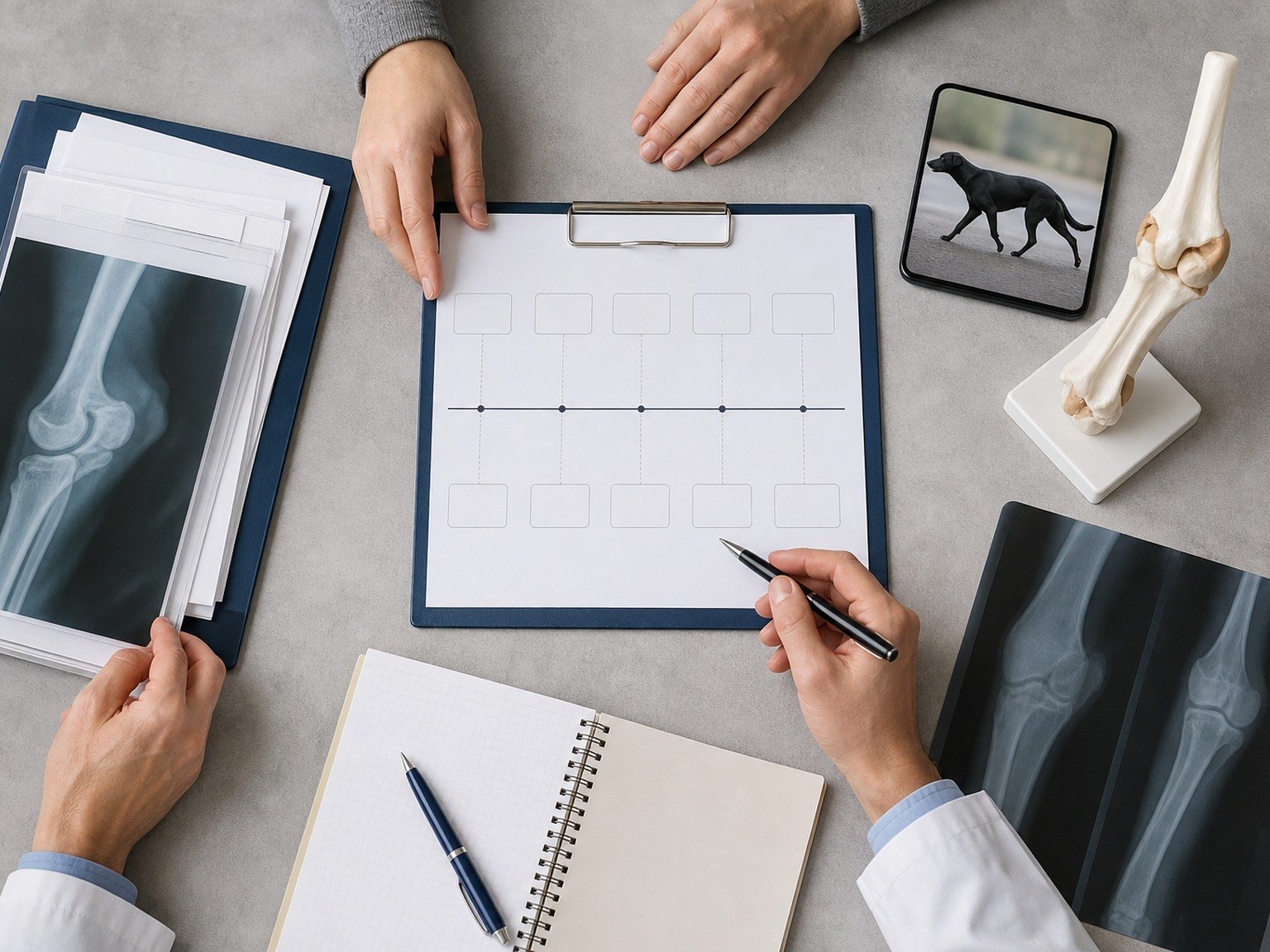
Record onset, affected side as observed, duration, progression, surface, activity, rest response, stairs, turning, play, and recovery. Note previous episodes, medications, injury, growth, weight trend, and whether the dog changes how it sits or lies down.
Capture a few safe videos of ordinary level walking from front, side, and behind only when the dog moves voluntarily. Do not repeatedly run, turn, jump, flex, extend, or palpate the limb to reproduce a sign. A video supports but does not replace examination.
Similar signs can come from shoulder, carpus, toes, nails, neck, nerves, muscle, tendon, infection, immune disease, or tumor. The history should keep alternatives visible instead of becoming a checklist for elbow dysplasia.
Follow the veterinary diagnostic pathway
The clinician may assess gait, posture, joint motion, pain response, muscle condition, feet, spine, and neurologic function. Sedation can be useful for a reliable examination or positioning when clinically indicated. The plan depends on the dog's comfort and the question being asked. [1]
Radiographs can show joint shape, fragments, incongruity, sclerosis, osteophytes, or other changes, but findings and limitations vary. CT or arthroscopy may be considered for selected questions. This is not a sequence every dog must undergo, and imaging cannot be selected from an article. [2]
Ask which abnormality is suspected, what alternatives remain, what each test could change, and whether referral to a board-certified veterinary surgeon is appropriate. Keep the images and reports for later comparison.
Make an individualized management decision
Planning may include pain management, body condition, activity modification, rehabilitation, environmental support, surgery, or monitoring. The combination depends on identified pathology, disease stage, age, function, concurrent disease, caregiver capacity, and goals.
A systematic review found limitations and heterogeneity in comparative evidence for medial elbow compartment treatments. That uncertainty does not mean nothing can help; it means procedure selection and expectations should match the dog and the evidence rather than a universal ranking. [4]
Do not give human pain medicine, use leftovers, begin a supplement, or copy another dog's restriction or rehabilitation plan. Clarify written instructions, expected functional change, complications, recheck timing, and what would trigger a revised plan.
Prepare for a focused veterinary conversation
Bring a concise timeline, short natural-movement or symptom videos when safe, the exact names and photographs of every food, treat, medication, and supplement label, and notes about appetite, water intake, stool, sleep, activity, comfort, and behavior. Include recent injuries, travel, boarding, diet changes, missed medication, and previous test results. A complete record helps the veterinary team separate a repeatable pattern from a single impression.
Decide in advance what you need from the visit: an urgency decision, a diagnosis plan, a nutrition review, a pain or mobility assessment, or a monitored trial. Ask what result would change the plan and what finding would rule an option out. This keeps research and product information in the right role. Evidence can shape questions and expectations, but it cannot determine what is safe for an individual dog without the history and examination.
Owner tool
Prepare an elbow-lameness record
On a phone, swipe across the table to see every column.
| Checkpoint | Record | Why it helps |
|---|---|---|
| Onset | Date, side, sudden or gradual | Frames history |
| Function | Walk, rise, stairs, play, recovery | Shows impact |
| Context | Growth, activity, surface, prior care | Finds alternatives |
| Evaluation | Exam, images, pathology, recheck | Tracks decisions |
Better questions, calmer next steps
Questions to ask your veterinarian
- Which elbow abnormality is suspected?
- What other causes of forelimb lameness remain?
- Would radiographs, CT, or referral change the plan?
- What functional outcome should I track?
- What change requires prompt reassessment?
FAQ
Is elbow dysplasia one disease?
No. It is an umbrella for several developmental abnormalities.
Does breed prove the diagnosis?
No. Breed is context only.
Can I test the elbow at home?
No. Do not manipulate or provoke the limb.
Is one treatment always best?
No. Pathology, stage, function, and evidence shape the plan.
Can arthritis still progress?
Structural disease may persist, so monitoring and reassessment matter.
Sources
- Cornell University College of Veterinary Medicine: Elbow Dysplasia. Development, signs, examination, and imaging.
- American College of Veterinary Surgeons: Canine Elbow Dysplasia. Umbrella abnormalities and individualized decisions.
- The Veterinary Journal: Canine Elbow Dysplasia: Aetiopathogenesis and Treatment. Multifactorial mechanisms.
- Frontiers in Veterinary Science: Therapeutic Success in Canine Medial Elbow Disease. Comparative-evidence limitations.
