


Vomiting, diarrhea, gas, appetite changes, and weight loss can occur with food-responsive disease, but they can also reflect parasites, infection, pancreatic disease, obstruction, toxins, endocrine disease, cancer, or other enteropathies. The signs alone cannot identify an offending ingredient. A useful evaluation starts with the whole dog and uses a deliberately selected, exclusively fed diet trial when the veterinarian considers one appropriate.
Short answer
A food response is demonstrated by a controlled pattern, not guessed from one meal
Chronic inflammatory enteropathy is a group of disorders with persistent or recurrent gastrointestinal signs. Current evidence supports therapeutic diet trials as an important early management step for many stable dogs after clinically important alternatives have been considered. Response varies, more than one trial may be needed, and diet response does not automatically identify an allergy. [1] [2]
- Record every food, treat, chew, flavored medication, supplement, and scavenged item before a trial.
- Feed the agreed diet exclusively for the veterinarian-defined period and document response objectively.
- Do not let a food-sensitivity theory delay evaluation of persistent, severe, or systemic signs.
Safety first
Digestive signs can be more than a food sensitivity
Seek prompt veterinary care for repeated vomiting, inability to keep water down, blood or black stool, severe or painful diarrhea, a swollen abdomen, unproductive retching, collapse, marked weakness, fever, dehydration, possible toxin or foreign-body exposure, rapid weight loss, or a puppy, senior, or medically fragile dog who is declining.
- Do not repeatedly switch foods or fast a sick dog without veterinary direction.
- Do not use online food-allergy tests to replace a diagnostic diet and supervised challenge.
- Do not stop prescribed medication or add antibiotics, probiotics, enzymes, or supplements to make a trial work.
Veterinary note
This article is educational and does not diagnose, treat, prescribe, or replace care from a licensed veterinarian. Your dog’s history, examination, diet, medications, and current signs determine what is appropriate.
Separate food-responsive signs from a claimed food allergy
Food-responsive enteropathy describes gastrointestinal signs that improve substantially with an appropriate diet intervention after other causes are addressed. That response may involve digestibility, fat level, fiber, antigen exposure, microbiota, or other diet characteristics. It does not prove an immune-mediated allergy to one ingredient. [1] [2]
Adverse food reactions can involve immune and nonimmune mechanisms, and skin signs may coexist with gastrointestinal signs. For cutaneous food allergy, elimination followed by provocation remains the reference diagnostic approach; serum food-specific IgE or IgG tests have variable accuracy and do not replace it. [4]
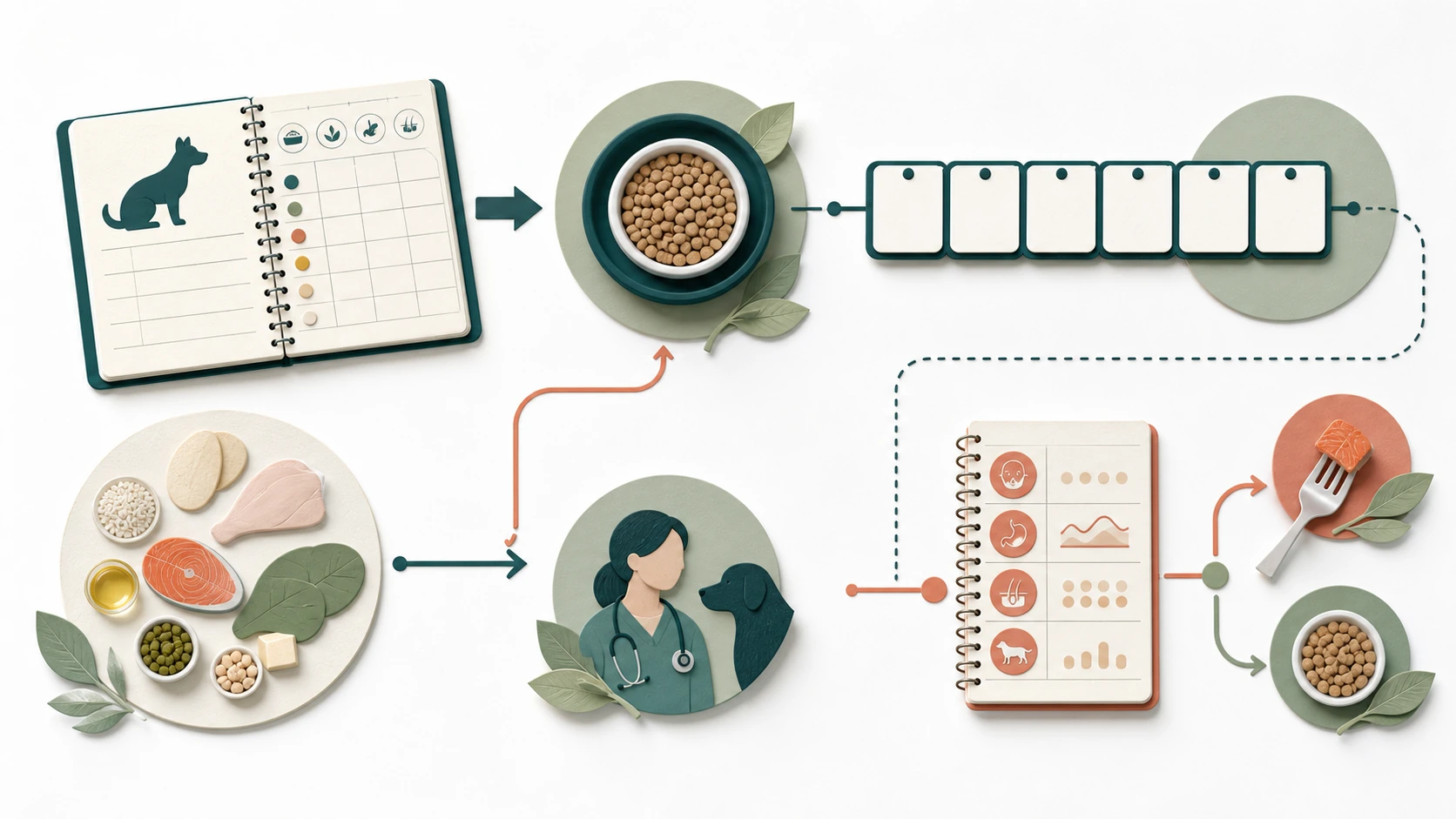
Build a baseline before changing the diet
Write down stool frequency and form, vomiting or regurgitation, appetite, weight trend, urgency, mucus or blood, pain, activity, skin or ear signs, medications, travel, parasite prevention, and exposure to trash or unfamiliar foods. A complete diet history includes every edible item and who gives it. [2] [3]
The veterinarian may recommend examination, fecal testing, bloodwork, imaging, pancreatic or vitamin tests, or other diagnostics based on the pattern. Stable chronic cases and acutely ill dogs do not follow the same path. Diagnostic testing is selected to identify consequential alternatives, assess severity, and determine whether a diet trial is safe.
Make the veterinary diet trial interpretable
The selected diet may use hydrolyzed protein, novel ingredients, altered digestibility, fiber, fat, or another therapeutic design. Choice depends on prior exposures, signs, nutritional needs, and comorbidities. The ACVIM-endorsed consensus recommends several diet categories as effective first-line options for many dogs with chronic inflammatory enteropathy, with more than one exclusive trial sometimes required. [2]
Exclusive means no unapproved treats, table scraps, flavored chews, toothpaste, supplements, scavenging, or shared food. Transition and trial duration should follow the veterinary plan. Improvement is recorded against the baseline; a supervised challenge may be needed to understand whether food exposure truly drives recurrence. Random switching destroys that comparison.
Interpret improvement and nonresponse carefully
A response supports continuing the most helpful nutritionally complete plan, but it does not prove that every future flare is dietary. A partial response may reflect imperfect exclusion, concurrent disease, or the need for additional treatment. Nonresponse should trigger reassessment rather than increasingly restrictive owner-designed diets. [1] [2]
Home-prepared elimination diets can be nutritionally incomplete unless formulated and monitored by a qualified veterinary nutrition professional. Long-term restriction can create deficiencies and practical strain. The goal is not the smallest possible ingredient list; it is an evidence-aligned diagnosis and a sustainable complete diet.
Bring the log and packaging to the recheck. Ask whether the observed change is clinically meaningful, whether a challenge is appropriate, and what monitoring is required for long-term use. New red flags override the trial schedule and deserve earlier care.
Prepare for a focused veterinary conversation
Bring a concise timeline, short natural-movement or symptom videos when safe, the exact names and photographs of every food, treat, medication, and supplement label, and notes about appetite, water intake, stool, sleep, activity, comfort, and behavior. Include recent injuries, travel, boarding, diet changes, missed medication, and previous test results. A complete record helps the veterinary team separate a repeatable pattern from a single impression.
Decide in advance what you need from the visit: an urgency decision, a diagnosis plan, a nutrition review, a pain or mobility assessment, or a monitored trial. Ask what result would change the plan and what finding would rule an option out. This keeps research and product information in the right role. Evidence can shape questions and expectations, but it cannot determine what is safe for an individual dog without the history and examination.
Owner tool
Keep a diagnostic diet trial interpretable
On a phone, swipe across the table to see every column.
| Stage | Owner record | Common confounder |
|---|---|---|
| Baseline | Signs, weight, complete exposures | Changing several things |
| Selection | Exact prescribed diet and purpose | Choosing by marketing label |
| Exclusive trial | Daily intake and symptom log | Treats or flavored products |
| Recheck | Trend and veterinary findings | Declaring a cure too early |
Better questions, calmer next steps
Questions to ask your veterinarian
- Which important causes should be checked before or during a diet trial?
- What exact diet category fits this history and nutritional need?
- Which treats, medicines, chews, and supplements could invalidate the trial?
- What outcome and timeframe will count as a meaningful response?
- Will a supervised challenge help clarify the diagnosis?
FAQ
Are food sensitivity and food allergy the same?
No. Food-related signs can arise through different mechanisms; allergy is only one possibility.
Can a blood test identify the problem food?
Commercial serum food tests do not replace a controlled elimination and provocation trial.
Why might more than one diet trial be needed?
Dogs differ, and therapeutic diets test different nutritional strategies.
Can treats continue?
Only items the veterinary team explicitly includes; small exposures can make the trial uninterpretable.
Does improvement mean the dog is cured?
No. It supports a diet-responsive pattern but ongoing nutrition and medical follow-up still matter.
Sources
- Frontiers in Veterinary Science: Canine Chronic Enteropathy: Current State of the Art. Classification, diagnosis, diet response, barrier research, and treatment context.
- Journal of Veterinary Internal Medicine: ACVIM Consensus on Chronic Inflammatory Enteropathy in Dogs. Current evidence-graded diagnostic and dietary guidance.
- WSAVA: Global Nutrition Guidelines and Toolkit. Complete diet history and individualized nutritional assessment.
- BMC Veterinary Research: Can We Diagnose Adverse Food Reactions with In Vivo or In Vitro Tests?. Evidence limits for commercial food-reaction tests.
- Veterinary Sciences: Food-Responsive Enteropathy in 222 Dogs. Clinical response patterns and need for multiple diet trials.
