

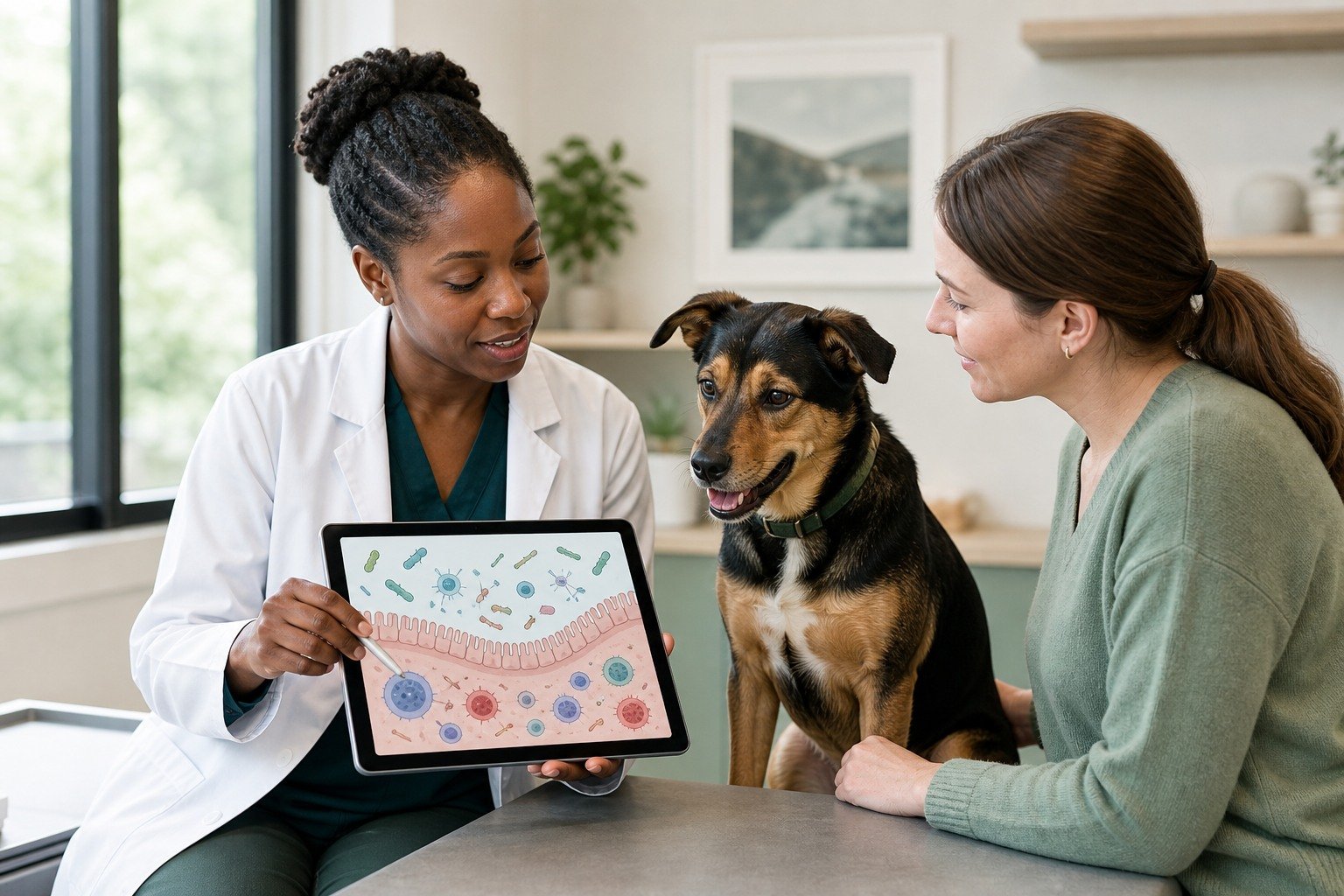
The intestinal tract is not only a digestive tube. Its physical barrier, mucus, immune cells, microbial community, and microbial metabolites continually interact. Canine studies and veterinary reviews describe roles in metabolism, pathogen resistance, epithelial health, and immune education, but association is not proof that one food, probiotic, or microbiome score will improve immunity. Microbiome results vary with age, diet, environment, medication, disease, sampling, and laboratory method. Feces also represent the distal gut imperfectly. Owners can support a sound clinical discussion by tracking gastrointestinal signs, diet, medications, exposures, and whole-dog health while avoiding broad immune-boosting claims. This guide explains the research landscape without diagnosing dysbiosis or recommending a product, diet, dose, test, or treatment.
Short answer
Gut and immune function are connected, but the connection is not a product promise
Veterinary reviews describe the gut microbiome as contributing to epithelial health, pathogen resistance, metabolism, and immune education. They also emphasize substantial individual variation and incomplete small-animal evidence. A measured conclusion is that gut and immune systems interact; it is not that every microbiome change is harmful or that a supplement can generally boost immunity. [1] [2]
- Record changes in movement, appetite, stool, sleep, behavior, and daily function with dates.
- Use research to prepare questions, not to diagnose a dog or select treatment at home.
- Bring current diets, medications, supplements, prior records, and short natural-movement videos when useful.
- Agree on what to monitor, when to reassess, and which change requires urgent care.
Safety first
Persistent digestive signs or whole-body decline needs veterinary assessment
Contact a veterinarian for recurring vomiting or diarrhea, weight or muscle loss, appetite decline, blood or black stool, fever concern, marked lethargy, pain, dehydration, or a new problem in a puppy, senior, or medically fragile dog. Seek urgent care for collapse, repeated unproductive retching, severe weakness, breathing difficulty, a painful distended abdomen, or rapid deterioration.
- Do not delay care for sudden, severe, escalating, or function-limiting signs.
- Do not start, stop, combine, or calculate treatment from this article.
- Keep an exact timeline and product or exposure record available for the veterinary team.
Veterinary note
This article is educational and does not diagnose, treat, prescribe, or replace care from a licensed veterinarian. Your dog’s history, examination, diet, medications, and current signs determine what is appropriate.
How the intestinal barrier and immune system communicate
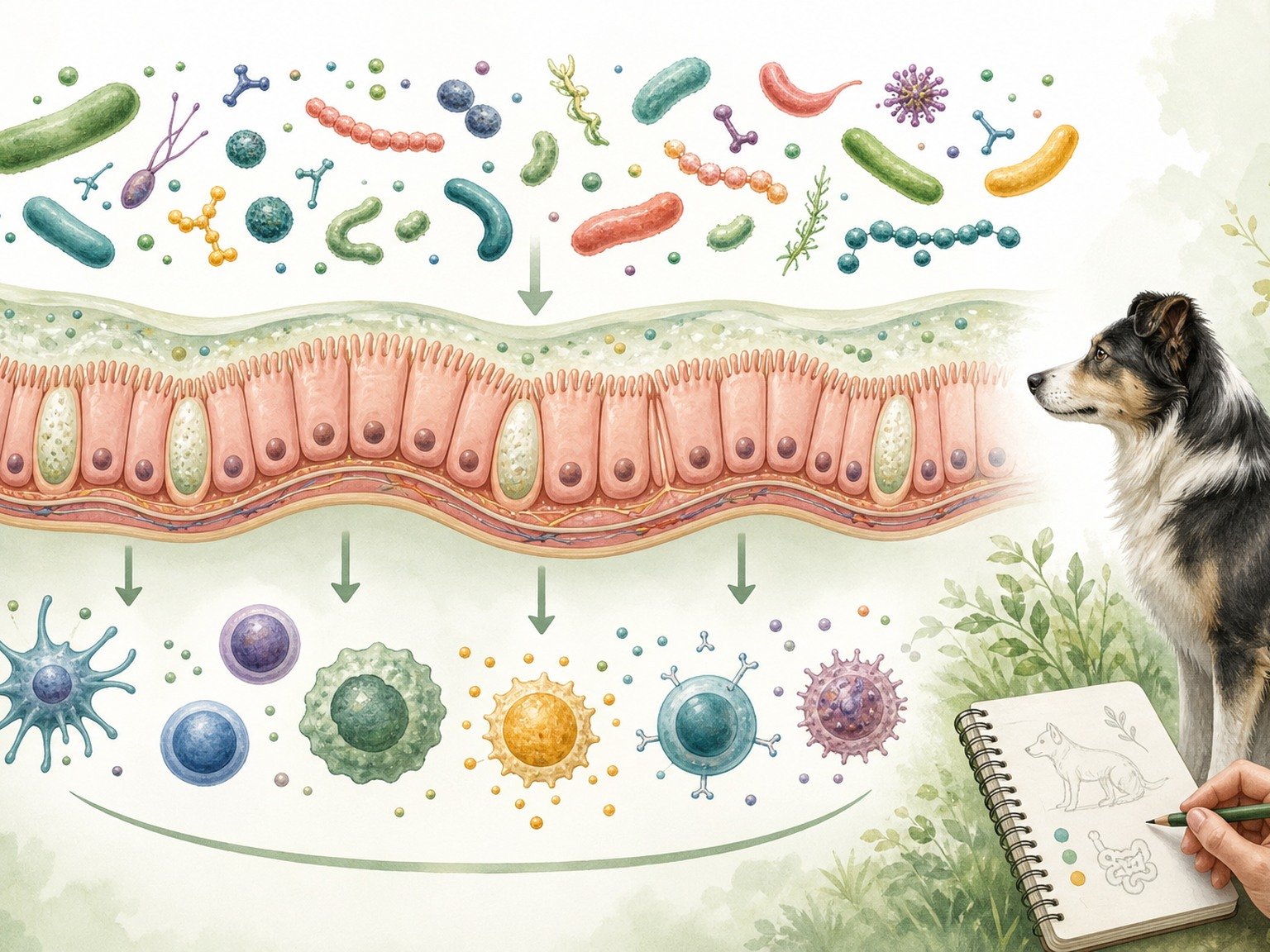
The intestinal surface must absorb nutrients while limiting unwanted entry by pathogens and harmful compounds. Epithelial cells, tight junctions, mucus, antimicrobial factors, and local immune cells form a coordinated barrier rather than a passive wall. Resident microbes and their metabolites can influence that environment, while the host immune system shapes which organisms persist. [1]
Short-chain fatty acids produced when microbes ferment suitable substrates can support colon cells and participate in immune signaling. Those functions depend on microbial pathways, available nutrients, the intestinal site, and the dog's health; the presence of one bacterial name does not establish what the entire community is doing. [2]
Immune balance is more accurate than immune strength. Appropriate defense must coexist with tolerance of food and resident organisms. Language that promises to activate, reset, detoxify, or supercharge immunity oversimplifies a regulated network and can distract from diagnosis of infection, inflammation, endocrine disease, cancer, or another condition.
What canine microbiome research can and cannot show
Studies have characterized common bacterial groups and functional patterns in healthy and ill dogs, but reported abundance varies across cohorts and methods. Diet, age, genetics, household environment, geography, medication, sample handling, sequencing platform, and analysis can all influence results. A difference between groups is not automatically a cause of disease. [3]
Dysbiosis describes a disruption in microbial composition or function, often in relation to a disease state. It is not a stand-alone owner diagnosis. Illness can alter the microbiome, and altered microbial activity can influence the intestinal environment, so direction and clinical importance require careful interpretation. [1]
A fecal sample is practical and informative for selected questions, yet it does not fully represent microbes attached to the intestinal lining or every segment of the gastrointestinal tract. Ask what a proposed test measures, whether it is validated for the specific clinical question, and what result would change the veterinary plan.
Diet, probiotics, and evidence boundaries
Dietary composition can alter microbial populations and metabolites. That observation does not mean owners should abruptly add fiber, fermented foods, raw ingredients, or restrictive diets. Nutrient adequacy, calorie balance, disease, food reactions, medication, life stage, and transition tolerance must be considered for the individual dog. [3]
Probiotic, prebiotic, synbiotic, and postbiotic effects are formulation- and context-specific. Reviews of canine evidence note inconsistent methods, strain specificity, limited populations, and gaps in dose, duration, safety, and clinically meaningful outcomes. Evidence for one strain or studied formula cannot be transferred to every product carrying a similar category label. [4]
When a veterinarian proposes a nutrition or microbial intervention, ask for the exact objective, formulation, baseline, monitoring measure, trial period, adverse-effect plan, and reassessment date. Do not stack products or change several variables at once, because doing so can increase risk and make response difficult to interpret.
Turn research into a useful owner record
Track stool pattern, vomiting, appetite, water, weight, body and muscle condition, skin or ear signs, energy, sleep, behavior, medications, supplements, preventives, and diet changes. Include antibiotics and other recent medical interventions because they can affect both symptoms and microbial measures. [5]
Record the question behind any test or treatment. Is the goal to investigate chronic gastrointestinal disease, monitor a diagnosed condition, assess nutrition, or understand a research finding? A defined question prevents a broad wellness result from being treated as a diagnosis.
Keep observations comparable over time and share the same record with the primary veterinarian and specialists. Report deterioration promptly rather than waiting for a future microbiome result. The clinical examination and established diagnostics remain central when a dog is ill.
Prepare for a focused veterinary conversation
Bring a concise timeline, short natural-movement or symptom videos when safe, the exact names and photographs of every food, treat, medication, and supplement label, and notes about appetite, water intake, stool, sleep, activity, comfort, and behavior. Include recent injuries, travel, boarding, diet changes, missed medication, and previous test results. A complete record helps the veterinary team separate a repeatable pattern from a single impression.
Decide in advance what you need from the visit: an urgency decision, a diagnosis plan, a nutrition review, a pain or mobility assessment, or a monitored trial. Ask what result would change the plan and what finding would rule an option out. This keeps research and product information in the right role. Evidence can shape questions and expectations, but it cannot determine what is safe for an individual dog without the history and examination.
Owner tool
Build a gut-and-immunity discussion record
On a phone, swipe across the table to see every column.
| Checkpoint | Record | Why it helps |
|---|---|---|
| Pattern | Stool, vomiting, appetite, weight, energy | Frames clinical concern |
| Inputs | Diet, treats, drugs, supplements | Shows changing factors |
| Evidence | Test purpose, method, limits | Prevents overinterpretation |
| Review | Target, adverse signs, recheck | Supports decisions |
Better questions, calmer next steps
Questions to ask your veterinarian
- What clinical problem are we trying to explain?
- Could disease or medication be driving the microbiome change?
- What does this test measure and what are its limits?
- What evidence applies to the exact intervention?
- Which sign requires urgent care?
FAQ
Does most immunity come from the gut?
That slogan is too simple; immune tissues and signals operate throughout the body.
Does dysbiosis diagnose a disease?
No. It must be interpreted with the dog and clinical question.
Can probiotics boost immunity?
Evidence is strain-, formula-, condition-, and outcome-specific.
Does a stool sample represent the whole gut?
No. It is useful but incomplete.
Should I change food after a microbiome result?
Only through an individualized veterinary nutrition plan.
Sources
- Frontiers in Veterinary Science: Role of the Canine Gut Microbiome and Metabolome. Metabolism, pathogen resistance, immune education, and disease context.
- Journal of Veterinary Internal Medicine: The Gastrointestinal Microbiome: A Review. Host physiology, immune activity, and evidence limits.
- Gut Microbes: The Canine Gastrointestinal Microbiota. Diet, composition, functions, and research frontiers.
- Journal of Animal Physiology and Animal Nutrition: Canine Intestinal Microbiota and Pro-, Pre-, and Synbiotics. Intervention evidence and strain-specific limitations.
- Frontiers in Veterinary Science: Gut Microbiota Development in the Growing Dog. Age, environment, host factors, and immune education.
