


Your dog’s gut is an ecosystem, not a single organ working alone. Its resident bacteria and other microorganisms interact with food, intestinal cells, bile acids, and the immune system. Those interactions matter most clearly inside the digestive tract. Research also explores links with health beyond the gut, but an association is not proof that a microbiome change caused a disease or that changing microbes will treat it.
Short answer
The microbiome helps run the intestinal environment, but it is not a wellness score
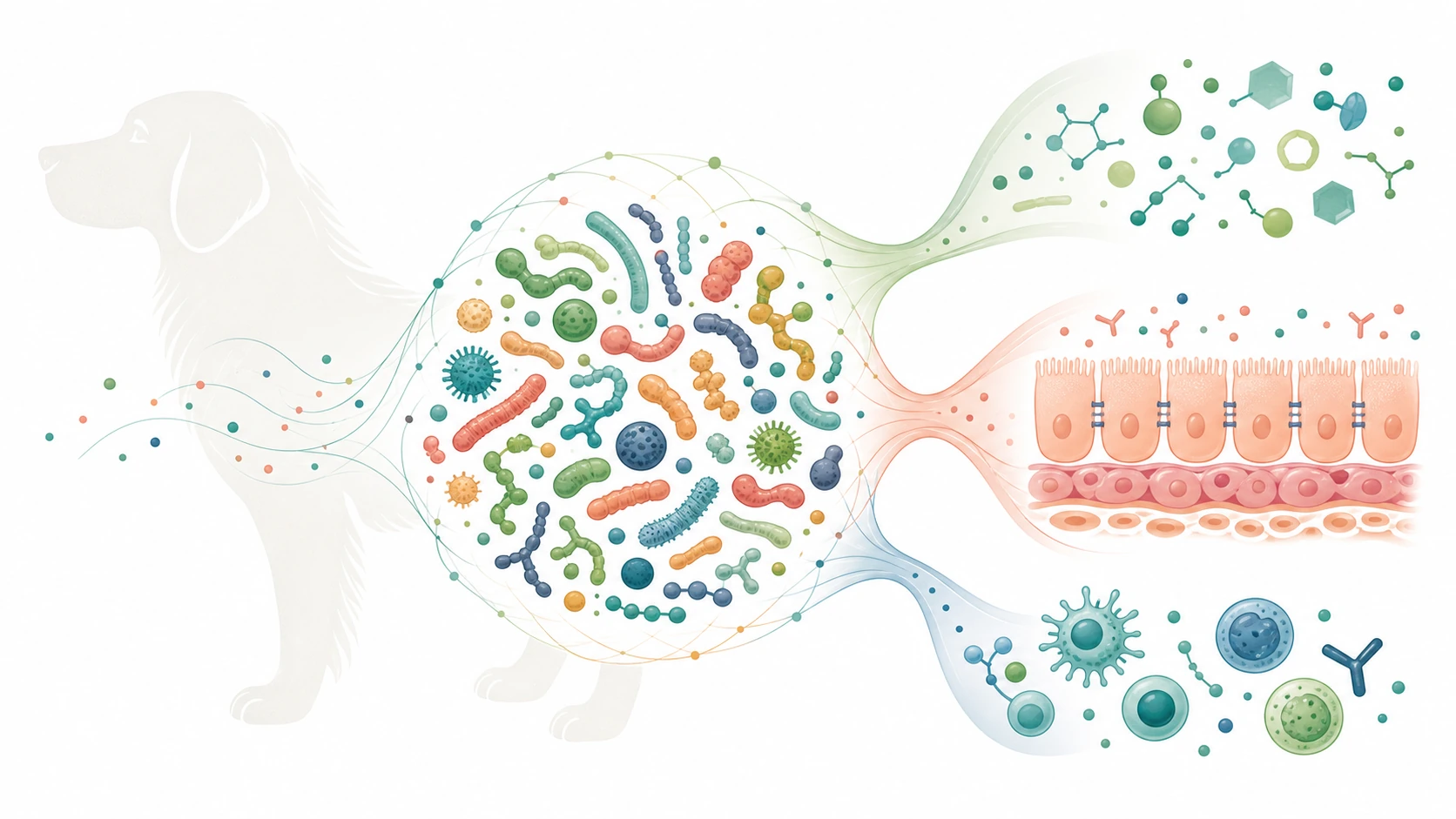
The canine gut microbiome is the collection of microorganisms and their genetic material in the gastrointestinal tract. These communities help process dietary components, produce and transform metabolites, interact with the intestinal barrier, and communicate with immune pathways. They also vary among dogs and can shift with diet, age, medication, environment, and disease. [1] [2]
- A diverse community is not automatically healthy, and one bacterial name rarely explains a dog’s signs.
- Fecal samples offer useful information about the lower-gut ecosystem but do not represent every part of the intestinal tract.
- Persistent digestive signs need a veterinary workup, not a supplement chosen from a microbiome marketing claim.
Safety first
Digestive signs can become urgent
Contact a veterinarian promptly for repeated vomiting, severe or worsening diarrhea, blood in stool or vomit, a swollen or painful abdomen, collapse, marked weakness, inability to keep water down, signs of dehydration, rapid weight loss, suspected toxin exposure, or concern that your dog swallowed an object. Puppies, senior dogs, very small dogs, and dogs with chronic illness can deteriorate faster.
- Do not use an at-home microbiome result to rule out obstruction, infection, pancreatitis, parasites, toxin exposure, or another cause.
- Do not stop a prescribed medication or start a restrictive diet solely to improve a microbiome score.
- Tell the clinic about recent antibiotics, acid-suppressing drugs, diet changes, travel, scavenging, and supplements.
Veterinary note
This guide is for general education only. It does not diagnose, treat, prescribe, or replace care from a licensed veterinarian. Microbiome findings must be interpreted alongside your dog’s history, examination, diet, medications, laboratory results, and clinical signs.
Microbiota and microbiome: a useful distinction
Microbiota refers to the microorganisms present in a location. Microbiome is often used more broadly for those organisms, their genes, and their surrounding environment. In everyday dog-health writing the words are sometimes used interchangeably, but neither means that all microbes are beneficial or that a single ideal community exists for every dog. [2]
The stomach, small intestine, colon, intestinal lining, and feces are different habitats. Oxygen, acidity, transit time, nutrients, and immune activity vary along the tract, so the community found in a stool sample is not a complete map of every intestinal site. This matters when a commercial report presents a sample as a definitive picture of total health.
What gut microbes do inside a dog’s digestive system
Microbial communities use dietary material that reaches the intestine and produce metabolites that can be used by other microbes or by the host. Among the best-studied examples are short-chain fatty acids created during fermentation and microbial changes to bile acids. These functions can influence the chemical environment of the colon, nutrient availability, and competition with potentially harmful organisms. [3]
Microbes also interact with mucus, intestinal epithelial cells, and immune signaling. A stable barrier helps keep luminal material separated from deeper tissue while allowing controlled communication. These relationships are dynamic: the host shapes the habitat, and microbial activity can shape conditions within it.
What dysbiosis means and what it does not prove
Dysbiosis describes a disruption in microbial composition or function relative to an expected state. In dogs, altered fecal microbial patterns are documented in chronic enteropathies, after some antibiotics, and in other clinical contexts. However, dysbiosis can be a contributor, a consequence of intestinal inflammation, an effect of treatment, or several of these at once. [4]
The canine Dysbiosis Index is a quantitative PCR test that measures total bacterial abundance and selected bacterial groups in feces, then summarizes the pattern. It is more clinically grounded than an unvalidated list of relative percentages, but it still needs veterinary interpretation. Texas A&M’s GI Laboratory notes that antibiotics and omeprazole can alter the index and that an underlying gastrointestinal disorder must be addressed rather than treating the number alone.
A normal result does not dismiss persistent vomiting, diarrhea, appetite loss, or weight change. An abnormal result does not by itself name the underlying diagnosis. The value is context: a defined method may add one piece to a larger clinical picture.
Owner tool
Separate the observation from the microbiome claim
Use this table when reading a report, product page, or article. It keeps evidence at the right level and gives your veterinarian a clearer starting point.
On a phone, swipe across the table to see all columns.
| What you see | What it may tell you | What it cannot establish alone | Useful next step |
|---|---|---|---|
| Stool consistency changed | Digestive function or transit has changed | The cause or which microbe is responsible | Track timing, food, medication, frequency, and other signs |
| Fecal microbial pattern differs | Measured taxa or community features differ from a reference | That the change caused disease | Review the method and clinical context with a veterinarian |
| A study reports an association | Two findings occurred together in the study group | Cause, direction, or benefit from treatment | Check study design, population, and whether the result was replicated |
| A product changes bacterial abundance | The measured community responded | A meaningful health benefit for your dog | Ask whether a clinical outcome was studied with the exact product |
| Dysbiosis Index is abnormal | Selected fecal bacterial groups shifted | The complete diagnosis or treatment plan | Interpret with history, examination, diet, drugs, and diagnostics |
Why diet, medication, and disease must be considered together
Diet supplies substrates for both the dog and its microbes. Changes in protein, fat, fiber, digestibility, calories, and ingredients can alter microbial activity and stool characteristics. A microbiome shift after a diet change is therefore not automatically good or bad; the clinical goal, complete nutritional adequacy, tolerance, and the dog’s response matter. [5]
Medication history matters too. Research in healthy dogs found that metronidazole caused substantial changes in fecal microbial composition and metabolites, with some changes persisting after treatment ended. That does not mean an indicated antimicrobial should never be used. It means antimicrobial decisions should be clinically justified and owners should not use leftover medication to chase nonspecific stool changes.
With chronic gastrointestinal disease, inflammation, barrier disruption, altered transit, diet, and the microbiome can influence one another. Treating the underlying disorder may help the microbial ecosystem recover. Conversely, focusing only on a probiotic, prebiotic, or test result can miss the condition driving the disturbance.
How to read “gut health affects everything” claims
The intestinal ecosystem is connected to immune and metabolic pathways, so researchers study possible gut-skin, gut-brain, and gut-joint relationships. In dogs, much of this work is observational, uses small or specialized populations, or measures microbial patterns rather than clinical outcomes. A biological pathway can be plausible without proving that a supplement will change a disease.
Look for careful language. “Associated with” is different from “causes.” A change in a laboratory marker is different from improved comfort, appetite, stool quality, mobility, or quality of life. Evidence from people, mice, or another dog condition cannot automatically be applied to your dog. Strong consumer guidance should identify those boundaries instead of converting an emerging research area into a universal promise.
Better questions, calmer next steps
Questions to ask your veterinarian
- Which causes should we evaluate before focusing on the microbiome?
- Could my dog’s diet, recent medication, or disease history explain the current signs or test result?
- Would a validated fecal test add useful information in this case?
- If we change the diet or add a biotic product, what exact outcome are we trying to improve?
- How long should we monitor, and which changes should trigger a recheck?
- What evidence supports this exact strain, substrate, diet, or intervention for dogs like mine?
FAQ
Is there one ideal microbiome for every dog?
No single microbial profile has been established as ideal for every dog. Age, diet, environment, medication, genetics, sampling method, and health status all affect findings.
Can a stool test diagnose my dog’s digestive problem?
A validated fecal test can provide useful information about selected microbial patterns, but it does not replace history, examination, and other diagnostics. Results should be interpreted by a veterinarian in context.
Does dysbiosis always cause disease?
No. Dysbiosis may contribute to disease, result from disease or treatment, or reflect several processes at once. An altered pattern alone does not prove cause and effect.
Should every dog take a probiotic for microbiome health?
No. Probiotic effects are strain-, product-, dose-, and context-specific. Some dogs may not need one, and a category label does not establish benefit.
Can diet change the canine gut microbiome?
Yes. Diet supplies microbial substrates and can change community composition and metabolites. The health meaning depends on the complete diet, the dog, and measured clinical outcomes.
When should I contact my veterinarian?
Seek guidance for persistent or recurrent digestive signs and promptly for blood, repeated vomiting, severe diarrhea, abdominal pain or swelling, weakness, dehydration, inability to keep water down, rapid decline, toxin exposure, or foreign-object concern.
Sources
- Veterinary Clinics of North America: Small Animal Practice: Analysis of the Gut Microbiome in Dogs and Cats. How fecal microbiome tests are interpreted, what the canine Dysbiosis Index measures, and why methods are not interchangeable.
- Frontiers in Veterinary Science: The Role of the Canine Gut Microbiome and Metabolome in Health and Gastrointestinal Disease. Canine microbial functions, metabolites, bile-acid conversion, and associations observed in gastrointestinal disease.
- Texas A&M Gastrointestinal Laboratory: Canine and Feline Microbiota Dysbiosis Index. Clinical context for the validated canine fecal Dysbiosis Index and factors that can alter results.
- Journal of Animal Physiology and Animal Nutrition: Canine Intestinal Microbiota and Modification by Pro-, Pre- and Synbiotics. The variability of canine intestinal communities and the limits of generalizing effects across biotic products.
- Frontiers in Veterinary Science: Effects of Metronidazole on the Fecal Microbiome and Metabolome in Healthy Dogs. Evidence that a commonly used antimicrobial can cause marked, sometimes persistent changes in fecal microbial and metabolic profiles.
