

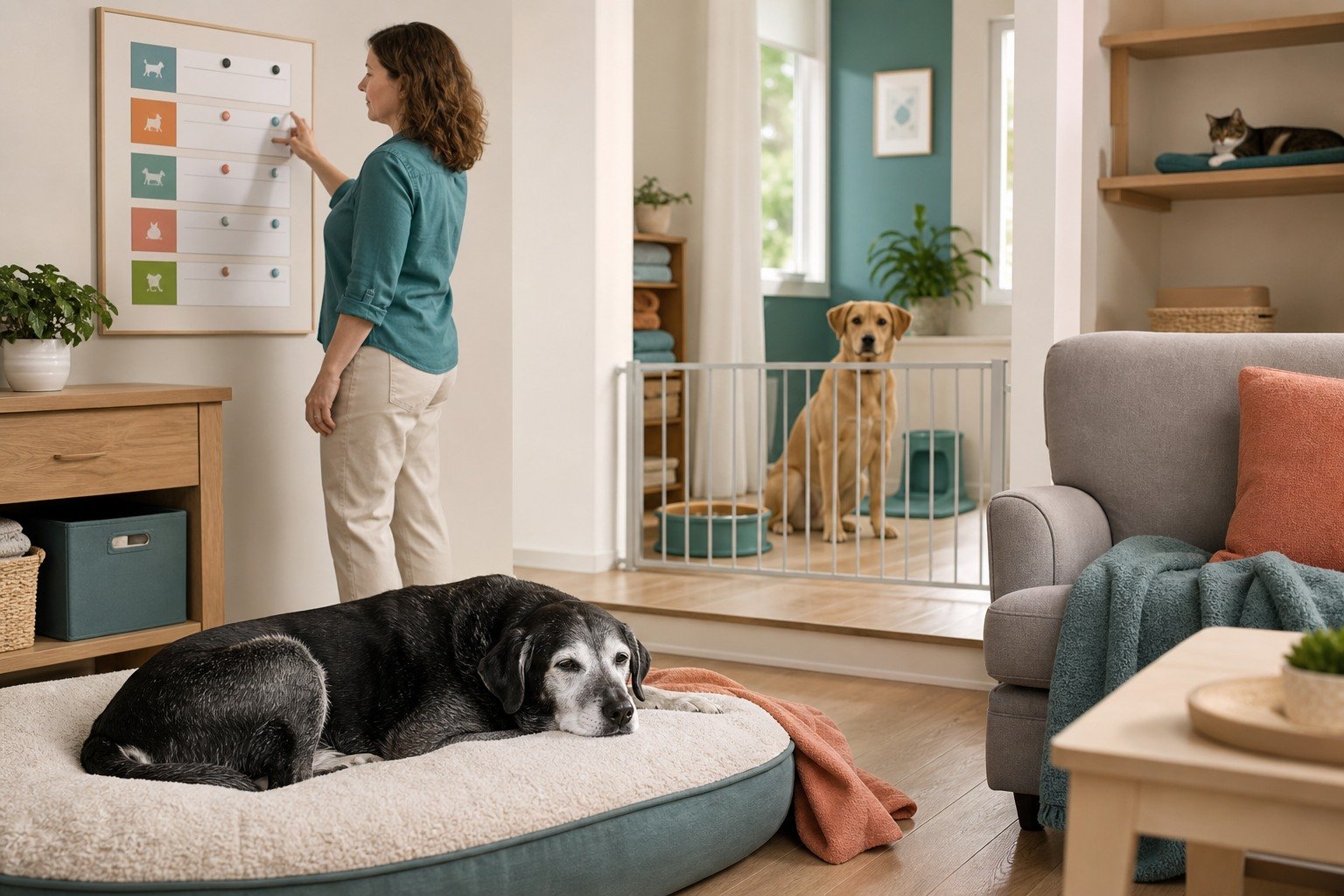
A senior dog may need more sleep, easier routes, different food, medication, slower movement, and protection from rough play. Younger dogs and cats still need species-appropriate activity, training, retreat, and resource access. Fair care does not mean identical care. It means that each animal can eat, drink, eliminate, rest, move, and interact without avoidable competition or interruption. Separate feeding and medication, create protected senior routes and rest, give cats vertical options, and meet a younger dog's activity needs away from the senior when necessary. Track observations by animal so the veterinary team knows who vomited, missed a meal, changed stool, drank more, or received a dose. Avoid dominance explanations for pain, fear, guarding, or conflict. Behavior change in a senior dog deserves medical context, and any injury risk requires immediate management.
Short answer
Design the household around individual access, not equal treatment
Senior-care guidance emphasizes mobility, pain, nutrition, cognition, and quality of life, while life-stage care recognizes that animals sharing a home can have different health and behavior needs. Clear zones and individual records make those needs visible. [1] [2]
- Record timing, context, intensity, recovery, and changes in daily function.
- Use observations to support veterinary assessment, not to diagnose or treat at home.
- Protect predictable routines, physical safety, rest, and access to essential resources.
- Agree on measurable outcomes, a review date, and clear urgent-contact signs.
Safety first
Separate animals promptly when access, rest, or safety breaks down
Contact a veterinarian for new avoidance, guarding, pain, sleep disruption, appetite change, house-soiling, weakness, falls, wounds, or escalating conflict. Use secure separation after staring, blocking, chasing, pinning, biting, repeated pestering, or inability to retreat. Seek urgent care for a bite wound, major trauma, collapse, severe pain, breathing difficulty, seizure, or rapid decline.
- Do not delay care for sudden, severe, escalating, or function-limiting change.
- Do not start, stop, combine, divide, or calculate treatment from this article.
- Use physical separation and professional help whenever a person or animal could be injured.
Veterinary note
This article is educational and does not diagnose, treat, prescribe, or replace care from a licensed veterinarian. Your dog’s history, examination, diet, medications, and current signs determine what is appropriate.
Map each animal's resources and daily needs
List food, water, medication, toileting, sleep, activity, grooming, training, and social needs for each pet. Identify where schedules conflict or one animal can block another's access.
Feed separately when diets, speed, guarding, or medication differ. Pick up bowls as directed and prevent cats or younger dogs from eating the senior diet or medicated food. Never assume a missing dose was consumed by the intended animal.
Give cats elevated and dog-free resting, feeding, and litter options. Give younger dogs enough structured activity and enrichment that the senior is not used as the default play partner.
Protect senior rest, traction, and routes
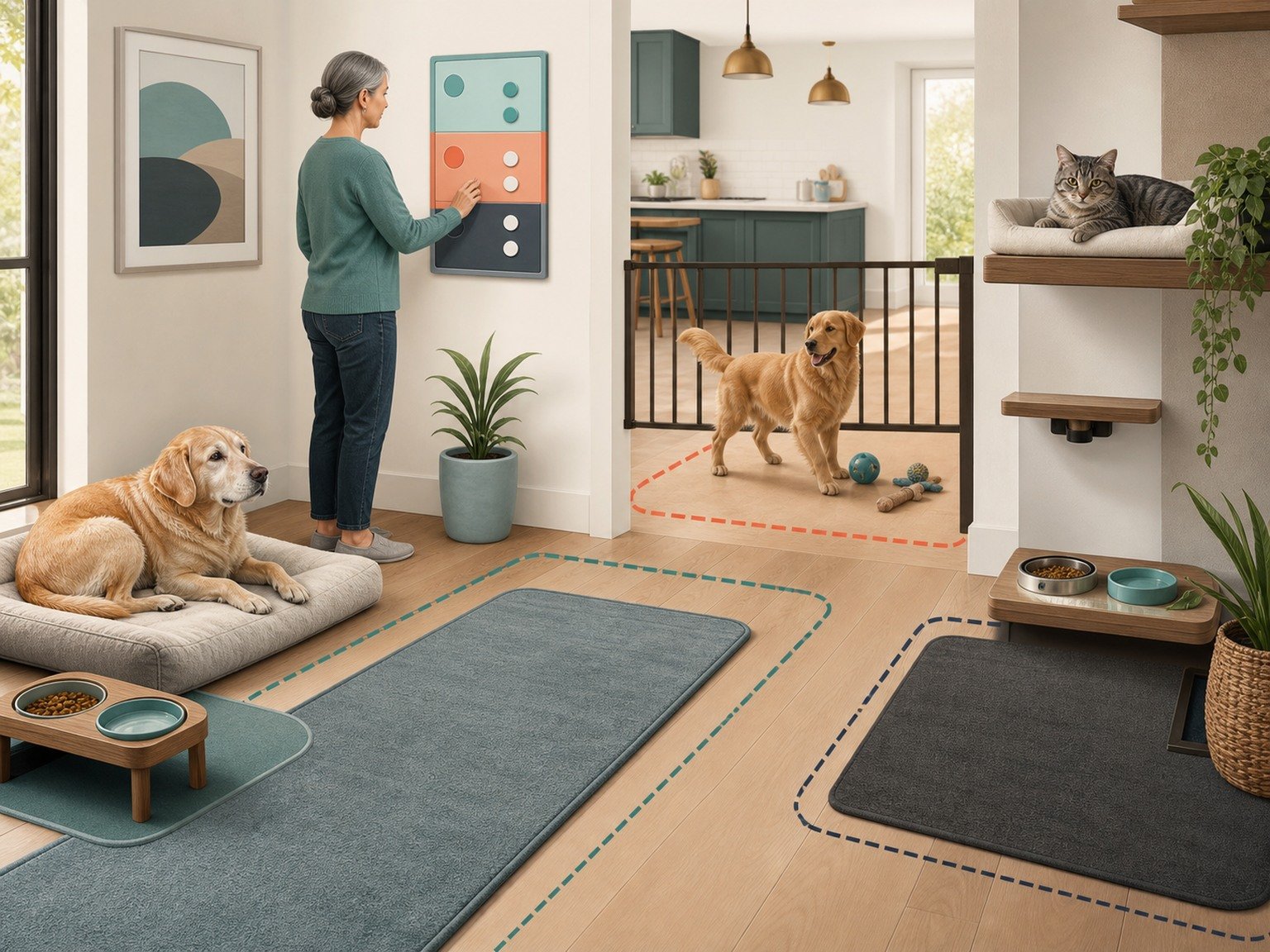
Create a rest zone that other pets cannot invade. Use nonslip paths to water, food, toileting, and family areas, and prevent younger animals from knocking the senior on stairs or at doorways.
Watch transitions at narrow spaces, gates, vehicles, feeding stations, and greeting areas. A painful or sensory-impaired dog may startle when approached during sleep or from behind.
Allow the senior to choose contact and leave. Do not require shared beds, bowls, toys, or greetings. Resource sharing is not proof of harmony, and separation is not a failure.
Use management before conflict becomes a training exercise
Barriers, leashes, rotations, and separate enrichment can prevent rehearsal while health and behavior are assessed. Do not provoke a reaction, punish warning signals, or use physical corrections.
When adding or reintroducing an animal, use gradual controlled exposure and professional guidance appropriate to species, history, health, and risk. A senior dog's pain or cognitive change can alter tolerance.
Maintain parasite prevention, vaccination, hygiene, and disease precautions with the veterinary team. New illness, diarrhea, coughing, skin lesions, or appetite change may require individual testing and temporary separation.
Keep records that identify the correct animal
Use distinct medication storage and a signed dose record. Include drug, strength, amount, time, and administrator as directed. Call the clinic after a suspected duplicate, missed, or wrong-pet dose rather than improvising. Store every product out of reach and do not rely on container color alone when several animals have treatments.
Record each pet's meals, water pattern, stool, urine, vomiting, sleep, mobility, and behavior separately. In a shared yard or feeding area, direct observation may be needed to know which animal changed. Photograph or label observations by animal when several caregivers communicate with the clinic.
Review whether the arrangement still works as health and mobility change. Adapt zones and schedules before fatigue, pain, sensory loss, or caregiver strain turns routine competition into a welfare problem. [3] [4] [5]
Prepare for a focused veterinary conversation
Bring a concise timeline, short natural-movement or symptom videos when safe, the exact names and photographs of every food, treat, medication, and supplement label, and notes about appetite, water intake, stool, sleep, activity, comfort, and behavior. Include recent injuries, travel, boarding, diet changes, missed medication, and previous test results. A complete record helps the veterinary team separate a repeatable pattern from a single impression.
Decide in advance what you need from the visit: an urgency decision, a diagnosis plan, a nutrition review, a pain or mobility assessment, or a monitored trial. Ask what result would change the plan and what finding would rule an option out. This keeps research and product information in the right role. Evidence can shape questions and expectations, but it cannot determine what is safe for an individual dog without the history and examination.
Owner tool
Create an individual multi-pet care map
On a phone, swipe across the table to see every column.
| Checkpoint | Record | Why it helps |
|---|---|---|
| Identity | Name, diet, medication, records | Prevents mix-ups |
| Access | Food, water, rest, toilet | Protects needs |
| Interaction | Trigger, distance, recovery | Finds conflict |
| Review | Health and household changes | Updates plan |
Better questions, calmer next steps
Questions to ask your veterinarian
- Does the senior dog show pain or sensory change?
- Which resources should be fully separate?
- How should we prevent medication mix-ups?
- What interactions require behavior support?
- Which disease precautions apply to this household?
FAQ
Should every pet eat together?
No. Separate feeding is often safer and clearer.
Is a younger dog being dominant?
That label does not diagnose the cause; assess context, health, and resources.
Can pets share water?
Ask the veterinary team when illness, medication, or infection control matters.
Should the senior correct the puppy?
Do not rely on the senior dog to manage unwanted play.
When should pets be separated?
Whenever rest, access, recovery, or physical safety cannot be protected.
Sources
- American Animal Hospital Association: 2023 Senior Care Guidelines. Senior health, behavior, pain, and caregiver considerations.
- American Animal Hospital Association: Canine Life Stage Guidelines Senior Checklist. Senior home observations and veterinary review.
- Veterinary Sciences: Rehabilitation of Geriatric Patients. Mobility, environment, pain, and frailty context.
- Animals: Lifestyle and Environmental Needs of Aging Dogs. Environmental and social needs in aging dogs.
- American Veterinary Society of Animal Behavior: Humane Dog Training Position Statement. Reward-based training and management.
