
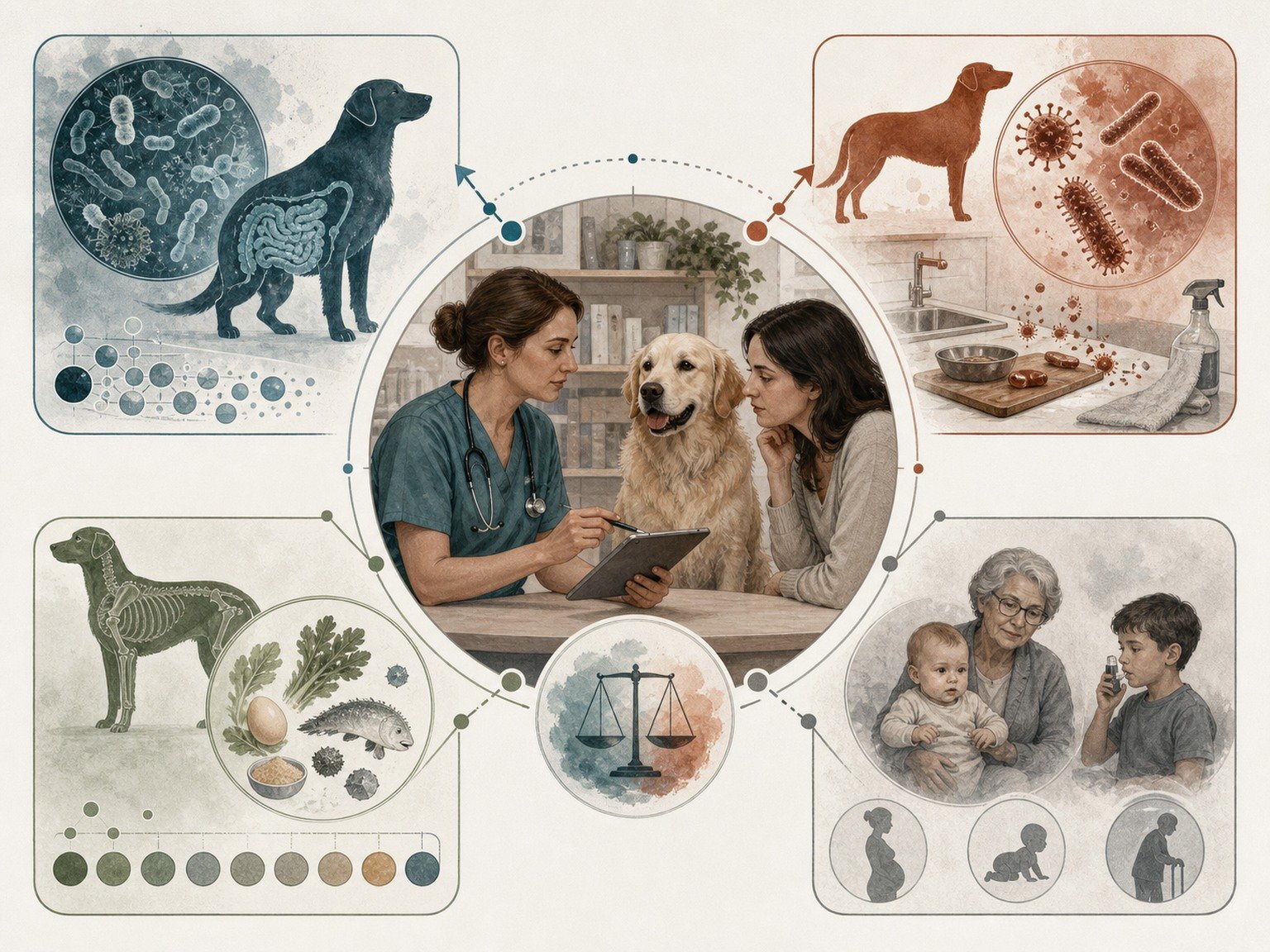
Current evidence does not establish broad raw-diet superiority for canine gut health. It does document microbial and household-exposure concerns, while microbiome studies show compositional differences that are not equivalent to clinical benefit. A responsible discussion considers the exact formulation, the individual dog's health, handling environment, and vulnerable people or animals without recipes, product endorsements, or a claim that risk can be eliminated. Document storage, serving areas, bowl access, waste handling, shared-care settings, and every person or animal who may encounter the food. This exposure map supports a more precise professional assessment without treating any one illness as automatic proof of its source.
Short answer
Microbiome differences do not prove better gut health
FDA found Salmonella and Listeria monocytogenes in a defined surveillance sample of commercial raw pet foods, and CDC does not recommend raw pet food or treats because contamination can make pets and people sick. WSAVA states that evidence does not establish raw meat-based food as healthier than balanced cooked or commercial food. Microbiota differences reported with raw feeding do not establish superior clinical outcomes. [1] [2] [3] [4]
- Record the exact pattern, products, diet, treatments, and recent changes.
- Separate what the evidence supports from what remains uncertain for this dog.
- Agree on a veterinary reassessment plan and urgent-response instructions.
Safety first
Illness after possible food exposure needs prompt veterinary and public-health guidance
Contact a veterinarian for vomiting, diarrhea, poor appetite, lethargy, fever, weight loss, or illness after a diet exposure. Seek emergency care for collapse, severe weakness, repeated vomiting, profuse or bloody diarrhea, pale gums, breathing difficulty, seizures, inability to stand, or rapid decline. People with illness concerns should contact their healthcare professional.
- Do not use general information to delay evaluation of severe, persistent, or worsening signs.
- Do not start, stop, combine, or calculate treatments from this article.
- Keep exact labels, exposure details, and a concise timeline available for the veterinary team.
Veterinary note
This article is educational and does not diagnose, treat, prescribe, or replace care from a licensed veterinarian. Your dog’s history, examination, diet, medications, and current signs determine what is appropriate.
Define the diet and question
Raw meat-based diets include commercial and home-prepared forms, complete products, complementary items, treats, and mixtures. Their ingredients, nutrient balance, processing, storage, and microbial controls differ. This article does not provide recipes, sourcing, preparation, or handling protocols.
State the goal: preference, stool quality, allergy concern, performance, or treatment of a diagnosed condition. Naturalness is a value judgment, not a clinical outcome. Claims about detoxification, curing disease, or universal superiority are not supported by this packet.
A board-certified veterinary nutritionist can evaluate formulation and nutrient adequacy. The primary veterinarian adds the dog's disease, medication, laboratory, and household context. Neither review can create a zero-risk guarantee.
Interpret microbiome studies correctly
Diet changes can alter measured microbial composition and metabolites. A difference demonstrates exposure and biological response; it does not by itself show improved comfort, fewer disease events, longer life, or treatment efficacy.
A review of raw-meat diet microbiota studies reports compositional differences while emphasizing limited evidence and heterogeneous methods. Outcomes, populations, formulations, sampling, and analysis vary. [4]
Avoid labeling individual taxa as universally good or bad from consumer summaries. Clinical gut health requires relevant symptoms and outcomes, not only sequencing data. Current evidence does not justify choosing raw food solely to produce a microbiome shift.
Understand food-safety evidence
FDA surveillance detected Salmonella and Listeria monocytogenes in a defined sample of commercial raw dog and cat foods. Those counts describe the tested sample, not the contamination rate for every product or lot. They still establish that pathogen exposure is a real concern. [1]
CDC does not recommend feeding raw pet food or treats because contaminated food can sicken animals and people. Exposure may occur through the food, bowls, surfaces, waste, saliva, or environmental transfer. Household vulnerability matters. [2]
Children, older adults, pregnant people, immunocompromised individuals, and vulnerable animals may face higher consequences. Food-safety practices may reduce exposure but cannot support a no-risk claim. Contact veterinary and human-health professionals for household-specific guidance.
Include nutrition and patient factors
WSAVA identifies microbial and nutritional concerns and states that available evidence does not establish raw food as healthier than nutritionally balanced cooked or commercial food. Balance cannot be inferred from ingredient appearance. [3]
Consider growth, pregnancy, immune status, gastrointestinal disease, kidney or liver disease, medications, previous infection, scavenging, and household capacity. A diet acceptable in one setting may be unsuitable in another.
If an owner is considering or already feeding raw, disclose it to the veterinary team and record the exact product, lot, formulation, storage, handling environment, stool and clinical signs. The goal is informed risk assessment, not shame or a universal verdict.
Prepare for a focused veterinary conversation
Bring a concise timeline, short natural-movement or symptom videos when safe, the exact names and photographs of every food, treat, medication, and supplement label, and notes about appetite, water intake, stool, sleep, activity, comfort, and behavior. Include recent injuries, travel, boarding, diet changes, missed medication, and previous test results. A complete record helps the veterinary team separate a repeatable pattern from a single impression.
Decide in advance what you need from the visit: an urgency decision, a diagnosis plan, a nutrition review, a pain or mobility assessment, or a monitored trial. Ask what result would change the plan and what finding would rule an option out. This keeps research and product information in the right role. Evidence can shape questions and expectations, but it cannot determine what is safe for an individual dog without the history and examination.
Owner tool
Prepare a raw-diet evidence discussion
On a phone, swipe across the table to see every column.
| Checkpoint | Record | Why it helps |
|---|---|---|
| Goal | Reason and clinical outcome | Tests relevance |
| Diet | Exact product and formulation | Defines exposure |
| Household | Vulnerable people and animals | Frames consequence |
| Evidence | Microbiome, safety, adequacy | Separates claims |
Better questions, calmer next steps
Questions to ask your veterinarian
- What clinical goal are we trying to meet?
- Is the exact diet nutritionally complete for this dog?
- Which patient and household factors change risk?
- What do microbiome findings fail to prove?
- Would a veterinary nutritionist change the assessment?
FAQ
Do microbiome differences prove benefit?
No. Composition is not the same as a clinically meaningful outcome.
Is every raw product contaminated?
The FDA sample does not establish a universal contamination rate.
Can handling remove all risk?
No. Practices may reduce exposure but cannot create a zero-risk guarantee.
Does this article recommend for or against raw feeding?
No. It provides evidence boundaries for an individualized discussion.
Who can assess a recipe?
A board-certified veterinary nutritionist can evaluate formulation and adequacy.
Sources
- U.S. Food and Drug Administration: Raw Pet Food Diets Can Be Dangerous. Defined surveillance findings and exposure concerns.
- Centers for Disease Control and Prevention: About Pet Food Safety. Public-health recommendation and household risk.
- World Small Animal Veterinary Association: Raw Meat Based Diets for Pets. Evidence, microbial, and nutritional boundaries.
- Journal of Animal Physiology and Animal Nutrition: Effects of Raw-Meat Diets on Gastrointestinal Microbiota. Microbiota differences and clinical-outcome limits.
