

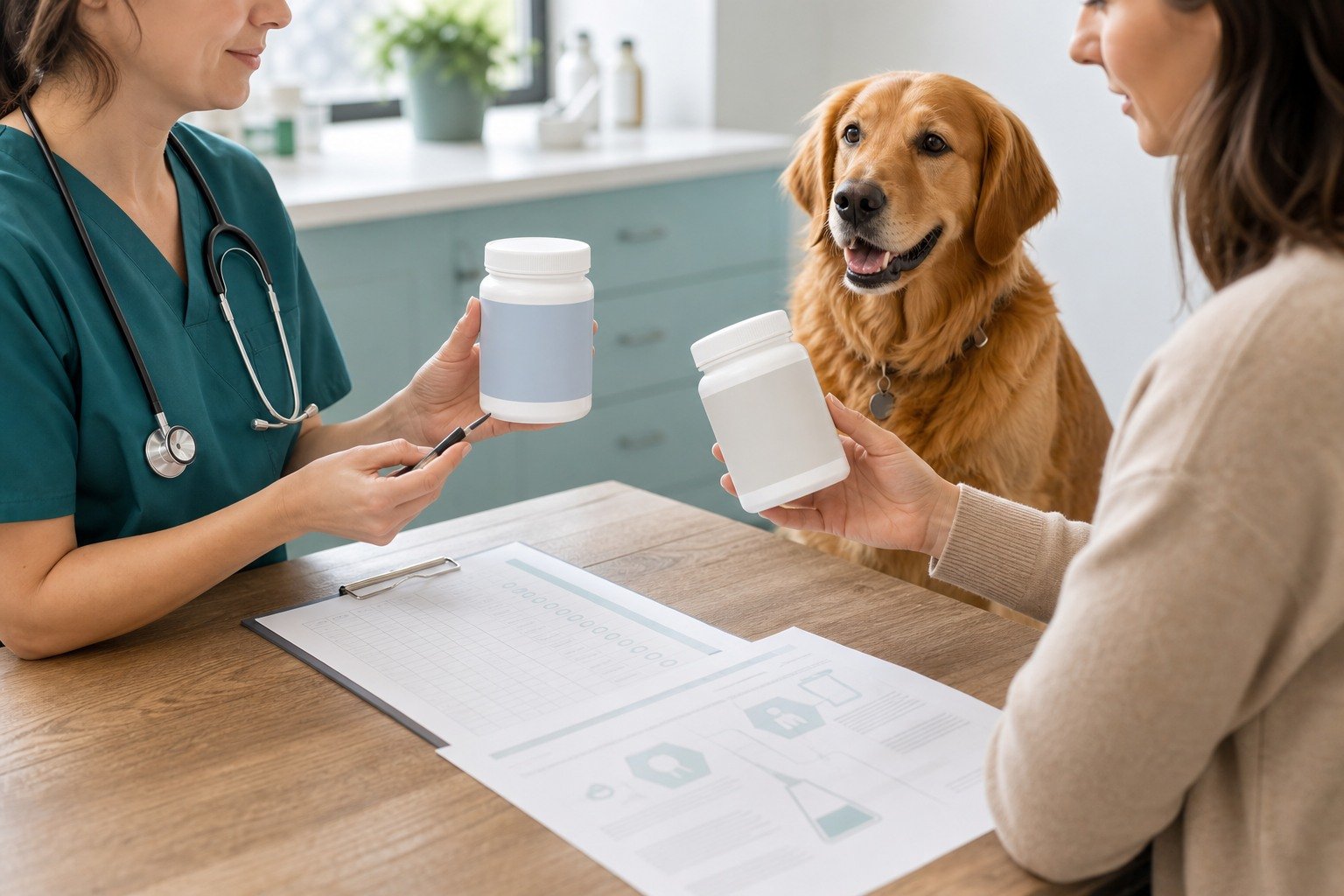
Choosing a supplement company is not a hunt for the most polished label. First determine whether a supplement belongs in the dog's plan. Then examine who makes it, whether lots can be traced, what testing actually measures, how complaints and recalls are handled, and whether evidence addresses the exact ingredient, formulation, and intended use. No seal or laboratory document proves universal efficacy or patient-specific safety.
Short answer
Evaluate the company and evidence chain, not one badge
U.S. law does not create a separate animal dietary-supplement category equivalent to the human framework; products are regulated according to composition and intended use as animal food or drugs. Voluntary quality programs and testing can provide useful process evidence, but their scope must be read precisely. They do not establish that a product works for a particular dog. [1] [2] [3]
- Start with the dog's clinical question and complete exposure list.
- Verify the exact product, ingredient amounts, lot, and evidence scope.
- Agree on monitoring, reassessment, and urgent-response instructions before use.
Safety first
Unknown ingredients, contamination concerns, or acute signs need veterinary guidance
Contact a veterinarian promptly after an accidental exposure, suspected contamination, unexpected reaction, or when the product identity or amount is uncertain. Seek emergency help for collapse, seizures, breathing difficulty, severe weakness, repeated vomiting with lethargy, marked agitation, tremors, or another rapid change.
- Do not use a supplement to delay examination of new, severe, or worsening signs.
- Do not combine, substitute, increase, stop, or restart products without veterinary direction.
- Keep the exact package, lot information, and all labels available for assessment.
Veterinary note
This article is educational and does not diagnose, treat, prescribe, or replace care from a licensed veterinarian. Your dog’s history, examination, diet, medications, and current signs determine what is appropriate.
Start with need and intended outcome
Define the health question before comparing companies. Ask what diagnosis or observed sign is being addressed, what standard care already exists, and whether evidence supports adding a supplement. A product that is well manufactured can still be unnecessary, ineffective for the intended use, or unsuitable for the individual dog.
List the dog's diet, treats, medications, supplements, diseases, allergies, and previous reactions. Ingredient overlap and interactions cannot be assessed from one front label. Decide what outcome would count as meaningful, how it will be measured, and when the veterinarian will reassess it.
The article remains product-neutral because the research packet does not support a ranked brand list. Quality questions narrow uncertainty; they do not replace clinical evidence or veterinary judgment. [3]

Identify the accountable company and lot
Look for a real company name, physical or reliable contact route, lot or batch identifier, expiration or best-use information, complete ingredient statement, net quantity, intended species, and directions that can be reviewed by the veterinarian. Save photographs before discarding the container.
Ask whether the company manufactures the product or contracts production, which quality system applies, how suppliers are qualified, and whether the company can trace ingredients and finished lots. A customer-service response should answer the specific question rather than recite marketing language.
FDA explains that animal products are regulated according to what they contain and how they are intended to be used. Therapeutic claims can change regulatory status. A supplement-like appearance does not itself establish approval, effectiveness, or safety. [1]
Interrogate testing claims
Ask who performed the test, whether the laboratory was independent, which lot and sample were tested, which analytes and contaminants were measured, which method and acceptance criteria were used, when testing occurred, and how frequently it is repeated. A certificate without this context may be difficult to interpret.
Testing identity or label amount is different from testing pathogens, heavy metals, oxidation, potency over shelf life, or clinical outcomes. Passing one test cannot be generalized to unmeasured hazards or efficacy. Compare the claim with the actual scope.
A study of selected canine fish-oil supplements found substantial product variation and some label discrepancies. It illustrates why quality evidence should be product-, lot-, analyte-, and method-specific rather than assumed from a category. [4]
Review complaints, recalls, and evidence
Ask how adverse events and complaints are documented, who reviews them, when veterinarians or regulators are contacted, and how customers are notified of a recall. Search current regulatory notices when relevant, but absence from a recall list is not proof of quality.
NASC describes audits, written procedures, adverse-event reporting, training, labeling criteria, and random label-claim testing in its voluntary program. Those are process signals with defined scope, not proof of clinical benefit or suitability for one patient. [2]
Match evidence to the exact ingredient, formulation, route, population, outcome, comparator, and duration. Evidence for a different species, blend, dose, or condition may not transfer. A responsible decision records both what is known and what remains uncertain.
Prepare for a focused veterinary conversation
Bring a concise timeline, short natural-movement or symptom videos when safe, the exact names and photographs of every food, treat, medication, and supplement label, and notes about appetite, water intake, stool, sleep, activity, comfort, and behavior. Include recent injuries, travel, boarding, diet changes, missed medication, and previous test results. A complete record helps the veterinary team separate a repeatable pattern from a single impression.
Decide in advance what you need from the visit: an urgency decision, a diagnosis plan, a nutrition review, a pain or mobility assessment, or a monitored trial. Ask what result would change the plan and what finding would rule an option out. This keeps research and product information in the right role. Evidence can shape questions and expectations, but it cannot determine what is safe for an individual dog without the history and examination.
Owner tool
Record the brand-verification chain
On a phone, swipe across the table to see every column.
| Checkpoint | Record | Why it matters |
|---|---|---|
| Need | Diagnosis and target outcome | Prevents shopping first |
| Identity | Company, contact, lot | Supports accountability |
| Testing | Lab, analyte, method, criteria | Defines claim scope |
| Response | Complaint and recall process | Shows follow-through |
Better questions, calmer next steps
Questions to ask your veterinarian
- Does this dog need a supplement for this goal?
- Who is accountable for this exact lot?
- What did the reported testing measure and omit?
- Does evidence match this formulation and use?
- How should an adverse event or lack of benefit be reported?
FAQ
Does a quality seal prove a supplement works?
No. It may indicate defined quality processes but does not prove clinical efficacy.
Is independent testing enough?
Only if the lot, laboratory, analytes, methods, criteria, and timing are clear.
Does no recall mean a product is safe?
No. Recall history is one signal and cannot prove safety or quality.
Should I choose by ingredient count?
No. Need, evidence, formulation, amount, overlap, and patient factors matter.
Can this guide name the best brand?
No. The packet supports verification questions, not a ranked recommendation.
Sources
- U.S. Food and Drug Administration: FDA's Regulation of Pet Food. Animal food and drug regulatory framework.
- National Animal Supplement Council: NASC Quality Seal. Voluntary program requirements and limits.
- Veterinary Sciences: Veterinary Pet Supplements and Nutraceuticals. Regulation, evidence, quality-control, and safety limitations.
- Topics in Companion Animal Medicine: Analysis of Selected Nutrients and Contaminants in Fish Oil Supplements for Dogs. Product variation and label-claim findings in a defined sample.
