

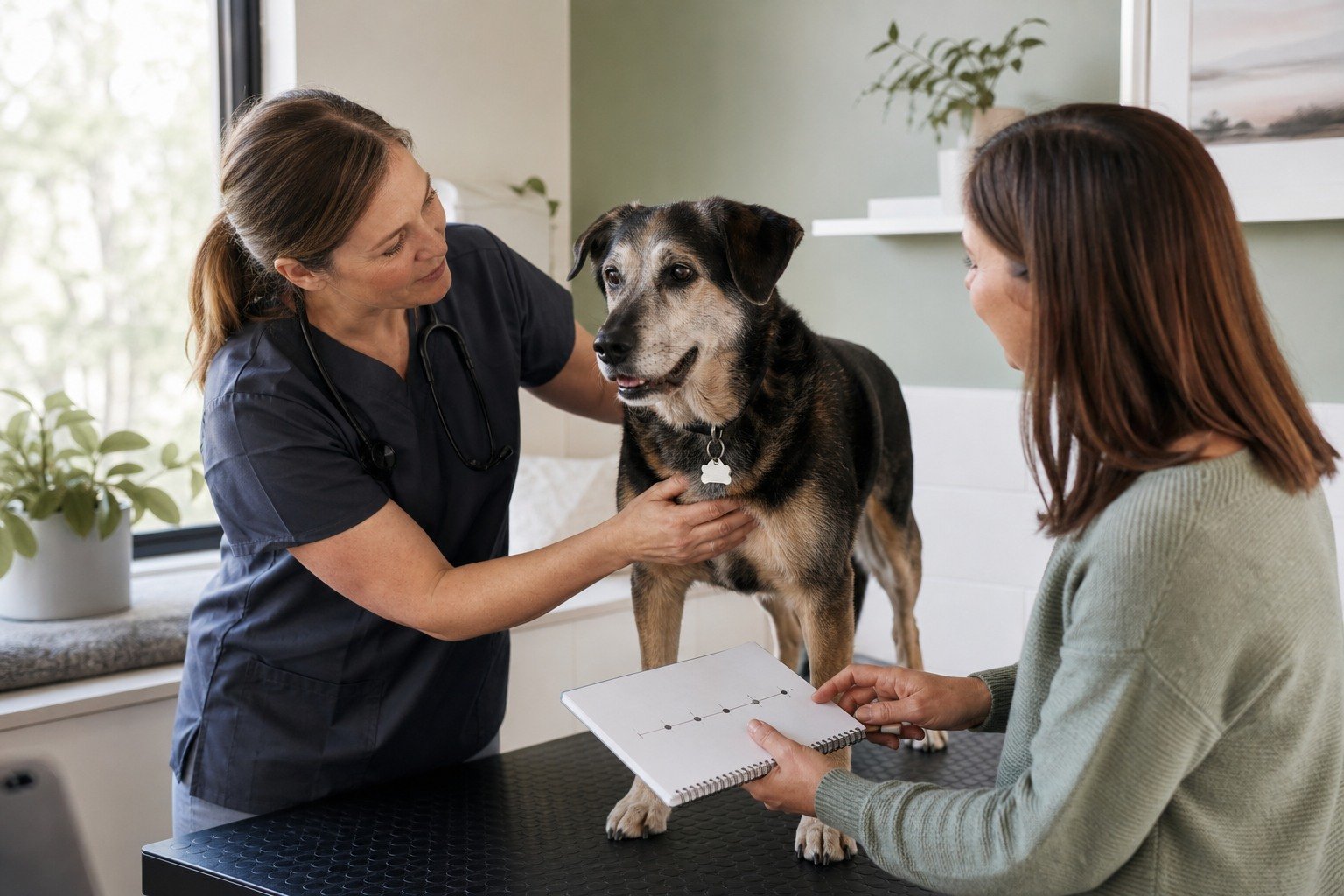
Senior visits are most useful when the veterinary team can connect subtle home changes with a complete examination and a patient-specific plan. Age increases the chance that more than one condition is present, but it does not create one universal test list or schedule. Preparation helps the visit focus on comfort, function, disease detection, prevention, and the next decision that matters for this dog.
Short answer
Expect a whole-dog review, then an individualized screening plan
AAHA senior-care guidance supports examinations at least every six months for senior dogs, paired with appropriate diagnostic screening and risk-based follow-up. The visit may cover history, oral health, pain and mobility, body and muscle condition, vision, hearing, behavior, nutrition, medications, supplements, and laboratory testing. The exact interval and tests still depend on the dog's age, breed risks, previous results, current signs, and health conditions. [1] [2] [3]
- Bring a concise timeline of changes rather than relying on memory during the appointment.
- List every food, treat, medication, and supplement with exact labels and schedules.
- Ask what each proposed test could find, what result would change care, and when follow-up is due.
Safety first
Sudden collapse, breathing trouble, severe pain, or neurologic change cannot wait for a routine visit
Seek prompt or emergency veterinary care for struggling to breathe, blue or very pale gums, collapse, seizures, inability to stand, sudden weakness, severe or escalating pain, repeated vomiting with weakness, a swollen abdomen with distress, uncontrolled bleeding, inability to urinate, or a rapid major change.
- Do not wait for a scheduled wellness appointment when signs are acute or worsening.
- Do not change medication or supplement doses to test whether a new sign improves.
- Do not force movement, food, water, or mouth handling when the dog is distressed.
Veterinary note
This article is educational and does not diagnose, treat, prescribe, or replace care from a licensed veterinarian. Your dog’s history, examination, diet, medications, and current signs determine what is appropriate.
Prepare a useful senior history
Write down when each change began, whether it is constant or intermittent, what makes it better or worse, and how recovery looks. Include appetite, water intake, urination, stool, sleep, breathing, coughing, mobility, falls, grooming, social interaction, confusion, hearing, vision, and tolerance of touch. Short natural videos can help when a sign is safe to record and does not appear in the clinic.
Bring prior records when the clinic does not already have them. List diagnoses, procedures, allergies, medication reactions, dental history, travel, parasite prevention, vaccines, diet changes, and every prescription, over-the-counter product, chew, powder, oil, or supplement. Include the exact amount actually given and any missed doses; brand or ingredient familiarity is not enough.
Choose two or three priorities before the visit. A long list is valuable, but ranking concerns helps the team allocate time and decide whether a separate appointment is needed. State the practical change: difficulty rising, nighttime pacing, new accidents, slower eating, weight change, or reduced interest. Avoid deciding the diagnosis before the examination. Similar observations can have several causes.
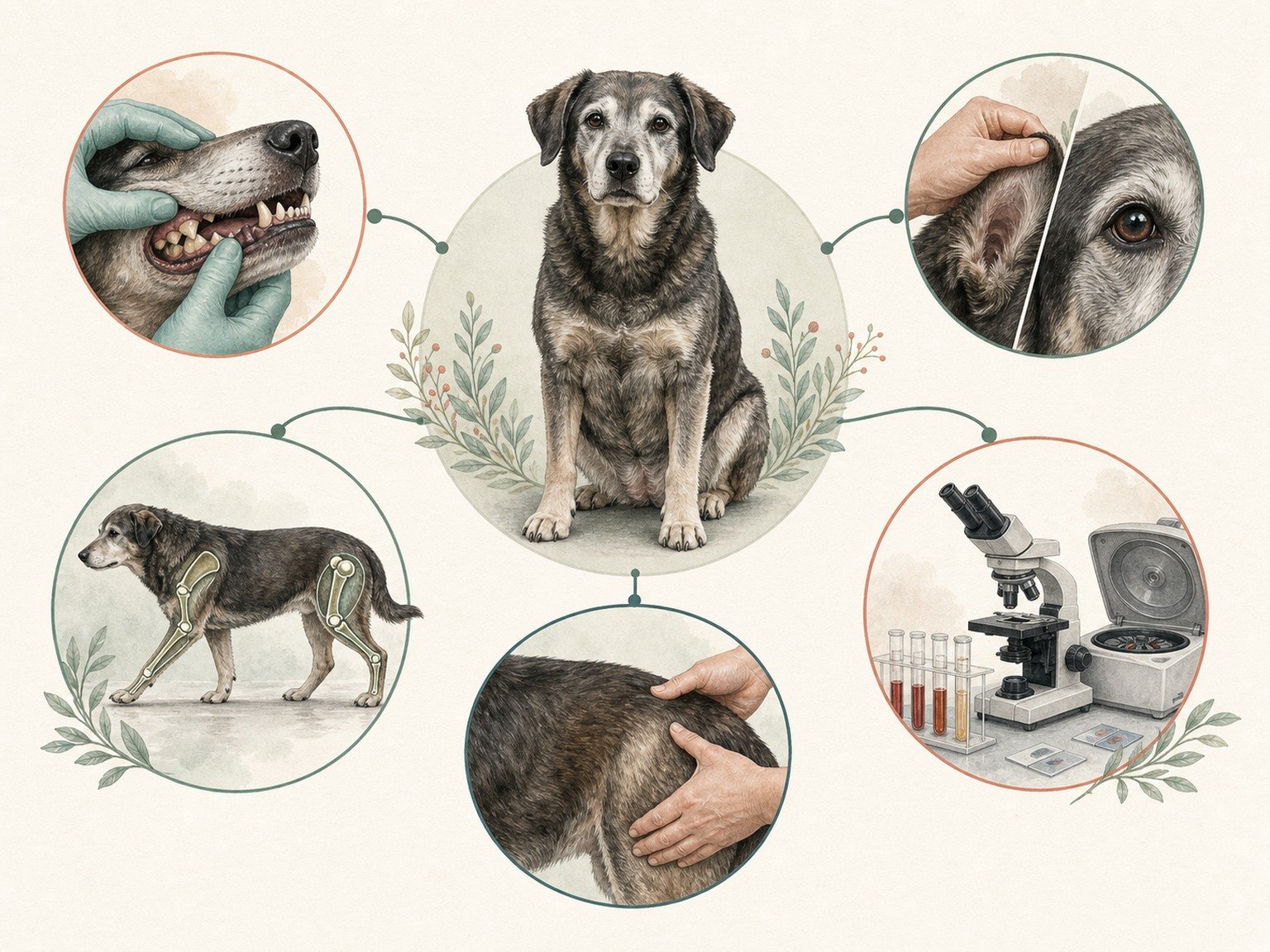
Understand the whole-dog examination
The veterinarian may assess heart and lung sounds, pulse, hydration, temperature when indicated, lymph nodes, abdomen, skin, coat, eyes, ears, mouth, teeth, body condition, muscle condition, joints, spine, gait, paws, and neurologic responses. Not every element looks the same in every patient. Temperament, pain, frailty, and the presenting concern shape how the examination proceeds.
An oral look can identify visible inflammation, masses, fractured teeth, or heavy deposits, but it cannot answer every below-gumline question. Mobility assessment may combine standing posture, transitions, gait, joint range, muscle symmetry, pain responses, and owner video. Sensory or behavior changes can overlap with pain, cognitive change, endocrine disease, medication effects, or neurologic illness, so context matters.
AAHA guidance emphasizes history, physical and oral examination, pain and mobility assessment, sensory history, and periodic medical workup in healthy senior pets. It should be read as a framework for individualized care, not proof that every dog needs an identical panel on the same calendar. [1] [2]
Ask what screening can and cannot answer
Common screening discussions may include a blood count, chemistry profile, urinalysis, blood pressure, thyroid testing, parasite tests, or imaging, but the combination depends on the patient. Breed, sex, reproductive status, geography, diet, medications, prior abnormalities, examination findings, and new signs can change both the value and urgency of a test.
A prospective study of 122 apparently healthy older dogs found at least one previously unrecognized disease in 20 percent at baseline and additional findings during follow-up. That supports the potential value of repeated screening in a defined population; it does not prove one universal schedule, guarantee prevention, or show that every abnormal result improves outcomes through the same intervention. [4]
Ask what the test is looking for, whether fasting or a urine sample is needed, how incidental findings will be handled, and what a normal result would leave unresolved. Screening can identify clues before obvious decline, but false positives, borderline values, biological variation, and follow-up burden are also part of informed decision-making.
Leave with a follow-up map
Before leaving, confirm which findings are normal, uncertain, or concerning; which tests are pending; when results will arrive; and who will contact whom. Write down medication or diet changes, monitoring instructions, activity restrictions, sample collection steps, and the date or trigger for recheck. Ask for plain-language explanations when a recommendation is not clear.
A good plan names measurable outcomes. Examples include easier rising, stable weight, fewer nighttime disruptions, comfortable eating, improved stool pattern, or unchanged kidney values. It also names warning signs and a response: call the clinic, arrange same-day care, or seek emergency help. Avoid using one good day or one difficult day as the entire trend.
Senior care often involves several conditions and several clinicians. Keep an updated problem list, medication and supplement list, laboratory trend, imaging report, dental record, and emergency contacts. Regular visits are not a promise that disease will be prevented. Their value lies in repeated observation, earlier questions, coordinated decisions, and adjustment as the dog's needs change.
Prepare for a focused veterinary conversation
Bring a concise timeline, short natural-movement or symptom videos when safe, the exact names and photographs of every food, treat, medication, and supplement label, and notes about appetite, water intake, stool, sleep, activity, comfort, and behavior. Include recent injuries, travel, boarding, diet changes, missed medication, and previous test results. A complete record helps the veterinary team separate a repeatable pattern from a single impression.
Decide in advance what you need from the visit: an urgency decision, a diagnosis plan, a nutrition review, a pain or mobility assessment, or a monitored trial. Ask what result would change the plan and what finding would rule an option out. This keeps research and product information in the right role. Evidence can shape questions and expectations, but it cannot determine what is safe for an individual dog without the history and examination.
Owner tool
Build a senior-visit preparation record
On a phone, swipe across the table to see every column.
| Domain | Bring | Ask |
|---|---|---|
| Daily function | Timeline and safe videos | What could explain the change? |
| Treatments | Exact labels and schedules | What could interact? |
| Screening | Prior results and risks | What will this test change? |
| Follow-up | Written plan | When and how do we reassess? |
Better questions, calmer next steps
Questions to ask your veterinarian
- Which findings are most important today?
- Which screening tests fit my dog's risks and why?
- What could a normal result leave unresolved?
- Which home observations should I track?
- Which signs require same-day or emergency care?
FAQ
How often should a senior dog see a veterinarian?
AAHA guidance supports at least six-month examinations for seniors, but the veterinarian may individualize the interval.
Does every senior dog need the same tests?
No. Screening depends on risks, history, examination findings, prior results, and current signs.
Should I bring supplements to the visit?
Yes. Bring exact labels or clear photographs for every medication, food, treat, and supplement.
Can a normal screening panel rule out disease?
No. Test scope and timing matter, and some problems require different evaluation.
What makes a home video useful?
Record natural behavior safely, with date and context, without provoking the sign.
Sources
- American Animal Hospital Association: Diagnostic Tests and Recommended Frequencies for Senior Dogs and Cats. Senior screening framework and individualized test selection.
- American Animal Hospital Association: Evaluating the Healthy Senior Pet. History, examination, pain, mobility, sensory, and medical-workup context.
- American Animal Hospital Association: Canine Life Stage Checklist. Senior examination frequency and life-stage assessment.
- Journal of Veterinary Internal Medicine: Exploring the Importance of Repeated Health Screening in Healthy Older Dogs. Prospective screening findings and study limits.
