
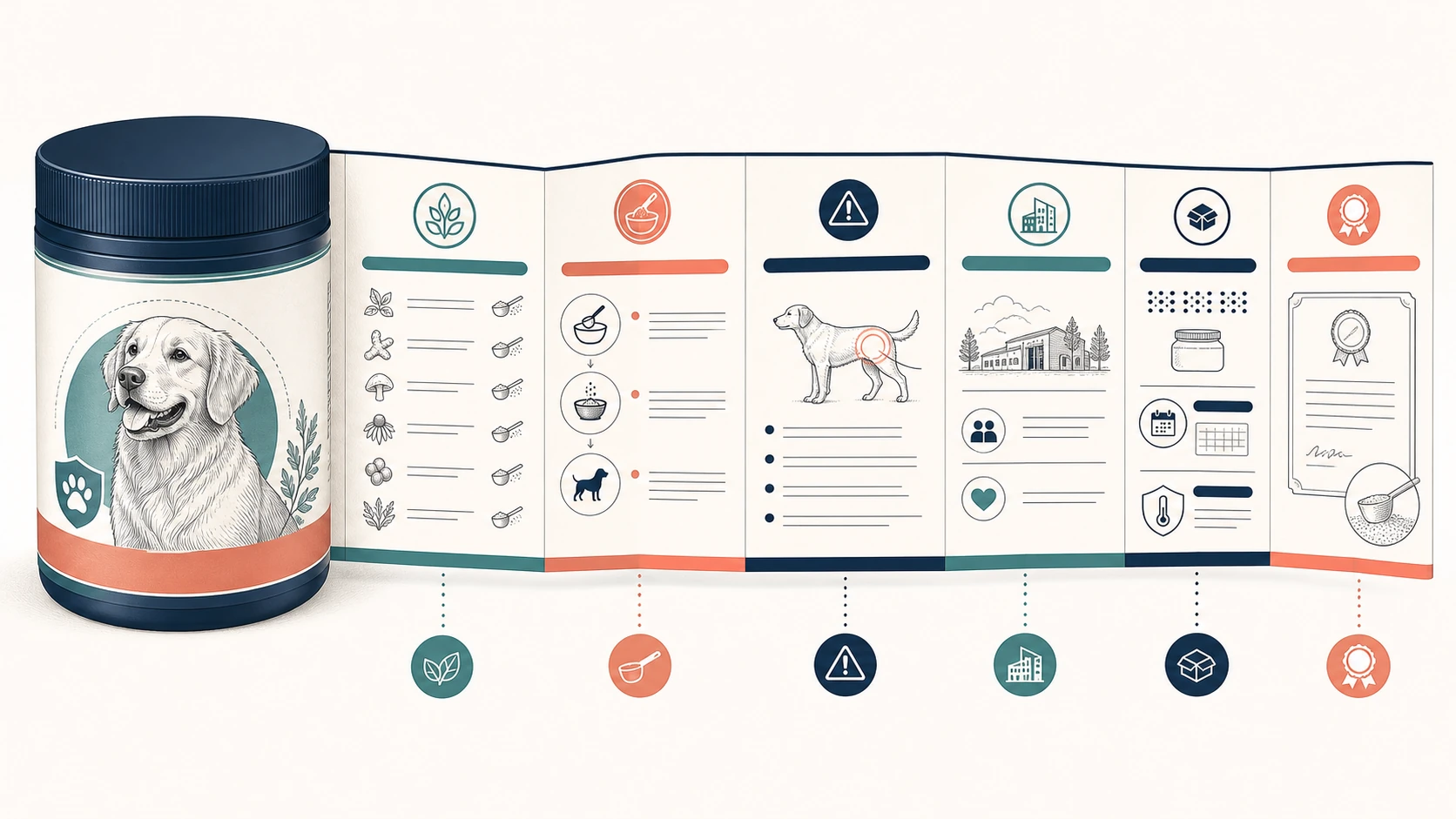
The front of a dog supplement package is designed to attract attention. The information needed for a safety review may be spread across the side, back, lid, insert, and online directions. Reading the label means reconstructing the exact exposure: product identity, active and inactive ingredients, amounts, serving basis, directions, cautions, responsible company, lot, date, storage, and claims.
Short answer
Read the label as an exposure record, not an advertisement
Federal animal-food labeling rules address product identity, net quantity, manufacturer or distributor information, and ingredient listing, while intended claims can affect regulatory status. Owners still need to determine what amount the dog would receive, whether ingredients overlap, and whether the product fits a veterinary goal. [1] [2]
- Photograph every panel, seal, insert, lot code, and date before opening the product.
- Convert each ingredient to the amount delivered by the intended daily serving when the label permits.
- Separate quality and traceability signals from evidence of clinical benefit.
Safety first
Pause when the label cannot support a basic safety review
Do not use a product when the identity is unclear, the seal is broken, the lot or responsible company cannot be found, directions conflict, the product is expired or damaged, or ingredient amounts needed for veterinary review are hidden. Contact a veterinarian promptly for any suspected reaction or overdose.
- Do not assume a scoop, chew, tablet, dropper, or serving means the same dose across products.
- Do not rely on the online listing when the container label says something different.
- Do not treat a guarantee, testimonial, quality badge, or natural claim as proof of benefit.
Veterinary note
This article is educational and does not diagnose, treat, prescribe, or replace care from a licensed veterinarian. Your dog’s history, examination, diet, medications, and current signs determine what is appropriate.
Start with product identity and intended use
Record the exact product name, form, species, life-stage language, net quantity, and intended-use statements. Similar brand names may cover different formulations. Disease-treatment, prevention, cure, or mitigation claims deserve special scrutiny because intended use helps distinguish animal food from a new animal drug. [1] [2]
Compare the physical label with the manufacturer page only after preserving the container evidence. Note any formula, direction, or caution mismatch. A marketplace title or search snippet is not the controlling label and may combine details from another size or version.
Map every ingredient and amount
Separate named active or functional ingredients from flavors, carriers, sweeteners, binders, coatings, preservatives, and allergens. Record chemical form when listed because different salts, extracts, organisms, and strains are not interchangeable. Proprietary blends may prevent calculation of individual exposure.
Follow the arithmetic from amount per unit to units per serving and servings per day. Then compare the total with every other food, treat, chew, topper, and supplement. Do not create a dose recommendation from this calculation; use it to give the veterinary team an accurate exposure list. [3] [4]
Use lot, date, storage, and company details for traceability
Locate the lot or batch code, expiration or best-by date, storage conditions, tamper evidence, and responsible company contact. These details matter when a formula changes, a product is recalled, a container is damaged, or an adverse event needs investigation. Keep the container until the trial and any follow-up are complete.
A certificate of analysis can answer specific identity, amount, or contaminant questions when it is tied to the lot and issued by a credible laboratory. A generic certificate, undated marketing graphic, or statement that testing occurred cannot establish that the purchased lot met every relevant specification. [3]
Interrogate claims, seals, and directions
Terms such as premium, holistic, veterinarian formulated, clinically studied, or scientifically proven need context. Ask what exact formulation was studied, in which dogs, against what comparator, for how long, and with what meaningful result. A company-level quality program and a product-level efficacy claim answer different questions.
Directions are not individualized medical advice. Age, weight, diet, disease, pregnancy, anesthesia, medications, and other supplements can change suitability. Before use, ask the veterinarian to review the full label and define the goal, baseline, stop signs, and recheck date. [4] [5]
Record changes over time rather than editing the old record. A dated label photo, purchase source, opening date, and first-use date can clarify whether signs began after a formula or container change. If a replacement package looks, smells, or measures differently, pause and confirm the product identity instead of assuming the variation is harmless.
Prepare for a focused veterinary conversation
Bring a concise timeline, short natural-movement or symptom videos when safe, the exact names and photographs of every food, treat, medication, and supplement label, and notes about appetite, water intake, stool, sleep, activity, comfort, and behavior. Include recent injuries, travel, boarding, diet changes, missed medication, and previous test results. A complete record helps the veterinary team separate a repeatable pattern from a single impression.
Decide in advance what you need from the visit: an urgency decision, a diagnosis plan, a nutrition review, a pain or mobility assessment, or a monitored trial. Ask what result would change the plan and what finding would rule an option out. This keeps research and product information in the right role. Evidence can shape questions and expectations, but it cannot determine what is safe for an individual dog without the history and examination.
Owner tool
Capture the complete label record
On a phone, swipe across the table to see every column.
| Label area | Record | What it does not prove |
|---|---|---|
| Front | Exact identity and intended use | Effectiveness |
| Ingredient panel | Names, forms, amounts, serving basis | Absorption or suitability |
| Traceability | Company, lot, date, storage | Clinical benefit |
| Claims and seals | Exact wording and program | A guarantee for this dog |
Better questions, calmer next steps
Questions to ask your veterinarian
- Can you calculate each daily ingredient exposure from this label?
- Which inactive ingredients or allergens matter for this dog?
- Do any ingredients duplicate food, treats, drugs, or other supplements?
- Is the quality evidence tied to this formula and lot?
- Which claim is supported by canine clinical evidence, and how will we monitor it?
FAQ
What if ingredient amounts are hidden?
Pause and ask the company for enough information to support veterinary review; avoid guessing.
Does a guaranteed analysis prove quality?
No. It reports specified components but does not establish every ingredient, contaminant, or clinical outcome.
Is a lot number important?
Yes. It links the container to manufacturing and is useful for complaints, recalls, and investigation.
Does an expiration date prove potency until that day?
It is one traceability detail; storage, packaging, stability evidence, and container condition also matter.
Can the label tell me the right dose?
It provides product directions, not an individualized veterinary recommendation.
Sources
- U.S. Food and Drug Administration: Animal Foods and Feeds. Federal classification and oversight of animal foods and products marketed as supplements.
- U.S. Food and Drug Administration: Animal Food Labeling and Pet Food Claims. Federal label elements and disease-claim boundaries.
- Veterinary Clinics of North America: Veterinary Pet Supplements and Nutraceuticals. Peer-reviewed review of regulation, quality control, safety, and evidence.
- Tufts Petfoodology: When Less Is More: Sensible Use of Supplements. Veterinary nutrition guidance on duplication and interactions.
- U.S. Food and Drug Administration: Report a Problem. Official routes for reporting animal product problems and adverse events.
