

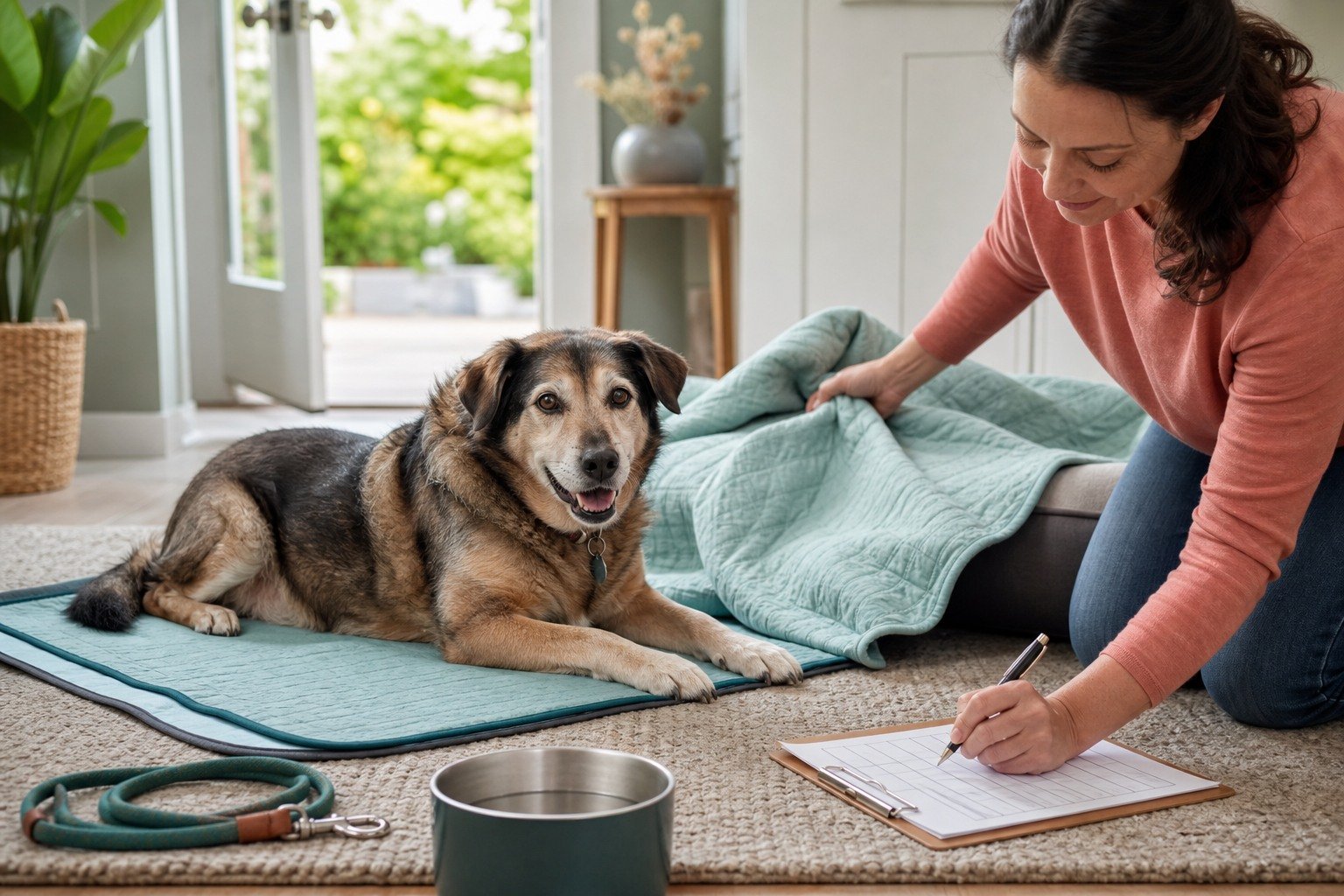
Urinary incontinence means involuntary loss of urine, but owners may use the word for frequent urination, house-soiling, marking, difficulty posturing, overflow, or inability to reach the door. Those patterns have different causes and urgency. The 2024 ACVIM consensus recommends a detailed history, observation or video of leakage and conscious urination, complete physical and neurologic examination, urinalysis, and targeted testing. Age itself is not the cause. Urethral sphincter weakness is common in some spayed female dogs, while urinary infection, stones, increased urine production, anatomic disease, spinal or nerve disease, bladder dysfunction, obstruction, pain, cognitive change, and mobility limitations may contribute. Management can include treating a cause, prescribed medication, procedures, mobility support, skin care, and practical home changes. Punishment, water restriction, and borrowed medication are unsafe.
Short answer
First identify whether the problem is storage, voiding, volume, mobility, or behavior
The ACVIM consensus defines urinary incontinence as involuntary urine passage and recommends pattern-based history plus examination and diagnostic testing. A puddle during sleep, dribbling while walking, straining, frequent small voids, and a full-bladder overflow pattern are not equivalent. [1] [2]
- Record observable changes, context, frequency, severity, recovery, and whole-dog function with dates.
- Use this guide to prepare a veterinary conversation, not to diagnose or choose treatment alone.
- Bring every medication, supplement, diet, prior result, and safe home video to the appointment.
- Agree on the next decision, measurable outcomes, reassessment timing, and urgent-contact signs.
Safety first
Straining without urine or a painful distended abdomen can be an emergency
Seek urgent care for repeated unsuccessful attempts to urinate, severe straining, a painful or enlarged abdomen, collapse, vomiting with weakness, major blood loss, or sudden hindlimb paralysis. Contact the veterinarian promptly for blood, foul odor, pain, fever, increased thirst, new leakage, skin sores, neurologic change, or rapid worsening.
- Do not delay care because a change seems like normal aging, stress, or a minor accident.
- Do not start, stop, combine, or calculate medication or treatment from this article.
- Protect comfort and safety while arranging appropriate veterinary evaluation.
Veterinary note
This article is educational and does not diagnose, treat, prescribe, or replace care from a licensed veterinarian. Your dog’s history, examination, diet, medications, and current signs determine what is appropriate.
Describe the pattern before naming the cause
Record whether leakage occurs during sleep, rising, walking, excitement, or after normal urination. Note urine volume, frequency, stream, posture, awareness, straining, blood, odor, licking, wet coat, and whether the bladder seems to empty normally.
The ACVIM panel recommends observing or reviewing video of both involuntary leakage and conscious voiding when safe. Orthopedic or neurologic disease may impair posture or emptying and create a pattern that resembles primary bladder disease. [1]
Do not reduce water to control accidents. Increased thirst and urine production can reflect kidney, endocrine, medication, or other disease, and restriction can cause dehydration or worsen illness.
Understand the major diagnostic categories
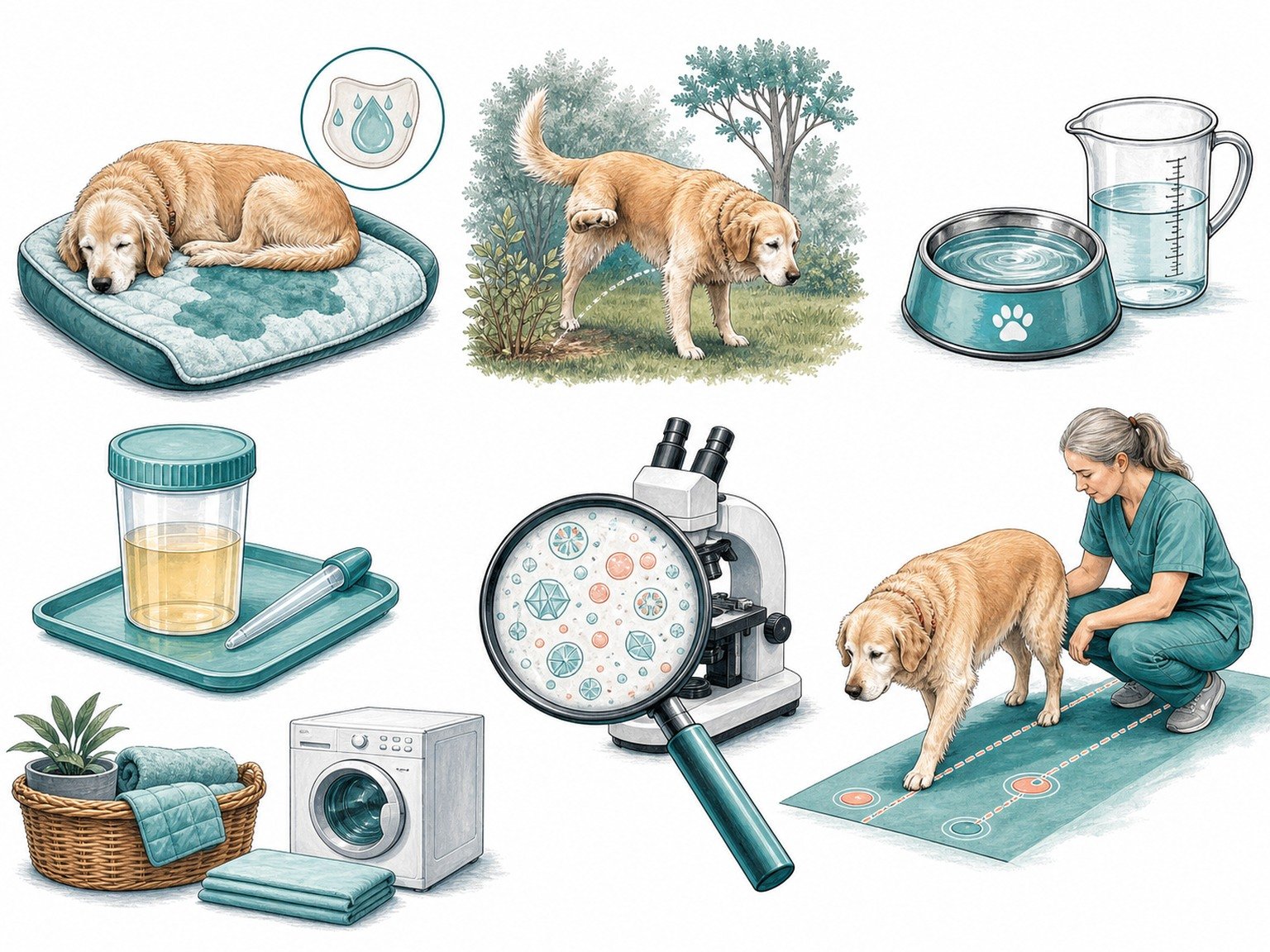
Storage disorders include inadequate urethral closure, bladder overactivity, inflammation, and anatomic abnormalities. Voiding disorders include obstruction, weak bladder contraction, functional outflow problems, and neurologic dysfunction. [2]
Urethral sphincter mechanism incompetence is common in affected spayed females but is not the only explanation and does not occur only in seniors. Infection, stones, masses, ectopic ureters, prostate disease, spinal lesions, and urine-volume disorders may require different testing.
A complete evaluation may include urinalysis, culture, blood work, blood pressure, rectal or reproductive examination, neurologic assessment, residual urine evaluation, radiographs, ultrasound, contrast study, endoscopy, or urodynamic testing. Not every dog needs every test. [1] [3]
Why treatment must follow the diagnosis
Medication that increases urethral tone can help selected dogs with sphincter incompetence, while infection, obstruction, anatomic defects, neurologic disease, or bladder dysfunction require different plans. Response to one drug should not substitute for an adequate diagnosis.
Merck reviews estrogenic and alpha-adrenergic options along with contraindications and adverse effects. These are prescription decisions that may require blood pressure, blood counts, interaction review, and follow-up; owners should not use leftover or human products. [3]
The consensus notes that comparative prospective trials remain limited for several approaches. Ask what evidence supports the option, what outcome defines success, what adverse signs matter, and what will happen if leakage persists. [1]
Protect comfort and dignity during evaluation
Provide frequent outdoor opportunities, easy routes, nonslip flooring, washable absorbent bedding, gentle cleaning, and careful drying. Check skin and coat around the vulva or prepuce for redness, odor, moisture, or wounds and report changes promptly.
Do not punish accidents or assume cognitive decline. A senior dog may be unaware, unable to rise quickly, painful, weak, confused, producing more urine, or unable to empty the bladder normally. Home changes support comfort but do not replace investigation.
AAHA senior guidance includes urine testing and body-system evaluation because urinary changes can intersect with kidney, endocrine, neurologic, cognitive, and mobility disease. Keep one record of accidents, water, medication, gait, and laboratory results. [4] [5]
Prepare for a focused veterinary conversation
Bring a concise timeline, short natural-movement or symptom videos when safe, the exact names and photographs of every food, treat, medication, and supplement label, and notes about appetite, water intake, stool, sleep, activity, comfort, and behavior. Include recent injuries, travel, boarding, diet changes, missed medication, and previous test results. A complete record helps the veterinary team separate a repeatable pattern from a single impression.
Decide in advance what you need from the visit: an urgency decision, a diagnosis plan, a nutrition review, a pain or mobility assessment, or a monitored trial. Ask what result would change the plan and what finding would rule an option out. This keeps research and product information in the right role. Evidence can shape questions and expectations, but it cannot determine what is safe for an individual dog without the history and examination.
Owner tool
Record a urinary pattern for the veterinarian
On a phone, swipe across the table to see every column.
| Checkpoint | Record | Why it helps |
|---|---|---|
| Leakage | Sleep, walking, posture, awareness | Classifies pattern |
| Voiding | Stream, strain, volume, frequency | Checks emptying |
| Whole dog | Water, gait, pain, drugs | Finds contributors |
| Skin | Moisture, odor, redness | Protects comfort |
Better questions, calmer next steps
Questions to ask your veterinarian
- Is this involuntary leakage or another urinary pattern?
- Could infection, obstruction, volume, pain, or neurologic disease contribute?
- Which tests are needed first?
- How will treatment response be measured?
- Which sign requires urgent care?
FAQ
Is incontinence normal in old dogs?
No. It deserves evaluation.
Should I limit water?
No.
Does a sleep puddle prove sphincter weakness?
No. It is one useful pattern clue.
Can diapers replace treatment?
No. They are temporary management and require skin checks.
Will one medication work for every dog?
No.
Sources
- Journal of Veterinary Internal Medicine: ACVIM Urinary Incontinence Consensus. Definitions, diagnostic algorithm, treatment evidence, and monitoring.
- Merck Veterinary Manual: Disorders of Micturition in Dogs and Cats. Storage, voiding, obstruction, and neurologic patterns.
- Merck Veterinary Manual: Pharmacotherapeutics in Urinary Incontinence. Prescription options, adverse effects, and contraindications.
- American Animal Hospital Association: Evaluating the Unhealthy Senior Pet. Senior urinary, endocrine, neurologic, and mobility evaluation.
- American Animal Hospital Association: Senior Diagnostic Tests. Urinalysis and individualized senior screening.
