

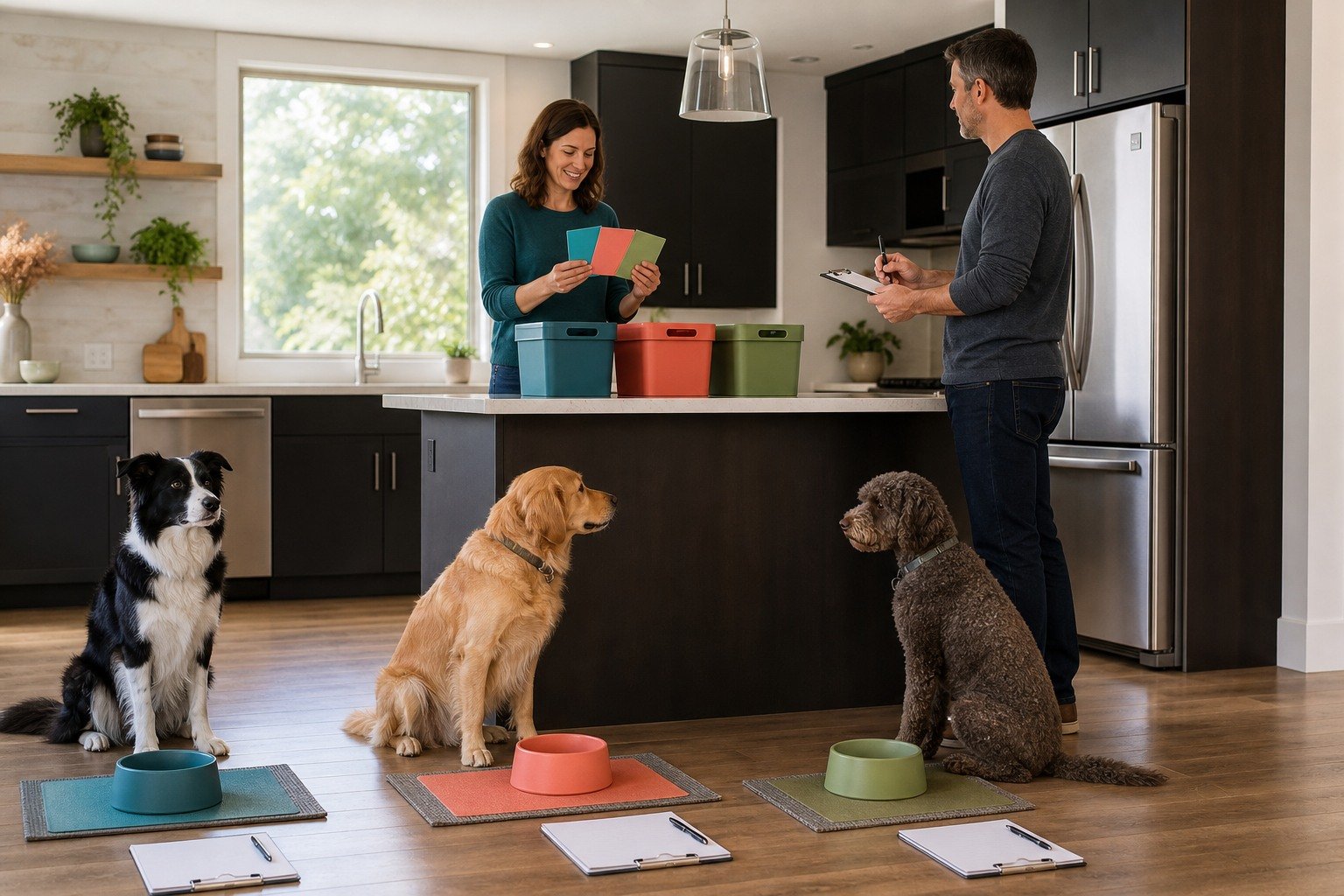
Several dogs can have different diets, diagnoses, weights, medications, sensitivities, and supplement plans even when they live in the same home. Similar containers, flavored chews, shared bowls, and multiple caregivers create risks of wrong-dog administration, duplicate doses, missed doses, theft, and uncertainty about which dog developed a sign. Build one record per dog, store every product in a clearly separated closed location, prepare and give items to one dog at a time, and sign the record immediately. Never calculate a dog-to-dog transfer or dose from body size alone. If the wrong dog receives a product, a dog accesses a container, or an extra amount may have been given, call a veterinarian or animal poison service with the exact label and estimated exposure. This guide is about error prevention, not a dosing system.
Short answer
One household still requires one plan and one record per dog
FDA adverse-event guidance asks for the animal's health history plus names and amounts of all drugs, vitamins, supplements, foods, and treats. Individual records make that information available and help separate a product event from a household guess. [1] [2]
- Record the exact dog, product or treatment, purpose, timing, and observed response.
- Use observations to support veterinary assessment, not to diagnose or treat at home.
- Protect complete nutrition, medication safety, storage, and reliable caregiver handoffs.
- Agree on measurable outcomes, a review date, and clear urgent-contact signs.
Safety first
Treat wrong-dog, duplicate, and container exposures as time-sensitive
Do not wait for symptoms after a possible overdose or unknown exposure. Contact a veterinarian, emergency hospital, or animal poison service with dog identity, weight if known, product and ingredient panels, amount missing, time, and current signs. Seek urgent care for collapse, seizure, weakness, tremors, repeated vomiting, breathing difficulty, severe agitation, bleeding, or loss of coordination.
- Do not delay care for sudden, severe, escalating, or function-limiting change.
- Do not start, stop, combine, divide, or calculate treatment from this article.
- After a possible overdose, wrong-dog dose, or toxic exposure, contact a veterinarian or animal poison service promptly.
Veterinary note
This article is educational and does not diagnose, treat, prescribe, or replace care from a licensed veterinarian. Your dog’s history, examination, diet, medications, and current signs determine what is appropriate.
Build one complete profile per dog
Record each dog's identifying photo, current weight and body condition, food and treats, prescriptions, preventives, supplements, allergies, diagnoses, clinic, and emergency contacts. Update after every treatment change.
Photograph every panel of each product and preserve lot and expiration information. Similar product names or container colors are not reliable identifiers, and a reformulation may change ingredients.
Ask the veterinary team to review the whole household inventory for duplication and interactions. A product appropriate for one dog may be unsuitable for another because of age, disease, medication, or diet.
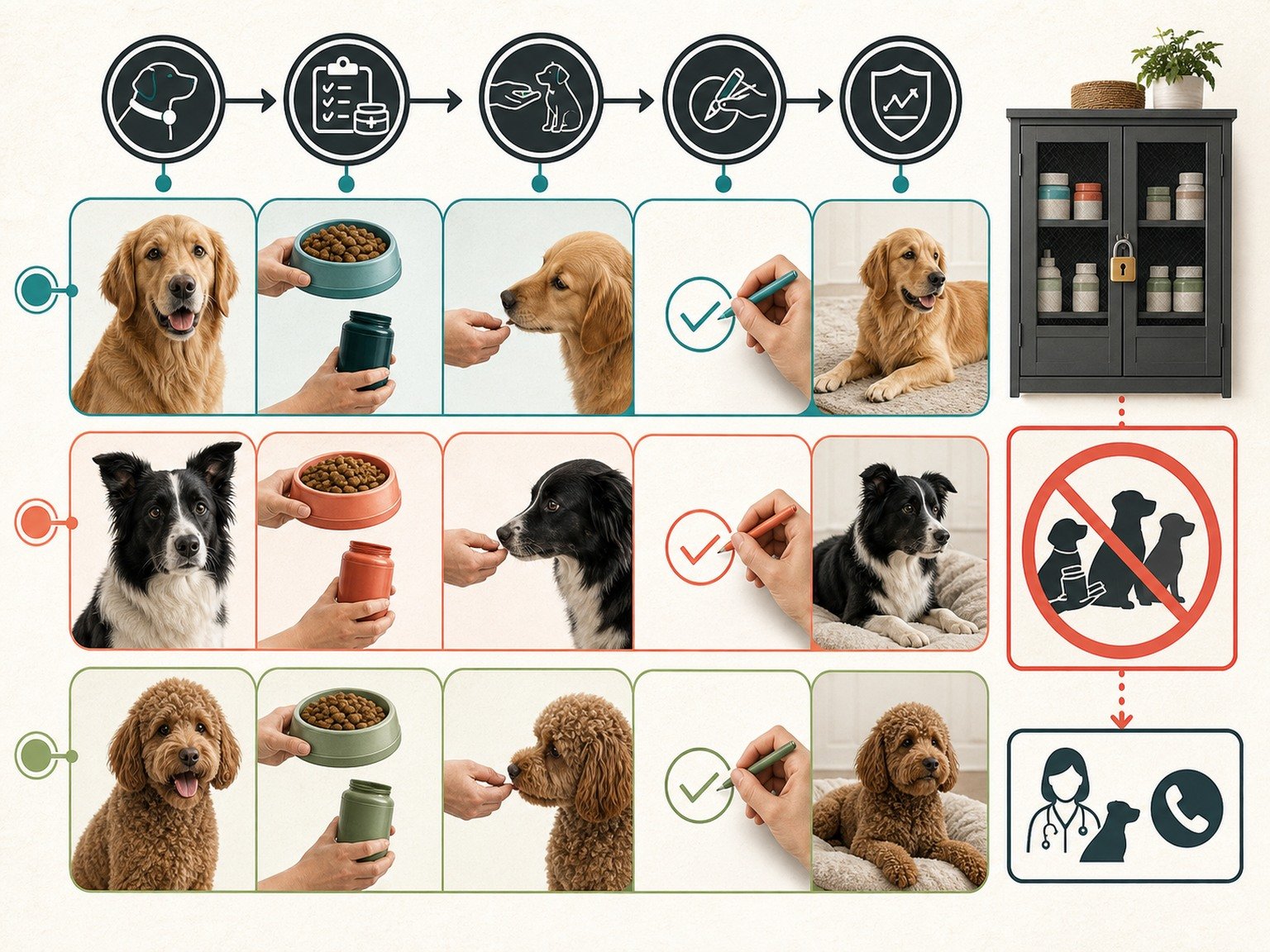
Separate storage, preparation, and administration
Use a locked or securely closed high storage area inaccessible to every pet and child. Human vitamins and chewable products may contain ingredients such as xylitol that are dangerous to dogs. [3]
Prepare only one dog's items at a time, away from other animals. Use that dog's designated mat, bowl, and record, administer according to veterinary and label instructions, then sign before preparing the next dog.
Do not leave chews, powders, opened containers, pill organizers, or medicated food unattended. Feed separately and observe consumption when an item is mixed with food so another dog cannot finish it.
Use a sign-off system that prevents duplicate decisions
Record date, time, product, amount exactly as directed, and caregiver immediately after administration. Never pre-check a task, and do not rely on a text message that another person may not see.
If the record is missing or ambiguous, pause and verify rather than giving a possible second amount. Call the veterinary team for advice after a suspected missed or duplicate dose; do not average amounts across later days.
Audit supplies against the record. Unexpected container depletion, damaged packaging, vomited material, or a dog found near storage should trigger investigation and professional guidance.
Track each dog and prepare for adverse events
Record appetite, water, stool, vomiting, energy, sleep, skin, behavior, movement, and the specific outcome the product is intended to change. Identify observations by dog and time.
FDA reporting guidance values product details, all concurrent products, food, prior health, veterinary findings, and follow-up. Preserve the container and record after a suspected event. [4]
Know who to call before an exposure. FDA advises contacting a veterinarian, emergency hospital, or animal poison control service for pet emergencies. Do not induce vomiting or give a home antidote unless a professional specifically directs it. [5]
Prepare for a focused veterinary conversation
Bring a concise timeline, short natural-movement or symptom videos when safe, the exact names and photographs of every food, treat, medication, and supplement label, and notes about appetite, water intake, stool, sleep, activity, comfort, and behavior. Include recent injuries, travel, boarding, diet changes, missed medication, and previous test results. A complete record helps the veterinary team separate a repeatable pattern from a single impression.
Decide in advance what you need from the visit: an urgency decision, a diagnosis plan, a nutrition review, a pain or mobility assessment, or a monitored trial. Ask what result would change the plan and what finding would rule an option out. This keeps research and product information in the right role. Evidence can shape questions and expectations, but it cannot determine what is safe for an individual dog without the history and examination.
Owner tool
Create a multi-dog administration record
On a phone, swipe across the table to see every column.
| Checkpoint | Record | Why it helps |
|---|---|---|
| Dog | Photo, diet, medicines, products | Prevents mix-ups |
| Storage | Separate, closed, inaccessible | Prevents access |
| Administration | One dog, one caregiver, sign-off | Prevents duplicates |
| Event | Label, amount, time, signs, contacts | Speeds response |
Better questions, calmer next steps
Questions to ask your veterinarian
- Does each dog need this product?
- Could any diet or medicine duplicate or interact?
- How should every product be stored and administered?
- What should we do after a missed or duplicate amount?
- Which emergency and reporting contacts should we keep?
FAQ
Can dogs share the same supplement?
Only when each has an individual veterinary plan.
Can I scale one dog's amount by weight?
No. Do not calculate treatment this way.
Is a shared pill organizer safe?
Separate identity and immediate sign-off are safer.
Should I wait for symptoms after an extra chew?
No. Call promptly with the label and exposure estimate.
Can I induce vomiting at home?
Only if a veterinary or poison professional specifically directs it.
Sources
- U.S. Food and Drug Administration: How to Report Animal Drug and Device Side Effects. Information needed for adverse-event reports.
- openFDA: Animal and Veterinary Adverse Events. Concurrent product, food, and medical context.
- Merck Veterinary Manual: Xylitol Toxicosis in Dogs. Xylitol sources and canine toxicity.
- U.S. Food and Drug Administration: Adverse Event Reports for Animal Drugs and Devices. Animal product event and defect context.
- U.S. Food and Drug Administration: Who Do You Call if You Have a Pet Emergency?. Emergency contact pathways.
