


Puppies, adults, and senior dogs have different preventive-care and nutrition questions, but age alone does not prove that a supplement is needed. A puppy eating a complete and balanced growth diet may be harmed by unnecessary nutrient additions. A healthy adult may need no supplement at all. A senior dog may have changing energy, muscle, disease, medication, or appetite needs that require diagnostic and dietary assessment before a product is chosen. In the United States, products marketed as animal supplements do not occupy the same federal category created for human dietary supplements; composition and intended use influence whether FDA treats them as animal food or drugs. Begin with the complete diet, treats, body and muscle condition, health status, medications, and the exact question to solve. Use a product only when the veterinary plan defines its purpose, evidence, interaction risks, measurable outcome, and review date.
Short answer
Life stage guides assessment, not a universal supplement schedule
AAHA defines life stages as a framework for individualized preventive care based on age, size, breed, lifestyle, and health. AAFCO notes that healthy dogs eating a complete and balanced life-stage-appropriate diet generally do not need routine supplements. [1] [2]
- Record the exact dog, product or treatment, purpose, timing, and observed response.
- Use observations to support veterinary assessment, not to diagnose or treat at home.
- Protect complete nutrition, medication safety, storage, and reliable caregiver handoffs.
- Agree on measurable outcomes, a review date, and clear urgent-contact signs.
Safety first
Puppy growth, illness, and medication make guessing especially risky
Contact a veterinarian for poor growth, weight or muscle change, repeated vomiting or diarrhea, appetite loss, weakness, pain, collapse, seizures, breathing difficulty, suspected overdose, or a new sign after a product starts. Bring the container and full diet and medication list. Do not use human vitamins or adjust nutrients for growth without veterinary direction.
- Do not delay care for sudden, severe, escalating, or function-limiting change.
- Do not start, stop, combine, divide, or calculate treatment from this article.
- After a possible overdose, wrong-dog dose, or toxic exposure, contact a veterinarian or animal poison service promptly.
Veterinary note
This article is educational and does not diagnose, treat, prescribe, or replace care from a licensed veterinarian. Your dog’s history, examination, diet, medications, and current signs determine what is appropriate.
Puppies: protect balanced growth
Choose a complete and balanced food appropriate for growth and expected adult size. Nutrient excess can be as important as deficiency, and large-breed growth requires particular attention to energy and mineral balance.
Count training treats, chews, toppers, and homemade additions as part of the diet. Adding calcium, vitamins, oils, or other nutrients can change the intended balance even when the product sounds natural.
Use supplements only for a defined veterinary reason. Record the puppy's food, amount, body condition, stool, growth, medications, and product label so the plan can be reviewed as size and diet change.
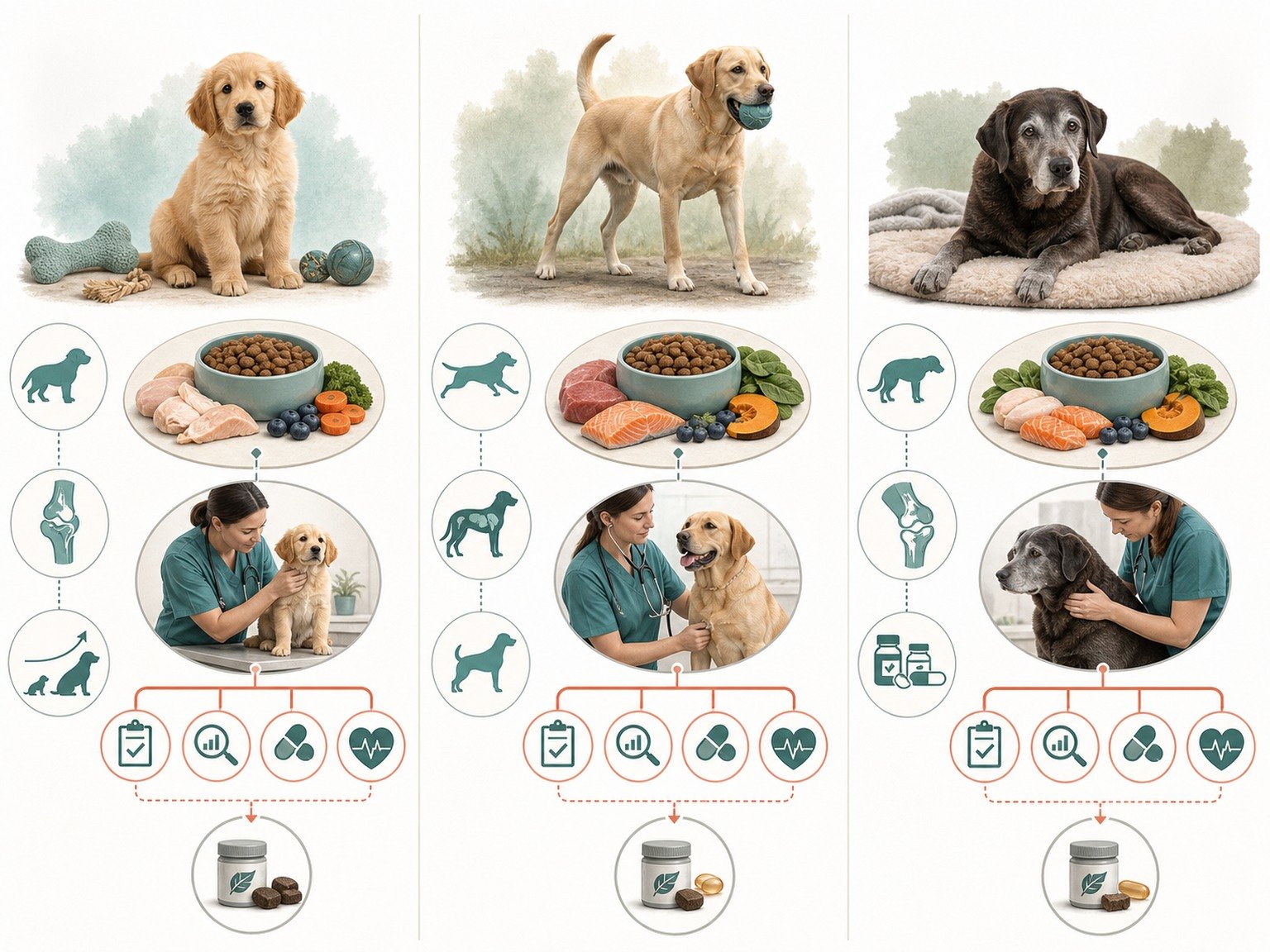
Healthy adults: do not turn maintenance into stacking
A complete diet, appropriate calories, preventive care, dental health, activity, sleep, and behavior support usually matter more than a general wellness stack. No number of products substitutes for examination or a diagnosed need.
If a specific goal is proposed, ask what evidence applies to dogs like yours, whether the ingredient duplicates the diet, and how success will be measured. Marketing claims and testimonials do not establish benefit.
Introduce no more than the veterinary plan can interpret. Simultaneous changes to food, treats, supplements, and medication make it difficult to identify benefit, intolerance, or interaction.
Senior dogs: assess disease, muscle, and medications first
Senior is a life stage, not a diagnosis. Evaluate appetite, weight, body and muscle condition, oral health, pain, mobility, cognition, kidney and liver function when indicated, and every medication before choosing a product.
AAHA notes that senior nutrition needs vary and that AAFCO has no separate senior nutrient profile. A senior label alone does not prove suitability, and unexplained weight or muscle loss needs evaluation. [3]
A product may add calories, minerals, active ingredients, or administration burden. Define one outcome such as stool quality, a validated mobility measure, or a laboratory parameter and set a review date.
At every stage: distinguish food, product claims, and drug claims
FDA does not recognize animal dietary supplements as the same special category used for people. Depending on composition and intended use, a marketed product may be regulated as animal food or as an animal drug. [4]
Claims to diagnose, cure, mitigate, treat, or prevent disease can make a product an animal drug by intended use. An unapproved disease-treatment claim is not made safe by words such as natural, holistic, or veterinarian formulated.
Use the WSAVA nutrition toolkit to evaluate the primary diet and the expertise and quality controls behind it. Complete nutrition assessment belongs before optional add-ons, not after them. [5]
Prepare for a focused veterinary conversation
Bring a concise timeline, short natural-movement or symptom videos when safe, the exact names and photographs of every food, treat, medication, and supplement label, and notes about appetite, water intake, stool, sleep, activity, comfort, and behavior. Include recent injuries, travel, boarding, diet changes, missed medication, and previous test results. A complete record helps the veterinary team separate a repeatable pattern from a single impression.
Decide in advance what you need from the visit: an urgency decision, a diagnosis plan, a nutrition review, a pain or mobility assessment, or a monitored trial. Ask what result would change the plan and what finding would rule an option out. This keeps research and product information in the right role. Evidence can shape questions and expectations, but it cannot determine what is safe for an individual dog without the history and examination.
Owner tool
Compare supplement questions by life stage
On a phone, swipe across the table to see every column.
| Checkpoint | Record | Why it helps |
|---|---|---|
| Puppy | Growth diet, size, nutrient balance | Protects development |
| Adult | Diet, lifestyle, defined goal | Avoids stacking |
| Senior | Disease, muscle, medication, appetite | Adds context |
| All stages | Evidence, interaction, outcome, review | Tests purpose |
Better questions, calmer next steps
Questions to ask your veterinarian
- Is the complete diet appropriate for this life stage?
- What documented need would this product address?
- Could it duplicate nutrients or interact with treatment?
- What measurable outcome and timeframe are reasonable?
- What finding means stop and call?
FAQ
Do all puppies need vitamins?
No. Unnecessary additions can unbalance a complete growth diet.
Should every adult dog take a wellness supplement?
No. Zero products may be appropriate.
Does every senior dog need joint support?
No. Assess diagnosis, diet, function, and evidence first.
Is a natural product automatically safer?
No. Natural does not define safety, quality, or interaction risk.
Can one product work across all ages?
A label range does not replace individual assessment.
Sources
- American Animal Hospital Association: Canine Life Stage Guidelines. Individualized preventive care by life stage.
- Association of American Feed Control Officials: Supplements. Complete diets and supplement context.
- American Animal Hospital Association: Nutrition in Senior Pets. Senior nutrition variability and body condition.
- U.S. Food and Drug Administration: FDA Regulation of Pet Food. Animal food, supplement, and drug regulatory context.
- World Small Animal Veterinary Association: Global Nutrition Toolkit. Nutrition assessment and food selection questions.
